
MSBA-141 · Lesson 3 of 12 · 22 min
Legal entities and organization hierarchies
▶ Video coming soon A video version of this lesson is on the way.
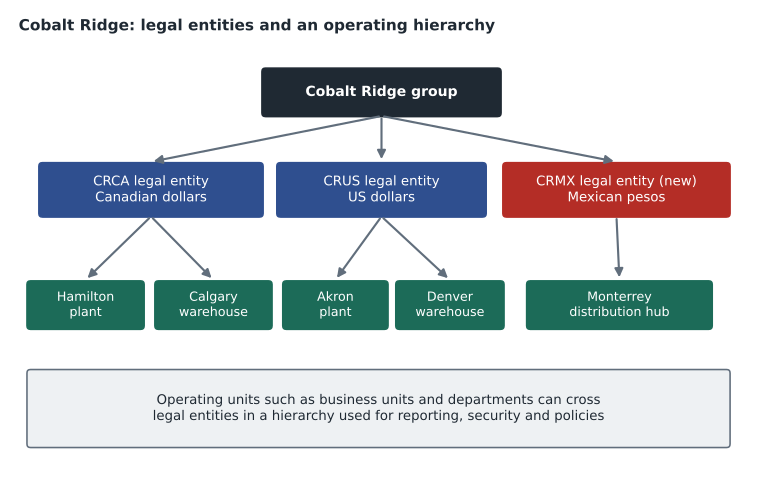
The third session began with Thandeka's favourite subject: how the company is structured. Cobalt Ridge was not one company in the legal sense. It was a Canadian corporation headquartered in Hamilton, with a wholly owned US subsidiary that ran the Akron plant and the Denver warehouse. The board had also approved a small distribution company in Monterrey, Mexico, to serve mining customers there, which would start trading in the new year. Each of these companies files its own tax returns, keeps its own books in its own currency and signs its own contracts. Annelise said that this one fact would shape everything the team built.
What a legal entity is
In finance and operations apps, a legal entity is an organization that has a registered legal structure and can enter into contracts and prepare financial statements. Each legal entity has an identifier of up to four characters, a name, an address, a country or region that drives localized features, and registration numbers for tax and other purposes. Legal entities are created under Organization administration on the Legal entities page. Most data in the application is company-specific: customers, vendors, items released to a company, ledger transactions, number sequences and parameters all belong to one legal entity, which is why the company picker in lesson 2 matters so much.
Cobalt Ridge chose identifiers that told users where they were. CRCA would be the Canadian company, keeping its books in Canadian dollars. CRUS would be the US company, in US dollars. CRMX would be the new Mexican company, in Mexican pesos. Annelise advised against clever codes; the identifier appears on every screen and in every report, and people need to recognize it instantly.
| Legal entity | Country | Accounting currency | Sites and warehouses |
|---|---|---|---|
| CRCA | Canada | Canadian dollar (CAD) | Hamilton plant, Calgary warehouse |
| CRUS | United States | US dollar (USD) | Akron plant, Denver warehouse |
| CRMX | Mexico | Mexican peso (MXN) | Monterrey distribution hub (from January 2027) |
What hangs off a legal entity
Creating a legal entity record is the start, not the end. Each legal entity is linked to a ledger, which brings together its chart of accounts, fiscal calendar, accounting currency, reporting currency and exchange rate types. Several legal entities can share one chart of accounts while keeping separate ledgers, which is what Cobalt Ridge planned so that consolidated reporting would line up account for account. The Finance courses cover ledger setup in detail; here the point is that a legal entity cannot post a transaction until its ledger is configured.
Legal entities also carry country-specific features. Setting the country or region on the legal entity's primary address turns on localizations for that country: tax reports, bank formats, electronic invoicing and fields that only apply there. This is why the address is not a cosmetic field. When CRMX is set to Mexico, the localization for Mexico, including its electronic invoicing requirements, becomes available, and the electronic reporting configurations in lesson 8 produce the required formats.
Operating units
Not every part of a business is a legal entity. An operating unit is an organization used to divide and control the business for management purposes. Finance and operations apps provide several types: business units, which have strategic objectives and often their own profit targets; departments, which group people by function; cost centres, which collect costs; value streams, which follow a product family through production; and retail channels for Commerce. Operating units are not tied to one legal entity. Cobalt Ridge's Municipal Water business unit sells from both CRCA and CRUS, and its Engineering department has people on both payrolls.
Operating units appear in many places. They can be financial dimension values, so that every posting records which business unit or department it belongs to. They can be the scope of number sequences, so that each department numbers its own requisitions. They can define who approves what in a workflow, and they can limit what a person sees through organization-specific security. They are also the building blocks of hierarchies.
Organization hierarchies and purposes
An organization hierarchy arranges legal entities and operating units in a tree. You can have as many hierarchies as you need, because a company is organized differently for different purposes. Cobalt Ridge would have a legal hierarchy for statutory reporting, a management hierarchy by business unit, and a procurement hierarchy for purchasing policies. Hierarchies are designed in the organization hierarchy designer, where you add nodes, drag them under parents and set effective dates.
What makes a hierarchy do anything is its purpose. When you create a hierarchy, you assign one or more purposes, and each purpose connects the hierarchy to features that use it. Examples include organization chart, security, procurement internal control, expense control, centralized payments and retail assortment. A hierarchy with the procurement internal control purpose is the one that procurement policies are attached to. A hierarchy with the security purpose is the one used when a security role is granted for an organization and everything below it. A hierarchy with no purpose is just a picture.
Hierarchies change over time, so they are published with an effective date. You edit a draft, then publish it to take effect immediately or on a future date. The system keeps the history, which matters for audit: a report run for last year uses last year's structure. Annelise suggested scheduling structural changes for the start of a fiscal period, so that reports do not split a month between two structures.
| Purpose | What it controls | Cobalt Ridge use |
|---|---|---|
| Organization chart | Displays reporting lines | Management overview for the board |
| Security | Granting roles for an organization and its children | Plant managers see only their plant's data |
| Procurement internal control | Purchasing policies, catalogs and approval rules | Different spending rules for plants and head office |
| Expense control | Expense report policies | Travel policies by business unit |
| Centralized payments | Paying for several legal entities from one | CRCA pays some CRUS vendors centrally |
Worked problem
Choosing between a legal entity and an operating unit
Piotr asks whether the Calgary warehouse should be its own legal entity, a department, or something else. The warehouse has no separate registration, files no tax returns and is managed by the CRCA operations team. How should it be modelled?
Show solution
- Test for a legal entity: does it have its own registration, contracts and financial statements? No.
- It is a physical place where inventory is stored, so in Supply Chain Management it becomes a site and a warehouse inside CRCA.
- If management wants to report costs for it separately, it can also be a cost centre or a financial dimension value.
- It can appear in a management hierarchy without becoming a legal entity.
Answer: A site and warehouse in the CRCA legal entity, with a cost centre or dimension value for reporting. Legal entities are only for organizations with their own legal and financial obligations.
Sites and warehouses are not organizations
Supply Chain Management adds its own structure for physical places. A site groups warehouses and production resources, usually by location, and a warehouse is a place where inventory is stored. Sites and warehouses belong to one legal entity and are part of the inventory dimensions covered in the supply chain courses. They are not operating units, and they do not appear in organization hierarchies, although it is common to keep names aligned so that the Hamilton site, the Hamilton cost centre and the Hamilton node in the management hierarchy are obviously related.
Shared data across legal entities
Some data is shared by every legal entity in an environment. The global address book holds parties, people and organizations, so that one supplier who sells to both CRCA and CRUS is a single party with two vendor accounts, one in each company, sharing one name and address. Products are defined once as shared products and then released to each legal entity that buys, stocks or sells them, where company-specific settings such as prices and item groups are added. Currencies, exchange rate types, units of measure and the chart of accounts are also shared.
Other data is company-specific by default, and companies with many similar legal entities sometimes want to keep it in step. Finance and operations apps offer tools to copy configuration from one legal entity to another, including data management templates and a copy-into-legal-entity function in the data management workspace, which lesson 7 explains. Annelise's advice was to design a configuration once in a template legal entity in a sandbox, test it, and copy it, rather than configuring three companies by hand and hoping they matched.
Intercompany relationships
Because CRCA, CRUS and CRMX are in one environment, transactions between them can be automated. When CRUS buys pumps from CRCA, an intercompany purchase order in CRUS can create the matching sales order in CRCA, and invoices can flow back automatically. Intercompany accounting can also post one journal that affects two legal entities, with due-to and due-from accounts set up between them. These features are configured in Finance and Supply Chain Management, but they rest on the decision made in this lesson: model real companies as legal entities in the same environment.
Worked problem
How many vendor accounts?
A steel supplier, Lakehead Forge, sells to both CRCA and CRUS and will sell to CRMX next year. How many parties and vendor accounts will exist once CRMX starts buying?
Show solution
- Parties are global: Lakehead Forge is one party in the global address book.
- Vendor accounts are company-specific: one in CRCA, one in CRUS and one in CRMX.
- All three accounts share the party's name and addresses but can have different payment terms and currencies.
Answer: One party and three vendor accounts.
Operating units and financial dimensions
Thandeka wanted to know how the business units would show up in her reports. The answer is financial dimensions. A financial dimension is an extra attribute recorded on every ledger posting, such as business unit, department or cost centre. Dimensions can be custom lists, such as product line, or they can use existing records as their values, including operating units, customers, vendors and items. When the BusinessUnit dimension is backed by the business unit operating units, every business unit created under Organization administration becomes a valid dimension value automatically, and reports can be sliced by it.
This is the bridge between structure and reporting. The legal entity tells you whose books a posting belongs to; the dimensions tell you which part of the business earned or spent it. The Finance courses cover account structures and the rules that decide which dimensions are required on which accounts. For now, the design rule is to decide your operating units and your dimensions together, so that a department in the organization model and a department value on a posting are the same thing.
Creating a legal entity: the essential fields
Annelise walked through the Legal entities page in the sandbox, creating a test company called CRZZ that would be deleted later. The essential fields are the identifier, the name, and the country or region, which is chosen when the record is created. After saving, the details page offers FastTabs for addresses, contact information, registration numbers, tax registration, statutory reporting, bank account information for the company itself, and settings for features that some countries require, such as foreign trade or electronic invoicing. A logo can be added for printed documents.
A few settings are worth knowing from the start. The time zone on the legal entity affects how dates such as the posting date are interpreted when users in other time zones work in that company. The language on the legal entity sets the default language for documents sent to customers and vendors, which can be overridden per party. And the primary address must be complete and correct, because tax calculations, document headers and localization features all read it. In the sandbox, Annelise deliberately left the CRZZ address blank and showed the team a tax setup page that refused to work until it was filled in.
Where people fit
People appear in the organization model too. Workers are employees and contractors, recorded in the global address book and employed by a legal entity; they can be linked to positions in departments, which forms the reporting lines that some workflow assignments use. Users are sign-in accounts, covered in lesson 5. A person can be both: Thandeka is a worker employed by her legal entity and a user with security roles. Keeping worker and position data reasonably accurate pays off later, because workflows that route approvals to a manager depend on it.
Designing the structure
By the end of the session the team had a short list of design rules. Model each registered company as a legal entity and nothing else. Use operating units for how the business is managed, and financial dimensions for how results are reported. Create a hierarchy only when a feature needs it, and give it a clear purpose. Keep names consistent across legal entities, sites, operating units and dimension values. And decide early, because changing a legal entity's identifier after transactions exist is not possible; a new legal entity would have to be created and data moved.
Common mistakes
MistakeCreating a legal entity for every plant or warehouse.
InsteadUse legal entities only for registered companies; model places as sites and warehouses and management units as operating units.
MistakeBuilding a hierarchy without a purpose and expecting policies to follow it.
InsteadAssign the purpose, such as procurement internal control or security, that connects the hierarchy to features.
MistakeChanging a hierarchy in the middle of a period without an effective date.
InsteadPublish changes with an effective date, ideally at the start of a period.
MistakeCreating a separate party for the same supplier in each company.
InsteadUse one party in the global address book with a vendor account in each legal entity.
Summary and key terms
- A legal entity is a registered organization with its own books; most data is company-specific.
- Each legal entity links to a ledger and its primary address country turns on localizations.
- Operating units such as business units, departments and cost centres can span legal entities.
- Organization hierarchies arrange organizations; purposes connect them to features such as security and procurement policies, and they are published with effective dates.
- Shared data includes the global address book, shared products, currencies and charts of accounts; intercompany features connect legal entities in one environment.
- Legal entity
- An organization with a registered legal structure that can contract and prepare financial statements.
- Operating unit
- An organization, such as a business unit or department, used to divide and control the business for management.
- Organization hierarchy
- A tree of legal entities and operating units used for a defined purpose.
- Hierarchy purpose
- The setting that connects a hierarchy to features such as security or procurement internal control.
- Global address book
- The shared store of parties, people and organizations used across legal entities.
Practice problems
Work each problem on paper first, then reveal the answer to check.
Why does the country on a legal entity's primary address matter?
Show answer
It turns on country-specific features and localizations such as tax reports and electronic invoicing.
What makes a hierarchy usable by procurement policies?
Show answer
Assigning the procurement internal control purpose to it.
One customer buys from two Cobalt Ridge companies. How is that modelled?
Show answer
One party in the global address book and a customer account in each legal entity.
Lesson quiz · 5 questions
Score 60% or more to complete this lesson.
Create a free account to save your progress, take quizzes and earn a certificate.