
MSAZ-289 · Lesson 3 of 12 · 19 min
Domain weights
▶ Video coming soon A video version of this lesson is on the way.
Before Walt opened the exam sandbox on November 10, Elena gave him a 60-question diagnostic she wrote herself, with questions spread across the five skill groups in proportion to their weights. It is not an official practice test and its score says nothing about a scaled exam score. Its purpose is narrower: to show where Walt's knowledge is thin, so that the next six months of study go where they will earn the most. This lesson explains how to read exam weights, how to turn them and a diagnostic into a study plan, and why a weight range is a guide rather than a promise.
What a weight range means
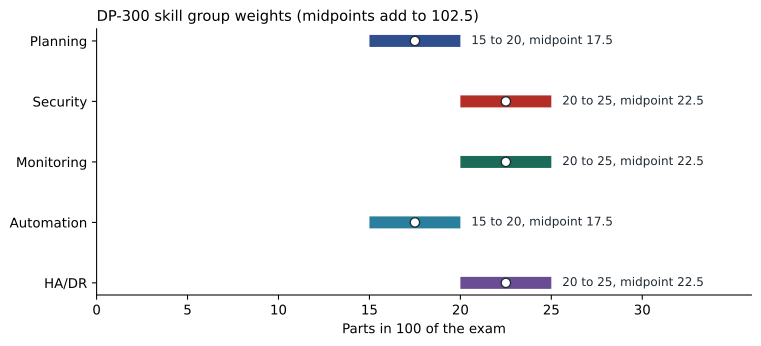
Each skill group in the study guide has a weight range, such as 20 to 25 parts in 100. The range describes the share of the exam that comes from the group. A range rather than a single number reflects that each sitting draws a different set of questions, and the mix varies a little. The ranges add up to more than 100 at their upper ends and less at their lower ends: 15 + 20 + 20 + 15 + 20 = 90 at the bottom, and 20 + 25 + 25 + 20 + 25 = 115 at the top. Any real sitting falls somewhere between.
A simple way to work with the ranges is to take the midpoint of each: 17.5, 22.5, 22.5, 17.5 and 22.5. These add to 102.5. Dividing each by 102.5 gives a normalized share that sums to one: about 0.17 for planning and automation and about 0.22 for each of the other three. That is the share of study effort the exam would suggest if a candidate were equally strong everywhere.
| Skill group | Range | Midpoint | Share of 102.5 | Questions out of 60 |
|---|---|---|---|---|
| Plan and implement data platform resources | 15 to 20 | 17.5 | 0.171 | 10 |
| Implement a secure environment | 20 to 25 | 22.5 | 0.220 | 13 |
| Monitor, configure and optimize | 20 to 25 | 22.5 | 0.220 | 14 |
| Configure and manage automation | 15 to 20 | 17.5 | 0.171 | 10 |
| Plan and configure HA/DR | 20 to 25 | 22.5 | 0.220 | 13 |
Elena's diagnostic gives 10, 13, 14, 10 and 13 questions to the groups. The exact shares would give 10.2, 13.2, 13.2, 10.2 and 13.2, and whole numbers must add to 60, so one of the large groups had to take an extra question. She gave it to monitoring, because that group's outline has the most separate bullets.
Walt's diagnostic
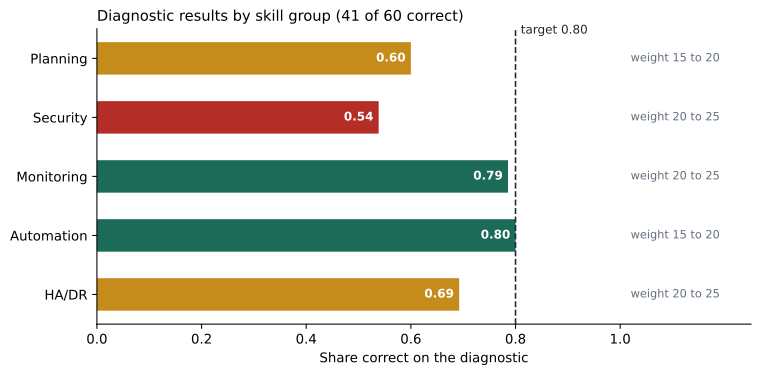
Walt's results, in correct answers out of questions asked, were: planning 6 of 10, security 7 of 13, monitoring 11 of 14, automation 8 of 10, HA/DR 9 of 13. In total he answered 41 of 60 correctly, 68 in 100. The pattern matches his history. Monitoring and tuning are what he has done every day for seventeen years, and SQL Server Agent jobs are second nature. Security is weaker, because StockLine has used SQL logins and a single sysadmin group since 2009, and Entra authentication, Always Encrypted and ledger are new to him. Planning is weak because choosing between Azure offerings is a new kind of decision. HA/DR is middling: he knows backups and log shipping well but is less sure about failover groups and geo-replication.
From weights and gaps to study hours
A study plan should weigh two things at once: how much the group is worth and how far the candidate is from the target in it. A strong group with a high weight needs maintenance, not hours. A weak group with a low weight needs some hours. A weak group with a high weight needs the most. One way to combine them is to multiply each group's share by its gap below a target, then divide the available hours in proportion to those products. Elena sets the target at 0.80 correct in every group and gives Walt a floor of five hours per group, so that no area is left untouched.
# Walt's diagnostic: (correct, asked) per group, with the group's weight midpoint
groups = {
    "Planning":   (6, 10, 17.5),
    "Security":   (7, 13, 22.5),
    "Monitoring": (11, 14, 22.5),
    "Automation": (8, 10, 17.5),
    "HA/DR":      (9, 13, 22.5),
}
target = 0.80
total_hours = 90
floor_hours = 5

need = {}
for name, (right, asked, mid) in groups.items():
    score = right / asked
    gap = max(target - score, 0)
    need[name] = (mid / 102.5) * gap

spare = total_hours - floor_hours * len(groups)
total_need = sum(need.values())
for name, (right, asked, mid) in groups.items():
    hours = floor_hours + spare * need[name] / total_need
print(f"{name:10s} score {right/asked:.2f} hours {hours:4.1f}")Planning score 0.60 hours 23.8 Security score 0.54 hours 36.5 Monitoring score 0.79 hours 6.7 Automation score 0.80 hours 5.0 HA/DR score 0.69 hours 18.0
What this code does
The program starts with Walt's correct answers in each group and the weight of each group. For each group it works out how far his score falls below 0.80, and multiplies that gap by the group's share of the exam, so a big gap in a heavy group counts most. Every group first gets five hours; the remaining hours are shared out in proportion to those weighted gaps. The output shows security getting the most time and monitoring and automation getting little more than the floor.
The result puts about 37 of the 90 hours into security, about 24 into planning and 18 into HA/DR, with monitoring at about 7 and automation at its five-hour floor. Walt is a little alarmed that monitoring, the area he loves, gets so little. Elena's answer is that he can still read about it for pleasure, but the plan counts only the hours that move his result.
Ninety hours sounds like a lot, but spread over the weeks from mid-January to early May it is about five or six hours a week, a manageable load next to a full-time job and the clinic sessions. The plan will be revised after each practice set, and lesson 11 builds the full timetable.
The limits of weights
Weights describe groups, not individual skills. Within the security group, for instance, there are about twenty bullets, from Entra authentication to row-level security, and the outline does not say how many questions each one gets. Some bullets are broad, such as 'Apply the principle of least privilege for all securables', and can appear inside questions about almost anything. Others are narrow. A candidate should cover every bullet at least once, because any one of them can produce a question, and should give extra time to the broad ones that appear in many questions.
Weights also say nothing about difficulty. A group with a small weight may contain hard questions, and the planning group in particular often asks for judgments that combine cost, features and constraints. Walt's 0.60 there is a warning that matters more than its 15 to 20 weight might suggest, because those judgments also appear inside case studies, where one wrong choice of offering can lead to several wrong answers.
Finally, the outline changes. The October 27, 2026 version made one minor change in the data at rest and in transit area, and Microsoft may update it again before May. Elena sets a reminder to check the study guide's change log in mid-April, so that any late change gets attention in the last weeks.
Using the outline as a checklist
Elena turns the study guide into a spreadsheet with one row per bullet, about 90 rows in all, and three columns for Walt to fill in: 'Can explain it', 'Have done it in Azure', and 'Missed it in practice'. A bullet is finished when the first two columns are ticked and the third has stayed empty through two practice sets. The spreadsheet is more useful than any single score, because it points to the exact skill rather than to a group. Walt starts it on November 10 with the bullets he is sure of, and marks forty of them as known on the first evening. The rest are the work of the winter.
Weights and the score report
After the real exam, Microsoft's score report shows the overall scaled score and a bar for each skill group describing relative performance. The bars are not scores in their own right and should not be read as exact shares of questions answered correctly; they show where performance was stronger or weaker. They are most useful after a failed attempt, because they point to the groups that need work before a retake. A candidate who passes rarely needs them, but Elena asks Walt to save his report either way, because it is a good record of what to refresh before the renewal assessment a year later.
The same logic applies to practice sets. A practice score in a group with only ten questions moves by a tenth with every answer, so one lucky guess or one misread question changes the picture a lot. Elena treats any group result as reliable only after at least two practice sets point the same way. When Walt's monitoring score was 11 of 14 on the diagnostic, she did not conclude that he was weak in one bullet; she waited to see which questions he missed on the next set, and only acted when the same bullet, Extended Events, came up twice.
Weights inside a case study
Case studies cut across groups. A single case study about a retailer moving to Azure can ask about the offering to choose, the authentication method, the backup retention and the failover design, one question from each of four groups. The questions still count toward their own groups, but they come in a block, and a candidate who is weak in one group will feel it in the middle of a case study rather than spread across the exam. That is another reason Elena wants no group left below the target: a weak group is not just a few lost marks, it is a few lost marks in a section that cannot be revisited.
Walt asks whether he should study the heavy groups first or last. Elena's answer is both. The plan opens with the weakest heavy group, security, while his energy is high and there is time to practise, and it ends with a short review of every group in proportion to its weight, so that the last weeks refresh the areas worth the most marks. In between, the order follows the clinic sessions in MSAZ-281 and MSAZ-282, so that review comes soon after the topic is taught and while the hands-on work is fresh.
Worked problem
A second diagnostic
Suppose that in March Walt sits a second 60-question set with the same spread and scores planning 8 of 10, security 11 of 13, monitoring 12 of 14, automation 8 of 10 and HA/DR 10 of 13. What is his overall share correct, and which groups are still below 0.80?
Show solution
- Total correct: 8 + 11 + 12 + 8 + 10 = 49.
- \[49 \div 60 \approx 0.82\]
- Planning: 8 ÷ 10 = 0.80. Security: 11 ÷ 13 ≈ 0.85. Monitoring: 12 ÷ 14 ≈ 0.86.
- Automation: 8 ÷ 10 = 0.80. HA/DR: 10 ÷ 13 ≈ 0.77.
Answer: Overall about 0.82. Only HA/DR, at about 0.77, is still below the target, so the next block of study would move most of the flexible hours there.
Common mistakes
MistakeThe weight ranges add up to exactly 100.
InsteadThe ranges overlap: they add to 90 at the lower ends and 115 at the upper ends.
MistakeA high-weight group should always get the most study time.
InsteadTime should follow weight multiplied by the gap below the target; a strong heavy group needs little.
MistakeWeights say how many questions each outline bullet gets.
InsteadWeights apply to groups only; cover every bullet at least once.
MistakeA low-weight group cannot decide the result.
InsteadAt 15 to 20 parts in 100, planning or automation alone can turn a pass into a fail.
Summary and key terms
- Each skill group has a weight range that describes its share of the exam; ranges reflect variation between sittings.
- Midpoints (17.5, 22.5, 22.5, 17.5, 22.5) add to 102.5 and give a simple share for each group.
- A diagnostic spread by weight shows where a candidate is weak; Walt scored 41 of 60, weakest in security and planning.
- Study hours should follow weight multiplied by the gap below a target, with a floor for every group.
- Weights cover groups, not bullets, and say nothing about difficulty; cover every bullet and check the change log before the exam.
- Weight range
- The published share of an exam that a skill group can make up, such as 20 to 25 parts in 100.
- Midpoint
- The value halfway between the ends of a range, used as a simple estimate of a group's share.
- Diagnostic
- A practice set used to find weak areas rather than to predict a score.
- Study floor
- A minimum number of hours given to every group so that no area is skipped.
- Change log
- The part of a study guide that lists what changed in the latest outline.
Practice problems
Work each problem on paper first, then reveal the answer to check.
What do the five weight ranges add up to at their lower and upper ends?
Show answer
90 and 115.
What is the midpoint of the security group's range?
Show answer
22.5 parts in 100.
Why did Walt's study plan give monitoring so few hours?
Show answer
He already scored close to the target there, so its weighted gap was small.
Why should every outline bullet be covered, even in a small group?
Show answer
Any bullet can produce a question, and weights do not say how questions are spread within a group.
When should a candidate check the study guide change log?
Show answer
Shortly before the exam, for example a month ahead, in case the outline changed.
Lesson quiz · 5 questions
Score 60% or more to complete this lesson.
Create a free account to save your progress, take quizzes and earn a certificate.