
MSAZ-289 · Lesson 11 of 12 · 20 min
Timed practice plan
▶ Video coming soon A video version of this lesson is on the way.
Knowing the material and finishing the exam in time are different skills. Walt's diagnostic on November 10 was untimed, and he took 96 minutes for 60 questions, about 1.6 minutes each. The real exam gives 100 minutes, includes case studies that need reading time, and puts its questions in front of him in an unfamiliar room. This lesson builds the timetable Elena and Walt agreed for the months before May 14, 2027: how the study hours from lesson 3 are spread over the weeks, which practice sets he will sit and when, how he will pace himself in the exam, and what he will do in the last week.
The shape of the plan
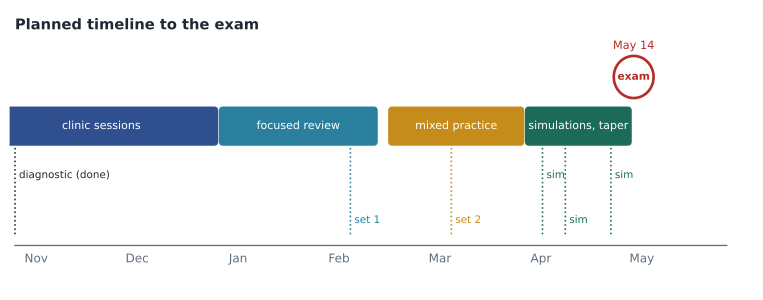
The plan has four phases. From November to early January, Walt keeps attending the MSAZ-281 and MSAZ-282 clinic sessions, which teach the material for the security, monitoring, automation and HA/DR groups, and he fills in his outline spreadsheet as each topic is covered. From Monday, January 11, to the end of February, the focused review phase spends the flexible study hours from lesson 3 on his weakest groups, starting with security and planning, with hands-on tasks in the sandbox every week. March and the first half of April are for mixed practice: timed sets that draw on all five groups and practice case studies. The last four weeks are for full timed simulations, targeted review of whatever the simulations show, and rest.
| Phase | Dates (all planned) | Focus | Hours a week |
|---|---|---|---|
| Clinic sessions | November 2026 to early January 2027 | MSAZ-281 and MSAZ-282 topics; fill in the outline spreadsheet | 2 to 3 |
| Focused review | January 11 to February 28 | Security and planning first, then HA/DR; sandbox tasks | 6 |
| Mixed practice | March 1 to April 11 | Timed mixed sets, case studies, distractor review | 6 |
| Simulation and taper | April 12 to May 13 | Full timed simulations, targeted review, rest before the exam | 5, then 2 in the last week |
At six hours a week, the focused review and mixed practice phases provide about 7 weeks × 6 = 42 and 6 weeks × 6 = 36 hours, 78 hours in all, close to the 90 hours lesson 3 divided between the groups once the clinic sessions' review time and the simulation phase are counted. Elena prefers a plan that slightly overestimates the hours available, because study plans always lose time to work and family, and a plan with a little slack survives a bad week.
Practice sets and what they are for
Microsoft offers a free practice assessment for DP-300. The study guide points to a new version on AI Skills Navigator, which it says matches the exam more closely, and notes that the older version on Microsoft Learn is no longer updated. Walt will use the new one. Practice assessments are useful for the style of questions and for finding weak areas, but they are not copies of exam questions, and a high score on a set taken several times means memory of the set, not readiness. Elena's rule is that each practice set is taken once under exam conditions, reviewed in full, and then not repeated for at least three weeks.
Walt's planned sets are a mixed timed set on Saturday, February 20, after the focused review; a second on Saturday, March 20, after the mixed practice; and full simulations, 100 minutes with case studies, on Saturdays April 17 and April 24, and on Friday, May 7, a week before the exam at the same time of day as his exam booking. His target is 80 in 100 or better in every skill group across the last two simulations, with no group below 0.75 in either.
Pacing inside the exam
Pacing means knowing at any moment whether there is enough time left. Because the number of questions varies and case studies take longer per item, Walt cannot set a single number of minutes per question. Instead he will use checkpoints. When the exam begins, it shows the number of items; he will divide the 100 minutes by that number to get an average, keep five minutes aside for review at the end, and check at three points whether he is ahead or behind. Elena gives him a small calculation to practise with, for different possible item counts.
exam_minutes = 100
reserve = 5                     # minutes kept for the review screen at the end

for items in (40, 50, 60):
    per_item = (exam_minutes - reserve) / items
    marks = [round(items * f) for f in (0.25, 0.5, 0.75)]
    times = [round(m * per_item) for m in marks]
    print(f"{items} items: {per_item:.2f} min each")
    for m, t in zip(marks, times):
print(f" by item {m:2d} aim to be at about minute {t}")40 items: 2.38 min each by item 10 aim to be at about minute 24 by item 20 aim to be at about minute 48 by item 30 aim to be at about minute 71 50 items: 1.90 min each by item 12 aim to be at about minute 23 by item 25 aim to be at about minute 48 by item 38 aim to be at about minute 72 60 items: 1.58 min each by item 15 aim to be at about minute 24 by item 30 aim to be at about minute 48 by item 45 aim to be at about minute 71
What this code does
The program takes the 100 minutes of the exam, sets five aside for the final review, and divides the rest evenly between the questions for three possible numbers of questions. For each, it finds the question numbers a quarter, half and three quarters of the way through and works out the minute by which the candidate should have reached each one. The output is a short table of checkpoints: if the clock shows a later minute at a checkpoint, the candidate is behind and should speed up.
For 50 items, the checkpoints are item 12 at about minute 23, item 25 at about minute 48 and item 38 at about minute 72. Walt will write the three checkpoints on the whiteboard or note sheet the test centre provides as soon as he sees the item count. Case studies complicate this: a case study's items take longer on average because of the reading, so being a few minutes behind at a checkpoint just after a case study is expected. Being ten minutes behind is a signal to stop rereading and start choosing.
Habits that save time
Most lost time on Microsoft exams comes from three habits. The first is rereading the whole scenario for every question instead of reading the question's last sentence first and then looking only for the constraints it needs. The second is staying with one hard question for five or more minutes; the better move is to choose the best current answer, mark it for review where the section allows, and continue. The third is reviewing too much at the end, changing correct answers to wrong ones. Elena's rule is to change an answer at review only when he can name the requirement that proves the first answer wrong, not because the second option suddenly feels better.
Timed practice is also where Walt will find out how he handles the no-return sections. In the simulations, Elena will include a case study and a yes-or-no series, and she wants him to notice how long he spends deciding whether he is ready to leave them. The right amount is a final check of each answer against the stated goal, not a second full reading.
The last week
The final week is for consolidation, not new material. Walt plans a short review of each skill group in proportion to its weight on Monday to Wednesday, about forty minutes a day, using his 'Why it was wrong' page and the one-page table of numbers from lesson 4. Thursday, May 13, is a rest day with only a ten-minute look at the card of case study themes. He will check the exam booking details, the test centre address and the identification he needs, and plan to arrive thirty minutes early. Lesson 12 covers exam day itself.
What a study session looks like
Each six-hour week in the review phases is three sessions of about two hours, on Tuesday and Thursday evenings and Saturday morning. A session has a fixed shape. The first fifteen minutes are a quick recall test on the previous session's topic, written from memory before looking anything up, because retrieving a fact strengthens it more than rereading it. The next hour covers one or two outline bullets: reading the Microsoft Learn page in his own words, then doing the task in the sandbox. The last thirty to forty-five minutes are practice questions on the bullets of the week, timed at about two minutes each, followed by a review of every miss.
Elena insists on the hands-on part even for topics Walt finds easy to read about. A person who has created a failover group, watched its listener switch and read the link status view will recognize the right option instantly. A person who has only read about it will hesitate between two options that sound similar. The sandbox costs Harrow & Finch a little each month, and she keeps the test resources small and stopped when not in use, so the cost is far below the price of a retake.
Using practice results
After each timed set, Walt does three things. He enters the score for each skill group in the outline spreadsheet next to the bullets the missed questions came from. He writes one line on the 'Why it was wrong' page for every miss, naming the distractor family. And he moves the flexible hours of the next two weeks toward the bullets with the most misses, keeping the five-hour floor for every group. This keeps the plan honest: hours follow evidence, not preference.
If a simulation in April shows a group below 0.75, the plan has a fallback. Walt will take the two weekends before May 7 for that group alone, and if the May 7 simulation is still below the target in two or more groups, Elena and Walt will discuss moving the exam by a few weeks. Pearson VUE allows rescheduling without a fee if it is done at least a set number of hours before the appointment; Walt will check the current notice period in his booking confirmation so that the option is real if it is needed.
Timing case studies in practice
Case studies need their own timing practice, because they combine reading and answering. In the mixed practice phase, Walt will do one practice case study each week, alternating between Elena's and his own, with a target of two minutes for the skim and about two minutes per question after that. He will record both numbers and compare them over the weeks; the skim time usually falls quickly, while the per-question time falls more slowly as the habit of going straight to the right requirement develops.
Worked problem
Is he on pace?
Suppose the exam shows 52 items. Walt keeps 5 minutes for review. He reaches item 26 at minute 53 after a case study. Is he ahead of or behind the half-way checkpoint, and by how much?
Show solution
- Time for items: 100 − 5 = 95 minutes.
- \[95 \div 52 \approx 1.83 \text{ minutes per item}\]
- Half-way checkpoint: item 26, at 26 × 1.83 ≈ 47.5 minutes.
- He is at minute 53, so he is about 5.5 minutes behind.
Answer: He is about 5.5 minutes behind the half-way checkpoint. Just after a case study, that is not alarming, but he should not reread scenarios in the next section and should take hard items with a mark-and-move approach.
Common mistakes
MistakeEvery question should get the same number of minutes.
InsteadUse checkpoints; case study items need more time and short items less.
MistakeTaking the same practice set many times shows readiness.
InsteadRepeated sets measure memory; take each set once, review it, and rest it for weeks.
MistakeStudy new topics in the last week.
InsteadUse the last week to consolidate and rest; new topics add anxiety more than marks.
MistakeChange answers at review when a different option feels better.
InsteadChange only when you can name the requirement that proves the first answer wrong.
Summary and key terms
- Walt's plan has four phases: clinic sessions, focused review, mixed practice, then simulations and a taper before Friday, May 14, 2027.
- Use Microsoft's free practice assessment and timed sets for style and weak areas, taking each set once and reviewing it fully.
- Divide the time left after a review reserve by the item count and set checkpoints at a quarter, half and three quarters.
- Save time by reading the question's last sentence first, marking and moving on hard items, and limiting changes at review.
- Spend the last week consolidating and resting, not learning new material.
- Checkpoint
- A planned point in the exam, such as the half-way item, with the minute by which it should be reached.
- Review reserve
- Minutes kept at the end of the exam for the review screen.
- Simulation
- A full-length, timed practice exam under exam conditions.
- Taper
- Reducing study in the last days before an exam so the candidate arrives rested.
- Practice assessment
- Microsoft's free set of practice questions for an exam, for style and weak areas.
Practice problems
Work each problem on paper first, then reveal the answer to check.
With 60 items and a 5-minute reserve, about how many minutes per item are available?
Show answer
95 ÷ 60 ≈ 1.58 minutes.
Why does Elena say not to repeat a practice set within three weeks?
Show answer
A repeated set measures memory of the questions, not readiness.
What is Walt's target across the last two simulations?
Show answer
80 in 100 or better in every skill group, with no group below 0.75 in either.
When should an answer be changed at review?
Show answer
Only when you can name the requirement that proves the first answer wrong.
Where does the study guide say the newer DP-300 practice assessment is?
Show answer
On AI Skills Navigator; the older Learn version is no longer updated.
Lesson quiz · 5 questions
Score 60% or more to complete this lesson.
Create a free account to save your progress, take quizzes and earn a certificate.