
MSAZ-289 · Lesson 1 of 12 · 21 min
The Azure Database Administrator certification
▶ Video coming soon A video version of this lesson is on the way.
On Tuesday, November 10, 2026, Elena Brandt closes the door of the small meeting room at Winnipeg head office and writes three dates on the whiteboard. The first is today. The second is the end of the DBA clinic sessions in MSAZ-281 and MSAZ-282, which run through the winter. The third, circled twice, is Friday, May 14, 2027, the date Walt Hadley has chosen to sit exam DP-300. Walt has been the StockLine DBA for seventeen years and has never taken a certification exam. He is not worried about the database work; he is worried about the exam itself. Elena's answer is this course. It does not teach new technology. It teaches how the exam is built, what it expects, and how to turn what Walt already knows into marks.
This first lesson explains what the certification is, who it is for, what the exam covers at the highest level, and the rules that surround it: how it is delivered, how it is scored, how long it lasts and how it is kept current. Later lessons go deeper into question types, weights, each skill group, T-SQL reading, scenarios, timing and exam day.
What the certification is
Passing exam DP-300, Administering Microsoft Azure SQL Solutions, earns the Microsoft Certified: Azure Database Administrator Associate certification. Microsoft groups its role-based certifications into levels. Fundamentals certifications, such as DP-900 and AZ-900, check broad understanding. Associate certifications, such as this one, check that a person can do a job role. Expert certifications build on associates. DP-300 is an associate exam, which means its questions assume hands-on experience. A fundamentals question might ask what Azure SQL Managed Instance is. A DP-300 question is more likely to describe a company with forty databases, a cross-database query and a four-hour downtime limit, and ask which offering, migration method and service tier fit.
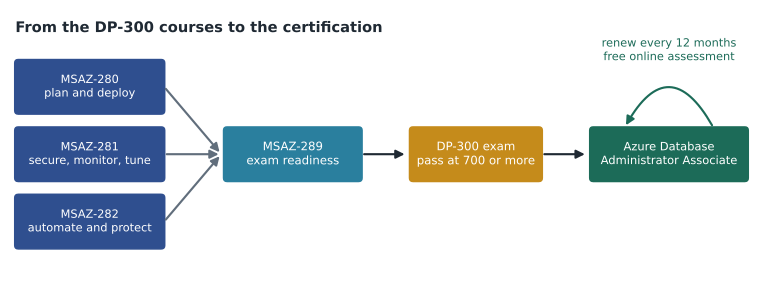
The certification has no formal prerequisite. Microsoft does not require DP-900 first, and it does not require any other exam. The study guide describes the candidate it has in mind: a database administrator who manages cloud and on-premises databases and knows Azure SQL Database, Azure SQL Managed Instance, SQL Server on Azure Virtual Machines and on-premises SQL Server. That candidate is expected to plan and deploy data platform resources, secure them, monitor and tune them, automate routine work and design high availability and disaster recovery. That description fits Walt's job, with one gap: most of his experience is on a single SQL Server 2016 instance in a server room, not in Azure. The MSAZ-280, MSAZ-281 and MSAZ-282 courses closed most of that gap. This course turns the knowledge into exam readiness.
The five skill groups
Microsoft publishes a study guide for each exam with a list of skills measured. The DP-300 list was last updated on October 27, 2026, and it is the document that defines what can be asked. It has five skill groups, each with a weight range that says roughly how much of the exam comes from that group.
| Skill group | Weight (parts in 100) | Where it was taught |
|---|---|---|
| Plan and implement data platform resources | 15 to 20 | MSAZ-280 |
| Implement a secure environment | 20 to 25 | MSAZ-281, lessons 1 to 6 |
| Monitor, configure and optimize database resources | 20 to 25 | MSAZ-281, lessons 7 to 12 |
| Configure and manage automation of tasks | 15 to 20 | MSAZ-282, lessons 1 to 3 |
| Plan and configure a high availability and disaster recovery environment | 20 to 25 | MSAZ-282, lessons 4 to 12 |
Three groups carry the most weight: security, monitoring and optimization, and high availability with disaster recovery. Together they make up between 60 and 75 parts in 100 of the exam. Planning and automation are smaller but not small; at 15 to 20 parts each, either could decide a pass or a fail. Lesson 3 looks at what the weights mean for study time. For now, the point is that the exam is broad. No single group is more than a quarter of it, so a candidate cannot pass by knowing one area very well.
The October 2026 update changed one area only: the skill 'Implement security for data at rest and data in transit' received a minor revision. Everything else was unchanged from the previous outline. Microsoft updates the English version of an exam first; localized versions usually follow about eight weeks later, though not always on that schedule. Walt will sit in English, so the October outline is the one that applies to him.
Delivery, length and languages
The exam is proctored and scheduled through Pearson VUE, the testing company Microsoft uses. A candidate can sit at a test centre or online from home or the office with a webcam and a proctor watching remotely. Lesson 12 covers the practical differences. The certification page gives 100 minutes for the exam itself. It does not state the number of questions, and the number can vary from one sitting to another, so this course does not quote one. What matters for planning is the time: 100 minutes to read scenarios, reason about them and answer.
The exam is offered in English, Chinese (Simplified), Japanese, Korean, French, German, Portuguese (Brazil), Italian, Chinese (Traditional) and Spanish. A candidate who sits in a language that is not their first language can ask for 30 extra minutes if the exam is not offered in their preferred language. Other accommodations, such as extra time for a documented need or assistive devices, are requested through Microsoft Learn before booking.
The price depends on the country or region where the exam is proctored, so the certification page does not list a single figure. Candidates see the price for their location when they schedule. Harrow & Finch is paying for Walt's exam, and Dana Whitcombe's training budget has a line for one sitting and one retake, which Elena thinks is sensible planning rather than pessimism.
Walt asks Elena whether the exam has labs, where a candidate configures a real Azure resource. The certification page says only that the exam may have interactive components. Microsoft provides an exam sandbox that shows the question types and the interface, and Elena wants Walt to try it well before May, so that no screen on exam day is new to him. Lesson 2 goes through the formats one by one.
Scoring: what 700 means
Microsoft reports exam results on a scale from 1 to 1,000, and the passing score is 700 or greater. The study guide states the 700 mark. Candidates often assume 700 means 70 correct answers in every 100. It does not. The score is scaled: the raw result is converted onto the 1,000-point scale in a way that accounts for the difficulty of the particular set of questions a candidate received. Two candidates who answer the same number of questions correctly could receive different scaled scores if their question sets differed in difficulty. Some questions may be worth more than one point. Microsoft does not publish the conversion.
The practical lesson is that a practice score of 70 in 100 is not a guarantee, and a practice score of 65 in 100 is not a certain fail. Practice scores are useful as trends and for finding weak areas, not as predictions of the scaled score. Elena's rule for Walt is to aim for consistent practice results of 80 in 100 or better across all five groups, which leaves room for nerves and for unfamiliar wording.
There is no penalty for a wrong answer. An unanswered question scores the same as a wrong one, so every question should get an answer, even a guess. A guess between two remaining options after eliminating two wrong ones is right half the time; a blank is never right.
Retakes
A candidate who fails the first attempt can retake the exam after 24 hours. After a second failure, and between each later attempt, the wait is 14 days. Nobody can take the same exam more than five times within 12 months of the first attempt; after five failures, the next attempt is allowed 12 months after the first. Each retake is paid for, unless a voucher or offer covers it. A candidate who has passed cannot retake the exam while the certification is current. The waiting period can be waived only when a technical problem, such as a lost internet connection or an equipment failure, interrupted the exam and a Pearson VUE case was opened at the time.
Elena tells Walt not to plan around a retake, but to know the rules so that a bad day does not feel like the end of the road. If he does not pass on May 14, a second attempt could be as early as the next day, but she would rather he spend two weeks on the areas the score report shows as weak.
Keeping the certification current
Associate certifications expire every 12 months unless renewed. Renewal is free. It is done by passing an online renewal assessment on Microsoft Learn, which is unproctored and shorter than the exam, and which focuses on recent changes to the technology. The renewal window opens in the six months before the expiry date. There is no limit on renewal attempts, but the assessment must be passed before the certification expires. After a failed first attempt the next can follow immediately; after the second, there is a 24-hour wait between attempts. A certification that expires is not renewed by the assessment; the candidate must pass the full exam again.
For Walt, a pass on May 14, 2027 would mean an expiry date in May 2028 and a renewal window from about November 2027. Elena puts a reminder in his calendar now, because she has seen colleagues lose certifications simply by not noticing the email.
Registering the right account
Microsoft recommends that candidates manage their certifications with a personal Microsoft account rather than a work or school account. Records tied to an organization's account can be lost when the person leaves that organization. Walt creates a personal Microsoft account, links it to his Microsoft Learn profile and adds his work email only as a contact address. The profile then holds his exam history, transcript and renewal assessments whatever happens to his employment. It is a small step that saves real trouble later, and it should be done before booking, because the name on the profile must match the name on the identification he will show at check-in.
What the exam rewards
Associate exams reward judgment more than recall. Most DP-300 questions describe a situation and ask for the best choice under its constraints: the cheapest option that meets a recovery point objective, the least-privileged permission that lets an application work, the migration method that keeps downtime under an hour. Many wrong options are things that would work in some other situation, or would work but cost more, or would work but break a stated rule. A candidate who reads every requirement and checks each option against all of them does better than one who recognizes a familiar product name and picks it.
This is good news for an experienced DBA. Walt's seventeen years have trained exactly this habit: reading a request carefully, asking what it really needs and noticing the constraint nobody mentioned. The exam rewards the same habit, applied quickly and to Azure services he has learned more recently. Elena's task in this course is to connect the two.
Worked problem
Reading a score report
Walt passes a practice exam with these results by skill group, shown as correct answers out of questions asked: planning 7 of 10, security 9 of 13, monitoring 12 of 14, automation 8 of 10, HA/DR 9 of 13. What fraction of all questions did he answer correctly, and which group most needs attention?
Show solution
- Total correct: 7 + 9 + 12 + 8 + 9 = 45.
- Total asked: 10 + 13 + 14 + 10 + 13 = 60.
- \[45 \div 60 = 0.75 \text{, or 75 in 100}\]
- By group: planning 0.70, security 0.69, monitoring 0.86, automation 0.80, HA/DR 0.69.
- Security and HA/DR are lowest, and both are heavy groups (20 to 25 parts in 100 each).
Answer: He answered 75 in 100 correctly. Security and HA/DR, at about 69 in 100 each, most need attention, because they are both weak and heavily weighted. A practice score is not a scaled score, so 75 in 100 says he is close, not that he would pass.
Common mistakes
MistakeA passing score of 700 means answering 70 in 100 questions correctly.
InsteadThe score is scaled and adjusted for question difficulty; 700 is not a fixed share of correct answers.
MistakeLeaving a hard question blank avoids losing marks.
InsteadThere is no penalty for wrong answers; a blank scores zero, so always answer.
MistakeDP-900 must be passed before DP-300.
InsteadDP-300 has no prerequisite exam.
MistakeThe certification lasts for life once earned.
InsteadAssociate certifications expire after 12 months unless renewed with the free online assessment.
MistakeA work account is the best place to keep certification records.
InsteadMicrosoft recommends a personal Microsoft account so records stay with the person.
Summary and key terms
- Passing DP-300 earns the Microsoft Certified: Azure Database Administrator Associate certification; there is no prerequisite exam.
- The skills outline, updated October 27, 2026, has five groups: planning 15 to 20, security 20 to 25, monitoring and optimization 20 to 25, automation 15 to 20, HA/DR 20 to 25 parts in 100.
- The exam is delivered by Pearson VUE at a test centre or online, lasts 100 minutes, and is offered in ten languages; the price depends on the country.
- Scores are scaled from 1 to 1,000 and 700 passes; there is no penalty for wrong answers.
- Retakes: 24 hours after a first failure, 14 days between later attempts, at most five attempts in 12 months.
- The certification expires after 12 months; renew it free with an online assessment in the six months before expiry.
- Associate certification
- A Microsoft role-based certification that checks the ability to do a job role, above fundamentals level.
- Skills measured
- The published list of skills and weights that defines what an exam can cover.
- Scaled score
- A result converted onto a 1-to-1,000 scale that accounts for the difficulty of the questions received.
- Pearson VUE
- The testing company that proctors and schedules Microsoft exams at test centres and online.
- Renewal assessment
- A free, unproctored online assessment on Microsoft Learn that extends an associate certification for another year.
- Exam sandbox
- A Microsoft demonstration of exam question types and the interface, for practice before the real exam.
Practice problems
Work each problem on paper first, then reveal the answer to check.
What score is needed to pass DP-300?
Show answer
700 or greater on a scale of 1 to 1,000.
How long is the DP-300 exam, according to the certification page?
Show answer
100 minutes.
After a second failed attempt, how long must a candidate wait before the next attempt?
Show answer
14 days.
How is an associate certification renewed, and what does it cost?
Show answer
By passing a free online renewal assessment on Microsoft Learn in the six months before it expires.
Which three skill groups each carry 20 to 25 parts in 100?
Show answer
Implement a secure environment; monitor, configure and optimize database resources; and plan and configure HA/DR.
Lesson quiz · 5 questions
Score 60% or more to complete this lesson.
Create a free account to save your progress, take quizzes and earn a certificate.