
MCAT-122 · Lesson 9 of 12 · 25 min
Carboxylic acids and their derivatives
▶ Video coming soon A video version of this lesson is on the way.
Devika had a soap bar on her desk when the session started. 'My grandmother makes soap in Trinidad from coconut oil and lye,' she said. 'She calls it cooking. I just realized it is an ester reaction.' Thandiwe laughed. 'It is the oldest organic reaction people still do in their kitchens. Today you learn why it works, and why the same chemistry that makes soap breaks down fats in your gut and opens the ring of penicillin.'
This lesson covers carboxylic acids and the four main acid derivatives: acid chlorides, anhydrides, esters and amides, along with nitriles. It explains their naming and properties, the acidity of carboxylic acids, the general mechanism of nucleophilic acyl substitution, the relative reactivity of the derivatives, and the key reactions: formation of esters (Fischer esterification), amides and anhydrides; hydrolysis and saponification; transesterification; reduction; decarboxylation; and reactions at the alpha carbon. The AAMC outline lists carboxylic acids (nomenclature and physical properties; carboxyl group reactions including amides and lactams, esters and lactones, and anhydride formation; reduction; decarboxylation; reactions at the 2-position; substitution) and acid derivatives (anhydrides, amides and esters; nucleophilic substitution; transesterification; hydrolysis of amides; relative reactivity; steric effects; electronic effects; and strain, such as beta-lactams) in content category 5D.
Carboxylic acids: structure and properties
A carboxylic acid has a carboxyl group, -COOH, in which a carbonyl carbon carries an OH. The suffix is -oic acid, and the carboxyl carbon is always carbon 1: CH3CH2COOH is propanoic acid. Common names are still used for small acids and fatty acids: formic (methanoic), acetic (ethanoic), butyric (butanoic), palmitic (hexadecanoic, 16 carbons), stearic (octadecanoic, 18) and oleic (cis-octadec-9-enoic). Dicarboxylic acids include oxalic, malonic and succinic acids, the last familiar from the citric acid cycle.
Carboxylic acids are the most polar of the common organic functional groups. They hydrogen bond strongly, forming dimers in nonpolar solvents and in the liquid, so they have high boiling points, higher than alcohols of similar mass. Small acids mix with water; solubility falls as the chain lengthens, and long-chain fatty acids are insoluble in water unless they are ionized.
Carboxylic acids are weak acids, with pKa values of about 4 to 5 (acetic acid 4.76). They are much more acidic than alcohols because the carboxylate ion is stabilized by resonance, sharing its negative charge equally between two oxygens (lesson 2). Electron-withdrawing groups near the carboxyl increase acidity by stabilizing the carboxylate inductively, and the effect weakens with distance. Chloroacetic acid has a pKa near 2.9, dichloroacetic acid near 1.3 and trichloroacetic acid near 0.7. A chlorine on carbon 2 has a large effect; on carbon 4 it has almost none. Electron-donating alkyl groups make acids slightly weaker.
At physiological pH, about 7.4, a carboxylic acid with pKa near 4.5 is almost completely ionized: by the Henderson-Hasselbalch equation the ratio of carboxylate to acid is 10 to the power (7.4 - 4.5), close to 1,000 to 1. That is why amino acids, fatty acids and metabolites such as pyruvate and lactate are drawn as carboxylates in biochemistry, and why their names often end in -ate.
Nucleophilic acyl substitution
Acid derivatives share one reaction pattern. A nucleophile attacks the carbonyl carbon, forming a tetrahedral intermediate. Then the carbonyl re-forms and a leaving group is expelled. The overall result is substitution of one group on the acyl carbon (R-C=O) for another. This is the key difference from aldehydes and ketones (lesson 8): their tetrahedral intermediates have no good leaving group, because H- and R- never leave, so they stop at addition. Acid derivatives carry a group that can leave, so they substitute.
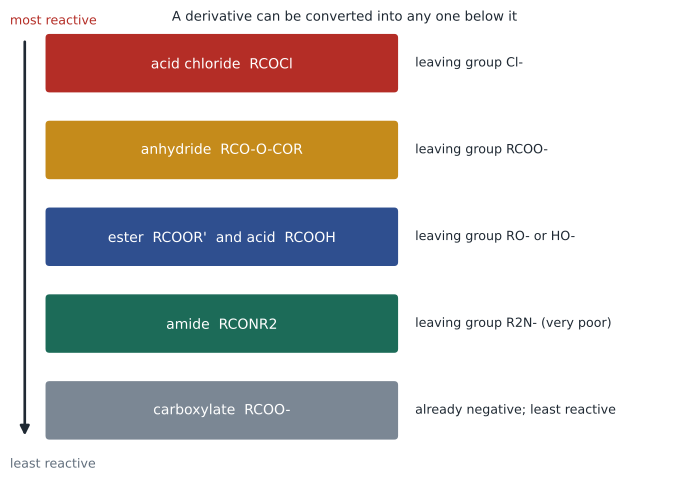
The order of reactivity, from most to least reactive, is acid chloride > anhydride > ester, about equal to carboxylic acid > amide > carboxylate. Two factors explain it, and the MCAT expects you to name both. The first is leaving-group ability: chloride is a very weak base and leaves easily, carboxylate is next, alkoxide and hydroxide are poorer, and the amide ion (NH2-) is a very poor leaving group. The second is resonance donation into the carbonyl: the more the attached atom donates its lone pair to the carbonyl carbon, the less electrophilic that carbon is. Nitrogen donates most, so amides are the least reactive and most stable derivative. Chlorine's lone pairs, in larger 3p orbitals, overlap poorly with carbon's 2p orbital and donate almost nothing, so acid chlorides are the most reactive.
Reactivity also explains the direction of interconversion. A more reactive derivative can be converted into any less reactive one by choosing the right nucleophile: an acid chloride reacts with a carboxylate to give an anhydride, with an alcohol to give an ester and with an amine to give an amide. Going the other way, from an amide to an ester, is not possible directly. The stability of amides is also why peptide bonds last for years in water at neutral pH, even though their hydrolysis is thermodynamically favourable: it is just very slow without a catalyst.
| Derivative | Structure | Naming | Leaving group | Typical reactions |
|---|---|---|---|---|
| Acid chloride | RCOCl | -oyl chloride | Cl- | Reacts with water, alcohols and amines, often vigorously |
| Anhydride | RCO-O-COR | -oic anhydride | RCOO- | Acylates alcohols and amines (aspirin synthesis) |
| Ester | RCOOR' | alkyl -oate | R'O- | Hydrolysis, saponification, transesterification |
| Amide | RCONR2 | -amide | R2N- (very poor) | Hydrolysis only under harsh conditions or by enzymes |
| Nitrile | R-C triple bond N | -nitrile | None (adds then hydrolyzes) | Hydrolysis to amides and acids; reduction to amines |
Making esters: Fischer esterification
A carboxylic acid heated with an alcohol and a strong acid catalyst forms an ester and water. This is Fischer esterification. The acid catalyst protonates the carbonyl oxygen, making the carbon more electrophilic; the alcohol attacks to form a tetrahedral intermediate; proton transfers turn one OH into water, which leaves; and loss of a proton gives the ester. Isotope-labelling experiments show that the oxygen of the alcohol ends up in the ester, while the OH of the acid leaves as water.
Fischer esterification is an equilibrium, with an equilibrium constant near 1 for many acids and alcohols. Le Chatelier's principle drives it: using a large excess of the alcohol, or removing water as it forms, pushes the reaction toward the ester. The reverse reaction, acid-catalyzed hydrolysis of the ester, is favoured by a large excess of water. Esters are responsible for many fruit odours and flavours, such as isoamyl acetate in bananas and ethyl butanoate in pineapples. Cyclic esters are called lactones; they form when a hydroxy acid esterifies itself, most readily when the ring formed has five or six atoms.
Hydrolysis and saponification
Esters are hydrolyzed in two ways. In acid, hydrolysis is the reverse of Fischer esterification and is an equilibrium. In base, hydroxide attacks the carbonyl carbon, the tetrahedral intermediate expels the alkoxide, and the carboxylic acid that forms is immediately deprotonated by the alkoxide or by hydroxide. That final acid-base step makes base hydrolysis irreversible, because a carboxylate cannot be attacked by the alcohol. Base hydrolysis consumes one equivalent of hydroxide per ester group and is called saponification.
Soap making is saponification of triacylglycerols, the esters of glycerol with three fatty acids. Heating fats or oils with sodium hydroxide (lye) gives glycerol and sodium salts of the fatty acids: soap. Soap molecules have a long nonpolar tail and an ionic carboxylate head, so in water they gather into micelles, spheres with tails inside and heads outside, which trap grease in their cores and carry it away. Bile salts do something similar in the small intestine, emulsifying dietary fat so that pancreatic lipase, an enzyme that catalyzes ester hydrolysis, can reach it.
Worked problem
Saponification stoichiometry
A triacylglycerol with molar mass of about 885 g/mol (glyceryl trioleate) is saponified. How many moles of NaOH are needed for 0.10 mol of fat, and what are the products?
Show solution
- Each triacylglycerol has three ester groups.
- Each ester needs one hydroxide: 3 x 0.10 = 0.30 mol NaOH.
- Products: 0.10 mol of glycerol and 0.30 mol of sodium oleate.
Answer: 0.30 mol NaOH; glycerol plus three sodium carboxylates (soap) per fat molecule.
Amides hydrolyze much more slowly. Breaking an amide requires prolonged heating with strong aqueous acid or base, giving a carboxylic acid (or carboxylate) and an amine (or ammonium ion). In acid hydrolysis of a peptide, the products are amino acids in their protonated forms. In the body, proteases catalyze amide hydrolysis under mild conditions; serine proteases such as chymotrypsin use a serine OH as the nucleophile, forming an acyl-enzyme ester that is then hydrolyzed by water, a two-step nucleophilic acyl substitution.
Transesterification
In transesterification, an ester reacts with an alcohol, under acid or base catalysis, to exchange its alkoxy group: RCOOR' + R''OH gives RCOOR'' + R'OH. Like Fischer esterification, it is an equilibrium driven by excess alcohol. Biodiesel is made this way, by transesterifying vegetable oil triacylglycerols with methanol and a base catalyst to give fatty acid methyl esters and glycerol. Transesterification also explains a laboratory pitfall: running a base-catalyzed reaction of a methyl ester in ethanol solvent with ethoxide slowly converts it into the ethyl ester. Chemists match the alkoxide base to the ester to avoid this.
Amides, anhydrides and strain
Amides form when amines react with acid chlorides or anhydrides. Heating an amine directly with a carboxylic acid is less useful, because the two first form an ammonium carboxylate salt; amide formation then requires high temperatures or a coupling agent that activates the acid. Peptide synthesis in the laboratory uses coupling agents for exactly this reason, and cells use ribosomes and activated aminoacyl-tRNA esters. Cyclic amides are lactams. Anhydrides form when two carboxylic acids lose water, or when a carboxylate reacts with an acid chloride; acetic anhydride acylates the phenol OH of salicylic acid to make aspirin (acetylsalicylic acid).
Ring strain can override the normal stability of amides. In penicillins and cephalosporins, the amide nitrogen is part of a four-membered beta-lactam ring. The ring forces bond angles near 90 degrees and prevents the nitrogen from lying flat, so its lone pair cannot delocalize into the carbonyl well. The beta-lactam carbonyl is therefore unusually electrophilic. It acylates a serine in the bacterial enzymes (transpeptidases, also called penicillin-binding proteins) that cross-link the cell wall, permanently inactivating them. Bacterial resistance often comes from beta-lactamase enzymes that hydrolyze the strained ring first, which is why some antibiotics are given with beta-lactamase inhibitors such as clavulanic acid.
Reduction and decarboxylation
LiAlH4 reduces carboxylic acids and esters to primary alcohols, and amides to amines. NaBH4 is too weak to reduce acids, esters or amides under ordinary conditions. With an ester, two hydrides are delivered: the first gives a tetrahedral intermediate that expels the alkoxide to form an aldehyde, and the aldehyde, more reactive than the ester, is reduced again at once. Nitriles are reduced to primary amines by LiAlH4.
Decarboxylation is the loss of CO2 from a carboxylic acid. Most acids decarboxylate only at very high temperatures, but beta-keto acids (with a ketone two carbons from the carboxyl, on the beta carbon) lose CO2 easily on gentle heating. They react through a six-membered cyclic transition state that gives an enol, which tautomerizes to a ketone. Malonic acids, with two carboxyls on one carbon, decarboxylate in the same way. In metabolism, decarboxylation releases the CO2 we exhale: pyruvate dehydrogenase removes one carbon from pyruvate, and isocitrate dehydrogenase and alpha-ketoglutarate dehydrogenase remove two more in the citric acid cycle.
Worked problem
Decarboxylation of a beta-keto acid
What is the product when 3-oxobutanoic acid (acetoacetic acid, CH3COCH2COOH) is warmed?
Show solution
- The carboxyl is beta to the ketone, so the compound is a beta-keto acid.
- A cyclic six-membered transition state transfers the acid proton to the ketone oxygen as CO2 leaves.
- The enol formed, CH2=C(OH)CH3, tautomerizes to acetone.
Answer: Acetone plus CO2. This is why the breath of a person in diabetic ketoacidosis can smell of acetone: acetoacetate, a ketone body, decarboxylates.
Reactions at the alpha carbon
The alpha carbon of a carboxylic acid derivative, called the 2-position on the AAMC outline, can be substituted through enol or enolate chemistry, just as in ketones. In the Hell-Volhard-Zelinsky reaction, a carboxylic acid treated with bromine and a phosphorus catalyst is brominated at the alpha carbon. The alpha-bromo acid can then undergo SN2 reactions; with ammonia it gives an alpha-amino acid, one of the classic amino acid syntheses. Esters with alpha hydrogens form enolates that undergo the Claisen condensation, the ester analogue of the aldol reaction, in which an ester enolate attacks a second ester and the product is a beta-keto ester. Fatty acid synthesis in cells uses a Claisen-type condensation to add two carbons at a time.
Passage practice: a resistant bacterium
Data invented for this course. Researchers compared two antibiotics, compound L (a beta-lactam) and compound M (an analogue in which the four-membered ring is replaced by a five-membered lactam). Against a susceptible strain, L inhibited growth at 0.5 micrograms per mL and M at 64 micrograms per mL. Against a resistant strain producing a beta-lactamase, L required 128 micrograms per mL, but adding a beta-lactamase inhibitor restored activity to 1 microgram per mL. IR spectroscopy showed the lactam C=O of L at 1770 per centimetre and that of M at 1690.
Question 1. Why is compound L much more potent than M against the susceptible strain? (A) L is more polar. (B) Ring strain makes the beta-lactam carbonyl more electrophilic, so it acylates the target enzyme readily. (C) M cannot enter bacteria. (D) L forms more hydrogen bonds.
Question 2. The higher IR frequency of the C=O in L is consistent with: (A) more single-bond character from amide resonance. (B) less amide resonance because of ring strain. (C) hydrogen bonding to water. (D) conjugation with an alkene.
Question 3. What does a beta-lactamase most likely do? (A) Hydrolyses the strained amide, opening the ring. (B) Oxidizes the antibiotic. (C) Adds a phosphate group. (D) Converts the amide to an ester.
Question 4. Which reaction type describes the antibiotic's action on its target serine? (A) Nucleophilic acyl substitution. (B) Electrophilic aromatic substitution. (C) E2 elimination. (D) Aldol addition.
Answers. 1: B (skill 2). 2: B (skill 2). Less donation from nitrogen leaves more C=O double-bond character, raising the stretching frequency. 3: A (skill 1). 4: A (skill 1). The serine OH attacks the lactam carbonyl and the ring nitrogen leaves, forming an acyl-enzyme ester. Ezequiel connected it to his EMT years: 'We always asked about penicillin allergies. I never knew it was a ring that was too tight.'
Common mistakes
MistakeEsters are more reactive than anhydrides.
InsteadAnhydrides are more reactive, because a carboxylate leaves more easily than an alkoxide.
MistakeSaponification is reversible like acid-catalyzed hydrolysis.
InsteadIn base, the carboxylic acid is deprotonated to a carboxylate, which makes the reaction irreversible.
MistakeNaBH4 reduces esters to alcohols.
InsteadLiAlH4 is needed for esters, acids and amides; NaBH4 reduces aldehydes and ketones.
MistakeAll carboxylic acids decarboxylate easily.
InsteadOnly beta-keto acids and malonic acids decarboxylate on gentle heating, through a cyclic transition state.
MistakeAmides are unreactive because nitrogen is a strong electron-withdrawing group.
InsteadAmides are unreactive because nitrogen donates its lone pair into the carbonyl and NH2- is a very poor leaving group.
Summary and key terms
- Carboxylic acids (pKa 4 to 5) are stabilized by carboxylate resonance; electron-withdrawing groups nearby increase acidity.
- Acid derivatives react by nucleophilic acyl substitution through a tetrahedral intermediate.
- Reactivity: acid chloride > anhydride > ester about equal to acid > amide > carboxylate, from leaving-group ability and resonance donation.
- Fischer esterification and acid hydrolysis are equilibria; saponification is irreversible.
- Transesterification swaps the alkoxy group; ring strain makes beta-lactams reactive.
- LiAlH4 reduces acids and esters to primary alcohols; beta-keto acids decarboxylate on warming.
- Nucleophilic acyl substitution
- Replacement of a leaving group on an acyl carbon by a nucleophile through a tetrahedral intermediate.
- Fischer esterification
- Acid-catalyzed formation of an ester from a carboxylic acid and an alcohol.
- Saponification
- Base hydrolysis of an ester to a carboxylate salt and an alcohol.
- Transesterification
- Exchange of the alkoxy group of an ester by reaction with an alcohol.
- Lactone
- A cyclic ester.
- Lactam
- A cyclic amide; a beta-lactam has a four-membered ring.
- Decarboxylation
- Loss of CO2 from a carboxylic acid.
Practice problems
Work each problem on paper first, then reveal the answer to check.
Which is the stronger acid: 2-chlorobutanoic acid or 4-chlorobutanoic acid?
Show answer
2-Chlorobutanoic acid; the electron-withdrawing chlorine is closer to the carboxyl.
What are the products of acetyl chloride with ethanol?
Show answer
Ethyl acetate and HCl.
What forms when methyl benzoate is heated with aqueous NaOH, then acidified?
Show answer
Benzoic acid (via sodium benzoate) and methanol.
What does LiAlH4 do to N,N-dimethylacetamide?
Show answer
Reduces it to the amine N,N-dimethylethanamine (ethyldimethylamine).
How can the yield of a Fischer esterification be increased?
Show answer
Use excess alcohol or remove water as it forms.
Lesson quiz · 5 questions
Score 60% or more to complete this lesson.
Create a free account to save your progress, take quizzes and earn a certificate.