
MCAT-122 · Lesson 2 of 12 · 25 min
Bonding, hybridization and resonance
▶ Video coming soon A video version of this lesson is on the way.
Devika arrived with a list. 'I can draw every structure,' she said, 'but I cannot tell you why the acetate ion is stable or why an amide is flat. I just memorized that it is.' Thandiwe smiled. 'Then today you get to stop memorizing. Almost every stability question on the MCAT, from acidity to reactivity, comes back to three ideas: where the electrons are, what shape the orbitals give the molecule, and whether a charge can spread out.'
This lesson reviews covalent bonding, Lewis structures and formal charge, the hybridization of carbon, nitrogen and oxygen, sigma and pi bonds, molecular geometry, and resonance. On the AAMC outline these topics sit in content category 5B, under the covalent bond: Lewis electron dot formulas, resonance structures, formal charge, Lewis acids and bases, partial ionic character, sigma and pi bonds, hybrid orbitals (sp3, sp2 and sp) and their geometries, delocalized electrons and resonance in ions and molecules, and multiple bonding. They also support category 5D, because resonance explains the reactivity of carbonyl compounds, acids and amides.
Covalent bonds and Lewis structures
A covalent bond is a shared pair of electrons between two atoms. Atoms in the second row of the periodic table, including carbon, nitrogen and oxygen, follow the octet rule: they are most stable with eight valence electrons around them, counting both shared and unshared electrons. Hydrogen is stable with two. Atoms in the third row and below, such as phosphorus and sulfur, can hold more than eight, which is why phosphate (PO4 3-) and sulfuric acid can be drawn with more than four bonds to the central atom.
To draw a Lewis structure, count the total valence electrons (adding one for each negative charge and removing one for each positive charge), connect the atoms with single bonds, complete the octets of the outer atoms with lone pairs, place leftover electrons on the central atom, and form double or triple bonds if the central atom still lacks an octet. Carbon usually has four bonds and no lone pairs; neutral nitrogen has three bonds and one lone pair; neutral oxygen has two bonds and two lone pairs; and halogens have one bond and three lone pairs. Recognizing these "normal" patterns lets you spot charged atoms at a glance.
Bond polarity depends on electronegativity, the tendency of an atom to attract shared electrons. Fluorine is the most electronegative element, followed by oxygen, nitrogen and chlorine; carbon and hydrogen are similar. When the difference is large, the bond is polar, with a partial negative charge on the more electronegative atom. The C=O bond in a carbonyl is strongly polar, with a partial positive carbon and a partial negative oxygen. That single fact explains why nucleophiles attack carbonyl carbons in lessons 8 and 9.
Formal charge
Formal charge is a bookkeeping tool that tells you whether an atom has more or fewer electrons than it would on its own. For each atom, formal charge equals the number of valence electrons minus the number of nonbonding electrons minus half the number of bonding electrons. A simpler way to count is: valence electrons minus (lone pair electrons plus the number of bonds).
Common patterns are worth memorizing. Carbon with three bonds and one lone pair is a carbanion (formal charge -1); carbon with three bonds and no lone pair is a carbocation (+1). Nitrogen with four bonds, as in ammonium, is +1; nitrogen with two bonds and two lone pairs is -1. Oxygen with three bonds and one lone pair, as in the hydronium ion or a protonated carbonyl, is +1; oxygen with one bond and three lone pairs, as in hydroxide or an alkoxide, is -1. When several Lewis structures are possible, the best one usually has the fewest formal charges, and any negative charge sits on the most electronegative atom.
Worked problem
Formal charges in the nitrate ion
In one Lewis structure of nitrate (NO3-), nitrogen has one double bond and two single bonds to oxygen. What are the formal charges?
Show solution
- Nitrogen: 5 valence electrons, no lone pairs, 4 bonds. 5 - 0 - 4 = +1.
- Double-bonded oxygen: 6 valence electrons, two lone pairs (4 electrons), 2 bonds. 6 - 4 - 2 = 0.
- Each single-bonded oxygen: 6 valence electrons, three lone pairs (6 electrons), 1 bond. 6 - 6 - 1 = -1.
- Sum: +1 + 0 - 1 - 1 = -1, matching the ion's charge.
Answer: N is +1, the double-bonded O is 0 and the two single-bonded O atoms are -1 each. Because the double bond can be drawn to any oxygen, nitrate has three resonance structures.
Hybridization and geometry
Valence shell electron pair repulsion (VSEPR) theory predicts geometry from the number of electron domains around an atom: each bond (single, double or triple) and each lone pair counts as one domain. Hybridization describes the same thing in orbital language. Carbon mixes its 2s orbital with some of its 2p orbitals to form hybrid orbitals that point toward the domains.
| Electron domains | Hybridization | Electron geometry | Ideal angle | Carbon example |
|---|---|---|---|---|
| 4 | sp3 | Tetrahedral | 109.5 degrees | Methane, any C with four single bonds |
| 3 | sp2 | Trigonal planar | 120 degrees | Alkene carbons, carbonyl carbons, carbocations |
| 2 | sp | Linear | 180 degrees | Alkyne carbons, the central carbon of CO2 |
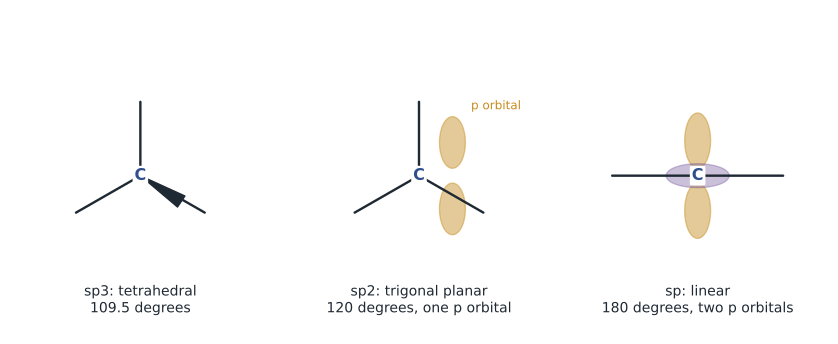
Lone pairs count as domains, so they change the shape that you see. The nitrogen in ammonia has three bonds and one lone pair: four domains, sp3 hybridization and a trigonal pyramidal shape with angles near 107 degrees. The oxygen in water has two bonds and two lone pairs: four domains, sp3, and a bent shape near 104.5 degrees. Lone pairs take up more room than bonding pairs, which squeezes the bond angles slightly below 109.5 degrees.
A shortcut for hybridization is to count the atoms bonded to a central atom plus its lone pairs: 4 gives sp3, 3 gives sp2 and 2 gives sp. There is one important exception. An atom with a lone pair next to a pi system, such as the nitrogen of an amide or the oxygen of a phenol, usually becomes sp2 so that its lone pair can sit in a p orbital and overlap with the pi system. That is why amide nitrogens are planar rather than pyramidal, and it explains the restricted rotation of the peptide bond in proteins.
Sigma and pi bonds
A sigma bond forms by head-on overlap of orbitals along the line between two nuclei. Every single bond is a sigma bond, and sigma bonds allow free rotation. A pi bond forms by side-by-side overlap of unhybridized p orbitals, above and below the bond axis. A double bond is one sigma bond plus one pi bond; a triple bond is one sigma plus two pi bonds. Because rotating around a double bond would break the pi overlap, double bonds do not rotate freely, which is why cis and trans alkenes are separate compounds (lesson 3).
| Bond | Components | Typical length (pm) | Approximate bond energy (kJ/mol) |
|---|---|---|---|
| C-C | 1 sigma | about 154 | about 350 |
| C=C | 1 sigma + 1 pi | about 134 | about 610 |
| C triple bond C | 1 sigma + 2 pi | about 120 | about 835 |
| C-O | 1 sigma | about 143 | about 360 |
| C=O | 1 sigma + 1 pi | about 120 | about 740 |
Notice from the table that a double bond is not twice as strong as a single bond. The pi component adds less energy than the sigma component because side-by-side overlap is less effective. That is why pi bonds are the reactive part of alkenes and carbonyls: they are the electrons most easily pulled into new bonds. Another useful trend is that s character increases from sp3 (25 percent s) to sp2 (33 percent) to sp (50 percent). Orbitals with more s character hold electrons closer to the nucleus, which makes sp carbons more electronegative. This is why the C-H of a terminal alkyne (pKa about 25) is far more acidic than an alkene C-H (about 44) or an alkane C-H (about 50).
Resonance and delocalization
Some molecules cannot be described by a single Lewis structure. In the carboxylate ion, both C-O bonds are the same length, partway between a single and a double bond. Resonance describes this by drawing two or more structures that differ only in the placement of pi electrons and lone pairs, with the atoms fixed in place. The real molecule is a resonance hybrid, a weighted blend of the contributors. It does not flip between them. The double-headed arrow used between resonance structures means "these drawings describe one molecule", not an equilibrium.
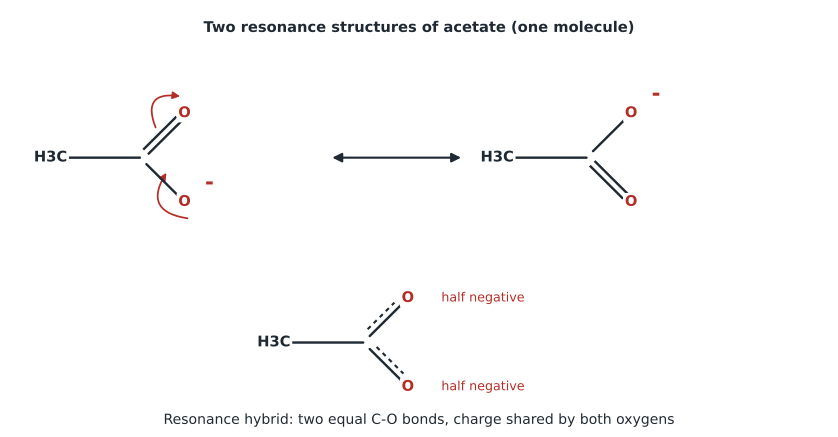
Curved arrows show how electrons move from one resonance structure to the next. Each arrow starts at a lone pair or a pi bond and points to where the electrons go: a neighbouring bond position or atom. Arrows never move atoms, and they never move sigma bonds in resonance. Practising the arrows here pays off later, because the same notation describes mechanisms in lessons 6 to 11.
Not all resonance contributors are equal. A contributor is more important (closer to the real structure) when it has full octets on every atom, fewer formal charges, negative charge on more electronegative atoms, and positive charge on less electronegative atoms. In the amide, for example, the neutral structure with C=O is the major contributor, but the minor structure with C=N+ and O- is significant enough to give the C-N bond partial double-bond character. That partial double bond explains why amides are planar, why the peptide bond does not rotate, and why amide nitrogens are not basic.
Delocalization almost always stabilizes a molecule or ion. Spreading a charge over several atoms lowers its energy, which is why resonance explains so many acidity trends. Acetic acid (pKa about 4.8) is about 11 orders of magnitude more acidic than ethanol (pKa about 16) because the acetate ion shares its negative charge between two oxygens, while the ethoxide ion keeps its charge on one oxygen. Phenol (pKa about 10) is more acidic than ethanol because the phenoxide charge spreads into the ring. Allylic and benzylic carbocations are more stable than ordinary primary carbocations because the positive charge is delocalized, which is why they form easily in SN1 reactions.
Worked problem
Comparing acidity with resonance
Rank these from most to least acidic: ethanol, phenol, acetic acid, 4-nitrophenol.
Show solution
- Look at the conjugate bases. The more stable the base, the stronger the acid.
- Acetate spreads its charge over two equivalent oxygens: very stable.
- 4-Nitrophenoxide spreads its charge into the ring and onto the oxygens of the nitro group, an electron-withdrawing group in the para position.
- Phenoxide spreads its charge into the ring only.
- Ethoxide has no resonance; the charge stays on one oxygen, and the ethyl group donates electron density slightly.
Answer: Acetic acid (pKa about 4.8) > 4-nitrophenol (about 7.2) > phenol (about 10) > ethanol (about 16).
Aromaticity
A special kind of delocalization makes some rings unusually stable. A compound is aromatic if it is cyclic, planar, fully conjugated (every ring atom has a p orbital) and has 4n + 2 pi electrons, where n is zero or a positive integer, so 2, 6, 10 and so on. This is Huckel's rule. Benzene, with six pi electrons, is the classic example. It does not undergo the addition reactions typical of alkenes; instead it undergoes substitution that keeps the aromatic ring intact.
Biological molecules are full of aromatic rings, including the side chains of phenylalanine, tyrosine and tryptophan, the imidazole ring of histidine, and the purine and pyrimidine bases of DNA and RNA. The AAMC outline lists "biological aromatic heterocycles" in content category 5D. In pyridine, the nitrogen lone pair lies in the plane of the ring and is not part of the aromatic system, so pyridine is a weak base. In pyrrole, the nitrogen lone pair is part of the six-electron aromatic system, so pyrrole nitrogen is not basic: protonating it would destroy the aromaticity. Histidine's imidazole ring has one nitrogen of each type, which is why histidine can accept and donate protons near neutral pH.
Lewis acids and bases
Lewis definitions describe acids and bases by electron pairs rather than protons. A Lewis base donates an electron pair and a Lewis acid accepts one. Every Bronsted-Lowry base is also a Lewis base, but the Lewis definition includes species that have nothing to do with protons. Boron trifluoride (BF3), with an empty p orbital on boron, and metal ions such as Fe3+, Mg2+ and Zn2+ are Lewis acids. In enzymes, metal ions often act as Lewis acids that stabilize negative charge in a transition state. In organic chemistry, nucleophiles are Lewis bases and electrophiles are Lewis acids, a connection that frames all of the reactions later in this course.
Passage practice: a flat bond in a peptide
Data invented for this course. Researchers measured the rotational barrier about the C-N bond in a series of small amides by NMR. N,N-dimethylacetamide showed a barrier of about 75 kJ/mol, compared with about 12 kJ/mol for rotation about the C-N bond of a simple amine. When the amide oxygen was replaced with sulfur (a thioamide), the barrier rose slightly. When the carbonyl was removed entirely, the barrier fell to amine-like values.
Question 1. What best explains the high rotational barrier in N,N-dimethylacetamide? (A) Steric clash between the methyl groups. (B) Partial double-bond character in the C-N bond from resonance. (C) Hydrogen bonding between the N-H and C=O. (D) The sp3 hybridization of the amide nitrogen.
Question 2. What is the hybridization of the amide nitrogen? (A) sp. (B) sp2. (C) sp3. (D) sp3d.
Question 3. Removing the carbonyl lowers the barrier because: (A) the molecule becomes larger. (B) the nitrogen lone pair can no longer delocalize into a pi bond. (C) the molecule becomes aromatic. (D) the nitrogen gains a positive formal charge.
Question 4. In proteins, the result of this barrier is that: (A) the peptide group is planar, limiting backbone rotation to the phi and psi angles. (B) peptide bonds hydrolyze spontaneously at pH 7. (C) amide nitrogens are protonated at physiological pH. (D) side chains cannot rotate.
Answers. 1: B (skill 1). Resonance places a pi bond between C and N in a minor contributor; rotating would break that overlap. Choice C is impossible, because N,N-dimethylacetamide has no N-H. 2: B (skill 1). The lone pair sits in a p orbital to delocalize, so N is sp2 and planar. 3: B (skill 2). Without the carbonyl there is no pi system to delocalize into. 4: A (skill 2). Planar peptide groups leave rotation only around the bonds to the alpha carbon. Devika had answered all four correctly and wrote one line in her error log anyway: "Stability = where the electrons can go."
Common mistakes
MistakeResonance structures are different molecules that interconvert quickly.
InsteadThey are drawings of one molecule; the real structure is a single hybrid.
MistakeCurved arrows can move atoms or sigma bonds in resonance.
InsteadIn resonance only pi electrons and lone pairs move; atoms stay put.
MistakeA double bond is twice as strong as a single bond.
InsteadThe pi bond is weaker than the sigma bond, so a C=C is less than twice as strong as a C-C.
MistakeEvery nitrogen with three bonds is sp3.
InsteadNitrogen next to a pi system (amides, pyrrole, aniline) is usually sp2 so its lone pair can delocalize.
MistakeAny ring with alternating double bonds is aromatic.
InsteadAromatic rings must be planar, fully conjugated and have 4n + 2 pi electrons; cyclobutadiene, with four, is not.
Summary and key terms
- Formal charge = valence electrons - lone-pair electrons - number of bonds.
- Four electron domains give sp3 (109.5 degrees), three give sp2 (120) and two give sp (180).
- Single bonds are sigma; double and triple bonds add one or two pi bonds, which block rotation.
- Resonance spreads charge and stabilizes molecules; major contributors have full octets and charges on suitable atoms.
- Aromatic rings are cyclic, planar, conjugated and have 4n + 2 pi electrons.
- Lewis acids accept electron pairs and Lewis bases donate them.
- Formal charge
- A count of whether an atom has more or fewer electrons than it would as a free atom.
- Hybridization
- Mixing of atomic orbitals into hybrid orbitals that point toward electron domains.
- Sigma bond
- A bond formed by head-on orbital overlap; allows rotation.
- Pi bond
- A bond formed by side-by-side overlap of p orbitals; prevents rotation.
- Resonance hybrid
- The real structure of a molecule described by several resonance contributors.
- Aromatic
- A cyclic, planar, fully conjugated system with 4n + 2 pi electrons.
- Lewis acid
- An electron-pair acceptor.
Practice problems
Work each problem on paper first, then reveal the answer to check.
What is the formal charge on oxygen in H3O+?
Show answer
+1: 6 valence electrons - 2 lone-pair electrons - 3 bonds.
What is the hybridization of each carbon in acetonitrile, CH3CN?
Show answer
The CH3 carbon is sp3; the nitrile carbon is sp.
How many sigma and pi bonds are in ethene, C2H4?
Show answer
Five sigma bonds (four C-H and one C-C) and one pi bond.
Is the cyclopentadienyl anion aromatic?
Show answer
Yes: it is cyclic, planar and fully conjugated, with six pi electrons (n = 1).
Why is the conjugate base of acetic acid more stable than ethoxide?
Show answer
Resonance shares the negative charge between two oxygens in acetate; in ethoxide it stays on one.
Lesson quiz · 5 questions
Score 60% or more to complete this lesson.
Create a free account to save your progress, take quizzes and earn a certificate.