
MCAT-122 · Lesson 1 of 12 · 25 min
Nomenclature and functional groups
▶ Video coming soon A video version of this lesson is on the way.
Ezequiel opened the first organic chemistry session with a confession. 'My June 2025 test had a passage about a drug that was an ester and an amide at the same time,' he said. 'I spent two minutes just trying to figure out which part was which.' Thandiwe nodded. 'Then that is where we start. Organic chemistry on the MCAT is mostly reading. If you can look at a structure and name its parts in five seconds, the chemistry follows. If you cannot, every question becomes a puzzle about the drawing instead of the science.'
This lesson covers how organic structures are drawn, the main functional groups that appear on the MCAT, the IUPAC rules for naming simple compounds, and how functional groups shape physical properties such as boiling point and solubility. It sets up every later lesson in this course. On the AAMC outline, functional groups and their nomenclature are listed under content category 5D (structure, function and reactivity of biologically relevant molecules), which names aldehydes and ketones, alcohols, carboxylic acids, acid derivatives, phenols and aromatic heterocycles. Intermolecular forces, which explain physical properties, belong to category 5B. Organic chemistry appears in both the Chem/Phys section and the Bio/Biochem section, usually inside a passage about a drug, a metabolite or a laboratory procedure.
Reading organic structures
Organic molecules are drawn in three common ways. A condensed formula writes every atom in a line, such as CH3CH2OH for ethanol. A Lewis structure shows every atom and every bond, including lone pairs. A skeletal (bond-line) structure, which is the style used in most MCAT passages, leaves out carbon and hydrogen atoms bonded to carbon. Each corner and each end of a line is a carbon, and each carbon is assumed to carry enough hydrogens to make four bonds. Heteroatoms (atoms other than carbon and hydrogen, such as O, N, S and halogens) are always written, along with any hydrogens on them.
Reading skeletal structures quickly takes practice. Count the carbons by counting corners and line ends. For each carbon, count its drawn bonds and subtract from four to get its hydrogens. A carbon at the end of a line with one bond has three hydrogens (a methyl group); a corner carbon with two bonds has two; a carbon at a branch with three bonds has one; and a carbon with four bonds has none. A double line counts as two bonds, and a triple line as three. Wedges show bonds coming toward you and dashes show bonds going away; these matter for stereochemistry in lesson 3.
Worked problem
Counting atoms in a skeletal structure
A skeletal structure shows a zigzag of five carbons with an OH on the second carbon and a double bond between carbons 4 and 5. What is its molecular formula?
Show solution
- Carbons: five.
- Hydrogens on carbon: C1 has one bond, so three H. C2 has two C-C bonds and one C-O bond, so one H. C3 has two bonds, so two H. C4 has one single bond and one double bond (three bonds), so one H. C5 has a double bond only (two bonds), so two H. Total 3 + 1 + 2 + 1 + 2 = 9.
- Add the hydrogen on oxygen: 10.
- Oxygen: one.
Answer: C5H10O. This is pent-4-en-2-ol.
A useful check is the degree of unsaturation, also called the index of hydrogen deficiency. Each ring or pi bond removes two hydrogens compared with a saturated, acyclic compound (CnH2n+2). For a formula CcHhNnXx (X is a halogen), the degree of unsaturation is (2c + 2 + n - h - x) / 2. Oxygen and sulfur do not change it. A value of 1 means one ring or one double bond; 4 or more often signals a benzene ring, which has three pi bonds and one ring. Passages that give a molecular formula and spectra (lesson 5) often expect this first step.
The main functional groups
A functional group is a specific arrangement of atoms that gives a molecule characteristic reactions. Molecules with the same functional group react in similar ways, which is why organic chemistry is organized by group rather than by individual compound. The table lists the groups that the MCAT expects you to recognize on sight.
| Group | General structure | Suffix or prefix | Example |
|---|---|---|---|
| Alkane | C-C single bonds only | -ane | Propane |
| Alkene | C=C | -ene | Propene |
| Alkyne | C triple bond C | -yne | Propyne |
| Aromatic ring | Benzene ring and relatives | -benzene, phenyl | Toluene (methylbenzene) |
| Alkyl halide | C-X (X = F, Cl, Br, I) | halo- prefix | 2-Chloropropane |
| Alcohol | C-OH | -ol, hydroxy- | Ethanol |
| Ether | C-O-C | alkoxy- prefix | Diethyl ether (ethoxyethane) |
| Phenol | OH on an aromatic ring | phenol | Phenol |
| Thiol | C-SH | -thiol | Ethanethiol |
| Amine | C-N (N with H or C groups) | -amine, amino- | Methylamine |
| Aldehyde | R-CHO (C=O at chain end) | -al, formyl- | Ethanal (acetaldehyde) |
| Ketone | R-CO-R (C=O inside chain) | -one, oxo- | Propanone (acetone) |
| Carboxylic acid | R-COOH | -oic acid | Ethanoic acid (acetic acid) |
| Ester | R-COO-R | -oate | Ethyl ethanoate (ethyl acetate) |
| Amide | R-CO-NR2 | -amide | Ethanamide (acetamide) |
| Acid anhydride | R-CO-O-CO-R | -oic anhydride | Ethanoic anhydride |
| Acid chloride | R-COCl | -oyl chloride | Ethanoyl chloride |
| Nitrile | R-C triple bond N | -nitrile | Ethanenitrile (acetonitrile) |
| Imine | C=N | -imine | Formed from a carbonyl and an amine |
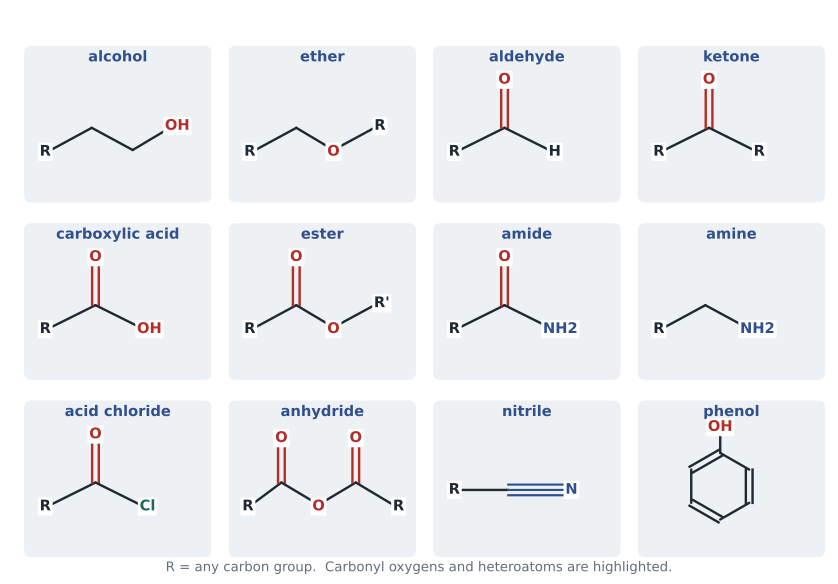
Several groups contain a carbonyl, a carbon double-bonded to oxygen. It helps to sort them by what is attached to the carbonyl carbon. If the attached atoms are carbon or hydrogen, the compound is an aldehyde (at least one H) or a ketone (two carbons). If one attached atom is a heteroatom that can leave, the compound is a carboxylic acid or one of its derivatives: an ester (OR), an amide (N), an anhydride (O-C=O) or an acid chloride (Cl). That distinction drives the two great families of carbonyl reactions in lessons 8 and 9: aldehydes and ketones undergo nucleophilic addition, while acids and derivatives undergo nucleophilic acyl substitution.
Amines and amides are a common source of confusion. An amine has nitrogen bonded only to carbon and hydrogen atoms. An amide has nitrogen bonded to a carbonyl carbon. The difference matters: amines are basic, because the nitrogen lone pair is available to accept a proton, while amides are essentially neutral, because the lone pair is delocalized into the carbonyl. Amines are also classified by how many carbons are on the nitrogen. A primary amine (RNH2) has one, a secondary (R2NH) has two, a tertiary (R3N) has three, and a quaternary ammonium ion (R4N+) has four and carries a permanent positive charge.
Alcohols and alkyl halides are classified differently, by the carbon that carries the group. In a primary alcohol the carbon bearing OH is bonded to one other carbon; in a secondary alcohol, to two; and in a tertiary alcohol, to three. This classification predicts reactivity. Primary alcohols oxidize to aldehydes and then acids, secondary alcohols oxidize to ketones, and tertiary alcohols resist oxidation (lesson 7). Primary alkyl halides favour SN2 reactions, tertiary halides favour SN1 and E1 (lesson 6).
IUPAC naming in five steps
The MCAT does not ask you to name complex natural products, but it expects you to translate between names and structures for simple compounds, and passages often use IUPAC names. The International Union of Pure and Applied Chemistry (IUPAC) system follows a fixed procedure.
First, find the principal functional group, the one with the highest priority. It sets the suffix of the name. A common priority order, highest first, is carboxylic acid, anhydride, ester, acid halide, amide, nitrile, aldehyde, ketone, alcohol, thiol, amine, then alkene and alkyne. Groups below the principal group are named as prefixes, such as hydroxy-, oxo- or amino-. Halogens and alkyl groups are always prefixes.
Second, find the parent chain: the longest carbon chain that contains the principal group (and, under current rules, as many multiple bonds as possible when there is a choice). The number of carbons sets the root: meth (1), eth (2), prop (3), but (4), pent (5), hex (6), hept (7), oct (8), non (9) and dec (10). If the principal group is on a ring, the ring is the parent and the prefix cyclo- is added.
Third, number the chain so that the principal group gets the lowest possible number. If that leaves a choice, give multiple bonds the lowest numbers, then substituents. For aldehydes and carboxylic acids the carbonyl carbon is always carbon 1, so its number is usually left out of the name.
Fourth, name and number the substituents and list them in alphabetical order, ignoring multiplying prefixes such as di-, tri- and tetra- (so "ethyl" comes before "dimethyl"). Fifth, assemble the name: substituent prefixes, the parent root, the unsaturation infix (-an-, -en-, -yn-) and the suffix, with locants (numbers) in front of the parts they describe.
Worked problem
Naming a hydroxy ketone
Name the compound CH3-CO-CH2-CH(OH)-CH3.
Show solution
- The ketone outranks the alcohol, so the suffix is -one and the OH becomes the prefix hydroxy-.
- The longest chain containing the carbonyl has five carbons: pentan-.
- Number from the end that gives the ketone the lower number. From the left, the C=O is carbon 2 and the OH is carbon 4; from the right, the C=O would be carbon 4. Number from the left.
- Assemble: 4-hydroxypentan-2-one.
Answer: 4-Hydroxypentan-2-one. In the older style, written as 4-hydroxy-2-pentanone; the MCAT accepts either format.
Esters have a two-part name. The alkyl group on the single-bonded oxygen is named first, as a separate word, and the acid part takes the ending -oate. CH3COOCH2CH3 comes from ethanoic acid and ethanol, so it is ethyl ethanoate, commonly called ethyl acetate. Amides with groups on nitrogen use the locant N, so CH3CONHCH3 is N-methylethanamide. These conventions show up in drug passages, where a name such as "methyl ester" or "N-acetyl" tells you exactly which atoms are present.
Common names still appear in passages and answer choices. Formaldehyde (methanal), acetaldehyde (ethanal), acetone (propanone), formic acid (methanoic acid), acetic acid (ethanoic acid), toluene (methylbenzene), aniline (aminobenzene) and phenol are the most frequent. The prefixes iso-, sec- and tert- describe branching: isopropyl is (CH3)2CH-, sec-butyl is CH3CH2CH(CH3)-, and tert-butyl is (CH3)3C-. The tert-butyl group is so bulky that it appears again and again in questions about steric hindrance.
On disubstituted benzene rings, older names use ortho- (adjacent, positions 1 and 2), meta- (positions 1 and 3) and para- (positions 1 and 4). Passages about drugs and natural products sometimes use these terms, and they matter for acidity and resonance questions about phenols in lesson 7.
How functional groups shape physical properties
Most MCAT questions about physical properties come down to intermolecular forces. All molecules have London dispersion forces, which grow with molecular size and surface area. Polar molecules add dipole-dipole forces. Molecules with an H bonded to N, O or F can form hydrogen bonds with each other, and any molecule with N or O can accept hydrogen bonds from water. Ionic groups, such as carboxylates and ammonium ions, interact with water through ion-dipole forces.
| Compound | Molar mass (g/mol) | Boiling point (degrees Celsius) | Strongest force between molecules |
|---|---|---|---|
| Butane | 58 | about -1 | Dispersion |
| Propanal | 58 | about 48 | Dipole-dipole |
| Acetone | 58 | about 56 | Dipole-dipole |
| 1-Propanol | 60 | about 97 | Hydrogen bonding |
| Acetic acid | 60 | about 118 | Hydrogen bonding (dimers) |
The table shows why functional group matters more than size when molar masses are similar. Butane and propanal have the same molar mass, yet propanal boils about 50 degrees higher because of its polar carbonyl. 1-Propanol boils higher again because its O-H hydrogen bonds to neighbours. Acetic acid is highest, because carboxylic acids form hydrogen-bonded pairs (dimers) that behave almost like a molecule of twice the mass. Among isomers, branching lowers the boiling point because a more compact molecule has less surface area for dispersion forces. Pentane boils at about 36 degrees, while its branched isomer 2,2-dimethylpropane (neopentane) boils near 10 degrees.
Solubility in water follows the same logic. Small alcohols, aldehydes, ketones, acids and amines dissolve in water because they can hydrogen bond with it, but solubility falls as the nonpolar carbon chain grows. A rough rule is that one polar group can carry about four or five carbons into water. Ionizing a group transforms its solubility: benzoic acid barely dissolves in neutral water, but sodium benzoate dissolves readily. Lesson 4 uses exactly this change to separate compounds by extraction.
Melting points also depend on how well molecules pack into a solid. Symmetrical molecules pack well and melt higher, while branched or bent molecules pack poorly. That is why cis fatty acids, with a bend at each double bond, melt lower than trans or saturated fatty acids of the same length, a point the Biochemistry Review course connected to oils and fats.
Passage practice: a drug with many groups
Thandiwe gave the group a short passage to read in three minutes. Data invented for this course.
A research team is developing compound P, an oral drug candidate. Its structure contains a benzene ring with a para hydroxyl group, an amide linking the ring nitrogen to an acetyl group, and a side chain ending in a methyl ester. The team measures the compound's water solubility at pH 7.4 (low) and finds that a metabolite formed in the liver, compound Q, is much more soluble and is excreted in urine. Mass spectrometry shows that Q has a molar mass 14 units lower than P.
Question 1. Which functional groups are present in compound P? (A) Phenol, amide and ester. (B) Alcohol, amine and ether. (C) Phenol, amine and carboxylic acid. (D) Ketone, amide and ether.
Question 2. A loss of 14 mass units (CH2) during metabolism is most consistent with which change? (A) Hydrolysis of the methyl ester to a carboxylic acid. (B) Oxidation of the phenol to a quinone. (C) Reduction of the amide to an amine. (D) Addition of water across the benzene ring.
Question 3. Why is compound Q more soluble than P in blood at pH 7.4? (A) Q has a larger nonpolar surface. (B) Q contains a carboxylic acid that is mostly ionized at pH 7.4. (C) Q has lost its hydrogen-bond donors. (D) Q has a lower molar mass, and solubility always increases with lower mass.
Question 4. Which group in P is the most basic? (A) The amide nitrogen. (B) The phenol oxygen. (C) The ester carbonyl oxygen. (D) None of these groups is significantly basic at pH 7.4.
Answers. 1: A (skill 1). The para OH on a benzene ring is a phenol, N-C=O is an amide and C(=O)OCH3 is an ester. 2: A (skill 2). Hydrolysis of RCOOCH3 to RCOOH replaces CH3 (15) with H (1), a loss of 14. 3: B (skill 2). A carboxylic acid with pKa near 4 to 5 is almost entirely carboxylate at pH 7.4, and ions dissolve in water. Choice D overgeneralizes. 4: D (skill 2). Amide nitrogen lone pairs are delocalized, phenols are weak acids, and ester oxygens are very weak bases; none is protonated at pH 7.4. Ezequiel had chosen A, the trap of treating any nitrogen as an amine. 'That is the ester-and-amide drug from my June test,' he said. 'I see it now.'
Common mistakes
MistakeAny nitrogen in a molecule makes it basic.
InsteadAmine nitrogens are basic; amide nitrogens are not, because their lone pair is delocalized into the carbonyl.
MistakePrimary, secondary and tertiary alcohols are classified by the number of OH groups.
InsteadThey are classified by the number of carbons attached to the carbon that bears the OH.
MistakeIn IUPAC names, di- and tri- count when alphabetizing substituents.
InsteadMultiplying prefixes are ignored: 3-ethyl-2,2-dimethylpentane lists ethyl before methyl.
MistakeA larger molecule always boils higher.
InsteadAt similar mass, hydrogen bonding and polarity dominate; among isomers, branching lowers the boiling point.
MistakeOxygen changes the degree of unsaturation.
InsteadOxygen and sulfur are ignored; only C, H, N and halogens enter the formula.
Summary and key terms
- Skeletal structures hide carbon and hydrogen on carbon; count bonds to four to find the hydrogens.
- The degree of unsaturation, (2C + 2 + N - H - X) / 2, counts rings plus pi bonds.
- Carbonyl compounds split into aldehydes and ketones (addition) and acids and derivatives (acyl substitution).
- IUPAC names are built from the principal group (suffix), the parent chain, lowest locants and alphabetical prefixes.
- Hydrogen bonding, polarity, size and branching explain most boiling point and solubility questions.
- Functional group
- An arrangement of atoms that gives a molecule characteristic reactions.
- Skeletal structure
- A drawing in which corners and line ends are carbons and hydrogens on carbon are implied.
- Degree of unsaturation
- The number of rings plus pi bonds in a molecule.
- Carbonyl group
- A carbon double-bonded to oxygen.
- Principal functional group
- The highest-priority group, which sets the suffix of an IUPAC name.
- Amide
- A carbonyl carbon bonded to nitrogen; neutral rather than basic.
- Hydrogen bond
- An attraction between an H bonded to N, O or F and a lone pair on another N, O or F.
Practice problems
Work each problem on paper first, then reveal the answer to check.
What is the degree of unsaturation of C6H6?
Show answer
(2 x 6 + 2 - 6) / 2 = 4: benzene has one ring and three pi bonds.
Name CH3CH2CH2COOH.
Show answer
Butanoic acid; the carboxyl carbon is C1, and the chain has four carbons.
Classify the alcohol (CH3)2CHOH.
Show answer
Secondary: the carbon bearing OH is bonded to two other carbons. Its name is propan-2-ol (isopropyl alcohol).
Which boils higher, diethyl ether or 1-butanol (both C4H10O)?
Show answer
1-Butanol, because its O-H can hydrogen bond with other alcohol molecules; ethers cannot donate hydrogen bonds.
What is the IUPAC name of CH3COOCH3?
Show answer
Methyl ethanoate (methyl acetate).
Lesson quiz · 5 questions
Score 60% or more to complete this lesson.
Create a free account to save your progress, take quizzes and earn a certificate.