
MCAT-122 · Lesson 4 of 12 · 24 min
Separations and purification
▶ Video coming soon A video version of this lesson is on the way.
Thandiwe started with a story from her lab-teaching years. 'Every term, someone poured away the wrong layer of a separatory funnel and lost their product down the drain. The MCAT loves that mistake, because avoiding it takes chemistry, not memory. You have to know which layer is on top, and where your compound went.' Elliot admitted he had always memorized "organic on top" without knowing why. 'Then you will learn when that rule fails,' she said.
This lesson covers the laboratory methods used to separate and purify organic compounds: liquid-liquid extraction (including acid-base extraction), filtration, recrystallization, distillation (simple, fractional and vacuum), and chromatography (thin-layer, column, gas, high-performance liquid, size-exclusion, ion-exchange and affinity). It closes with the resolution of racemic mixtures. On the AAMC outline these methods make up content category 5C, separation and purification methods: extraction (distribution of solute between two immiscible solvents), distillation, chromatography (basic principles, column, gas-liquid, high pressure liquid, paper, thin-layer, separation of proteins and peptides by electrophoresis and chromatography), and racemic mixtures and the separation of enantiomers. Passages that describe a synthesis almost always describe a workup, so these questions are common.
The principle behind every separation
Every separation exploits a difference in a physical or chemical property: polarity, acidity or basicity, boiling point, solubility at different temperatures, size, charge or specific binding. When you meet a separation question, first ask which property differs between the compounds. The method follows from the answer. Compounds that differ in acidity can be extracted; compounds with different boiling points can be distilled; compounds with different polarity can be separated by chromatography; and enantiomers, which differ in nothing measurable in an achiral setting, need a chiral partner.
Liquid-liquid extraction
Extraction moves a compound from one solvent to another that does not mix with it. The two immiscible phases are usually water (aqueous) and an organic solvent such as diethyl ether, ethyl acetate, hexane or dichloromethane. A solute distributes between the phases according to its relative solubility, described by the partition (distribution) coefficient K = [solute in organic] / [solute in aqueous]. Polar and ionic compounds favour the aqueous layer; nonpolar compounds favour the organic layer.
Which layer is on top depends on density, not on which solvent is "organic". Diethyl ether (density about 0.71 g/mL), ethyl acetate (about 0.90) and hexane (about 0.66) are less dense than water and form the top layer. Dichloromethane (about 1.33) and chloroform (about 1.49) are denser than water and form the bottom layer. Halogenated solvents sink. If a passage does not tell you, a quick test is to add a drop of water and see which layer it joins.
Several small extractions remove more solute than one large one with the same total volume. If K is 4, one extraction with 30 mL of solvent from 30 mL of water leaves one fifth of the solute behind (one part in water for every four in solvent). Three extractions with 10 mL each leave (3/7) cubed, about 8 percent, behind. The arithmetic matters less than the conclusion, which the MCAT tests directly: repeated extractions with smaller volumes are more efficient.
Acid-base extraction
The most powerful extraction trick turns neutral organic compounds into water-soluble ions. A carboxylic acid (pKa about 4 to 5) is deprotonated by a weak base such as aqueous sodium bicarbonate (the conjugate acid of bicarbonate, carbonic acid, has pKa about 6.4), becoming a carboxylate salt that moves into the water. A phenol (pKa about 10) is too weak an acid to react with bicarbonate but is deprotonated by a strong base such as sodium hydroxide. An amine (conjugate acid pKa about 9 to 11) is protonated by aqueous hydrochloric acid, becoming an ammonium salt that dissolves in water. Neutral compounds stay in the organic layer throughout.
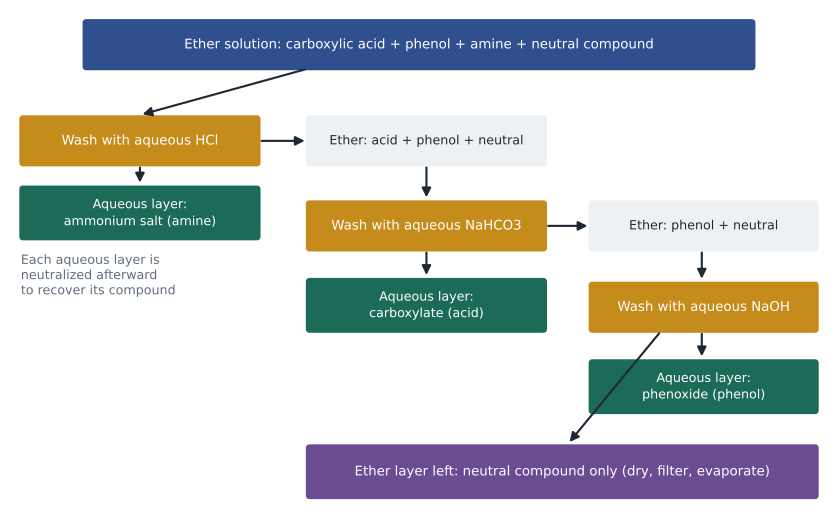
Order matters. Using sodium hydroxide first would deprotonate both the carboxylic acid and the phenol and pull them into the same aqueous layer. Using bicarbonate first removes only the stronger acid, then sodium hydroxide removes the phenol. To recover each compound, the aqueous layer is neutralized (acid added to the carboxylate or phenoxide, base added to the ammonium salt), which makes the compound neutral and insoluble in water again, so it can be extracted back into an organic solvent or filtered off as a solid.
Worked problem
Choosing the base
A student wants to separate benzoic acid (pKa 4.2) from 4-methylphenol (pKa 10.3), both dissolved in ether. Which aqueous wash separates them, and where does each compound end up?
Show solution
- A useful rule: an acid is mostly deprotonated when the pH is two or more units above its pKa.
- Saturated sodium bicarbonate solution has a pH of about 8.3.
- At pH 8.3, benzoic acid (pKa 4.2) is essentially fully deprotonated; 4-methylphenol (pKa 10.3) stays mostly protonated.
- Benzoate moves into water; the phenol stays in ether.
Answer: Wash with aqueous sodium bicarbonate. Benzoate goes to the aqueous layer and the phenol stays in the ether. Acidifying the aqueous layer then precipitates benzoic acid.
After extraction, the organic layer contains traces of dissolved water. A "brine" wash with saturated sodium chloride pulls out most of it, and a drying agent such as anhydrous magnesium sulfate or sodium sulfate removes the rest. The drying agent is then filtered off and the solvent is removed, usually with a rotary evaporator, which lowers the pressure so the solvent evaporates at a mild temperature.
Filtration and recrystallization
Filtration separates a solid from a liquid. Gravity filtration is used when the liquid is the product, for example to remove a drying agent or an insoluble impurity from a hot solution. Vacuum (suction) filtration with a Buchner funnel is faster and is used when the solid is the product, as when collecting crystals.
Recrystallization purifies a solid. The impure solid is dissolved in the minimum amount of a hot solvent in which the compound is very soluble when hot but poorly soluble when cold. As the solution cools slowly, the compound crystallizes in an ordered lattice that excludes most impurities, which remain dissolved in the cold solvent (the mother liquor). The ideal solvent dissolves the impurities well at all temperatures or not at all, does not react with the compound, and has a boiling point below the compound's melting point. Slow cooling gives larger, purer crystals; crashing a solid out quickly traps impurities.
Melting point is the standard check on purity. A pure crystalline compound melts sharply over a range of 1 or 2 degrees. Impurities disrupt the lattice, so an impure sample melts lower and over a broader range. This is melting point depression, the solid-state cousin of the colligative properties covered in the General Chemistry Review. A mixed melting point test adds a known pure sample: if the mixture melts sharply at the same temperature, the unknown is the same compound.
Distillation
Distillation separates liquids by boiling point. As a mixture is heated, the vapour is enriched in the more volatile component (the one with the higher vapour pressure and lower boiling point); condensing that vapour collects a liquid richer in that component. Simple distillation works when boiling points differ by more than about 25 degrees Celsius, or when separating a volatile liquid from a nonvolatile solid.
Fractional distillation separates liquids with closer boiling points. A fractionating column packed with glass beads or metal provides many surfaces where the vapour condenses and re-vaporizes. Each cycle (a theoretical plate) enriches the vapour further in the more volatile component, so the liquid that reaches the top is much purer than one round of simple distillation would give. Vacuum distillation lowers the pressure above the liquid, which lowers its boiling point. It is used for compounds that boil above about 150 degrees Celsius or that would decompose at their normal boiling point.
| Method | When to use it | Property exploited |
|---|---|---|
| Simple distillation | Boiling points differ by more than about 25 degrees; liquid from nonvolatile solid | Boiling point |
| Fractional distillation | Boiling points closer than about 25 degrees | Boiling point, with many vaporization cycles |
| Vacuum distillation | High-boiling or heat-sensitive compounds | Lower boiling point at reduced pressure |
| Recrystallization | Purifying a solid | Solubility that changes with temperature |
| Extraction | Separating by polarity or acidity | Partition between immiscible phases |
Some mixtures cannot be separated completely by distillation because they form an azeotrope, a mixture that boils at a constant composition. Ethanol and water form an azeotrope near 95 percent ethanol, which is why distillation alone cannot produce pure ethanol from fermented mixtures.
Chromatography: the general idea
All chromatography distributes compounds between a stationary phase, which stays in place, and a mobile phase, which moves past it. Compounds that interact more strongly with the stationary phase move more slowly; those that prefer the mobile phase move faster. The separation depends on the choice of both phases.
In normal-phase chromatography the stationary phase is polar, usually silica gel (SiO2, covered with Si-OH groups) or alumina, and the mobile phase is less polar. Polar compounds stick to the silica and move slowly; nonpolar compounds move quickly. In reverse-phase chromatography the stationary phase is nonpolar (silica coated with long hydrocarbon chains, such as C18) and the mobile phase is polar (water mixed with methanol or acetonitrile). The order reverses: polar compounds come off first.
Thin-layer and column chromatography
Thin-layer chromatography (TLC) uses a glass or plastic plate coated with silica. A tiny spot of the sample is placed near the bottom, the plate is stood in a shallow pool of solvent (the eluent), and the solvent climbs the plate by capillary action. When the solvent front nears the top, the plate is removed and the spots are made visible, often under ultraviolet light or by staining. Each compound is described by its retardation factor, Rf = distance travelled by the compound / distance travelled by the solvent front. Rf always lies between 0 and 1.
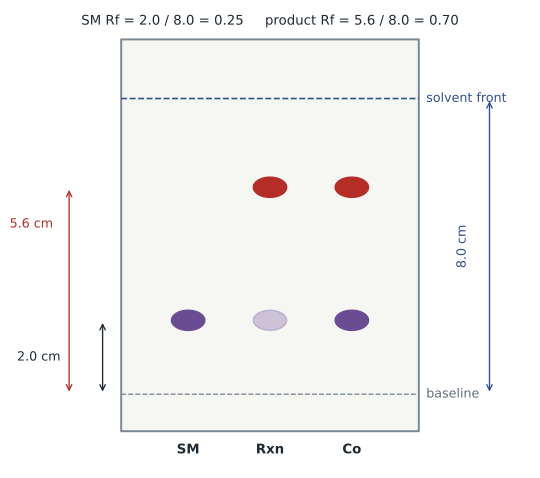
On silica, a more polar compound has a lower Rf. Increasing the polarity of the eluent raises every Rf, because the solvent competes better for the silica and carries compounds further. TLC is fast and uses tiny amounts, so it is used to monitor reactions (is the starting material gone?), to check purity (one spot or several?) and to choose a solvent system for column chromatography. In the plate shown, the product travels further than the starting material, so it is less polar, which would fit a reaction such as converting an alcohol to an ether or ester.
Column chromatography works on the same principle at a larger scale. A vertical tube is packed with silica, the mixture is loaded at the top, and solvent is run through. Compounds come off the bottom (elute) in order of increasing polarity on normal-phase silica, and are collected in a series of fractions that are checked by TLC. Paper chromatography is an older relative in which the stationary phase is water held in the cellulose fibres of paper.
Gas chromatography and HPLC
Gas chromatography (GC) vaporizes the sample and carries it through a long, thin column with an inert gas such as helium. Compounds separate mainly by boiling point and by interaction with a liquid film on the column wall; more volatile compounds come out first. The time a compound takes to pass through is its retention time. GC works only for compounds that vaporize without decomposing, and it is often paired with mass spectrometry (GC-MS) to identify each peak.
High-performance (high-pressure) liquid chromatography (HPLC) pushes a liquid mobile phase through a tightly packed column at high pressure. It separates compounds that are not volatile, including drugs, peptides and metabolites, and reverse-phase HPLC is the workhorse of pharmaceutical analysis. A detector, often measuring UV absorbance, records each compound's retention time and peak area, which is proportional to the amount present.
Separating biomolecules
Proteins and other large biomolecules need gentler methods. The Biochemistry Review course covered these in detail; here is the organic chemist's summary. Size-exclusion (gel filtration) chromatography uses porous beads: small molecules enter the pores and take a longer path, while large molecules are excluded and elute first. Ion-exchange chromatography uses a charged resin. A cation-exchange resin (negatively charged) binds positively charged proteins, which are released by raising the salt concentration or changing pH. An anion-exchange resin does the reverse. Affinity chromatography attaches a specific binding partner, such as an antibody, a substrate analogue or nickel ions for a histidine tag, to the beads, so only the target protein binds. Electrophoresis separates molecules by moving them through a gel in an electric field, by size (SDS-PAGE) or by isoelectric point (isoelectric focusing).
Resolving racemic mixtures
Enantiomers cannot be separated by distillation, recrystallization or ordinary chromatography, because they have identical physical properties (lesson 3). The classic solution is to react the racemic mixture with a single enantiomer of a chiral resolving agent. A racemic carboxylic acid, for example, reacts with a pure chiral amine such as (S)-1-phenylethylamine to form two salts: (R)-acid with (S)-amine, and (S)-acid with (S)-amine. These salts are diastereomers, so they have different solubilities and can be separated by recrystallization. Each salt is then treated with strong acid to release the pure enantiomer of the original acid.
Modern laboratories also use chiral chromatography, in which the stationary phase is itself chiral and interacts slightly differently with each enantiomer, and enzymatic resolution, in which an enzyme reacts selectively with one enantiomer. Enzymes are chiral catalysts, so they often distinguish enantiomers very well.
Passage practice: a workup that went wrong
Data invented for this course. A student oxidized 1-octanol to octanoic acid and needed to remove unreacted alcohol. She dissolved the crude product in dichloromethane and extracted it with aqueous sodium bicarbonate. Gas evolved during shaking. She then drained the lower layer into a flask labelled "organic" and kept the upper layer. After acidifying the layer labelled "organic", nothing precipitated. A TLC plate of the upper layer's contents after acidification and extraction showed one spot with Rf 0.15 in 30 percent ethyl acetate in hexane, while 1-octanol showed Rf 0.45 on the same plate.
Question 1. What gas was released during the bicarbonate wash? (A) Hydrogen. (B) Oxygen. (C) Carbon dioxide. (D) Methane.
Question 2. Which layer contained the carboxylate? (A) The lower layer, because dichloromethane is denser than water. (B) The upper layer, because the aqueous layer is less dense than dichloromethane. (C) The lower layer, because ionic compounds sink. (D) Both layers equally.
Question 3. What explains why acidifying the "organic" flask gave no precipitate? (A) The carboxylate was in the other layer; the flask held dichloromethane and 1-octanol. (B) Octanoic acid is a gas. (C) Bicarbonate reduced the acid to an alcohol. (D) The acid had polymerized.
Question 4. The TLC data show that octanoic acid: (A) is less polar than 1-octanol. (B) is more polar than 1-octanol. (C) has the same polarity as 1-octanol. (D) did not move on the plate.
Answers. 1: C (skill 1). Bicarbonate reacts with the acid to form carbonic acid, which decomposes into water and carbon dioxide. 2: B (skill 2). Dichloromethane is the bottom layer, so the aqueous layer with the carboxylate was on top. 3: A (skill 3). She mislabelled the layers, the classic error Thandiwe described. 4: B (skill 4). Its lower Rf on silica means it interacts more strongly with the polar stationary phase. Elliot laughed. '"Organic on top" would have saved me with ether and drowned me with dichloromethane.'
Common mistakes
MistakeThe organic layer is always on top.
InsteadThe less dense layer is on top; dichloromethane and chloroform are denser than water and sink.
MistakeSodium hydroxide is the best first wash for separating a carboxylic acid from a phenol.
InsteadNaOH deprotonates both; use bicarbonate first to remove only the carboxylic acid.
MistakeA higher Rf on silica means a more polar compound.
InsteadOn polar silica, more polar compounds stick and have lower Rf.
MistakeEnantiomers can be separated by recrystallization.
InsteadConvert them to diastereomers with a chiral resolving agent first, or use a chiral stationary phase.
MistakeIn size-exclusion chromatography small molecules elute first.
InsteadLarge molecules are excluded from the pores and elute first.
Summary and key terms
- Every separation exploits a property difference: polarity, acidity, boiling point, solubility, size, charge or binding.
- Acid-base extraction ionizes acids with bicarbonate or hydroxide and amines with acid to move them into water.
- Layer position depends on density; halogenated solvents form the lower layer.
- Recrystallization relies on high solubility when hot and low solubility when cold; impurities broaden and lower the melting point.
- Simple, fractional and vacuum distillation suit different boiling-point gaps and compound stabilities.
- On silica, polar compounds have low Rf; reverse-phase reverses the order. Racemates are resolved by making diastereomers.
- Partition coefficient
- The ratio of a solute's concentration in the organic phase to that in the aqueous phase.
- Acid-base extraction
- Separating compounds by converting acids or bases into water-soluble salts.
- Recrystallization
- Purifying a solid by dissolving it hot and letting it crystallize as the solution cools.
- Fractional distillation
- Distillation through a column that provides many vaporization-condensation cycles.
- Retardation factor (Rf)
- Distance travelled by a spot divided by distance travelled by the solvent front.
- Stationary phase
- The phase that stays in place in chromatography, such as silica.
- Resolution
- Separation of a racemic mixture into its enantiomers.
Practice problems
Work each problem on paper first, then reveal the answer to check.
A compound travels 3.0 cm while the solvent front travels 7.5 cm. What is its Rf?
Show answer
0.40.
Which wash removes an amine from an ether solution?
Show answer
Dilute aqueous HCl, which protonates the amine to a water-soluble ammonium salt.
Two liquids boil at 98 and 110 degrees Celsius. Which distillation should be used?
Show answer
Fractional distillation, because the boiling points differ by less than about 25 degrees.
In reverse-phase HPLC, which elutes first: glucose or a long-chain fatty acid ester?
Show answer
Glucose, because it is polar and the stationary phase is nonpolar.
Why does a sample with a melting range of 118 to 124 degrees suggest impurity?
Show answer
A pure solid melts sharply over 1 or 2 degrees; a broad, depressed range signals impurities.
Lesson quiz · 5 questions
Score 60% or more to complete this lesson.
Create a free account to save your progress, take quizzes and earn a certificate.