
MCAT-122 · Lesson 6 of 12 · 24 min
Key reactions: nucleophilic substitution and elimination
▶ Video coming soon A video version of this lesson is on the way.
Elliot came in confident. 'SN1, SN2, E1, E2. I have a flowchart.' Thandiwe asked him to explain why tertiary halides cannot do SN2. He paused. 'Because the flowchart says so?' 'Your flowchart is fine,' she said, 'but the MCAT will hand you a substrate your flowchart never saw. Learn the two or three physical reasons behind each branch, and you can build the flowchart yourself on test day.'
This lesson covers the four classic reactions of alkyl halides and related substrates: bimolecular and unimolecular nucleophilic substitution (SN2 and SN1) and bimolecular and unimolecular elimination (E2 and E1). It explains nucleophiles, electrophiles and leaving groups, the kinetics and stereochemistry of each pathway, carbocation stability and rearrangements, solvent effects, Zaitsev and Hofmann products, and how to predict which reaction wins. The AAMC outline lists SN1 and SN2 substitution under alcohols in content category 5D, and the principles of kinetics, mechanisms and energy diagrams in category 5E. Substitution is also the basis of many biological reactions, from methylation by S-adenosylmethionine to the alkylation of DNA by mutagens.
Nucleophiles, electrophiles and leaving groups
A nucleophile ("nucleus lover") is an electron-rich species that donates an electron pair to form a new bond. Nucleophiles are Lewis bases: anions such as hydroxide, alkoxides, cyanide, iodide and thiolates, and neutral molecules with lone pairs such as water, alcohols and amines. An electrophile ("electron lover") is an electron-poor species that accepts the pair. In substitution reactions the electrophile is usually a carbon bonded to an electronegative leaving group, which gives it a partial positive charge.
Nucleophilicity is a kinetic property: how fast a species attacks carbon. Basicity is a thermodynamic property: how strongly it holds a proton at equilibrium. They usually run together, but not always. Several trends are reliable. A negative charge makes a species more nucleophilic than its neutral form (hydroxide beats water). Along a row of the periodic table, nucleophilicity follows basicity (NH2- > HO- > F-). Down a column in protic solvents, nucleophilicity increases even as basicity decreases (I- > Br- > Cl- > F-), because larger, more polarizable ions are less tightly surrounded by solvent and their electron clouds distort easily toward the carbon. Bulky bases such as tert-butoxide are strong bases but poor nucleophiles, because they cannot reach a crowded carbon.
A good leaving group is a weak base, because weak bases are stable on their own after they leave with the bonding electrons. The conjugate bases of strong acids are excellent leaving groups: iodide, bromide, chloride, and sulfonates such as tosylate and mesylate. Fluoride is a poor leaving group. Hydroxide and alkoxides are very poor leaving groups, which is why alcohols do not react with nucleophiles directly. To use an alcohol in a substitution reaction, the OH must first be converted to a better leaving group, either by protonating it with strong acid (water then leaves) or by converting it to a tosylate or mesylate (lesson 7).
| Leaving group | Conjugate acid | Approximate pKa of conjugate acid | Quality |
|---|---|---|---|
| I- | HI | about -10 | Excellent |
| Br- | HBr | about -9 | Excellent |
| Cl- | HCl | about -7 | Good |
| Tosylate (TsO-) | p-Toluenesulfonic acid | about -2 | Excellent (very weak base) |
| H2O (from protonated alcohol) | H3O+ | about -1.7 | Good |
| F- | HF | about 3.2 | Poor |
| HO- | H2O | about 15.7 | Very poor |
| H2N- | NH3 | about 38 | Essentially never leaves |
The SN2 reaction
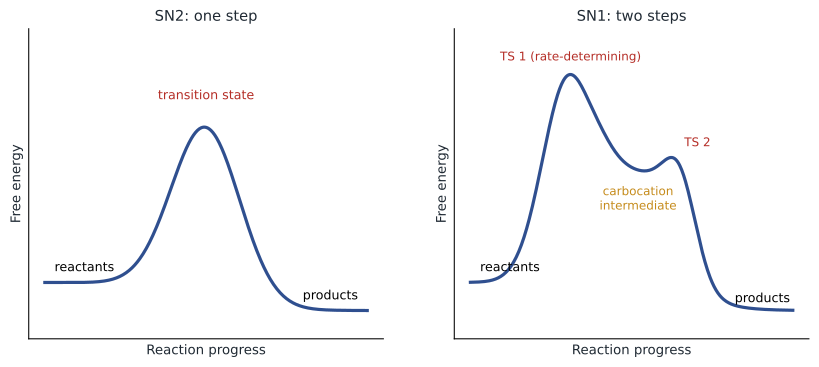
In an SN2 reaction (substitution, nucleophilic, bimolecular), the nucleophile attacks the carbon from the side opposite the leaving group (backside attack) while the leaving group departs, in one concerted step. The transition state has five groups partly bonded to the carbon in a trigonal bipyramidal arrangement. Because both the substrate and the nucleophile are in the rate-determining step, the rate law is second order: rate = k[substrate][nucleophile]. Doubling either concentration doubles the rate.
Backside attack produces inversion of configuration, like an umbrella turning inside out in the wind (the Walden inversion). If the carbon is a stereocentre, an (R) substrate gives the product with the opposite geometry. The label usually changes from R to S, but not always, because R and S depend on priorities. If the nucleophile has a different priority rank than the leaving group did, the label may stay the same even though the geometry inverted. Always draw the product.
SN2 is very sensitive to steric hindrance, because the nucleophile must reach the back of the carbon. Methyl and primary substrates react fastest, secondary substrates slowly, and tertiary substrates essentially not at all. Even branching on the next carbon slows the reaction: neopentyl bromide, (CH3)3CCH2Br, is primary but reacts very slowly. SN2 is also favoured by strong nucleophiles and by polar aprotic solvents such as acetone, dimethyl sulfoxide (DMSO), dimethylformamide (DMF) and acetonitrile. These solvents dissolve ionic nucleophiles but cannot hydrogen bond to them, so the anion is left "naked" and reactive.
The SN1 reaction
An SN1 reaction (substitution, nucleophilic, unimolecular) takes place in two steps. First, the leaving group departs on its own, forming a carbocation. This is the slow, rate-determining step. Second, the nucleophile attacks the carbocation quickly. Because only the substrate is in the rate-determining step, the rate law is first order: rate = k[substrate]. The concentration and strength of the nucleophile do not affect the rate.
The carbocation is sp2 and planar, so the nucleophile can attack from either face. If the carbon was a stereocentre, the product is a mixture of both configurations, close to racemic. In practice there is often a small excess of inversion, because the departing leaving group briefly shields one face, but the MCAT expects the answer "racemization".
SN1 rates depend on carbocation stability. Tertiary carbocations are more stable than secondary, which are more stable than primary; methyl and primary cations are too unstable to form in solution. Alkyl groups stabilize the positive charge by donating electron density through sigma bonds (an inductive effect) and through hyperconjugation, the overlap of neighbouring C-H and C-C bonds with the empty p orbital. Resonance stabilizes allylic and benzylic carbocations, so even primary allylic or benzylic substrates can react by SN1. Polar protic solvents such as water, alcohols and carboxylic acids favour SN1, because they stabilize both the carbocation and the leaving anion by solvation. When the solvent itself is the nucleophile, the reaction is called solvolysis.
Carbocation rearrangements
Carbocations rearrange whenever a nearby shift would make them more stable. In a 1,2-hydride shift, a hydrogen with its bonding electrons moves from an adjacent carbon to the cationic carbon; in a 1,2-methyl (alkyl) shift, a methyl group moves instead. Both convert a less stable cation into a more stable one, typically secondary to tertiary. Rearrangements are a signature of reactions that pass through carbocations (SN1 and E1) and never occur in SN2 or E2. If a passage reports a product whose carbon skeleton has changed, a carbocation was involved.
Worked problem
Spotting a rearrangement
3-Methyl-2-butanol is heated with concentrated HBr. The main product is 2-bromo-2-methylbutane, not 2-bromo-3-methylbutane. Explain.
Show solution
- Strong acid protonates the OH, and water leaves from C2, giving a secondary carbocation.
- The adjacent carbon, C3, is tertiary and carries one hydrogen.
- A 1,2-hydride shift moves that hydrogen to C2, placing the positive charge on C3, which is now a tertiary cation.
- Bromide attacks the more stable tertiary cation.
Answer: The reaction is SN1 with a hydride shift, so bromide ends up on the tertiary carbon. With the numbering of the product, that carbon is C2 of 2-bromo-2-methylbutane.
Elimination: E2 and E1
Elimination reactions remove atoms from adjacent carbons to form a double bond. Usually a base removes a hydrogen from the beta carbon (the carbon next to the one bearing the leaving group), and the leaving group departs from the alpha carbon. Elimination competes with substitution, because a nucleophile can also act as a base.
An E2 reaction (elimination, bimolecular) happens in one concerted step: the base removes a beta hydrogen as the C=C forms and the leaving group leaves. The rate law is rate = k[substrate][base]. E2 needs a strong base, and it has a stereochemical requirement: the beta hydrogen and the leaving group must be anti-periplanar, lying in the same plane on opposite sides of the C-C bond. In cyclohexane rings this means both must be axial. E2 works for primary, secondary and tertiary substrates, and tertiary substrates eliminate especially readily because they cannot do SN2.
An E1 reaction (elimination, unimolecular) shares its first step with SN1. The leaving group departs to form a carbocation, then a weak base (often the solvent) removes a beta hydrogen. The rate law is rate = k[substrate]. E1 competes with SN1 under the same conditions: tertiary or stabilized substrates, polar protic solvents and weak nucleophiles or bases. Heat favours elimination over substitution, because elimination produces more molecules and therefore increases entropy; at higher temperature the entropy term in delta G = delta H - T delta S becomes more important. Dehydration of alcohols with hot concentrated sulfuric or phosphoric acid is the classic E1 reaction.
Which alkene forms?
When more than one beta carbon carries hydrogens, elimination can give different alkenes. Zaitsev's rule says the more substituted alkene, the one with more alkyl groups on the double-bond carbons, is usually the major product, because more substituted alkenes are more stable. E1 reactions and E2 reactions with small strong bases such as ethoxide or hydroxide give the Zaitsev product. With a bulky base such as potassium tert-butoxide, the base removes the most accessible hydrogen, often on a CH3 group, and the less substituted Hofmann product becomes major. Trans alkenes, which avoid steric strain between groups, are generally favoured over cis alkenes.
Predicting the winner
Four factors decide which reaction a substrate undergoes: the substrate structure, the nucleophile or base, the solvent and the temperature. A short set of rules handles most MCAT questions.
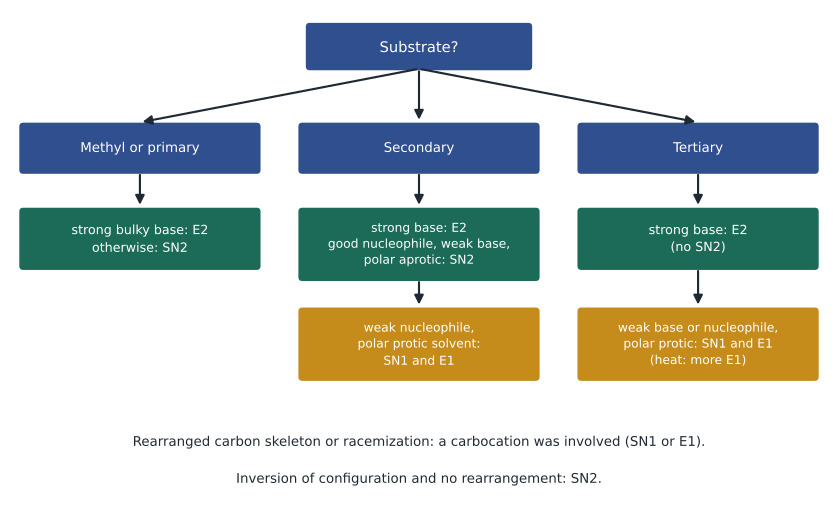
| Feature | SN2 | SN1 | E2 | E1 |
|---|---|---|---|---|
| Steps | One, concerted | Two, carbocation | One, concerted | Two, carbocation |
| Rate law | k[RX][Nu] | k[RX] | k[RX][base] | k[RX] |
| Best substrate | Methyl, primary | Tertiary, allylic, benzylic | Tertiary, secondary (any with beta H) | Tertiary |
| Nucleophile or base | Strong nucleophile | Weak nucleophile | Strong base | Weak base |
| Solvent | Polar aprotic | Polar protic | Varied | Polar protic |
| Stereochemistry | Inversion | Racemization | Anti-periplanar H and leaving group | Mixture; Zaitsev |
| Rearrangements | No | Possible | No | Possible |
Worked problem
Predicting products
Predict the main pathway and product for each: (a) 1-bromobutane with sodium cyanide in DMSO; (b) 2-bromo-2-methylpropane in ethanol at room temperature; (c) 2-bromo-2-methylbutane with sodium ethoxide in ethanol, heated; (d) 2-bromo-2-methylbutane with potassium tert-butoxide.
Show solution
- (a) Primary substrate, strong nucleophile, polar aprotic solvent: SN2. Product: pentanenitrile, CH3CH2CH2CH2CN.
- (b) Tertiary substrate, weak nucleophile, polar protic solvent: SN1 solvolysis (with some E1). Product: 2-ethoxy-2-methylpropane (tert-butyl ethyl ether).
- (c) Tertiary substrate, strong small base, heat: E2, Zaitsev. Product: 2-methyl-2-butene.
- (d) Tertiary substrate, strong bulky base: E2, Hofmann. Product: 2-methyl-1-butene.
Answer: (a) SN2 nitrile; (b) SN1 ether; (c) E2 to 2-methyl-2-butene; (d) E2 to 2-methyl-1-butene.
Substitution in biology
Nature uses substitution reactions constantly, with phosphates and sulfonium ions as leaving groups instead of halides. S-Adenosylmethionine (SAM) carries a methyl group on a positively charged sulfur. Methyltransferase enzymes position a nucleophile, such as a DNA cytosine or the nitrogen of a neurotransmitter precursor, for SN2 attack on that methyl group, and the neutral sulfur of S-adenosylhomocysteine leaves. This is how cells methylate DNA (the epigenetics covered in the Cell and Molecular Biology Review) and how norepinephrine is converted to epinephrine. Many chemotherapy drugs and environmental mutagens are alkylating agents that attack DNA bases in the same way.
Passage practice: a solvolysis study
Data invented for this course. Researchers measured the rate of reaction of three alkyl bromides in 80 percent aqueous ethanol at 25 degrees Celsius. Relative rates were: 2-bromo-2-methylpropane, 1,000,000; 2-bromopropane, 12; bromoethane, 1. Doubling the concentration of added hydroxide had no effect on the rate for 2-bromo-2-methylpropane. In a second experiment, (S)-3-bromo-3-methylhexane gave a nearly racemic alcohol product. In a third experiment, 3-bromo-2,2-dimethylbutane gave mainly 2,3-dimethyl-2-butanol and 2,3-dimethyl-2-butene.
Question 1. The rate data for 2-bromo-2-methylpropane are best explained by: (A) an SN2 mechanism. (B) a rate-determining ionization to a tertiary carbocation. (C) steric hindrance that slows nucleophilic attack. (D) a reaction that is second order overall.
Question 2. Why does the reaction of the (S) bromide give a nearly racemic product? (A) The nucleophile attacks from the back side only. (B) The planar carbocation can be attacked from either face. (C) The bromide is not chiral. (D) The product rapidly inverts at the stereocentre.
Question 3. The products of the third experiment show that: (A) the reaction went by SN2. (B) a methyl group shifted to form a tertiary carbocation. (C) bromide is a poor leaving group. (D) no carbocation formed.
Question 4. Which change would most increase the proportion of alkene in these reactions? (A) Lowering the temperature. (B) Heating the reaction. (C) Adding sodium iodide. (D) Using a polar aprotic solvent.
Answers. 1: B (skill 2). Zero-order dependence on hydroxide and a huge tertiary rate are signatures of SN1. 2: B (skill 1). 3: B (skill 2). The secondary cation at C3 gains stability when a methyl from C2 shifts, leaving a tertiary cation at C2; the alcohol and alkene both have the rearranged skeleton. 4: B (skill 2). Heat favours elimination because it increases entropy. Elliot got question 3 wrong, picking D. 'My flowchart has no box for "the skeleton changed",' he said. He added one.
Common mistakes
MistakeSN2 reactions always change R to S.
InsteadSN2 always inverts geometry; whether the label changes depends on the priorities of the nucleophile and leaving group.
MistakeA stronger nucleophile speeds up an SN1 reaction.
InsteadThe nucleophile is not in the rate-determining step of SN1, so it does not affect the rate.
MistakeHydroxide is a good leaving group.
InsteadHydroxide is a strong base and leaves poorly; protonate the alcohol or convert it to a tosylate first.
MistakePolar protic solvents favour SN2.
InsteadThey solvate and slow anionic nucleophiles; SN2 prefers polar aprotic solvents.
MistakeBulky bases give the most substituted alkene.
InsteadBulky bases remove the most accessible hydrogen and favour the Hofmann (less substituted) alkene.
Summary and key terms
- Good leaving groups are weak bases: I-, Br-, Cl-, tosylate, water from protonated alcohols.
- SN2: one step, second order, backside attack with inversion, best for methyl and primary, polar aprotic solvents.
- SN1: two steps through a carbocation, first order, racemization, best for tertiary and stabilized cations, polar protic solvents.
- Carbocations rearrange by hydride or alkyl shifts to more stable cations; rearrangement signals SN1 or E1.
- E2 needs a strong base and anti-periplanar geometry; E1 follows the carbocation path and is favoured by heat.
- Small bases give Zaitsev alkenes; bulky bases give Hofmann alkenes.
- Nucleophile
- An electron-pair donor that attacks an electron-poor atom.
- Leaving group
- The group that departs with the bonding electrons; best when it is a weak base.
- Backside attack
- Approach of the nucleophile opposite the leaving group in SN2, causing inversion.
- Carbocation
- A positively charged, sp2 carbon intermediate.
- Hyperconjugation
- Stabilization of a carbocation by overlap of neighbouring sigma bonds with its empty p orbital.
- Zaitsev product
- The more substituted, usually more stable, alkene.
- Polar aprotic solvent
- A polar solvent without O-H or N-H bonds, such as DMSO or acetone.
Practice problems
Work each problem on paper first, then reveal the answer to check.
Write the rate law for the reaction of methyl iodide with hydroxide.
Show answer
Rate = k[CH3I][OH-]; it is SN2.
Which reacts faster by SN2, 1-chlorobutane or 1-iodobutane?
Show answer
1-Iodobutane, because iodide is a better leaving group.
Why does tert-butyl bromide not undergo SN2?
Show answer
Three methyl groups block backside attack on the carbon.
What is the major product of heating 2-methyl-2-butanol with concentrated sulfuric acid?
Show answer
2-Methyl-2-butene, by E1 dehydration with Zaitsev selectivity.
Which solvent favours SN1: water or acetone?
Show answer
Water, a polar protic solvent that stabilizes the carbocation and leaving group.
Lesson quiz · 5 questions
Score 60% or more to complete this lesson.
Create a free account to save your progress, take quizzes and earn a certificate.