
MCAT-121 · Lesson 8 of 12 · 24 min
Light and optics: reflection, refraction, lenses and wave optics
▶ Video coming soon A video version of this lesson is on the way.
Elliot arrived at the optics session wearing his glasses for once, and Thandiwe used them as the first example. 'Are those converging or diverging lenses?' she asked. He did not know. She had him hold them over the text on his screen: the letters looked smaller, so the lenses were diverging, which meant he was nearsighted. By the end of the session the group could explain why diverging lenses fix nearsightedness, why a straw looks bent in a glass of water, why the sky is blue, and how an optical fibre carries light around corners inside an endoscope.
This lesson covers the light and optics parts of content category 4D: the electromagnetic spectrum, photon energy and colour, reflection and refraction (Snell's law), dispersion, total internal reflection, mirrors, thin lenses, combinations of lenses, the eye and optical instruments, and the wave behaviour of light: interference, diffraction, thin films and polarization. Absorption spectra in spectroscopy (infrared, ultraviolet-visible and NMR) belong to organic chemistry and are reviewed in MCAT-122.
The electromagnetic spectrum
Light is an electromagnetic wave: oscillating electric and magnetic fields, perpendicular to each other and to the direction of travel, that sustain each other and travel through a vacuum at c, about 3.0 times 10 to the 8th metres per second. Like any wave, it obeys v equals f λ, so in a vacuum c equals f λ. The electromagnetic spectrum, ordered from long wavelength to short, runs from radio waves through microwaves, infrared, visible light, ultraviolet and X-rays to gamma rays. Frequency rises in the same order.
| Region | Approximate wavelength | Typical medical or biological setting |
|---|---|---|
| Radio | longer than about 1 m | MRI signals |
| Microwave | about 1 mm to 1 m | heating water molecules |
| Infrared | about 700 nm to 1 mm | thermal imaging, IR spectroscopy |
| Visible | about 400 to 700 nm | vision, photosynthesis, pulse oximetry (red and near-infrared) |
| Ultraviolet | about 10 to 400 nm | sunburn, thymine dimers, vitamin D synthesis |
| X-ray | about 0.01 to 10 nm | radiography, CT, X-ray crystallography |
| Gamma | shorter than about 0.01 nm | nuclear medicine, radiotherapy |
Within the visible range, violet light has the shortest wavelengths (around 400 nanometres) and red the longest (around 700). A useful memory aid lists the colours from long to short wavelength: red, orange, yellow, green, blue, violet. Light also behaves as a stream of particles called photons, each with energy E equals h f, where h is Planck's constant, about 6.6 times 10 to the minus 34th joule-seconds. Shorter wavelengths therefore mean more energetic photons: ultraviolet photons carry enough energy to break chemical bonds and damage DNA, while infrared photons mostly just make molecules vibrate. Lesson 9 develops the photon picture.
The colour of an object depends on which wavelengths it reflects or transmits. A leaf looks green because chlorophyll absorbs strongly in the red and blue and reflects green. A solution that absorbs blue light looks orange, the complementary colour. A passage that shows an absorption spectrum may ask which colour a substance appears; the answer is the complement of the colour absorbed.
Reflection
When light strikes a smooth surface, it reflects so that the angle of reflection equals the angle of incidence, both measured from the normal, the line perpendicular to the surface. Smooth surfaces give specular, mirror-like reflection; rough surfaces scatter light in many directions, which is diffuse reflection and is how we see most objects.
A plane mirror forms a virtual image, upright, the same size as the object, and as far behind the mirror as the object is in front of it. "Virtual" means that the light rays only appear to come from the image; they do not actually pass through it, so the image cannot be projected onto a screen. A real image, in contrast, is formed where light rays actually converge, and it can be projected.
Curved mirrors focus light. A concave (converging) mirror, curved inward like the inside of a spoon, brings parallel rays to a focal point in front of it; its focal length f is half its radius of curvature. A convex (diverging) mirror, curved outward, spreads parallel rays as if they came from a focal point behind it. Convex mirrors always give small, upright, virtual images and a wide field of view, which is why they are used as shop security mirrors and car side mirrors. Dentists use concave mirrors to give an enlarged view of a tooth.
Refraction and Snell's law
Light travels more slowly in a material than in a vacuum. The index of refraction n of a material is c divided by the speed of light in it, so n is always at least 1: about 1.00 for air, 1.33 for water, about 1.38 for the cornea and around 1.5 for glass. When light crosses at an angle from one medium into another, its change of speed bends its path. This is refraction, and Snell's law describes it: n1 sin θ1 equals n2 sin θ2, with angles measured from the normal.
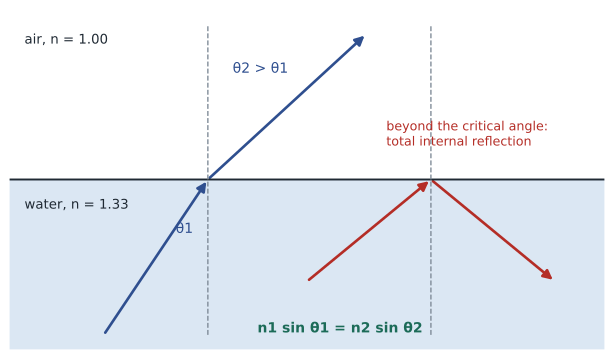
Light entering a medium with a higher index slows down and bends toward the normal; light entering a lower-index medium speeds up and bends away from the normal. Light that strikes a boundary along the normal (at 0 degrees) passes straight through without bending, though it still changes speed. As with sound, the frequency of light does not change when it enters a new medium, so its wavelength in the medium is its vacuum wavelength divided by n. Refraction explains why a straw appears bent in water and why a pool looks shallower than it is: light from the bottom bends away from the normal as it leaves the water, so it seems to come from a higher point.
Total internal reflection
When light travels from a higher-index medium toward a lower-index one, the refracted ray bends away from the normal. As the angle of incidence grows, the refracted ray approaches the boundary. At the critical angle, the refracted ray would travel along the boundary (θ2 equals 90 degrees). Beyond it, no light is transmitted and all of it reflects back into the first medium. The critical angle satisfies sin θc equals n2 over n1, which only has a solution when n1 is greater than n2. For water into air, sin θc is 1/1.33, about 0.75, giving a critical angle of about 49 degrees.
Optical fibres use total internal reflection. A glass core is surrounded by cladding with a slightly lower index, so light entering the core at a shallow angle keeps reflecting off the boundary and travels along the fibre, even around bends, with very little loss. Endoscopes carry light into the body and images back out through bundles of such fibres. Diamonds sparkle because their very high index (about 2.4) gives a small critical angle, so light entering them is reflected many times before it escapes.
Dispersion
The index of refraction of most materials varies slightly with wavelength, usually being larger for shorter wavelengths. Violet light therefore bends more than red light at each surface, and a prism spreads white light into a spectrum. Rainbows form the same way in raindrops. In lenses, dispersion causes chromatic aberration: different colours focus at slightly different distances, giving coloured fringes around images. Lens designers correct it by combining lenses made of different glasses.
Thin lenses
A lens refracts light at its two surfaces. A converging lens, thicker in the middle than at the edges, brings parallel rays to a real focal point on the far side; its focal length f is positive. A diverging lens, thinner in the middle, spreads parallel rays as though they came from a virtual focal point on the near side; its focal length is negative. Lens strength is often expressed as power in dioptres, equal to 1 over the focal length in metres. A plus 2-dioptre reading lens has a focal length of 50 centimetres; a minus 4-dioptre lens for a nearsighted eye has a focal length of minus 25 centimetres.
The thin lens equation relates the object distance o, the image distance i and the focal length f, and the magnification m gives the image size relative to the object. The same equations work for mirrors.
Sign conventions are where most errors happen. For lenses, use these rules. The object distance o is positive for a real object. The image distance i is positive for a real image, which forms on the opposite side of the lens from the object, and negative for a virtual image on the same side as the object. The focal length is positive for converging lenses and negative for diverging ones. A negative magnification means the image is inverted; a magnitude greater than 1 means it is enlarged. For mirrors, real images form in front of the mirror, on the same side as the object, so a positive i means in front of the mirror; concave mirrors have positive f and convex mirrors negative f.
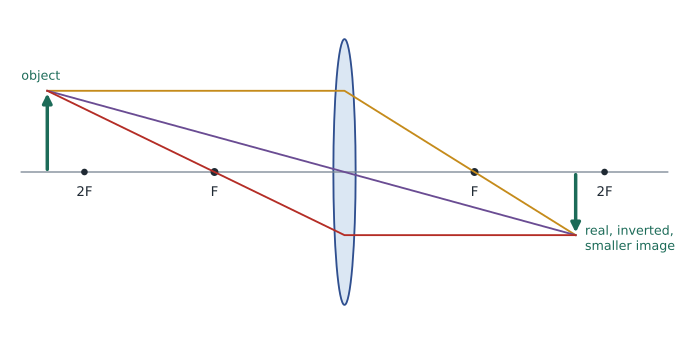
For a converging lens, the image depends on where the object sits. An object beyond twice the focal length gives a real, inverted, smaller image between f and 2f on the other side, as in a camera or the eye. An object at exactly 2f gives a real, inverted image of the same size at 2f. An object between f and 2f gives a real, inverted, enlarged image beyond 2f, as in a projector. An object at the focal point gives no image; the rays emerge parallel. An object inside the focal length gives a virtual, upright, enlarged image on the same side, which is how a magnifying glass works. A diverging lens, whatever the object distance, always gives a virtual, upright, smaller image. A useful pattern to remember: for a single lens or mirror, real images are inverted and virtual images are upright.
Worked problem
Locating an image
An object is 30 cm from a converging lens with a focal length of 10 cm. Where is the image, and what are its characteristics?
Show solution
- 1/i = 1/f − 1/o = 1/10 − 1/30 = 3/30 − 1/30 = 2/30.
- i = 15 cm, positive, so the image is real and on the far side of the lens.
- m = −i/o = −15/30 = −0.5.
Answer: A real, inverted image 15 cm from the lens, half the size of the object.
Combinations of lenses and optical instruments
When two thin lenses are placed in contact, their powers add: a plus 3-dioptre lens against a minus 1-dioptre lens behaves like a single plus 2-dioptre lens. When lenses are separated, the image formed by the first lens serves as the object for the second, and the total magnification is the product of the individual magnifications. A compound microscope uses an objective lens of short focal length to form an enlarged real image, which an eyepiece then magnifies further, so a 40-times objective with a 10-times eyepiece gives 400-times total magnification. The resolution of a light microscope is limited by diffraction, discussed below, to roughly half the wavelength of the light used, about 200 nanometres, which is why viruses and the fine structure of organelles require electron microscopy.
The eye
The eye is a converging optical system. Most of its focusing power, about two thirds, comes from the cornea, because the largest change in refractive index occurs where light passes from air into the cornea. The lens provides the rest and is adjustable: ciliary muscles change its shape, making it more curved and more powerful to focus on near objects, a process called accommodation. The image on the retina is real and inverted; the brain interprets it as upright.
Refractive errors are corrected with lenses. In myopia, or nearsightedness, the eye focuses distant objects in front of the retina, usually because the eyeball is too long; a diverging (negative) lens moves the focus back. In hyperopia, or farsightedness, the eye focuses behind the retina; a converging (positive) lens helps. Presbyopia, the age-related stiffening of the lens, reduces accommodation, so people in their forties and older often need converging reading glasses. Astigmatism, from an unevenly curved cornea, is corrected with cylindrical lenses. Elliot's glasses, which shrank the letters on the screen, were diverging lenses, consistent with myopia.
Wave optics: interference and diffraction
Because light is a wave, it interferes and diffracts. In Thomas Young's double-slit experiment, light passing through two narrow, closely spaced slits produces a pattern of bright and dark fringes on a screen. Bright fringes occur where the path difference from the two slits is a whole number of wavelengths, so the waves arrive in phase; dark fringes occur where the path difference is a half-integer number of wavelengths. For slit separation d, bright fringes appear at angles where d sin θ equals m λ, with m equal to 0, 1, 2 and so on. Wider spacing between fringes results from longer wavelengths or slits closer together.
Diffraction is the spreading of a wave as it passes through an opening or around an obstacle. It is significant when the opening is comparable in size to the wavelength. Sound, with wavelengths of metres, diffracts around doorways easily, which is why you can hear around corners; visible light, with wavelengths under a micrometre, diffracts noticeably only through very small openings. A single narrow slit produces a central bright band flanked by fainter bands; its dark fringes occur where a sin θ equals m λ for slit width a, with m equal to 1, 2 and so on. Narrower slits spread the light more. A diffraction grating, with many closely spaced slits, produces sharp, widely separated bright lines and is used in spectrometers to separate wavelengths. X-ray diffraction uses the regular spacing of atoms in a crystal as a grating for X-rays, whose wavelengths are similar to atomic spacings; the resulting patterns reveal molecular structures, including the double helix of DNA from Rosalind Franklin's images.
Thin films, such as soap bubbles and oil slicks, show colours because light reflecting from the top and bottom surfaces of the film interferes. Whether a given colour is reinforced or cancelled depends on the film's thickness and index and on whether each reflection inverts the wave; reflection from a higher-index medium causes a half-wavelength phase shift. Anti-reflection coatings on glasses and camera lenses are thin films chosen to cancel reflected light.
Polarization
Ordinary light, from the sun or a bulb, is unpolarized: its electric field oscillates in all directions perpendicular to its travel. A polarizing filter transmits only the component of the field along its axis, so unpolarized light passing through an ideal polarizer emerges polarized with half its original intensity. Polarized light passing through a second polarizer at angle θ to the first is reduced by a further factor of cos squared θ (Malus's law); at 90 degrees, crossed polarizers block the light entirely. Light reflected from water or a road is partly polarized horizontally, so polarized sunglasses with vertical transmission axes cut glare. Polarization is evidence that light is a transverse wave, since longitudinal waves cannot be polarized. In chemistry, solutions of chiral molecules rotate the plane of polarized light, the basis of measuring optical activity in organic chemistry.
Scattering of light by particles much smaller than its wavelength, called Rayleigh scattering, increases sharply at short wavelengths. Molecules in the air scatter blue light far more than red, so the sky looks blue, and sunsets look red because the light reaching you has lost much of its blue on its long path through the atmosphere.
Common mistakes
MistakeLight bends away from the normal when it enters glass from air.
InsteadEntering a higher-index medium, light slows and bends toward the normal.
MistakeTotal internal reflection can occur when light goes from air into water.
InsteadIt requires light travelling from higher index to lower index, such as water to air.
MistakeA converging lens always forms a real image.
InsteadAn object inside the focal length gives a virtual, upright, enlarged image.
MistakeA negative image distance for a lens means the image is inverted.
InsteadNegative i means a virtual image on the object's side; inversion is shown by negative magnification.
MistakeNearsightedness is corrected with converging lenses.
InsteadMyopia needs diverging (negative) lenses; hyperopia and presbyopia need converging ones.
Summary and key terms
- Light is an electromagnetic wave with c = fλ; photon energy E = hf rises as wavelength falls.
- Reflection: angle of incidence equals angle of reflection; plane mirrors give virtual, upright, same-size images.
- Refraction: n = c/v and n1 sin θ1 = n2 sin θ2; frequency is unchanged across boundaries.
- Total internal reflection occurs from high to low index beyond the critical angle, sin θc = n2/n1.
- Thin lens equation 1/f = 1/o + 1/i, m = −i/o; converging lenses have positive f, diverging negative.
- Interference, diffraction, thin films and polarization show light's wave nature; the eye focuses mainly with the cornea.
- Index of refraction
- The ratio of the speed of light in a vacuum to its speed in a material.
- Critical angle
- The angle of incidence beyond which light is totally internally reflected.
- Dispersion
- The variation of refractive index with wavelength, which separates colours.
- Focal length
- The distance from a lens or mirror to the point where parallel rays converge or appear to diverge from.
- Dioptre
- The unit of lens power, equal to the reciprocal of focal length in metres.
- Real image
- An image formed where light rays actually converge; it can be projected onto a screen.
- Diffraction
- The spreading of waves through openings or around obstacles comparable to their wavelength.
- Polarization
- Restriction of a transverse wave's oscillations to a particular direction.
Practice problems
Work each problem on paper first, then reveal the answer to check.
What is the speed of light in water (n = 1.33)?
Show answer
v = c/n ≈ 3.0 × 10⁸ / 1.33 ≈ 2.3 × 10⁸ m/s.
A lens has a power of +5 dioptres. What is its focal length?
Show answer
1/5 m = 20 cm, converging.
An object is 5 cm from a converging lens with f = 10 cm. Describe the image.
Show answer
1/i = 1/10 − 1/5 = −1/10, so i = −10 cm: virtual, upright, magnified 2 times.
Unpolarized light of intensity I0 passes through two polarizers at 60° to each other. What intensity emerges?
Show answer
I0/2 × cos² 60° = I0/2 × 1/4 = I0/8.
Why does the cornea contribute more focusing power than the lens?
Show answer
The largest change in refractive index occurs at the air-cornea boundary.
Lesson quiz · 5 questions
Score 60% or more to complete this lesson.
Create a free account to save your progress, take quizzes and earn a certificate.