
MCAT-121 · Lesson 6 of 12 · 27 min
Capacitors, magnetism and electricity in the body
▶ Video coming soon A video version of this lesson is on the way.
Ezequiel had used a defibrillator on patients more times than he wanted to remember, and he was the one who suggested the opening question for this session. 'The machine whines for a few seconds before you can shock,' he said. 'What is it doing?' Charging a capacitor, Thandiwe said, and storing a few hundred joules that it can release into the chest in a few milliseconds. From there the session moved to the other places where capacitors and magnetic fields show up in medicine: the membrane of every cell, the myelin around nerves, the mass spectrometer in a laboratory and the magnet of an MRI scanner.
This lesson completes content category 4C. It covers capacitance, parallel-plate capacitors, dielectrics, energy storage, capacitors in circuits and the RC time constant; magnetic fields, the Lorentz force on moving charges, the right-hand rule and the motion of charged particles in magnetic fields; and the physics of the nerve cell listed in the AAMC outline, including myelin, Schwann cells and the nodes of Ranvier.
Capacitors and capacitance
A capacitor stores separated charge, and with it energy, in an electric field. The simplest version is two parallel conducting plates separated by a small gap. When a capacitor is connected to a battery, charge flows until one plate carries plus Q and the other minus Q and the potential difference between the plates equals the battery voltage. The capacitance, C, is the charge stored per volt: C equals Q over V, measured in farads (coulombs per volt). A farad is very large; practical capacitors are measured in microfarads, nanofarads or picofarads.
For a parallel-plate capacitor, capacitance depends only on geometry and on the material between the plates: it is proportional to the plate area A and inversely proportional to the separation d. The constant ε0, the permittivity of free space, is about 8.85 times 10 to the minus 12th farads per metre. Larger plates hold more charge at a given voltage; closer plates do too, because the attraction between the plates holds the charge more tightly. The field between the plates is uniform, with magnitude V over d.
Dielectrics
Filling the gap with an insulating material, a dielectric, increases capacitance by a factor κ (kappa), the dielectric constant, which is 1 for a vacuum, very close to 1 for air, roughly 2 to 3 for lipids and plastics and about 80 for water. The dielectric's molecules polarize in the field, with their negative ends toward the positive plate, partly cancelling the field inside. What happens next depends on whether the capacitor is connected to a battery. If the battery stays connected, V is fixed, so inserting the dielectric lets more charge flow onto the plates and Q rises by κ. If the capacitor is first disconnected, Q is fixed, so the voltage and the field between the plates fall by κ. This distinction is a favourite MCAT trap.
Energy stored in a capacitor
Charging a capacitor takes work, because each additional bit of charge must be pushed onto a plate that already repels it. The stored energy is one half Q V, which can be written as one half C V squared or Q squared over 2C. The factor of one half arises because the voltage rises from zero to V as the capacitor charges, so the average voltage during charging is V over 2.
Worked problem
A defibrillator
A defibrillator capacitor of 100 microfarads is charged to 2,000 volts. How much energy does it store, and what average power is delivered if it discharges in 4 milliseconds?
Show solution
- U = one half C V² = 0.5 × (100 × 10⁻⁶ F) × (2,000 V)².
- (2,000)² = 4 × 10⁶, so U = 0.5 × 10⁻⁴ × 4 × 10⁶ = 200 J.
- Average power = 200 J / (4 × 10⁻³ s) = 5 × 10⁴ W.
Answer: 200 joules, delivered at an average of about 50 kilowatts. The battery charges the capacitor over several seconds (the whine Ezequiel heard), and the capacitor releases the energy far faster than the battery could.
Capacitors in circuits
Capacitors combine in the opposite way from resistors. In parallel, they share the same voltage and their charges add, so their capacitances add: C total equals C1 plus C2. In series, each capacitor carries the same charge and their voltages add, so their reciprocal capacitances add, giving a total smaller than any single one. An easy way to remember this: placing capacitors in parallel is like increasing the plate area, and placing them in series is like increasing the plate separation.
| Quantity | Resistors in series | Resistors in parallel | Capacitors in series | Capacitors in parallel |
|---|---|---|---|---|
| Shared quantity | Current | Voltage | Charge | Voltage |
| Adds up | Voltage | Current | Voltage | Charge |
| Combination rule | R1 + R2 | 1/R = 1/R1 + 1/R2 | 1/C = 1/C1 + 1/C2 | C1 + C2 |
The RC time constant
A capacitor does not charge or discharge instantly when it is connected through a resistor. When a battery charges an uncharged capacitor through a resistor R, current is largest at the start (the empty capacitor offers no opposing voltage) and falls toward zero as the capacitor's voltage approaches the battery's. The charge rises exponentially toward its final value with a time constant τ equal to R times C. After one time constant, the capacitor holds about 63 percent of its final charge; after about five time constants it is essentially full. During discharge, the charge, voltage and current all fall exponentially, to about 37 percent of their starting values after one time constant.
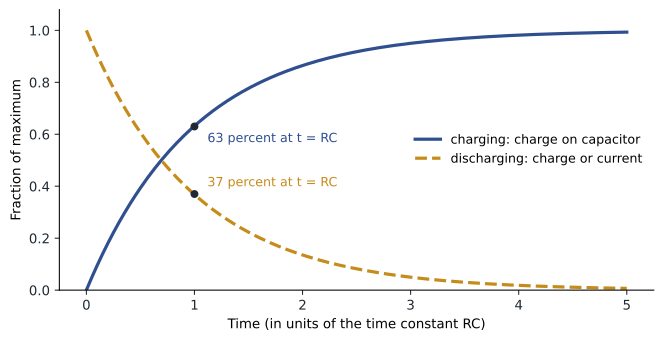
The time constant explains several physiological facts. A longer time constant means slower change. A cell membrane has both resistance (its ion channels) and capacitance (its lipid bilayer), so its voltage cannot change instantly when current is injected; it rises with a membrane time constant typically in the range of milliseconds. Units check: ohms times farads equals volts per ampere times coulombs per volt, which is coulombs per ampere, which is seconds.
The cell membrane as a capacitor
A lipid bilayer is a thin insulator, about 5 nanometres of low-dielectric hydrocarbon, separating two conducting salt solutions. It is a natural capacitor, and its specific capacitance is about 1 microfarad per square centimetre, a value nearly the same across many cell types. The resting potential of about minus 70 millivolts means a thin layer of excess negative charge lines the inside of the membrane and an equal layer of positive charge lines the outside. Because the capacitance is small, remarkably little charge needs to cross the membrane to change its voltage substantially. A typical action potential moves only a tiny fraction of the ions in the cell, which is why the sodium-potassium pump can keep up and why concentrations inside the cell barely change during a single action potential.
Worked problem
How much charge sets the resting potential?
A small spherical cell has a membrane area of about 10⁻⁵ cm² and a specific capacitance of 1 μF/cm². How much charge separation produces a membrane potential of 70 mV, and roughly how many monovalent ions is that?
Show solution
- C = 1 μF/cm² × 10⁻⁵ cm² = 10⁻¹¹ F.
- Q = CV = 10⁻¹¹ F × 0.07 V = 7 × 10⁻¹³ C.
- Number of ions = Q/e = 7 × 10⁻¹³ / 1.6 × 10⁻¹⁹ ≈ 4 × 10⁶.
Answer: About 7 × 10⁻¹³ coulombs, or a few million ions, a tiny fraction of the many billions of potassium ions inside such a cell.
Myelin, Schwann cells and the nodes of Ranvier
An axon behaves like a leaky electrical cable: current flows along its salty interior, which has resistance, while charge leaks out across the membrane, which has both resistance and capacitance. In an unmyelinated axon, the action potential must be regenerated continuously at every patch of membrane, and conduction is slow, a metre or two per second for thin fibres. Making the axon wider lowers its internal resistance and speeds conduction, which is the strategy of the squid giant axon.
Vertebrates use insulation instead. In the peripheral nervous system, Schwann cells wrap axons in many layers of membrane to form myelin; in the central nervous system, oligodendrocytes do the same. Myelin has two electrical effects that work together. It greatly increases the resistance of the membrane, so less current leaks out, and it greatly decreases the capacitance, because stacking many membranes in series increases the effective separation between the conducting fluids (capacitors in series combine to a smaller total capacitance). Less charge is then needed to change the voltage of each stretch of axon. Current injected at one point spreads farther and faster along the inside of the axon before it fades.
The myelin sheath is interrupted at short gaps, the nodes of Ranvier, where voltage-gated sodium channels are densely clustered. The action potential is regenerated only at the nodes, and the signal appears to jump from node to node, a process called saltatory conduction. Myelinated fibres can conduct at tens of metres per second, up to roughly 100 metres per second for the largest. Demyelinating diseases, such as multiple sclerosis in the central nervous system, raise membrane capacitance and lower membrane resistance where myelin is lost, so current leaks away before it can reach the next node, and conduction slows or fails. The biology of the action potential itself, including the ion channels involved, is reviewed in MCAT-112.
Magnetic fields
Moving charges create magnetic fields, and magnetic fields exert forces on moving charges. The magnetic field B is a vector measured in teslas (T). Earth's magnetic field at the surface is roughly 50 microteslas, a refrigerator magnet perhaps 5 milliteslas, and the main magnet of a clinical MRI scanner typically 1.5 or 3 teslas. Magnetic field lines form closed loops; outside a bar magnet they run from the north pole to the south pole. There are no isolated magnetic poles.
A long straight wire carrying current I produces a magnetic field that circles the wire, with a strength proportional to I and inversely proportional to the distance r from the wire. The direction follows a right-hand rule: point your right thumb along the conventional current, and your fingers curl in the direction of the field. A coil of wire, or solenoid, produces a nearly uniform field inside, stronger with more turns and more current. MRI scanners use superconducting solenoids to produce their strong, uniform fields.
The magnetic force on a moving charge
A charge q moving with velocity v through a magnetic field B feels a force of magnitude q v B sin θ, where θ is the angle between v and B. This is the magnetic part of the Lorentz force. Three features make magnetic forces distinctive. A stationary charge feels no magnetic force. A charge moving parallel or antiparallel to the field feels no force (sin 0 is zero). And the force is always perpendicular to both v and B, so it changes the direction of the charge's motion but never its speed; a magnetic force does no work.
The direction comes from a right-hand rule. Point your fingers along v, curl them toward B (or, with a flat hand, point fingers along B with the thumb along v), and your thumb, or the direction your palm pushes, gives the force on a positive charge. For a negative charge, such as an electron, reverse the result. MCAT questions often draw B pointing into the page (shown as crosses) or out of the page (shown as dots).
Because the force is perpendicular to the velocity, a charged particle moving perpendicular to a uniform magnetic field travels in a circle. Setting the magnetic force equal to the centripetal force, q v B equals m v squared over r, gives a radius of m v over q B. Heavier or faster particles follow larger circles; more highly charged particles and stronger fields give smaller ones. A mass spectrometer uses this result. Ions are accelerated to a known speed (or kinetic energy), enter a magnetic field and curve along paths whose radii depend on their mass-to-charge ratio. Detectors at different positions sort the ions, giving the isotopic composition of a sample or the masses of fragments of a molecule.
Worked problem
Sorting isotopes
Two singly charged ions with the same speed enter a uniform magnetic field perpendicular to their velocity. Ion A has a mass of 12 atomic mass units and ion B a mass of 14. How do the radii of their paths compare?
Show solution
- r = mv/(qB). Speed, charge and field are the same for both.
- So r is proportional to m: r_B / r_A = 14/12 ≈ 1.17.
Answer: Ion B follows a circle about 17 percent larger in radius than ion A.
A wire carrying current I through a magnetic field feels a force too, because the current is made of moving charges. For a straight wire of length L at angle θ to the field, the force is I L B sin θ. Electric motors and loudspeakers work by this force. Two parallel wires carrying currents in the same direction attract each other; currents in opposite directions repel.
Magnetic properties of matter and MRI, briefly
Most materials respond weakly to magnetic fields. Diamagnetic materials, which have all their electrons paired, are weakly repelled; water and most biological molecules are diamagnetic. Paramagnetic materials, which have unpaired electrons, are weakly attracted; molecular oxygen and the deoxygenated form of haemoglobin are paramagnetic. Ferromagnetic materials such as iron are strongly attracted and can be permanently magnetized. The paired-versus-unpaired electron distinction appears again in general chemistry, where electron configurations predict paramagnetism.
MRI images the body using the magnetic properties of hydrogen nuclei, mostly in water and fat. In the strong field of the scanner, the nuclear spins align slightly more often with the field than against it. Pulses of radio-frequency energy tip them out of alignment, and as they relax back they emit radio signals whose timing differs between tissues. The same physics, nuclear magnetic resonance, underlies the NMR spectroscopy reviewed in MCAT-122. The physics of MRI is listed in the content outline only indirectly, but a passage may describe it; the safe core ideas are that MRI uses magnetic fields and radio waves, not ionizing radiation, and that ferromagnetic objects are dangerous near the magnet.
Common mistakes
MistakeInserting a dielectric always increases a capacitor's charge.
InsteadOnly if the battery stays connected (V fixed). If isolated (Q fixed), the voltage falls instead.
MistakeCapacitors in series add their capacitances.
InsteadIn series, reciprocals add and the total is smaller; in parallel, capacitances add.
MistakeA magnetic field can speed up a charged particle.
InsteadThe magnetic force is perpendicular to the velocity, so it changes direction but not speed and does no work.
MistakeA charge moving along a magnetic field line feels the maximum force.
InsteadForce depends on sin θ; motion parallel to B gives zero force.
MistakeMyelin speeds conduction by increasing membrane capacitance.
InsteadMyelin decreases capacitance and increases membrane resistance, so current spreads farther between nodes.
Summary and key terms
- Capacitance C = Q/V; for parallel plates, C = κε0A/d, so larger plates, smaller gaps and dielectrics increase it.
- Stored energy U = one half CV²; a defibrillator stores hundreds of joules and releases them in milliseconds.
- Capacitors add in parallel and combine by reciprocals in series, the opposite of resistors.
- RC circuits charge and discharge exponentially with time constant τ = RC (63 percent and 37 percent after one τ).
- The membrane is a capacitor of about 1 μF/cm²; myelin raises membrane resistance and lowers capacitance, enabling saltatory conduction between nodes of Ranvier.
- The magnetic force F = qvB sin θ is perpendicular to v and B, does no work and bends charges into circles of radius mv/(qB).
- Capacitance
- The charge stored per unit potential difference, measured in farads.
- Dielectric
- An insulating material between capacitor plates that increases capacitance by a factor κ.
- Time constant
- The product RC, the characteristic time for a capacitor to charge or discharge through a resistor.
- Saltatory conduction
- The jumping of action potentials from node to node along a myelinated axon.
- Node of Ranvier
- A gap in the myelin sheath where voltage-gated sodium channels regenerate the action potential.
- Tesla
- The SI unit of magnetic field strength.
- Lorentz force
- The force on a charged particle from electric and magnetic fields; its magnetic part is qvB sin θ.
- Mass spectrometer
- An instrument that separates ions by their mass-to-charge ratio, often by bending their paths in a magnetic field.
Practice problems
Work each problem on paper first, then reveal the answer to check.
A 2 μF capacitor is charged to 10 V. How much charge and energy does it hold?
Show answer
Q = CV = 20 μC; U = one half CV² = 100 μJ.
What is the time constant of a 1 kΩ resistor with a 10 μF capacitor?
Show answer
RC = 10³ × 10⁻⁵ = 10⁻² s, or 10 ms.
The plate separation of an isolated charged capacitor is doubled. What happens to its voltage?
Show answer
C halves and Q is fixed, so V = Q/C doubles.
An electron moves east through a magnetic field that points north. Which way is the force on it, if up is out of the ground?
Show answer
For a positive charge, east × north gives up; for the electron, the force points down.
Why can a magnetic field not change a particle's kinetic energy?
Show answer
The force is always perpendicular to the velocity, so it does no work.
Lesson quiz · 5 questions
Score 60% or more to complete this lesson.
Create a free account to save your progress, take quizzes and earn a certificate.