
MCAT-121 · Lesson 1 of 12 · 27 min
Units, vectors and dimensional analysis
▶ Video coming soon A video version of this lesson is on the way.
The physics block of the Sunday Session started with a confession. Devika admitted that she had not taken a physics course since her first year at university and that her diagnostic misses in Chem/Phys were mostly calculations. Ezequiel said he remembered the formulas from his EMT training only as "the ones on the oxygen tank". Elliot said physics was fine as long as nobody asked him to explain it. Thandiwe nodded. 'Physics on the MCAT is about a quarter of Chem/Phys,' she said. 'The questions are rarely hard physics. They are ordinary physics in a biological setting, with numbers chosen so you can do them by hand. If your units are right, you are usually most of the way to the answer. So we start with units.'
This course reviews the introductory physics and the mathematical skills that the AAMC lists for the Chemical and Physical Foundations of Biological Systems section, usually called Chem/Phys. Physics content appears mainly in foundational concept 4, which covers motion, forces, energy and equilibrium (content category 4A), fluids (4B), electrostatics, circuits and magnetism (4C), light and sound (4D), and atoms and nuclear decay (4E). The AAMC estimates that introductory physics makes up roughly 25 percent of Chem/Phys, alongside general chemistry (about 30 percent), biochemistry (about 25 percent), organic chemistry (about 15 percent) and introductory biology (about 5 percent). The math skills, listed separately in the outline, apply across all three science sections.
Two facts shape how you should prepare. First, there is no calculator and no equation sheet; the test provides a periodic table and gives conversion factors when a question needs them. Second, the physics is almost always attached to a passage about something living: blood flowing through a narrowed artery, a nerve behaving like a cable, a lens in the eye, an ultrasound probe or a radioactive tracer. You will need the core equations in memory, but the skill that earns points is setting up a problem quickly and checking it with units and estimation. That is the subject of this first lesson.
SI units and prefixes
The MCAT uses the International System of Units (SI) almost exclusively. Seven base units underlie everything else, and five of them matter on the test: the metre for length, the kilogram for mass, the second for time, the ampere for electric current and the kelvin for temperature. The mole (amount of substance) appears constantly in chemistry. The candela, for luminous intensity, essentially never appears. Every other unit is derived from these base units.
| Quantity | Derived unit | In base units | Common MCAT setting |
|---|---|---|---|
| Force | newton (N) | kg·m/s² | muscle forces, weight, buoyancy |
| Energy, work, heat | joule (J) | kg·m²/s² = N·m | metabolism, photons, springs |
| Power | watt (W) | J/s = kg·m²/s³ | heart output, radiation dose rates |
| Pressure | pascal (Pa) | N/m² = kg/(m·s²) | blood pressure, gases, diving |
| Charge | coulomb (C) | A·s | ions, capacitors, nerve membranes |
| Electric potential | volt (V) | J/C | membrane potentials, batteries |
| Resistance | ohm (Ω) | V/A | circuits, tissues, axons |
| Capacitance | farad (F) | C/V | cell membranes, defibrillators |
| Frequency | hertz (Hz) | 1/s | sound, ultrasound, light |
Prefixes scale units by powers of ten, and the MCAT expects you to move between them without thinking. The prefixes you need run from giga (10 to the 9th) down to pico (10 to the minus 12th): giga, mega (10 to the 6th), kilo (10 cubed), centi (10 to the minus 2nd), milli (10 to the minus 3rd), micro (10 to the minus 6th), nano (10 to the minus 9th) and pico. A typical cell is about 10 micrometres across, a red blood cell about 7 to 8 micrometres, visible light has wavelengths of about 400 to 700 nanometres, and a membrane is about 5 to 10 nanometres thick. Having a few anchors like these in memory lets you catch answers that are off by a factor of a thousand.
Area and volume units carry squared and cubed prefixes, which is where many careless errors happen. One square centimetre is (10 to the minus 2nd metre) squared, which is 10 to the minus 4th square metres, not 10 to the minus 2nd. One cubic centimetre is 10 to the minus 6th cubic metres, and it equals one millilitre. One litre is 1,000 cubic centimetres, or 10 to the minus 3rd cubic metres. A useful anchor: a litre of water has a mass of about one kilogram, so the density of water is about 1,000 kilograms per cubic metre, or 1 gram per cubic centimetre.
Non-SI units you will still see
Passages about medicine often use non-SI units because clinicians do. Blood pressure is reported in millimetres of mercury (mm Hg); 760 mm Hg equals one standard atmosphere, which is about 101 kilopascals, or about 1 times 10 to the 5th pascals. Gas pressures may appear in atmospheres or torr (1 torr equals 1 mm Hg). Energy in nutrition is measured in kilocalories, often written as Calories with a capital C; one kilocalorie is about 4,184 joules, or roughly 4.2 kilojoules. Atomic and photon energies are often given in electron volts; 1 electron volt is 1.6 times 10 to the minus 19th joules. Angstroms (10 to the minus 10th metres) sometimes appear for bond lengths and X-ray wavelengths. The test will normally give an unusual conversion factor, but the common ones above are worth knowing.
Temperature deserves a special word. Physics and gas law equations require absolute temperature in kelvins. To convert, add 273 to the Celsius temperature: body temperature, 37 degrees Celsius, is about 310 kelvins. A change of 1 degree Celsius equals a change of 1 kelvin, so temperature differences can be used in either unit. Fahrenheit almost never appears; if it does, a conversion will be given.
Dimensional analysis
Dimensional analysis means tracking units through a calculation as if they were algebraic quantities. It does two jobs. It converts quantities from one unit to another by multiplying by factors equal to one, and it checks whether an equation or an answer can possibly be right.
Worked problem
Converting a flow rate
The heart pumps about 5 litres of blood per minute at rest. Express this in cubic metres per second.
Show solution
- Write the quantity with its units: 5 litres per minute.
- Multiply by 10 to the minus 3rd cubic metres per litre: 5 times 10 to the minus 3rd cubic metres per minute.
- Divide by 60 seconds per minute: (5 times 10 to the minus 3rd) divided by 60.
- Estimate: 5 divided by 60 is about 0.083, so the result is about 8 times 10 to the minus 5th cubic metres per second.
Answer: About 8 times 10 to the minus 5th cubic metres per second (8.3 times 10 to the minus 5th to two figures).
Units also let you check equations. If a candidate expression for a speed has units of metres squared per second, it is wrong, whatever the algebra suggests. Every term in a sum must have the same units, and the arguments of exponential, logarithmic and trigonometric functions must be dimensionless. So in the decay law N equals N0 times e to the power minus lambda t, the decay constant lambda must have units of inverse time, because lambda times t must be a pure number. In the Nernst equation, the ratio inside the logarithm is a ratio of concentrations, so its units cancel.
Worked problem
Using units to find a relationship
A passage says that the speed v of a wave on a stretched string depends only on the tension T (a force, in newtons) and the mass per unit length μ (in kilograms per metre). Which expression could be correct: (A) v = Tμ, (B) v = T/μ, (C) v = the square root of (T/μ), (D) v = the square root of (μ/T)?
Show solution
- T has units of kg·m/s². μ has units of kg/m.
- T divided by μ has units of (kg·m/s²) times (m/kg) = m²/s².
- The square root of m²/s² is m/s, which is a speed.
- Options A and B give the wrong units, and D gives s/m.
Answer: C. The square root of T/μ is the only option with units of speed.
Thandiwe made the group do this kind of check on every practice question for a week, even when they were sure of the formula. Ezequiel said it felt slow. By the end of the week he said it felt like reading a drug label twice: tedious, and the reason nobody gets hurt.
Significant figures and the level of precision the MCAT wants
Answer choices on the MCAT are usually spread far enough apart that you can estimate to one or two significant figures and still choose correctly. If the choices are 2.4, 24, 240 and 2,400, only the power of ten matters. If the choices are 2.1, 2.4, 2.7 and 3.0, you need a careful second figure. Read the choices before calculating, so you know how precise you must be. The formal rules for significant figures (counting digits, keeping the fewest significant figures in multiplication and the fewest decimal places in addition) matter mainly in laboratory passages that ask which reported value is justified by the measurement.
Scalars and vectors
A scalar has magnitude only: mass, time, temperature, energy, speed, distance, charge and electric potential are scalars. A vector has magnitude and direction: displacement, velocity, acceleration, force, momentum, electric field and magnetic field are vectors. The distinction matters in nearly every mechanics question. Distance is the total length of a path; displacement is the straight-line change in position, with direction. A runner who completes one lap of a 400-metre track has run 400 metres but has zero displacement, so her average velocity for the lap is zero even though her average speed is not.
Vectors are drawn as arrows and added head to tail. The sum, or resultant, runs from the tail of the first arrow to the head of the last. Two vectors pointing the same way add their magnitudes; two pointing opposite ways subtract. Vectors at right angles combine by the Pythagorean theorem: a 3-newton force east and a 4-newton force north give a 5-newton resultant. Subtracting a vector is the same as adding its opposite, which has the same magnitude and points the other way.
Components and basic trigonometry
Most vector problems are solved by breaking each vector into perpendicular components, usually horizontal (x) and vertical (y). A vector of magnitude F at angle θ above the horizontal has components F cos θ along x and F sin θ along y. Add the x components together and the y components together, then recombine if the question asks for the magnitude of the resultant.
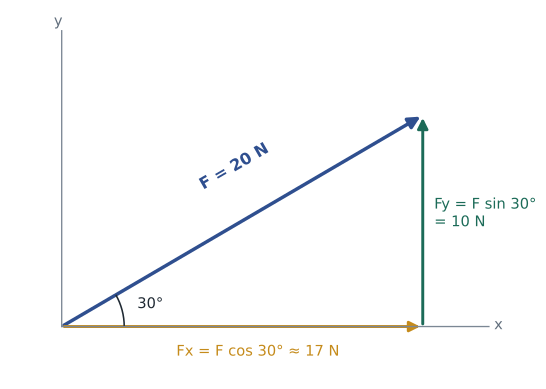
The MCAT expects you to know the sines and cosines of a few angles without a calculator.
| Angle | sin | cos | tan |
|---|---|---|---|
| 0° | 0 | 1 | 0 |
| 30° | 0.5 | about 0.87 (the square root of 3, over 2) | about 0.58 |
| 45° | about 0.71 (the square root of 2, over 2) | about 0.71 | 1 |
| 60° | about 0.87 | 0.5 | about 1.73 |
| 90° | 1 | 0 | undefined |
Two habits prevent most trigonometry errors. First, check extreme cases: at 0 degrees a force along x has its full magnitude in x, so the x component must use cosine (cos 0 equals 1). At 90 degrees the x component vanishes. Second, if the angle is measured from the vertical rather than the horizontal, the roles of sine and cosine swap. On an inclined plane, which lesson 2 covers in detail, the component of gravity along the slope is mg sin θ and the component perpendicular to the slope is mg cos θ, where θ is the angle of the incline. If you forget which is which, imagine the incline tilted to 0 degrees: the along-slope part of gravity must vanish, so it must be the sine.
Worked problem
Adding two forces
Two muscles pull on a tendon. Muscle 1 pulls with 300 newtons along the positive x axis. Muscle 2 pulls with 200 newtons at 60 degrees above the positive x axis. What is the approximate magnitude of the total force?
Show solution
- Muscle 2 components: x = 200 cos 60° = 100 N; y = 200 sin 60° ≈ 174 N.
- Total x = 300 + 100 = 400 N. Total y = 174 N.
- Magnitude = the square root of (400² + 174²) = the square root of (160,000 + about 30,000) = the square root of about 190,000.
- The square root of 190,000 is a little under 440 (since 440² = 193,600).
Answer: About 436 newtons, so "about 440 N" would be the best choice.
Multiplying vectors, briefly
Two kinds of vector product appear on the MCAT, usually hidden inside formulas. The dot product of two vectors gives a scalar equal to the product of their magnitudes times the cosine of the angle between them. Work is a dot product: W equals F d cos θ, so a force perpendicular to the displacement does no work. The cross product gives a vector whose magnitude is the product of the magnitudes times the sine of the angle between them, and whose direction is perpendicular to both, found with the right-hand rule. Torque (lesson 2) and the magnetic force on a moving charge (lesson 6) are cross products. You do not need the general machinery, only the sine-versus-cosine pattern: work and flux use cosine, torque and magnetic force use sine.
Reading a physics passage
Physics passages on the MCAT tend to follow a pattern. A paragraph introduces a biological or medical situation, a second paragraph describes a model or an experiment, and a figure or table supplies numbers. The questions then ask you to apply a basic principle, predict what happens when one variable changes, or interpret the data. Thandiwe gave the group three rules for these passages. First, find the variables and write their symbols and units in the margin of your scratch paper. Second, before any calculation, decide which principle applies: a force balance, conservation of energy, continuity of flow, Ohm's law and so on. Third, for any question that asks what happens when something doubles or halves, set up a ratio rather than computing two full answers. Lesson 10 develops the ratio method in detail, because it is the single most useful time saver in Chem/Phys.
Proportional reasoning: a first look
Many physics questions ask how one quantity changes when another changes, with everything else fixed. The answer comes straight from the form of the equation. If y is proportional to x, doubling x doubles y. If y is proportional to x squared, doubling x quadruples y. If y is inversely proportional to x squared, doubling x divides y by four. Poiseuille's law (lesson 4), in which flow depends on the fourth power of a vessel's radius, is the classic MCAT example: halving the radius divides flow by 16 if the pressure difference stays the same.
| If the relationship is | and x doubles, then y | Example |
|---|---|---|
| y ∝ x | doubles | force and acceleration (F = ma) |
| y ∝ x² | is multiplied by 4 | kinetic energy and speed |
| y ∝ 1/x | halves | resistance and cross-sectional area |
| y ∝ 1/x² | is divided by 4 | Coulomb force and distance |
| y ∝ x⁴ | is multiplied by 16 | Poiseuille flow and radius |
| y ∝ the square root of x | is multiplied by about 1.41 | wave speed and string tension |
Common mistakes
MistakeOne square centimetre is 10 to the minus 2nd square metres.
InsteadSquare the prefix too: 1 cm² = 10 to the minus 4th m², and 1 cm³ = 10 to the minus 6th m³ = 1 mL.
MistakeGas law and decay calculations can use degrees Celsius.
InsteadUse kelvins for absolute temperature; add 273 to the Celsius value.
MistakeAverage speed and the magnitude of average velocity are always equal.
InsteadVelocity uses displacement; a round trip has zero average velocity but nonzero average speed.
MistakeThe x component of a vector always uses sine.
InsteadUse cosine for the component adjacent to the angle; check by setting the angle to 0 degrees.
MistakeIf the formula looks familiar, there is no need to check units.
InsteadA 10-second unit check catches wrong formulas and missing conversions.
Summary and key terms
- Introductory physics is about a quarter of Chem/Phys and is set in biological contexts; there is no calculator or equation sheet.
- Know the SI base units, the derived units (N, J, W, Pa, C, V, Ω, F, Hz) and the prefixes from giga to pico.
- Square and cube prefixes for areas and volumes; 1 cm³ equals 1 mL, and water has a density of about 1,000 kg/m³.
- Dimensional analysis converts units and checks equations; arguments of exponentials and logarithms must be dimensionless.
- Vectors add head to tail; resolve them into components with F cos θ and F sin θ, and recombine with the Pythagorean theorem.
- Proportional reasoning answers most "what if it doubles" questions without full calculation.
- Dimensional analysis
- Tracking units through a calculation to convert quantities and check that equations are consistent.
- Scalar
- A quantity with magnitude only, such as mass, energy or speed.
- Vector
- A quantity with magnitude and direction, such as displacement, velocity or force.
- Displacement
- The straight-line change in position of an object, with direction.
- Component
- The projection of a vector along an axis, such as F cos θ along x.
- Resultant
- The single vector equal to the sum of two or more vectors.
- Electron volt
- An energy unit equal to 1.6 times 10 to the minus 19th joules.
Practice problems
Work each problem on paper first, then reveal the answer to check.
Convert 120 mm Hg to kilopascals, given 760 mm Hg = 101 kPa.
Show answer
120/760 is about 0.16; 0.16 times 101 is about 16 kPa.
What are the units of the decay constant λ in N = N0 e^(−λt)?
Show answer
Inverse time (for example, per second), because λt must be dimensionless.
A 10 N force acts at 60° above the horizontal. What are its components?
Show answer
x = 10 cos 60° = 5 N; y = 10 sin 60° ≈ 8.7 N.
How many cubic micrometres are in one cubic millimetre?
Show answer
1 mm = 10³ μm, so 1 mm³ = 10⁹ μm³.
If y is proportional to 1/x², what happens to y when x triples?
Show answer
It falls to one ninth of its original value.
Lesson quiz · 5 questions
Score 60% or more to complete this lesson.
Create a free account to save your progress, take quizzes and earn a certificate.