
MCAT-121 · Lesson 3 of 12 · 28 min
Work, energy, power and periodic motion
▶ Video coming soon A video version of this lesson is on the way.
'Forces tell you how things move from moment to moment,' Thandiwe said. 'Energy tells you where they end up, and it usually gets you there faster.' She drew a roller-coaster track on the shared whiteboard and asked how fast a car released at the top would be moving at the bottom. Elliot started writing kinematic equations for each curved section. Devika, who had prepared for this session, wrote one line using conservation of energy and had the answer in 20 seconds. Thandiwe let the moment speak for itself.
This lesson covers the rest of content category 4A: work, the work-energy theorem, kinetic and potential energy, conservative and nonconservative forces, conservation of energy, power, mechanical advantage, momentum and collisions, and periodic motion (springs and pendulums). Energy ideas run through the whole MCAT, from the metabolism of glucose in biochemistry to photon energies in optics, so a clear grasp of the physics definitions pays off in every science section.
Work
In physics, a force does work on an object when the object moves while the force acts and the force has a component along the displacement. For a constant force F acting through a straight displacement d, the work is W equals F d cos θ, where θ is the angle between the force and the displacement. Work is a scalar measured in joules (one newton-metre). Three cases are worth fixing in memory. A force along the direction of motion does positive work and adds energy. A force opposite to the motion, such as kinetic friction, does negative work and removes energy. A force perpendicular to the motion does no work: the normal force on a block sliding across a floor, the centripetal force in uniform circular motion and the force of a waiter holding a tray while walking at constant height all do zero work.
Holding a heavy object still does no work on the object in the physics sense, even though it tires you out; your muscles are using chemical energy internally, but the object's energy is not changing. A passage might exploit the gap between the everyday and the physics meaning of "work", so read carefully.
Work also appears in gases. When a gas expands at constant pressure P by a volume ΔV, it does work P ΔV on its surroundings. On a pressure-volume graph, the work done by the gas is the area under the curve. General chemistry (MCAT-120) uses this in thermodynamics; here, note that the units check out, because pascals times cubic metres give newtons per square metre times cubic metres, which is newton-metres, or joules.
Kinetic energy and the work-energy theorem
Kinetic energy is the energy of motion, one half m v squared. Because speed is squared, kinetic energy is never negative and it is far more sensitive to speed than to mass: doubling the speed quadruples the kinetic energy, while doubling the mass only doubles it. That is why a car's braking distance, which depends on removing its kinetic energy, rises roughly with the square of speed.
The work-energy theorem says that the net work done on an object equals its change in kinetic energy. It follows from Newton's second law and the kinematic equations, and it is often the quickest route to a speed or a stopping distance.
Worked problem
Stopping distance
A 1,000-kilogram car moving at 20 metres per second brakes to a stop. The braking (friction) force is 8,000 newtons. How far does it travel while braking?
Show solution
- Initial kinetic energy: one half times 1,000 times 20² = 200,000 J.
- Friction does negative work equal to minus the force times the distance: −8,000 d.
- Net work equals the change in kinetic energy: −8,000 d = 0 − 200,000.
- d = 200,000 / 8,000 = 25 m.
Answer: 25 metres. At 40 metres per second, with the same force, the distance would be 100 metres.
Potential energy
Potential energy is stored energy associated with position or configuration. Gravitational potential energy near Earth's surface is m g h, where h is the height above a reference level that you choose; only changes in potential energy have physical meaning, so the reference can be wherever is convenient. Elastic potential energy stored in a spring stretched or compressed by x from its rest length is one half k x squared, where k is the spring constant in newtons per metre. Electrical potential energy, covered in lesson 5, follows the same logic for charges.
Conservative and nonconservative forces
A force is conservative if the work it does on an object moving between two points does not depend on the path taken. Gravity, the spring force and the electrostatic force are conservative, and each has a potential energy associated with it. Lifting a box to a shelf by a ramp or straight up takes the same work against gravity. Friction and air resistance are nonconservative: the longer the path, the more energy they remove, and that energy ends up mostly as thermal energy. Forces exerted by people, muscles and motors are also usually treated as nonconservative, because they add energy from an outside source.
Conservation of energy
Energy is never created or destroyed; it changes form. In mechanics, if only conservative forces do work, the total mechanical energy, kinetic plus potential, stays constant. When nonconservative forces act, the change in mechanical energy equals the work they do. In symbols, KE1 + PE1 + W_nc = KE2 + PE2, where W_nc is the work done by nonconservative forces (negative for friction).
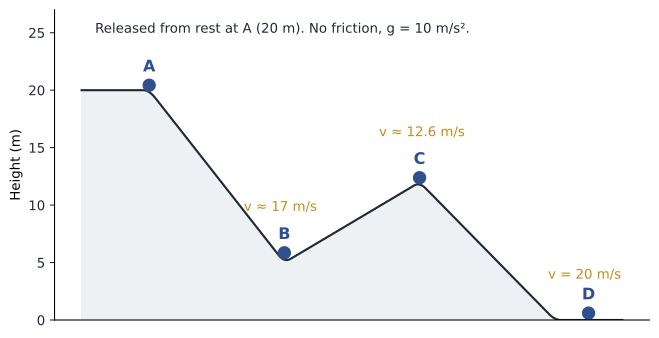
The track in the figure shows the power of the method. A car released from rest at A, 20 metres up, reaches B (5 metres up) having dropped 15 metres. Setting mgh equal to one half m v squared, the mass cancels and v equals the square root of 2 g h: the square root of 2 times 10 times 15, which is the square root of 300, about 17 metres per second. At C (12 metres up) it has dropped 8 metres, so v is the square root of 160, about 12.6 metres per second. At D, ground level, it has dropped 20 metres and moves at the square root of 400, exactly 20 metres per second. No forces, no angles, no times. If friction acted, each speed would be lower, and the missing kinetic energy would equal the work done by friction.
Worked problem
A spring launcher
A spring with k = 800 N/m is compressed 0.10 m and launches a 0.020-kilogram ball straight up. Ignoring air resistance, how high does the ball rise above its launch point? (g = 10 m/s²)
Show solution
- Spring energy: one half times 800 times (0.10)² = 400 times 0.01 = 4 J.
- At the top, all of it is gravitational potential energy: mgh = 4 J.
- h = 4 / (0.020 times 10) = 4 / 0.2 = 20 m.
Answer: 20 metres.
Power
Power is the rate of doing work or transferring energy: P equals W divided by t, measured in watts (joules per second). For a constant force moving an object at constant velocity, power also equals force times velocity. A human body at rest uses energy at roughly 80 to 100 watts, about the same as an old incandescent light bulb; a trained cyclist can sustain several hundred watts. The kilowatt-hour, which appears on electricity bills, is a unit of energy, not power: 1 kilowatt for 1 hour, or 3.6 million joules.
Worked problem
Climbing stairs
A 70-kilogram person climbs a flight of stairs 3 metres high in 6 seconds. What average power does she deliver against gravity? (g = 10 m/s²)
Show solution
- Work against gravity: mgh = 70 times 10 times 3 = 2,100 J.
- Power: 2,100 J / 6 s = 350 W.
Answer: 350 watts. Her muscles must use several times this much chemical energy, because muscle efficiency is well below 100 percent.
Efficiency is the ratio of useful output to total input, usually given as a percentage. Human muscle converts chemical energy to mechanical work with an efficiency of roughly 20 to 25 percent; the rest becomes heat, which is why exercise warms you up. MCAT passages sometimes give an efficiency and ask for the input energy, or give food energy in kilocalories and ask how much mechanical work could result.
Simple machines and mechanical advantage
A simple machine such as a lever, pulley or ramp changes the force needed to do a task, but it cannot reduce the work required (and friction only adds to it). Mechanical advantage is the ratio of the output force to the input force. An ideal ramp of length L rising height h has a mechanical advantage of L over h: pushing a load up a ramp four times longer than its height takes one fourth the force, applied over four times the distance. A system of pulleys in which n rope segments support a load reduces the needed force by a factor of n, again over n times the distance. In each case, force times distance, the work, stays the same. This trade-off explains the forearm result in lesson 2, where a muscle with a short lever arm exerts a large force over a short distance to move the hand a long distance.
Momentum and collisions
Momentum is mass times velocity, a vector. Newton's second law can be written as force equals the rate of change of momentum, and the product of a force and the time over which it acts is the impulse, equal to the change in momentum. Impulse explains why airbags, padded flooring and bending your knees on landing reduce injury: the change in momentum is fixed by the speeds involved, so stretching the stopping time lowers the average force.
In any collision in which external forces are negligible during the brief impact, total momentum is conserved. In an elastic collision, kinetic energy is also conserved. In an inelastic collision, some kinetic energy is converted to other forms such as heat and sound; in a perfectly inelastic collision, the objects stick together and the loss of kinetic energy is as large as momentum conservation allows. Collisions of everyday objects are inelastic; collisions of gas molecules are treated as elastic in kinetic theory.
Worked problem
A perfectly inelastic collision
A 2-kilogram cart moving at 3 metres per second collides with and sticks to a 1-kilogram cart at rest. What is their common velocity, and how much kinetic energy is lost?
Show solution
- Momentum before: 2 times 3 = 6 kg·m/s. After: 3 kg times v.
- v = 6 / 3 = 2 m/s.
- Kinetic energy before: one half times 2 times 9 = 9 J. After: one half times 3 times 4 = 6 J.
Answer: 2 m/s; 3 J of kinetic energy (one third) is converted to other forms.
Periodic motion: springs
A mass on a spring, displaced from equilibrium and released, oscillates back and forth. Because the spring force is proportional to the displacement and points back toward equilibrium (F equals minus k x), the motion is simple harmonic motion. Its position varies like a sine or cosine wave in time. The amplitude A is the maximum displacement. The period T is the time for one complete cycle, and the frequency f, in hertz, is the number of cycles per second, equal to 1 over T. For a mass m on a spring of constant k, the period is 2π times the square root of m over k. A heavier mass oscillates more slowly; a stiffer spring oscillates faster. The period does not depend on the amplitude.
Energy sloshes between kinetic and potential forms during the oscillation. At the extremes of the motion, the mass is momentarily at rest, so all the energy is elastic potential energy, one half k A squared, and the acceleration is greatest because the spring force is greatest. At the equilibrium position, the spring force is zero, the acceleration is zero, and the speed is greatest, with all the energy kinetic. A common MCAT question asks where speed or acceleration is maximal; the answer is always this pattern.
Periodic motion: pendulums
A simple pendulum, a small mass on a light string of length L, also performs simple harmonic motion for small swings. Its period is 2π times the square root of L over g. The period depends on the length and on g but not on the mass or (for small angles) the amplitude. A longer pendulum swings more slowly; a pendulum on the Moon, where g is about one sixth of Earth's, swings more slowly than on Earth. Legs swinging while walking behave roughly like pendulums, which is one reason taller animals tend to take slower strides.
| Change | Mass on a spring | Simple pendulum |
|---|---|---|
| Double the mass | Period × about 1.41 | No change |
| Double the length | Not applicable | Period × about 1.41 |
| Double the spring constant | Period ÷ about 1.41 | Not applicable |
| Double the amplitude (small) | No change | No change |
| Move to the Moon (g ÷ 6) | No change | Period × about 2.45 |
Periodic motion leads directly into waves. A wave is a travelling oscillation: each point of the medium oscillates in place, often in simple harmonic motion, while the disturbance moves along. The vocabulary of amplitude, period, frequency and phase carries over unchanged, and lesson 7 takes it from there.
Common mistakes
MistakeAny force on a moving object does work.
InsteadOnly the component along the displacement does work; perpendicular forces do none.
MistakeDoubling an object's speed doubles its kinetic energy.
InsteadKinetic energy depends on v²: doubling speed quadruples kinetic energy.
MistakeA simple machine reduces the work needed.
InsteadIt reduces the force needed but increases the distance; the work is the same or more.
MistakeA heavier pendulum swings more slowly.
InsteadA pendulum's period depends on its length and g, not its mass.
MistakeIn simple harmonic motion, speed and acceleration peak at the same place.
InsteadSpeed is greatest at equilibrium; acceleration is greatest at the turning points.
Summary and key terms
- Work is F d cos θ; perpendicular forces do no work, and friction does negative work.
- The net work on an object equals its change in kinetic energy, one half mv².
- Gravitational potential energy is mgh and spring potential energy one half kx²; only changes matter.
- With only conservative forces, mechanical energy is conserved; friction converts it to thermal energy.
- Power is work per time (watts); simple machines trade force for distance without saving work.
- Momentum is conserved in collisions; springs and pendulums show simple harmonic motion with periods set by m/k and L/g.
- Work
- Energy transferred by a force acting through a displacement, F d cos θ, measured in joules.
- Kinetic energy
- The energy of motion, one half mv².
- Conservative force
- A force whose work between two points does not depend on the path, such as gravity.
- Power
- The rate of doing work or transferring energy, measured in watts.
- Mechanical advantage
- The ratio of the output force to the input force of a machine.
- Impulse
- Force multiplied by the time it acts, equal to the change in momentum.
- Simple harmonic motion
- Oscillation in which the restoring force is proportional to the displacement from equilibrium.
- Period
- The time for one complete cycle of a periodic motion.
Practice problems
Work each problem on paper first, then reveal the answer to check.
How much work is needed to lift a 10 kg box 2 m at constant speed? (g = 10 m/s²)
Show answer
mgh = 10 × 10 × 2 = 200 J.
From what height must an object fall to reach 30 m/s, ignoring air resistance?
Show answer
h = v²/2g = 900/20 = 45 m.
A motor lifts 500 N at 2 m/s. What power does it deliver?
Show answer
P = Fv = 500 × 2 = 1,000 W.
A pendulum has a period of 2 s. What is the period if its length is quadrupled?
Show answer
4 s, because T is proportional to the square root of L.
Where in its oscillation does a mass on a spring have its greatest kinetic energy?
Show answer
At the equilibrium position, where the spring force is zero.
Lesson quiz · 5 questions
Score 60% or more to complete this lesson.
Create a free account to save your progress, take quizzes and earn a certificate.