
MCAT-121 · Lesson 10 of 12 · 26 min
Math without a calculator: scientific notation, logarithms and estimation
▶ Video coming soon A video version of this lesson is on the way.
Devika had been doing her 15-minute mental math drill every morning since September, and Thandiwe asked her to lead the first ten minutes of this session. She put up five problems: 3.2 times 10 to the 4th times 5 times 10 to the minus 7th; the square root of 4.9 times 10 to the minus 5th; log of 2 times 10 to the minus 4th; 7 percent of 380; and 0.693 divided by 0.035. Elliot finished first but got the logarithm wrong. Ezequiel finished last but got everything right. 'That,' said Thandiwe, 'is the whole lesson. Speed comes from method. Accuracy comes from checking. You need both, and you build them here, not on test day.'
The AAMC lists the mathematical skills that the science sections expect: arithmetic with fractions, ratios, proportions, percentages and square roots; exponentials and logarithms, both natural and base 10; scientific notation; significant figures and estimation; metric units, unit conversion and dimensional analysis; algebra at about a second-year high-school level, including simultaneous equations; basic trigonometry; vector addition with the right-hand rule; and reading linear, semilog and log-log graphs. Calculus is not required. This lesson gathers the calculation skills; lesson 11 covers statistics, data and research design.
Why method beats arithmetic
MCAT answer choices are usually spread far enough apart that a well-chosen estimate identifies the right one. Before calculating, look at the choices. If they differ by powers of ten, you need only the order of magnitude. If two are close, you need more care, but usually only for those two. Rounding generously and tracking whether each rounding pushed the result up or down lets you finish most calculations in under a minute. Thandiwe's rule: round to one significant figure first, see whether that is enough, and refine only if it is not.
Scientific notation
A number in scientific notation has the form a times 10 to the n, where a is at least 1 and less than 10 and n is an integer. To multiply, multiply the coefficients and add the exponents. To divide, divide the coefficients and subtract the exponents. If the resulting coefficient falls outside 1 to 10, shift the decimal point and adjust the exponent.
Worked problem
Multiplying and dividing
Calculate (3.2 × 10⁴) × (5 × 10⁻⁷), and (6.0 × 10⁻³) / (1.5 × 10²).
Show solution
- 3.2 × 5 = 16, and 10⁴ × 10⁻⁷ = 10⁻³, giving 16 × 10⁻³ = 1.6 × 10⁻².
- 6.0 / 1.5 = 4, and 10⁻³ / 10² = 10⁻⁵, giving 4 × 10⁻⁵.
Answer: 1.6 × 10⁻² and 4 × 10⁻⁵.
Adding and subtracting require the same exponent first: 3 times 10 to the 5th plus 4 times 10 to the 4th equals 3 times 10 to the 5th plus 0.4 times 10 to the 5th, which is 3.4 times 10 to the 5th. When one term is more than about 100 times the other, the smaller one can often be ignored, a simplification chemists make constantly when one concentration dwarfs another.
Powers and roots follow the same rules. To square a number, square the coefficient and double the exponent. To take a square root, make the exponent even first, then halve it and take the square root of the coefficient: the square root of 4.9 times 10 to the minus 5th is the square root of 49 times 10 to the minus 6th, which is 7 times 10 to the minus 3rd. A cube root requires an exponent divisible by 3. Memorize the perfect squares up to 15 squared (225) and a few square roots: the square root of 2 is about 1.41, of 3 about 1.73, of 5 about 2.24 and of 10 about 3.16.
Fractions, ratios and percentages
Converting between fractions and decimals quickly saves time. Know that one third is about 0.33, one sixth about 0.17, one seventh about 0.14, one eighth 0.125, one ninth about 0.11 and one twelfth about 0.083. To find a percentage of a number, break it into easy pieces: 7 percent of 380 is 1 percent (3.8) times 7, which is 26.6; or 10 percent (38) minus 3 percent (11.4), also 26.6. Percent change is the change divided by the original value: a rise from 80 to 100 is a 25 percent increase, while a fall from 100 to 80 is a 20 percent decrease. Percent changes do not simply add: a 10 percent increase followed by a 10 percent decrease leaves you at 99 percent of where you started.
To divide by awkward numbers, rewrite them. Dividing by 0.035 is the same as multiplying by 1,000 and dividing by 35: 0.693 divided by 0.035 equals 693 divided by 35, which is about 19.8. Dividing by 25 is the same as multiplying by 4 and dividing by 100. Dividing by 0.2 is the same as multiplying by 5.
The ratio method
Many questions ask how a result changes when inputs change. Rather than computing the result twice, write the ratio of the new value to the old one. Constants and unchanged quantities cancel, and only the changes remain. This is the single largest time saver in Chem/Phys.
Worked problem
A ratio problem
The force between two charges is F. One charge is tripled, the other halved and the distance doubled. What is the new force?
Show solution
- F is proportional to q1 q2 / r².
- New/old = (3 × 1/2) / 2² = 1.5 / 4 = 0.375.
Answer: 0.375 F, or three eighths of the original.
The same approach handles gas laws, Poiseuille's law, kinetic energy, lens power and dozens of other relationships. It also works for rates: if a reaction rate is proportional to the square of a concentration, raising the concentration by 50 percent multiplies the rate by 1.5 squared, which is 2.25.
Logarithms
A logarithm answers the question "to what power must the base be raised to give this number?" The base-10 logarithm of 1,000 is 3; of 0.01 it is minus 2. The natural logarithm, ln, uses base e, about 2.718. Logarithms appear in pH and pKa, in the Nernst and Henderson-Hasselbalch equations, in decibels, in half-life and first-order kinetics, and in semilog graphs. Three rules cover most uses: the log of a product is the sum of the logs, the log of a quotient is the difference, and the log of x to the n is n times the log of x.
| Value | log₁₀ | Use |
|---|---|---|
| 1 | 0 | log of any power of 10 is its exponent |
| 2 | about 0.30 | doubling intensity adds about 3 dB |
| 3 | about 0.48 | pH calculations |
| 5 | about 0.70 | log 5 = log 10 − log 2 |
| 7 | about 0.85 | interpolation |
| ln 2 | about 0.693 | half-life: t½ = 0.693/λ |
| ln 10 | about 2.30 | converting ln to log: ln x = 2.30 log x |
To take the log of a number in scientific notation, add the log of the coefficient to the exponent. The log of 2 times 10 to the minus 4th is 0.30 plus minus 4, which is minus 3.7. This is how pH is found: a hydrogen ion concentration of 2 times 10 to the minus 4th molar gives a pH of 3.7. Elliot's error in the drill was writing minus 4.3, adding the log of 2 in the wrong direction. Thandiwe's check: the concentration is more than 10 to the minus 4th, so the pH must be less than 4.
Going the other way, an antilog, is just as useful. If pH is 5.3, the hydrogen ion concentration is 10 to the minus 5.3, which is 10 to the 0.7 times 10 to the minus 6th. Since 10 to the 0.7 is about 5 (because log 5 is about 0.7), the concentration is about 5 times 10 to the minus 6th molar. A quick reasonableness check for any logarithm: every factor of 10 in the number shifts the log by exactly 1, and every factor of 2 shifts it by about 0.3.
Exponentials
Exponential growth and decay appear whenever the rate of change of a quantity is proportional to the quantity itself: bacterial growth, radioactive decay, first-order reactions, capacitor discharge and drug elimination. In each case the quantity is multiplied by a constant factor in each equal time interval. Thinking in doubling times or half-lives turns most exponential problems into counting. A culture that doubles every 20 minutes grows by 2 to the 3rd, eightfold, in an hour and by 2 to the 9th, about 500-fold, in three hours. A useful approximation: 2 to the 10th is 1,024, about 10 cubed, so ten doublings is roughly a thousandfold.
Worked problem
First-order elimination
A drug is eliminated with first-order kinetics and a half-life of 4 hours. The plasma concentration is 80 mg/L at 8 a.m. When will it fall to 10 mg/L?
Show solution
- 80 → 40 → 20 → 10 is three halvings.
- Three half-lives = 12 hours.
Answer: At 8 p.m.
Estimation in practice
Good estimation is deliberate. Round each number to one or two significant figures, choosing round numbers that make the arithmetic easy, and keep a mental note of whether you rounded up or down. If you round one factor up and another down, the errors partly cancel. If the choices are close together, redo the step that introduced the largest rounding error. For square roots, bracket the answer between perfect squares: the square root of 70 is between 8 and 9, closer to 8 (since 8 squared is 64 and 9 squared is 81), about 8.4.
Worked problem
Estimating a photon energy
Estimate the energy of a photon of wavelength 480 nm using E = hc/λ, with h = 6.63 × 10⁻³⁴ J·s and c = 3.00 × 10⁸ m/s. The choices are 4.1 × 10⁻²⁰ J, 4.1 × 10⁻¹⁹ J, 4.1 × 10⁻¹⁸ J and 2.4 × 10⁻¹⁹ J.
Show solution
- hc ≈ 6.6 × 3 × 10⁻²⁶ = 2.0 × 10⁻²⁵ J·m (more precisely about 1.99).
- λ = 4.8 × 10⁻⁷ m.
- E ≈ 2.0 × 10⁻²⁵ / 4.8 × 10⁻⁷ ≈ 0.42 × 10⁻¹⁸ = 4.2 × 10⁻¹⁹ J.
- The exponent rules out the first and third choices; the coefficient is near 4, not 2.4.
Answer: 4.1 × 10⁻¹⁹ J, about 2.6 eV.
Significant figures
Significant figures express the precision of a measurement. Nonzero digits are significant; zeros between nonzero digits are significant; leading zeros are not; trailing zeros after a decimal point are. When multiplying or dividing, the result keeps as many significant figures as the least precise factor; when adding or subtracting, it keeps as many decimal places as the least precise term. Exact numbers, such as counted objects or defined conversion factors, do not limit precision. On the MCAT, significant figures matter mainly in laboratory passages that ask which reported result a measurement can justify; elsewhere, estimate freely.
Algebra and simultaneous equations
Most MCAT algebra means rearranging an equation to isolate the unknown before substituting numbers. Rearranging first is faster and avoids arithmetic with messy intermediate values. Occasionally two unknowns are linked by two equations, such as momentum and energy conservation in a collision or two mixing conditions in a dilution problem; solve one equation for one unknown and substitute into the other, or add the equations to eliminate a variable. Quadratic equations are rare; in chemistry, the "x is small" approximation usually removes them.
Trigonometry and vectors, recap
You need sine, cosine and tangent for 0, 30, 45, 60 and 90 degrees (lesson 1), the habit of checking extreme angles to decide between sine and cosine, and the right-hand rules for magnetic forces and fields (lesson 6). Vector problems reduce to adding components.
Reading graphs: linear, semilog and log-log
On a linear graph, equal distances on an axis represent equal differences. A straight line means y equals m x plus b, with slope m (in units of y per unit x) and intercept b. The slope of a graph often has physical meaning: velocity on a position-time graph, resistance on a voltage-current graph, the spring constant on a force-extension graph.
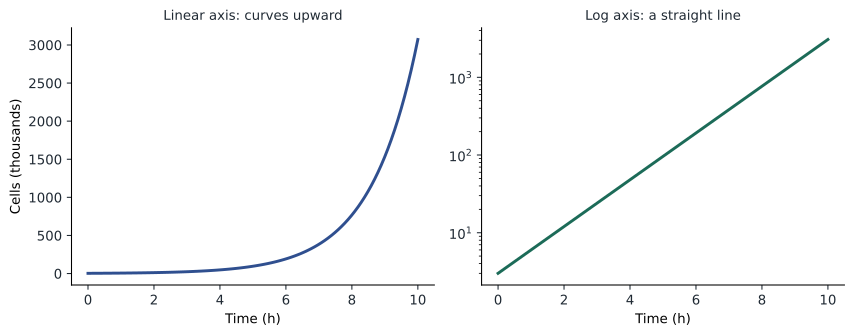
On a semilog graph, one axis (usually y) is logarithmic: equal distances represent equal factors, such as 1, 10, 100, 1,000. Exponential growth or decay appears as a straight line, and the slope corresponds to the rate constant. Doubling time or half-life can be read directly as the horizontal distance over which the line rises or falls by a factor of 2. Semilog plots are standard for bacterial growth curves, drug concentrations over time and radioactive decay. On a log-log graph, both axes are logarithmic, and a power law, y equals k x to the n, appears as a straight line with slope n. If a log-log plot of flow against vessel radius has a slope of 4, that is Poiseuille's fourth-power law.
When reading any graph, start with the axes: the variables, their units, whether the scale is linear or logarithmic and where it starts. A truncated axis that does not begin at zero can make small differences look large. Lesson 11 continues with error bars, statistics and how to judge whether a difference in a graph is meaningful.
Common mistakes
Mistakelog(2 × 10⁻⁴) = −4.3.
InsteadAdd the log of the coefficient to the exponent: 0.3 + (−4) = −3.7.
MistakeA 10 percent increase followed by a 10 percent decrease returns to the starting value.
Instead1.1 × 0.9 = 0.99, a net 1 percent decrease.
MistakeTo take the square root of 10⁻⁵, halve the exponent to 10⁻²·⁵.
InsteadMake the exponent even first: 10⁻⁵ = 10 × 10⁻⁶, and the square root is about 3.16 × 10⁻³.
MistakeA straight line on a semilog plot means linear growth.
InsteadIt means exponential growth or decay; linear growth curves on a semilog plot.
MistakeYou must compute both the old and new values to find how a result changes.
InsteadWrite the ratio new/old; unchanged quantities cancel.
Summary and key terms
- Estimate to one significant figure first; look at the answer choices to decide how precise you must be.
- In scientific notation, multiply coefficients and add exponents; make exponents even before taking square roots.
- Use the ratio method for any "what if this changes" question.
- Know log 2 ≈ 0.30, log 3 ≈ 0.48, log 5 ≈ 0.70, ln 2 ≈ 0.693 and ln 10 ≈ 2.30; log(a × 10ⁿ) = n + log a.
- Exponential processes multiply by a constant factor per interval; count doublings and half-lives.
- Semilog plots make exponentials straight; log-log plots make power laws straight with slope equal to the exponent.
- Scientific notation
- A number written as a coefficient between 1 and 10 times a power of ten.
- Order of magnitude
- The power of ten nearest to a quantity.
- Logarithm
- The exponent to which a base must be raised to produce a given number.
- Natural logarithm
- A logarithm with base e, about 2.718.
- Exponential decay
- Decrease by a constant factor in each equal time interval.
- Semilog graph
- A graph with one logarithmic axis, on which exponential change is a straight line.
- Log-log graph
- A graph with both axes logarithmic, on which a power law is a straight line.
- Significant figures
- The digits in a measurement that carry information about its precision.
Practice problems
Work each problem on paper first, then reveal the answer to check.
Calculate (4 × 10⁶)(2.5 × 10⁻⁹).
Show answer
10 × 10⁻³ = 1 × 10⁻².
What is the square root of 3.6 × 10⁻⁷?
Show answer
Rewrite as 36 × 10⁻⁸; the root is 6 × 10⁻⁴.
What is the pH of a solution with [H⁺] = 5 × 10⁻³ M?
Show answer
3 − 0.7 = 2.3.
A bacterial culture doubles every 30 minutes. By roughly what factor does it grow in 5 hours?
Show answer
10 doublings: 2¹⁰ ≈ 1,000.
On a log-log plot, intensity against distance falls with a slope of −2. What law does this show?
Show answer
An inverse-square law: intensity ∝ 1/r².
Lesson quiz · 5 questions
Score 60% or more to complete this lesson.
Create a free account to save your progress, take quizzes and earn a certificate.