
MBA-612 · Lesson 8 of 12 · 21 min
Sustainability reporting standards and assurance
Anne Dufresne, who chairs Cedarline's audit committee, sends Dr. Holloway's class a folder of requests the company received last year. Its two largest wholesale customers want its greenhouse gas emissions, its targets and evidence of audits of its contract factories, because they must report the emissions of their own suppliers. Its banks, preparing to renew its credit facility, ask for its emissions and climate risks, because their regulators require them to understand the climate exposure of their loans. A bondholder asks whether it plans to publish a report aligned with international standards. And a rating agency has sent a questionnaire of 140 questions. Cedarline has answered each request separately, with different numbers in some of them, because nobody owns the data.
Dr. Holloway says that Cedarline's experience is typical of companies that are not yet required to report but are already being asked. The demand for sustainability information comes through the value chain, from lenders and customers, long before it comes from regulators. The answer is not to respond to each request but to prepare one set of reliable information, using a recognized standard, with the same controls that apply to financial information. This lesson describes the standards, the patchwork of requirements in different jurisdictions and the growing role of assurance.
From many frameworks to a global baseline
For two decades, companies that reported on sustainability could choose among many frameworks. The Global Reporting Initiative, founded in 1997, published standards for reporting a company's impacts on the economy, the environment and people, and remains the most widely used framework for impact reporting. CDP, founded in 2000 as the Carbon Disclosure Project, collects environmental data from companies through annual questionnaires on behalf of investors and large purchasers. The Sustainability Accounting Standards Board developed industry standards for financially material topics. And the Task Force on Climate-related Financial Disclosures, created by the Financial Stability Board and chaired by Michael Bloomberg, published recommendations in 2017 for disclosing climate risks under four headings: governance, strategy, risk management, and metrics and targets.
Investors complained that the choice of frameworks made reports incomparable. In November 2021 the IFRS Foundation, which oversees international accounting standards, announced the creation of the International Sustainability Standards Board, which absorbed the SASB standards and built on the task force's recommendations. In June 2023 the ISSB issued its first two standards. IFRS S1 sets general requirements for disclosing sustainability-related risks and opportunities that could reasonably be expected to affect a company's cash flows, access to finance or cost of capital. IFRS S2 sets specific requirements for climate. Both use the task force's four pillars and are designed to be published at the same time and for the same entity as the financial statements.
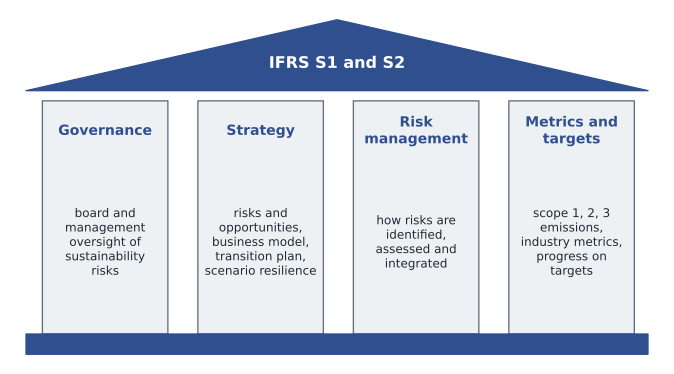
IFRS S2 requires a company to disclose how its board and management oversee climate risks; the climate risks and opportunities it faces, including physical risks from extreme weather and chronic changes, and transition risks from policy, technology and market changes; their current and anticipated effects on its business model, strategy and financial position; any transition plan; the resilience of its strategy under different climate scenarios, using scenario analysis; how it identifies and manages climate risks; and metrics including its scope 1, scope 2 and scope 3 greenhouse gas emissions measured under the Greenhouse Gas Protocol, together with industry-specific metrics and progress toward any targets. The standards include transition reliefs, allowing companies in their first year to report on climate only and to omit scope 3 emissions.
Adoption has spread quickly. By mid-2026, according to one widely followed tracker, 35 jurisdictions had adopted the ISSB standards on a voluntary or mandatory basis and about a dozen more planned to, including Australia, Japan, Brazil, the United Kingdom and many Asian and African markets, often with local modifications.
The requirements in Canada, the United States and Europe
Canada's approach has two parts. The Canadian Sustainability Standards Board, created in 2023, published the Canadian Sustainability Disclosure Standards in December 2024: CSDS 1, based on IFRS S1, and CSDS 2, based on IFRS S2, with longer transition reliefs, including relief from reporting scope 3 emissions until fiscal years beginning in 2028. The standards are voluntary unless a regulator requires them. In April 2025 the Canadian Securities Administrators, which had proposed a climate disclosure rule for listed companies in 2021, paused work on it, citing the need to support the competitiveness of Canadian markets amid changes in the United States and elsewhere; listed companies must still disclose material climate risks under existing rules. The federal financial regulator, OSFI, has kept its Guideline B-15, which requires federally regulated banks and insurers to manage climate risk and publish climate disclosures, and in 2025 aligned its requirements with CSDS 2, deferring scope 3 emissions to fiscal 2028. Because banks must understand the emissions of the companies they lend to, the guideline reaches borrowers like Cedarline indirectly.
The European Union's Corporate Sustainability Reporting Directive, adopted in 2022, requires reporting under European Sustainability Reporting Standards based on double materiality, with limited assurance. After objections that it was too burdensome, the EU adopted a simplification package, the Omnibus Directive, which entered into force in March 2026. It narrowed the scope to companies with more than 1,000 employees and net turnover above 450 million euros, and to non-EU groups with more than 450 million euros of turnover in the EU and an EU subsidiary or branch with turnover above 200 million. Many Canadian and American multinationals with large European operations remain in scope, and their suppliers, like Cedarline, receive data requests as a result.
Measuring greenhouse gas emissions
Almost all emissions reporting uses the Greenhouse Gas Protocol, developed by the World Resources Institute and the World Business Council for Sustainable Development from 1998 onwards. It divides a company's emissions into three scopes. Scope 1 covers direct emissions from sources the company owns or controls, such as fuel burned in its boilers and vehicles. Scope 2 covers indirect emissions from the generation of electricity, steam, heat and cooling it buys. Scope 3 covers all other indirect emissions in its value chain, in fifteen categories, including purchased goods and services, transportation, business travel, employee commuting, the use of sold products and their end-of-life treatment.
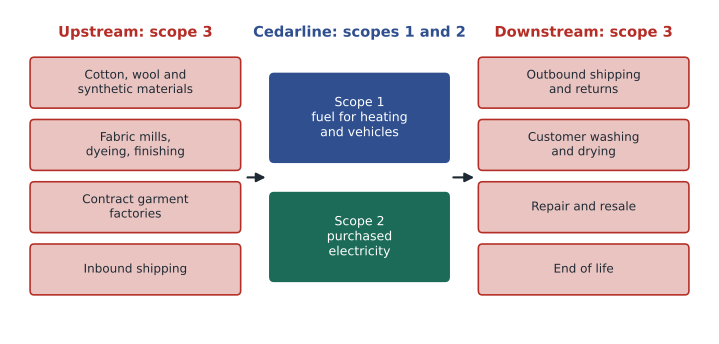
Emissions are usually estimated rather than measured, by multiplying activity data, such as litres of fuel, kilowatt hours of electricity, kilograms of fabric or dollars spent, by emission factors that give the emissions per unit of activity. Scope 2 can be reported by two methods: the location-based method uses the average emission factor of the grid where the electricity is used, while the market-based method uses the factors of the specific electricity a company has contracted for, such as renewable power purchase agreements. For scope 3, companies combine supplier-specific data where they have it with industry averages and spend-based factors where they do not.
The code below estimates Cedarline's emissions for fiscal 2026 from the data its teams have gathered. Electricity emission factors differ greatly among Canadian provinces, from very low in Quebec, British Columbia and Ontario, where hydroelectric and nuclear power dominate, to much higher in Alberta and Saskatchewan; the calculation uses a weighted average for the provinces where Cedarline's stores and distribution centre are located.
# Cedarline's greenhouse gas emissions, fiscal 2026 (t of CO2 equivalent)
scope1 = {"natural gas for heating": (1_450_000, 0.0019),      # m3, t per m3
          "diesel and gasoline in vehicles": (210_000, 0.0026)}  # L, t per L
scope2 = {"electricity, stores and offices": (9_800_000, 0.00012),  # kWh, weighted grid factor for its provinces
          "electricity, warehouse": (3_900_000, 0.00004)}
scope3 = {"purchased goods: garments and gear": (3_150_000, 0.0168),  # units, t per unit, raw material to finished
          "inbound shipping": (41_000_000, 0.000_000_08 * 1_000),      # t-km of ocean and road freight
          "outbound shipping and returns": (1_200_000, 0.0021),        # parcels
          "business travel and commuting": (1, 1_900),
          "use of sold products: washing and drying": (3_150_000, 0.0014),
          "end of life of sold products": (3_150_000, 0.0009)}
def total(d): return {k: q * f for k, (q, f) in d.items()}
t1, t2, t3 = total(scope1), total(scope2), total(scope3)
s1, s2, s3 = sum(t1.values()), sum(t2.values()), sum(t3.values())
grand = s1 + s2 + s3
for name, part in (("Scope 1", s1), ("Scope 2 (location-based)", s2), ("Scope 3", s3)):
    print(f"{name:25s} {part:9,.0f}  {part / grand:6.1%}")
print(f"{'Total':25s} {grand:9,.0f}")
for k, v in sorted(t3.items(), key=lambda kv: -kv[1])[:3]:
    print(f"  largest scope 3 item: {k:42s} {v:8,.0f}")
revenue_m = 468
print(f"intensity: {grand / revenue_m:,.0f} t per million dollars of revenue; {grand / 3_150_000 * 1000:.1f} kg per unit sold")Scope 1 3,301 4.6% Scope 2 (location-based) 1,332 1.8% Scope 3 67,865 93.6% Total 72,498 largest scope 3 item: purchased goods: garments and gear 52,920 largest scope 3 item: use of sold products: washing and drying 4,410 largest scope 3 item: inbound shipping 3,280 intensity: 155 t per million dollars of revenue; 23.0 kg per unit sold
Cedarline's total footprint is about 72,500 tonnes, and scope 3 is about 94 per cent of it, dominated by the materials and manufacturing of the products it buys. Its own operations, scopes 1 and 2, account for only about 4,600 tonnes, because Canadian grids where most of its stores are located have relatively low emission factors. The implication for strategy is clear: Cedarline cannot make a meaningful difference by changing its light bulbs. Its emissions depend on what its products are made of, where and how they are made, and how long they last. That is where the durable strategy matters, because a jacket that lasts twice as long, with a repair or two, roughly halves the manufacturing emissions per year of use.
Dr. Holloway warns the cohort about the uncertainty in such numbers. Scope 3 estimates based on industry averages can be wrong by a third or more, and a change in emission factors or methods can move the total more than any real reduction. Companies should state their methods, use supplier data where possible, restate prior years when methods change and avoid claiming progress that is really a change in estimates.
Connecting sustainability and financial reporting
The ISSB standards require sustainability disclosures to be connected to the financial statements: the same reporting entity, the same period and consistent assumptions. If a company tells investors in its sustainability report that rising carbon prices or changing customer demand will reduce the value of some assets, its accountants must ask whether the financial statements reflect the same view, for example in impairment tests, the useful lives of equipment or provisions for restoring sites. Regulators and auditors have increasingly asked about such inconsistencies. A company that describes severe climate risks in one document and assumes business as usual in its impairment models in another invites questions about both.
Connectivity also changes who prepares the information. In companies that report well, the finance function owns the process, the sustainability team provides expertise, operations provide the activity data, and internal audit tests the controls, just as for financial reporting. The board's audit committee reviews the report before publication, and the full board approves the disclosures on governance and strategy, since they describe the board's own oversight. Dr. Holloway notes that directors are legally responsible for what the company publishes about sustainability as much as for its accounts, and that misleading sustainability statements in a prospectus or continuous disclosure can give rise to the same liability as misleading financial information.
Assurance
As sustainability information becomes part of decisions by investors, lenders and customers, they want independent assurance that it is reliable, just as they do for financial statements. Assurance may be limited, in which the practitioner performs fewer procedures and concludes that nothing has come to its attention suggesting the information is materially misstated, or reasonable, the level of an audit, in which the practitioner gives a positive opinion. Most current sustainability assurance is limited, and most regulations phase in reasonable assurance only after several years.
In November 2024 the International Auditing and Assurance Standards Board issued ISSA 5000, a global standard for sustainability assurance usable by both accountants and other assurance providers, and Canada's standard setter has adopted a Canadian equivalent. Assurance requires that the information be prepared under controls: defined owners for each data set, documented methods, reconciliations to source data and review, which is why Anne Dufresne's audit committee, rather than marketing, should oversee Cedarline's sustainability reporting.
Worked problem
Planning Cedarline's first sustainability report
Cedarline is not required to publish a sustainability report, but its customers, lenders and bondholders are asking, and a listing would bring further expectations. Plan its first report.
Show solution
- Standard: report against the ISSB-based standards, CSDS in Canada or IFRS S1 and S2 in the United States, using the climate-first relief in year one, because these are what investors and lenders recognize; publish a short index mapping to the GRI standards for customers interested in impacts.
- Scope: climate in year one, with scope 1 and 2 emissions and an estimate of scope 3, plus the other topics found material in lesson 7: supply chain labour, chemicals and durability.
- Controls: name an owner for each data set, document methods, reconcile to source data and place the process under the audit committee, with internal audit testing it.
- Assurance: obtain limited assurance of scope 1 and 2 emissions in year one, adding scope 3 and other metrics later.
- Single source: answer every customer, lender and rating questionnaire from the same data set.
Answer: Cedarline should publish a climate-first report under the ISSB-based standards with assured scope 1 and 2 emissions and an estimated scope 3, prepared under financial-style controls overseen by the audit committee, and use it to answer all external requests consistently.
Common mistakes
MistakeSustainability reporting is only for companies required to do it.
InsteadDemand arrives through lenders, customers and investors long before regulation.
MistakeA company's own operations are its main source of emissions.
InsteadFor most product companies, scope 3 emissions in the value chain are far larger.
MistakeThe ISSB and European standards ask for the same information.
InsteadThe ISSB uses financial materiality; European standards use double materiality and cover more topics.
MistakeSustainability data can be prepared by marketing.
InsteadReliable data need owners, methods, reconciliations and review, overseen like financial information.
Summary and key terms
- Many frameworks, including GRI, CDP, SASB and the TCFD, have consolidated around the ISSB's IFRS S1 and S2, built on four pillars.
- IFRS S2 requires disclosure of climate governance, strategy, risk management, scenario resilience and scope 1, 2 and 3 emissions.
- Canada has voluntary CSDS standards, a paused securities rule and OSFI requirements for financial institutions; the SEC has moved to rescind its rule while California requires emissions reporting by large companies; the EU narrowed the CSRD in 2026.
- The GHG Protocol divides emissions into three scopes; scope 3 usually dominates for product companies, and estimates are uncertain.
- Assurance, limited or reasonable, is spreading under ISSA 5000 and requires financial-style controls over sustainability data.
- Companies facing many requests should build one controlled data set and report it under a recognized standard.
- IFRS S2
- The ISSB standard for climate-related disclosures.
- Scope 1 emissions
- Direct emissions from sources a company owns or controls.
- Scope 2 emissions
- Indirect emissions from purchased electricity, steam, heat and cooling.
- Scope 3 emissions
- All other indirect emissions in a company's value chain.
- Emission factor
- The emissions per unit of an activity, used to estimate emissions from activity data.
- Limited assurance
- A lower level of assurance in which the practitioner reports that nothing suggests material misstatement.
Practice problems
Work each problem on paper first, then reveal the answer to check.
What are the four pillars of ISSB disclosure?
Show answer
Governance, strategy, risk management, and metrics and targets.
In the code example, what is the largest source of Cedarline's emissions?
Show answer
The materials and manufacturing of the garments and gear it buys.
What is the difference between location-based and market-based scope 2?
Show answer
Location-based uses average grid factors; market-based uses the factors of the electricity a company has contracted for.
Why should the audit committee oversee sustainability reporting?
Show answer
The data need the same controls, review and assurance as financial information.
Lesson quiz · 5 questions
Score 60% or more to complete this lesson.
Create a free account to save your progress, take quizzes and earn a certificate.