
MBA-612 · Lesson 1 of 12 · 25 min
What corporate governance is: agency, accountability and control
In June 2020 Wirecard, a German payments company that had joined the DAX index of Germany's largest listed firms two years earlier, announced that 1.9 billion euros of cash that its accounts showed in trust accounts in Asia probably did not exist. Within days its chief executive had resigned and been arrested, and the company had filed for insolvency. Journalists and short sellers had raised questions about its accounts for years. Its auditor had signed clean opinions for a decade, its supervisory board had accepted management's explanations, and the national financial regulator had at one point investigated the critics rather than the company. Shareholders lost almost everything, and Germany later rebuilt its system of audit oversight.
Dr. Margaret Holloway opens the cohort's course on corporate governance with the case because, in her words, nothing about it required genius to detect. Every safeguard that is supposed to protect investors existed on paper: a board, an audit committee, an external auditor, a regulator and a stock exchange. Each assumed that another was doing the checking. Dr. Holloway spent nineteen years as an audit partner, has chaired the audit committees of two listed companies, a pension fund and a hospital, and now teaches and researches boards. She tells the cohort that governance is not a set of documents but a set of habits: who asks which questions, who has the information to answer them, and what happens when the answers are unsatisfactory.
This is the last winter term of the weekend MBA at the Lakeshore School of Business in Toronto, and the course draws on everything the cohort has studied. Each member brings an organization with its own governance. Owen Tremblay works for Prairie Ridge Energy, which is listed on the Toronto Stock Exchange and faces pressure from investors over its climate plans. Daniel Osei is the controller of Northfield Components, a private manufacturer owned by a founding family. Leo Brandt is co-founder and chief financial officer of Kestrel Analytics, a software company whose board includes its venture capital investors. Hana Kowalski runs operations at Lakeview Health, a not-for-profit with a volunteer board. Grace Mwangi has just left Fairway Grocers, which is owned by a pension fund and a family holding company, to lead Second Ascent, the repair start-up the cohort helped launch in MBA-602.
Defining corporate governance
The most widely quoted definition comes from the 1992 Cadbury Report in the United Kingdom, written after a series of corporate collapses: corporate governance is the system by which companies are directed and controlled. The definition is short but contains two ideas. Direction concerns where the company is going: its purpose, strategy and major decisions. Control concerns whether those decisions are carried out properly and honestly: oversight of management, the reliability of financial reporting, the management of risk and compliance with the law. A board that only controls becomes a group of auditors who never ask whether the strategy makes sense; a board that only directs becomes a second management team that nobody is watching.
A broader definition from the OECD Principles of Corporate Governance, first issued in 1999 and revised several times since, describes governance as the set of relationships between a company's management, its board, its shareholders and other stakeholders, which provides the structure through which objectives are set and the means of attaining them and monitoring performance are determined. This definition emphasizes relationships rather than rules. Governance allocates rights and responsibilities among the people who have a stake in a company and creates ways of holding each of them to account.
Dr. Holloway asks the cohort to think of governance as answering four questions. Who decides? Governance allocates decision rights among shareholders, the board and managers. On whose behalf? It defines the interests that decisions should serve. With what information? It determines what decision makers can see and how reliable it is. And with what consequences? It creates rewards for good decisions and penalties for bad ones, from bonuses to dismissal to lawsuits. When governance fails, it is usually because one of these four has broken down.
The separation of ownership and control
In 1932 Adolf Berle and Gardiner Means published The Modern Corporation and Private Property, which documented a new fact about the American economy. The largest corporations were no longer run by the people who owned them. Their shares were spread across thousands of investors, none holding enough to influence management, so salaried executives controlled assets that belonged to others. Berle and Means worried that such managers would serve themselves rather than the owners, and they asked what could make them accountable. Almost a century later, that question still organizes the field.
In 1976 Michael Jensen and William Meckling gave the problem its modern form in a paper on agency theory. An agency relationship exists whenever one party, the principal, engages another, the agent, to act on its behalf and delegates some decision-making authority. Because the agent's interests are not identical to the principal's, and because the principal cannot observe everything the agent does, the agent will sometimes act in its own interest. A manager may build an empire through acquisitions that raise her status but destroy value, enjoy perquisites paid for by the firm, avoid risky but valuable projects that might cost her job, or simply work less hard than an owner would.
Jensen and Meckling showed that these problems create agency costs, which they divided into three parts. Monitoring costs are what principals spend to watch agents, such as audits, boards and reporting systems. Bonding costs are what agents spend to assure principals that they will behave, such as accepting contracts that tie their pay to results or submitting to reviews. Residual loss is the value that still disappears because monitoring and bonding are never perfect. Good governance does not eliminate agency costs, which would be impossibly expensive; it tries to minimize their total.
Three agency problems
The lawyers who wrote The Anatomy of Corporate Law, a comparative study first published in 2004, identified three agency problems that every system of corporate law must address. The first is between owners and managers, the problem Berle and Means described: how to ensure that managers act in the owners' interest rather than their own. It dominates in companies with widely dispersed shareholders, such as most large companies listed in the United States and the United Kingdom.
The second is between controlling and minority shareholders. When a family, a founder, a parent company or a government holds enough shares to control a company, the owner-manager problem shrinks, because the controller can watch management closely. But a new problem appears: the controller may use its power to benefit itself at the expense of other shareholders, for example by paying itself through related-party contracts, by appointing relatives regardless of ability, or by buying out minority holders at an unfair price. Economists call such transfers private benefits of control. This problem dominates in much of continental Europe, Asia and Latin America, and is common in Canada.
The third is between the company, as represented by its shareholders, and other parties who deal with it, such as creditors, employees, customers and communities. Shareholders, through the managers they control, may take actions that benefit them at others' expense, such as taking on risks that creditors bear if the company fails or cutting safety spending whose costs fall on workers and neighbours. Contracts, regulation and the duties of directors each address parts of this problem, and the debate over stakeholder capitalism, which the cohort will study in lesson 6, is largely a debate about how much corporate governance itself should address it.
Canada has an unusually large number of controlled companies among its larger listed firms, many with dual-class shares that give a family or founder more votes than its economic stake. Familiar examples include Rogers Communications, where the late founder's family controls the voting shares through a trust; in 2021 a public dispute within the family over the company's leadership was resolved in the Supreme Court of British Columbia, which upheld the controlling shareholder's right to replace directors by written resolution. Cases like this show both sides of control: a long-term owner can protect a company from short-term pressure, but minority shareholders have little influence when the controller decides to act.
The agency problem can be made concrete with a simple model. Suppose a manager chooses how hard to work and how much the firm spends on her perquisites, such as a larger office or a corporate jet. Effort raises the firm's value but is costly to her personally; perquisites cost the firm but please her. The code below compares the choices of a manager who owns the firm outright with those of a salaried manager and a manager whose pay includes a share of the profits, and shows the value lost in each case.
# Agency costs in a simple model of a manager's choices (amounts in millions)
def firm_value(effort, perks):
    return 100 + 40 * effort - perks          # effort from 0 to 1 raises value; perks reduce it

def best_choice(stake, salary=2.0, monitoring=0.0):
    best = None
    for e10 in range(11):                     # try effort levels 0.0, 0.1, ..., 1.0
        effort = e10 / 10
        for perks in range(0, 9):             # try perquisite spending of 0 to 8
            caught = min(1.0, monitoring * perks / 8)        # monitoring makes perks risky
            payoff = (salary + stake * firm_value(effort, perks)
                      + 0.6 * perks * (1 - caught)          # she values perks below their cost
                      - 12 * effort ** 2)                    # the personal cost of effort
            if best is None or payoff > best[0]:
                best = (payoff, effort, perks)
    return best[1], best[2]

owner_value = firm_value(*best_choice(stake=1.0, salary=0.0))
for label, stake, monitor in [("owner-manager", 1.0, 0.0), ("salaried manager", 0.0, 0.0),
                              ("salaried, monitored", 0.0, 1.0), ("30% equity stake", 0.30, 0.0),
                              ("30% stake, monitored", 0.30, 1.0)]:
    e, p = best_choice(stake, salary=0.0 if stake == 1.0 else 2.0, monitoring=monitor)
    v = firm_value(e, p)
print(f"{label:22s} effort {e:.1f} perks {p} firm value {v:6.1f} loss vs owner {owner_value - v:5.1f}")owner-manager effort 1.0 perks 0 firm value 140.0 loss vs owner 0.0 salaried manager effort 0.0 perks 8 firm value 92.0 loss vs owner 48.0 salaried, monitored effort 0.0 perks 4 firm value 96.0 loss vs owner 44.0 30% equity stake effort 0.5 perks 8 firm value 112.0 loss vs owner 28.0 30% stake, monitored effort 0.5 perks 2 firm value 118.0 loss vs owner 22.0
The owner-manager works hard and spends nothing on perquisites, because she bears every dollar of their cost and receives every dollar of the value her effort creates. The salaried manager, who bears none of the cost and receives none of the value, does the reverse, and the firm is worth 48 million less. Monitoring halves the perquisites but cannot force effort, because effort is hard to observe. A 30 per cent equity stake restores half the effort, but the manager still bears less than a third of the cost of her perquisites, so she keeps spending on them. Only the combination of an equity stake and monitoring cuts the loss to about 22 million, and even then a residual loss remains. Real governance works the same way: boards, audits and controls limit the observable abuses, while pay and ownership address the unobservable ones, neither works fully on its own, and some loss is the price of having managers at all.
The mechanisms of governance
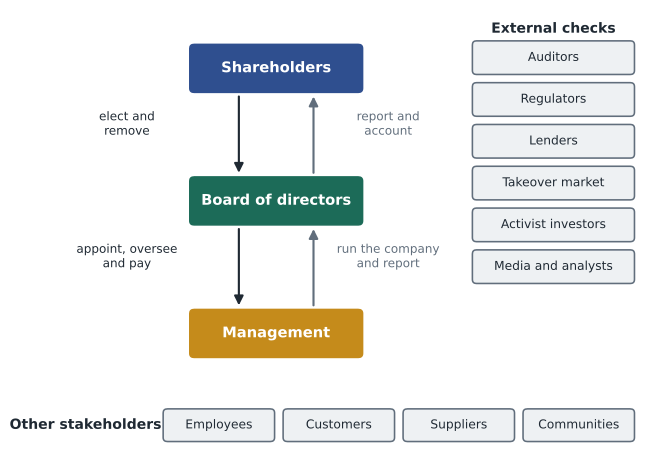
Governance mechanisms are often divided into internal and external ones. Internal mechanisms operate within the company. The board of directors is the central one: shareholders elect it, it appoints and can dismiss the chief executive, approves strategy and major transactions, sets executive pay and oversees financial reporting and risk. Executive compensation aligns managers' interests with those of shareholders. Internal audit and internal control give the board assurance that information is reliable and rules are followed. Ownership structure matters too: a large shareholder has both the incentive and the power to monitor.
External mechanisms operate from outside. The market for corporate control, described by Henry Manne in 1965, disciplines poorly run companies, because their low share prices invite takeovers by buyers who will replace management. Activist investors buy stakes and push for change without taking control. Lenders impose covenants and monitor borrowers. External auditors give an independent opinion on the financial statements. Securities regulators and stock exchanges set disclosure rules and listing standards. Courts enforce the duties of directors. Analysts, credit rating agencies, journalists and short sellers scrutinize companies, and, as Wirecard showed, are sometimes the only ones who do.
These mechanisms substitute for and complement each other. Where takeovers are difficult, boards and large shareholders must work harder. Where boards are captured by management, activists and the takeover market matter more. And where every mechanism assumes another is doing the work, as at Wirecard, the system can fail completely. Part of the task of a board is to understand which mechanisms actually operate on its company and which exist only on paper.
Rules, principles and comply or explain
Countries differ in how they write governance requirements. Canada uses a mix. Some requirements are mandatory, such as the rules in National Instrument 52-110 that require listed companies to have an audit committee of independent, financially literate directors. Most board practices, however, are set out in National Policy 58-201, a set of recommended practices covering board independence, an independent chair or lead director, position descriptions, orientation, codes of conduct, nomination, compensation and board assessments. Companies are not required to follow them but must disclose, under National Instrument 58-101, how their practices compare and explain any differences. This approach, called comply or explain, was pioneered by the United Kingdom's Cadbury code and lets investors judge whether a departure is sensible for a particular company.
Each approach has strengths. Mandatory rules create a floor that every company must meet and are easier to enforce, but they impose the same structure on companies that differ greatly, and they encourage box-ticking: a board can meet every rule and still fail to ask hard questions. Comply or explain allows flexibility and encourages companies to think about why they do what they do, but it depends on investors reading the explanations and acting on them, which many do not. In practice, Dr. Holloway says, the most important parts of governance cannot be written into rules at all: whether directors prepare, whether they challenge, and whether management tells them bad news early.
Cedarline and its governance
The cohort's case company for the course is again Cedarline Outdoor, the invented maker and retailer of outdoor clothing and equipment that it has followed since MBA-501. In MBA-514 the board approved a focused strategy of durable gear repaired for life, with fewer styles, less wholesale and a new service unit, Cedarline Care; in MBA-603 it approved a digital roadmap built around a single view of inventory and customers. This course turns to the board itself.
Cedarline was founded in 1981 by Thomas Rourke, a climbing guide who began by repairing other people's packs. It is private, owned 55 per cent by the Rourke family through a holding company and 45 per cent by Halcyon Ridge Capital, a private equity firm that bought its stake two years ago. Because it has publicly held bonds, it reports under IFRS and files financial statements with securities regulators. Its board has seven members: Elizabeth Rourke, the founder's daughter and former head of design, who chairs it; her brother Michael Rourke, who runs the family holding company; the chief executive, a professional manager hired from outside the family five years ago; Victor Lam and Sarah Feldman of Halcyon Ridge; Robert Ingram, the family's lawyer for thirty years; and Anne Dufresne, a former retail chief financial officer who chairs the audit committee.
The shareholders' agreement between the family and Halcyon Ridge gives each side the right to nominate directors in proportion to its ownership, gives Halcyon Ridge a veto over major transactions, new debt and changes to the chief executive, and gives it the right after five years to require a sale of the company or an initial public offering. That date is three years away. Elizabeth Rourke has asked Dr. Holloway's class to review Cedarline's governance, assess its sustainability reporting and climate risks, and recommend a board and sustainability strategy that would serve the company whether it lists its shares, is sold or stays private.
Worked problem
Diagnosing Cedarline's agency problems
Using the three agency problems, identify the main governance risks at Cedarline and the mechanisms that currently address them.
Show solution
- Owners and managers: the chief executive is not an owner, so her interests may diverge from the shareholders'. The risk is moderate, because both owners are concentrated and watch closely, and Halcyon Ridge has a veto over her replacement.
- Controlling and minority shareholders: neither owner is a minority in the usual sense, but the two have different horizons. The family thinks in generations; Halcyon Ridge needs an exit within three years. Decisions such as dividends, investment in long-payback projects like Cedarline Care, or the timing of a sale could favour one side.
- Shareholders and others: bondholders bear risk if the owners load the company with debt to pay themselves dividends, as the family considered in an earlier course; employees and customers depend on the repair promise being kept for decades.
- Mechanisms: the shareholders' agreement, the bond covenants, the audited statements and the two concentrated owners on the board. Missing are independent directors who could mediate between the owners, protect the company's long-term interests and give future public investors confidence.
Answer: Cedarline's main governance risk is not a self-serving manager but a potential conflict between two owners with different horizons, and a board that has only one independent director to mediate it. That is the first issue the cohort will address.
Common mistakes
MistakeCorporate governance is a set of compliance rules.
InsteadIt is a system of decision rights, information and accountability; rules are only part of it.
MistakeAgency problems disappear when a company has a controlling shareholder.
InsteadThe owner-manager problem shrinks, but a controller-minority problem appears.
MistakePaying managers with shares solves the agency problem.
InsteadIncentives help with unobservable effort but must be combined with monitoring and can create new problems.
MistakeIf a company has an auditor, an audit committee and a regulator, its accounts can be trusted.
InsteadEach safeguard works only if it actually checks, rather than assuming another has.
Summary and key terms
- Corporate governance is the system by which companies are directed and controlled: it allocates decision rights, defines whose interests they serve, determines information flows and creates consequences.
- The separation of ownership and control, described by Berle and Means, creates agency problems that Jensen and Meckling analysed as monitoring costs, bonding costs and residual loss.
- There are three agency problems: owners and managers, controlling and minority shareholders, and the company and other parties such as creditors and employees.
- Internal mechanisms include the board, pay, internal control and ownership; external ones include the takeover market, activists, lenders, auditors, regulators, courts and the media.
- Some countries rely on mandatory rules and others on comply or explain; the most important parts of governance cannot be written into rules at all.
- Cedarline is private, owned by a family and a private equity investor with an exit right in three years, and has a board with only one independent director.
- Corporate governance
- The system by which companies are directed and controlled.
- Agency relationship
- An arrangement in which a principal delegates decisions to an agent whose interests may differ.
- Agency costs
- The sum of monitoring costs, bonding costs and residual loss.
- Private benefits of control
- Value a controlling shareholder extracts that is not shared with other shareholders.
- Dual-class shares
- Share classes with different voting rights, often used to keep control with a founder or family.
- Comply or explain
- An approach in which companies disclose how their practices compare with a code and explain any departures.
Practice problems
Work each problem on paper first, then reveal the answer to check.
Why did Berle and Means see the separation of ownership and control as a problem?
Show answer
Managers controlled assets owned by dispersed shareholders, none of whom had the incentive or power to hold them to account.
In the code example, why does monitoring not restore the salaried manager's effort?
Show answer
Effort is hard to observe, so monitoring can stop visible perquisites but not shirking; incentives are needed for that.
Which agency problem is most important in a company controlled by a family with dual-class shares?
Show answer
The problem between the controlling and minority shareholders.
What is the main weakness of comply or explain?
Show answer
It depends on investors reading the explanations and acting on them, which many do not.
Lesson quiz · 5 questions
Score 60% or more to complete this lesson.
Create a free account to save your progress, take quizzes and earn a certificate.