
MBA-612 · Lesson 6 of 12 · 21 min
Stakeholder capitalism and the purpose of the corporation
In August 2019 the Business Roundtable, an association of the chief executives of about two hundred of the largest American companies, published a one-page statement on the purpose of a corporation signed by 181 of them. For more than twenty years the group's statements had said that the principal duty of management and boards was to shareholders. The new one committed the signatories to deliver value to all their stakeholders: customers, employees, suppliers, communities and shareholders, listed in that order. Supporters called it a turning point. Critics on one side called it an abandonment of accountability to owners; critics on the other called it public relations, noting that the signatories had not changed their pay plans, their boards' legal duties or, as far as anyone could tell, their decisions.
Dr. Holloway asks the cohort which critics were right. Grace Mwangi, who now runs Second Ascent, says she has never met a business that could succeed by ignoring its customers and employees, so the debate seems artificial. Owen Tremblay says that at Prairie Ridge, the hard decisions are exactly the ones where stakeholders' interests conflict, such as whether to close an old gas plant that employs a town but loses money, and a statement that everyone matters does not tell the board what to do. Both are right, Dr. Holloway says, and the lesson is about why.
Shareholder primacy
The case for focusing on shareholders was put most famously by Milton Friedman in a 1970 essay in The New York Times Magazine, whose title declared that the social responsibility of business is to increase its profits. Friedman argued that executives are employees of the owners, so when they spend company money on social causes they are spending other people's money without their consent; that they have no special competence in deciding social questions; and that such questions should be decided by governments accountable to voters. Profits should be pursued within the rules of the game, meaning open competition without deception or fraud.
Economists added further arguments. Shareholders are residual claimants: they are paid only after employees, suppliers, lenders and governments receive what their contracts and the law entitle them to, so maximizing the value of the residual claim tends to maximize the total value the firm creates, as long as contracts and laws protect the others. A single objective also makes managers accountable, because their performance can be measured; Michael Jensen argued in 2001 that a manager told to serve many masters is accountable to none, since any decision can be justified by appeal to some stakeholder.
Stakeholder theory
Stakeholder theory, developed by R. Edward Freeman in his 1984 book Strategic Management: A Stakeholder Approach, starts from a different observation. A firm is a set of relationships among groups that contribute to and depend on it, and its success depends on creating value for all of them. Employees invest skills specific to the firm, communities build roads and schools around it, suppliers invest in equipment to serve it, and none of these investments is fully protected by contracts. If the firm treats them as costs to be minimized, they will invest less, and the firm will be less valuable for everyone, including shareholders.
The two views overlap more than their rhetoric suggests. Jensen himself proposed enlightened value maximization: firms should maximize long-term value, and they cannot do so without attending to stakeholders. The United Kingdom wrote a similar idea into section 172 of its Companies Act 2006, which requires directors to promote the success of the company for the benefit of its members, having regard to the long-term consequences of decisions and the interests of employees, suppliers, customers, the community and the environment. In most decisions, serving customers, employees and communities well is how a company creates long-term value for its owners.
The views diverge in the decisions that remain: those where serving one group costs another and no long-run benefit to shareholders offsets it. Oliver Hart and Luigi Zingales argued in 2017 that companies should maximize shareholder welfare rather than shareholder value, because many shareholders care about more than money. A pension fund whose members would accept slightly lower returns for much lower pollution, for example, might reasonably want the company to pollute less even if that reduces its value. Lucian Bebchuk and Roberto Tallarita replied in 2020 that stakeholder commitments by managers who answer to no one in particular are likely to be illusory, and that protecting stakeholders is better done by laws and contracts.
What the law says
Canadian corporate law, as the cohort saw in lesson 2, takes a stakeholder-inclusive view. The duty of directors is owed to the corporation, not to shareholders as such, and since the BCE decision and the 2019 amendments to the Canada Business Corporations Act, directors may consider the interests of employees, retirees, creditors, consumers, governments and the environment, as well as shareholders and the long-term interests of the corporation. The law permits but does not require such consideration, and courts defer to boards' business judgment in weighing the interests. British Columbia has allowed companies to become benefit companies since 2020, committing in their articles to conduct business in a responsible and sustainable way and to promote one or more public benefits, and reporting annually on how they have done so.
Separate from these legal forms, the non-profit B Lab certifies companies as B Corporations if they meet standards of social and environmental performance, accountability and transparency, assessed through its impact assessment and renewed every three years. Thousands of companies worldwide hold the certification, including several well-known outdoor clothing makers.
The most discussed example in Cedarline's own industry is Patagonia. In 2022 its founder, Yvon Chouinard, and his family transferred their ownership of the company: the voting shares went to a trust designed to protect its values and the non-voting shares, representing nearly all the economic interest, to a non-profit organization that uses the profits not reinvested in the business to fight climate change and protect nature. The structure gave up the family's wealth to make the company's purpose permanent, which few owners would choose, but it shows how ownership and governance can be designed around a purpose rather than the other way round.
The backlash
Stakeholder and sustainability commitments have faced a backlash since about 2022, concentrated in the United States but felt in Canada. Several American states passed laws restricting public pension funds and state contracts from dealing with financial firms that consider environmental or social factors in ways the states objected to, and some investment managers scaled back public commitments. The Net-Zero Banking Alliance, launched in 2021 by Mark Carney, then the United Nations' special envoy on climate finance, lost its largest members, including all six of Canada's largest banks, which left in January 2025, and its members voted to shut it down in October 2025. Canadian companies operating in the United States now find that the same commitment may be demanded by investors in Toronto and attacked by officials in some American states.
Dr. Holloway draws a practical conclusion from the backlash. Commitments framed as moral statements, without a clear link to the business, are fragile: they are the first to be dropped when political winds change, and their abandonment damages trust. Commitments grounded in the company's strategy and economics, such as a durable product promise that customers pay for, or safety practices that reduce costs and attract workers, survive because they are part of how the company makes money.
Does serving stakeholders pay?
Evidence on whether attention to stakeholders improves financial performance is extensive but hard to interpret, because companies that treat stakeholders well may simply be those that can afford to. Some careful studies are suggestive. Alex Edmans found in 2011 that companies on a published list of the best companies to work for in America earned stock returns two to three percentage points a year above comparable firms over more than two decades, suggesting that the market undervalued employee satisfaction, an intangible that eventually showed up in profits. Mozaffar Khan, George Serafeim and Aaron Yoon found in 2016 that companies performing well on the sustainability issues material to their industry outperformed, while performance on immaterial issues made no difference.
The pattern in the research matches Dr. Holloway's practical advice. Attention to stakeholders pays when it addresses relationships that matter to the business, such as employees in a service company, customers' trust in a brand built on quality or safety in a hazardous industry. It does not pay, and may not be meant to, when it is spread across causes unrelated to the business. Boards should therefore ask two separate questions about any stakeholder commitment: does it create long-term value for the company, and, if not, is it something the owners want the company to do anyway, knowing the cost? Both are legitimate questions; confusing them is what makes many commitments fragile.
Mapping stakeholders
Boards and managers analyse stakeholders in practical ways. A common tool is the power-interest grid, which places each group according to its power to affect the company and its interest in the company's decisions. Groups with high power and high interest must be managed closely; those with high power but low interest kept satisfied; those with high interest but low power kept informed. Ronald Mitchell, Bradley Agle and Donna Wood proposed in 1997 a related model of stakeholder salience based on three attributes: power to influence the firm, legitimacy of the claim and urgency, meaning the degree to which the claim calls for immediate attention. Stakeholders with all three demand the most attention.
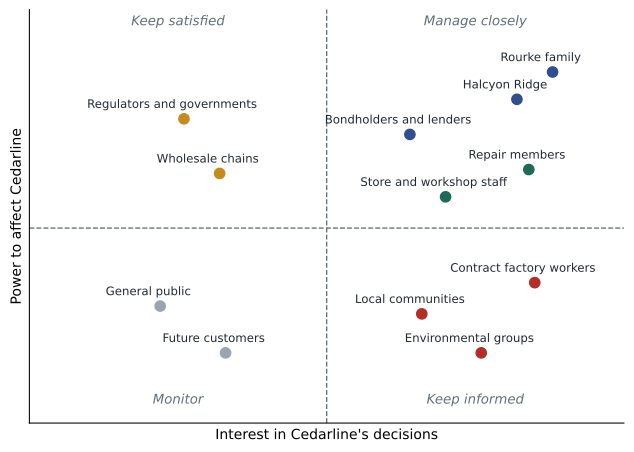
The code below scores Cedarline's main stakeholders on the three salience attributes and then applies the scores to a real decision the board faces: whether to close the repair workshop in a small northern town where the founder opened Cedarline's first store, which loses money but trains most of the company's senior technicians.
# 1. Stakeholder salience scores (1 low to 5 high)
stakeholders = {  # power, legitimacy, urgency
    "Rourke family":             (5, 5, 3),
    "Halcyon Ridge":             (5, 5, 4),
    "Bondholders and lenders":   (4, 5, 2),
    "Repair members":            (3, 5, 3),
    "Workshop technicians":      (2, 5, 4),
    "Contract factory workers":  (1, 5, 3),
    "Northern town":             (1, 4, 4),
    "Environmental groups":      (2, 3, 2),
}
ranked = sorted(stakeholders.items(), key=lambda kv: -(kv[1][0] * kv[1][1] * kv[1][2]))
for name, (p, l, u) in ranked:
    print(f"{name:26s} power {p} legitimacy {l} urgency {u}  salience {p * l * u:3d}")

# 2. Close the northern workshop? Present values over ten years (thousands)
effects = {  # effect of closing, by stakeholder
    "Shareholders: operating savings":        +3_100,
    "Shareholders: training replaced in city":  -1_400,
    "Shareholders: repair turnaround and churn": -900,
    "Technicians: lost jobs and moves":          -2_200,
    "Town: lost payroll and store traffic":      -1_600,
    "Repair members: longer waits":              -500,
}
shareholder = sum(v for k, v in effects.items() if k.startswith("Shareholders"))
everyone = sum(effects.values())
print(f"effect on shareholder value {shareholder:+,}; effect on all stakeholders {everyone:+,}")Halcyon Ridge power 5 legitimacy 5 urgency 4 salience 100 Rourke family power 5 legitimacy 5 urgency 3 salience 75 Repair members power 3 legitimacy 5 urgency 3 salience 45 Bondholders and lenders power 4 legitimacy 5 urgency 2 salience 40 Workshop technicians power 2 legitimacy 5 urgency 4 salience 40 Northern town power 1 legitimacy 4 urgency 4 salience 16 Contract factory workers power 1 legitimacy 5 urgency 3 salience 15 Environmental groups power 2 legitimacy 3 urgency 2 salience 12 effect on shareholder value +800; effect on all stakeholders -3,500
The salience scores put the two owners at the top, with Halcyon Ridge first because its approaching exit makes its claims urgent, followed by the repair members, whose renewals fund Cedarline Care. The workshop technicians score level with the bondholders, because their claim is legitimate and urgent even though their power is modest. In the closure decision, closing the workshop appears to save 3.1 million dollars, but once the cost of replacing the training it provides and the effect of slower repairs on members' renewals are counted, the gain to shareholders shrinks to 0.8 million. Counting the costs to the technicians, the town and members, the closure destroys 3.5 million of value in total. A board applying narrow shareholder value might close it; one applying enlightened value maximization would first check whether the training and loyalty benefits have been valued properly; and one weighing stakeholders' welfare would keep it open or look for a way to reduce its losses, such as making it the national training centre for Cedarline Care.
Dr. Holloway notes that the numbers for the town and the technicians are estimates that no accounting system produces, which is exactly why such effects tend to be ignored. Making them explicit, even roughly, changes the discussion, because the board must decide openly whether and how much to weigh them rather than leaving them out by default.
Worked problem
Writing Cedarline's statement of purpose
Elizabeth Rourke asks the cohort for a one-sentence statement of purpose for Cedarline and a recommendation on whether it should become a certified B Corporation or adopt a benefit company or public benefit corporation form.
Show solution
- Ground the purpose in the strategy: Cedarline's competitive advantage, as the cohort found in MBA-514, is durability and repair, which customers value and which also reduces the environmental cost of clothing.
- Draft: Cedarline makes outdoor gear that lasts, and keeps it in use for life, so that people can spend more time outdoors while using fewer of the world's resources.
- Certification: B Corporation certification would test the claim independently and is valued by many of Cedarline's customers, but requires effort and recertification; it is compatible with private ownership, a listing or a sale.
- Legal form: a benefit company or public benefit corporation form would make the purpose binding and require reporting, but could reduce the pool of buyers if Halcyon Ridge sells, so it should be considered with the family as part of the decision on control.
Answer: Cedarline should adopt a purpose statement grounded in durability and repair, pursue B Corporation certification as an independent test, and decide on a legal benefit form only together with the decision on its long-term ownership.
Common mistakes
MistakeFriedman argued that companies should do anything to make a profit.
InsteadHe argued for profits within the rules of the game, without deception or fraud, with social questions left to governments.
MistakeStakeholder theory means ignoring shareholders.
InsteadIt holds that value for shareholders depends on creating value for all groups who contribute to the firm.
MistakeShareholder and stakeholder views conflict in most decisions.
InsteadThey agree in most decisions; they diverge only where one group's gain is another's loss with no offsetting long-run benefit.
MistakePurpose statements are harmless if they are vague.
InsteadVague commitments are fragile and damage trust when abandoned; commitments grounded in the strategy last.
Summary and key terms
- The Business Roundtable's 2019 statement reopened the debate over whether companies serve shareholders or all stakeholders.
- Shareholder primacy rests on accountability, the residual claim and the role of government; Friedman and Jensen are its best-known advocates.
- Stakeholder theory, from Freeman, holds that firms succeed by creating value for all who contribute; enlightened value maximization joins the views.
- Canadian law permits directors to consider stakeholders; Delaware law is more stockholder-focused; benefit forms and B Corporation certification make commitments explicit.
- A backlash since about 2022 has made fragile commitments costly; those grounded in strategy survive.
- Power-interest grids and salience scores help boards map stakeholders and make trade-offs explicit.
- Shareholder primacy
- The view that the corporation should be run mainly to maximize value for shareholders.
- Stakeholder theory
- The view that firms should create value for all groups that contribute to and depend on them.
- Enlightened value maximization
- Maximizing long-term firm value, recognizing that this requires attention to stakeholders.
- Benefit corporation
- A legal form in which a company commits in its charter to a public benefit and reports on it.
- B Corporation
- A company certified by B Lab as meeting standards of social and environmental performance and accountability.
- Stakeholder salience
- The degree to which a stakeholder's claim commands attention, based on power, legitimacy and urgency.
Practice problems
Work each problem on paper first, then reveal the answer to check.
Why did Jensen argue that a single objective is necessary?
Show answer
Managers told to serve many masters are accountable to none, because any decision can be justified by appeal to some stakeholder.
How do Hart and Zingales differ from Friedman?
Show answer
They argue for maximizing shareholder welfare, including shareholders' non-financial preferences, rather than only value.
In the code example, why does the shareholder gain from closing the workshop shrink?
Show answer
The savings are offset by the cost of replacing its training and by slower repairs that reduce renewals.
What did Patagonia's 2022 restructuring do?
Show answer
It placed voting control in a purpose trust and the economic interest in a non-profit that uses surplus profits to fight climate change.
Lesson quiz · 5 questions
Score 60% or more to complete this lesson.
Create a free account to save your progress, take quizzes and earn a certificate.