
MBA-612 · Lesson 7 of 12 · 22 min
ESG: concepts, ratings and materiality
In May 2022 S&P Dow Jones Indices removed Tesla from its S&P 500 ESG index, which selects companies with stronger environmental, social and governance scores. The maker of the world's best-selling electric cars was out; ExxonMobil, one of the world's largest oil companies, remained in. The index provider explained that Tesla's score had fallen because of concerns about working conditions, racial discrimination claims and its handling of investigations into crashes involving its driver assistance system, and that the index measured how companies managed the risks of their own industries rather than whether their products were good for the planet. Elon Musk called ESG a scam. Many observers, whatever they thought of Tesla, concluded that something was confusing about a measure that could produce such a result.
Dr. Holloway says the episode is a good way into the subject, because it shows that ESG means different things to different people. To some it means managing the environmental and social risks that affect a company's value; to others, the company's impact on the world; to others still, a set of values that investors want their money to reflect. Ratings, reporting standards and investment products have been built on each of these meanings, often without saying which. This lesson untangles the concepts, examines how ESG ratings work and why they disagree, and introduces materiality, the idea that determines what a company should measure and report.
Where ESG came from
The term ESG was popularized by Who Cares Wins, a 2004 report by a group of financial institutions convened by the United Nations Global Compact, which argued that environmental, social and governance issues affect investment value and that analysts should integrate them into their work. The Principles for Responsible Investment, launched in 2006 with United Nations support, committed signatories to incorporate ESG issues into investment analysis and ownership; thousands of investors managing a large share of the world's invested assets have since signed. Earlier traditions fed in too: socially responsible investing, which excluded industries such as tobacco or weapons on ethical grounds, and corporate social responsibility, the idea that companies have obligations beyond profit.
Each letter covers a broad set of issues. Environmental issues include greenhouse gas emissions, energy use, pollution, water, waste, biodiversity and the use of materials. Social issues include labour practices, health and safety, human rights in the supply chain, product safety, data privacy, diversity and relations with communities. Governance issues include board structure, executive pay, shareholder rights, business ethics, bribery and corruption, tax practices and political lobbying. Governance has the longest history in investment analysis and the clearest links to value; the environmental and social issues that matter vary greatly by industry.
Two meanings of materiality
Information is material, in the accounting and securities law sense, if omitting or misstating it could reasonably be expected to influence the decisions of investors. Sustainability reporting has adopted two different versions of the idea. Financial materiality asks which sustainability matters could affect the company's cash flows, cost of capital or access to finance, and therefore its value; it looks from the outside in. Impact materiality asks which matters represent the company's significant impacts on people and the environment, whether or not they affect its value; it looks from the inside out.
The International Sustainability Standards Board, created in 2021 by the foundation that sets international accounting standards, uses financial materiality: its standards require disclosure of sustainability-related risks and opportunities that could reasonably be expected to affect the company's prospects. The European Union's sustainability reporting standards use double materiality, requiring companies to report matters that are material from either perspective. A matter material from one perspective often becomes material from the other over time, a dynamic sometimes called dynamic materiality: a company's pollution may affect only its neighbours today but become a financial risk when regulation tightens or customers react.
Materiality also depends on industry. The Sustainability Accounting Standards Board, founded in 2011 and now part of the ISSB's foundation, developed standards for 77 industries, each identifying the few sustainability topics most likely to be financially material for companies in that industry. For apparel, accessories and footwear companies, the standards emphasize raw materials sourcing, environmental impacts in the supply chain, labour conditions in the supply chain and the management of chemicals in products. For an electric utility, they emphasize greenhouse gas emissions, grid resilience and end-use efficiency. The ISSB requires companies to refer to these industry standards in identifying their sustainability risks and opportunities.
ESG ratings
ESG ratings attempt to summarize a company's performance on these issues in a single score or letter grade. The largest providers include MSCI, Sustainalytics, owned by Morningstar, S&P Global and ISS. Most combine data from companies' own reports, questionnaires sent to companies, news and other public sources, and analysts' judgments, weighted by industry. MSCI's ratings, for example, aim to measure a company's resilience to financially material ESG risks relative to industry peers, which explains results like Tesla's: a rating of risk management within an industry is not a rating of a company's contribution to solving environmental problems.
Ratings from different providers disagree to a remarkable degree. Florian Berg, Julian Kölbel and Roberto Rigobon, in a study published in 2022 that they titled Aggregate Confusion, compared the ratings of six prominent providers for the same companies and found correlations between pairs of providers ranging from about 0.38 to 0.71. Credit ratings from different agencies, by comparison, are correlated at about 0.99. The authors traced the disagreement to three sources: scope, meaning which issues each provider includes; measurement, meaning how each provider measures the same issue; and weights, meaning how much importance each gives to each issue. Measurement differences were the largest source.
The code below illustrates the problem with ten invented apparel companies rated by three providers, and then shows how the choice of weights alone can reorder the companies.
import math
firms = ["A", "B", "C", "D", "E", "F", "G", "H", "I", "J"]   # Cedarline is firm C
rater1 = [72, 55, 61, 80, 45, 68, 50, 77, 59, 64]
rater2 = [60, 70, 52, 74, 58, 49, 66, 71, 63, 55]
rater3 = [81, 48, 69, 62, 40, 73, 57, 66, 52, 70]

def corr(x, y):
    mx, my = sum(x) / len(x), sum(y) / len(y)
    cov = sum((a - mx) * (b - my) for a, b in zip(x, y))
    return cov / math.sqrt(sum((a - mx) ** 2 for a in x) * sum((b - my) ** 2 for b in y))

for (n1, x), (n2, y) in [(("1", rater1), ("2", rater2)), (("1", rater1), ("3", rater3)), (("2", rater2), ("3", rater3))]:
    print(f"correlation between raters {n1} and {n2}: {corr(x, y):.2f}")

def rank(scores): return sorted(firms, key=lambda f: -scores[firms.index(f)])
for name, r in (("rater 1", rater1), ("rater 2", rater2), ("rater 3", rater3)):
    print(f"{name} ranking: {' '.join(rank(r))}   Cedarline (C) is number {rank(r).index('C') + 1}")

# Same underlying topic scores, different weights
topics = {  # emissions, working conditions, governance scores for each firm
    "A": (70, 75, 80), "B": (50, 62, 58), "C": (92, 55, 40), "D": (60, 85, 82), "E": (40, 50, 55),
    "F": (75, 60, 70), "G": (45, 72, 50), "H": (65, 70, 90), "I": (55, 58, 66), "J": (80, 52, 60),
}
for label, w in (("emissions-heavy", (0.6, 0.2, 0.2)), ("governance-heavy", (0.2, 0.2, 0.6))):
    score = {f: sum(a * b for a, b in zip(v, w)) for f, v in topics.items()}
    order = sorted(score, key=lambda f: -score[f])
print(f"{label:17s} weights: {' '.join(order)} C is number {order.index('C') + 1}")correlation between raters 1 and 2: 0.24 correlation between raters 1 and 3: 0.69 correlation between raters 2 and 3: -0.34 rater 1 ranking: D H A F J C I B G E Cedarline (C) is number 6 rater 2 ranking: D H B G I A E J C F Cedarline (C) is number 9 rater 3 ranking: A F J C H D G I B E Cedarline (C) is number 4 emissions-heavy weights: C A F H J D I B G E C is number 1 governance-heavy weights: H D A F J I B C G E C is number 8
The three raters agree only partly. Raters 1 and 3 are reasonably consistent, but rater 2 is barely related to rater 1 and is negatively related to rater 3, so a company it likes, the others tend not to. Cedarline ranks fourth for rater 3, sixth for rater 1 and ninth for rater 2. The second part shows that even when every rater agrees on how well each company performs on each topic, a rater that weights emissions heavily ranks Cedarline first, because its durable products and repair service give it strong emissions performance per use, while one that weights governance heavily ranks it near the bottom, because it is a private company with few independent directors. Neither is wrong; they measure different things. A board that wants to understand its ratings must ask what each one measures, and should not chase a higher score for its own sake.
Ratings have also become a target of regulation. The European Union adopted a regulation in 2024 requiring ESG rating providers that operate in the EU to be authorized and supervised by the European Securities and Markets Authority from 2 July 2026, to disclose their methods and to separate rating from consulting to avoid conflicts. Canada has no equivalent rules, but Canadian companies rated by providers serving European clients are affected indirectly, and Canadian institutional investors increasingly ask providers to explain their methods.
What boards should do with ratings
Ratings matter to companies even when they are imperfect, because some investors use them to screen portfolios, some index funds use them to select constituents, some lenders link loan margins to them and some large customers use them to choose suppliers. Grace Mwangi reports that two of Fairway's suppliers lost shelf space after scoring poorly on a supplier sustainability questionnaire that Fairway's buyers barely read. Boards should therefore know their main ratings and the reasons behind them, but treat them as one input among many rather than as targets.
Dr. Holloway suggests four practices. First, identify which ratings and questionnaires actually affect the company's capital, customers or reputation, and ignore the rest. Second, make sure the data the providers use are correct, since many low scores reflect missing or outdated information rather than poor performance, and providers usually allow companies to review and correct the facts. Third, ask what each rating measures and whether it is relevant to the company's strategy; a low score on an issue that is immaterial to the business is not a reason to change course. Fourth, publish clear, comparable data on the material topics, because better disclosure is the most reliable way to improve the accuracy of every rating at once. Chasing a score, by contrast, tends to produce long reports full of policies that change little.
ESG in investing
Investors use ESG information in several distinct ways, and confusion about which way a product follows has caused much of the controversy. Exclusion, or negative screening, removes companies or industries from a portfolio on ethical grounds or because of risks. Integration adds ESG factors to ordinary financial analysis, with the aim of better risk-adjusted returns. Best-in-class selection chooses the companies with the strongest ESG performance within each industry. Thematic investing targets themes such as clean energy or water. Impact investing seeks measurable social or environmental benefits alongside returns. And stewardship uses voting and engagement to improve companies' practices.
Only integration and stewardship claim to be driven purely by financial returns; the others express investors' preferences, accepting that this may cost some return. Products that blurred these purposes, presenting value-based choices as risk management or vice versa, invited the charge from one side that ESG was a political project and from the other that it was greenwashing. After years of rapid growth, funds marketed on ESG criteria saw significant withdrawals in the United States from 2023, while European demand held up better.
Greenwashing
Greenwashing means making misleading claims about the environmental performance of a product, a company or an investment fund. In Canada, amendments to the Competition Act in June 2024 added specific provisions requiring that claims about the environmental benefits of a product be based on adequate and proper testing, and that claims about a business's environmental benefits, such as a net-zero target, be based on adequate and proper substantiation. Further amendments that received royal assent in March 2026 removed the requirement that business claims be substantiated in accordance with internationally recognized methodology and limited private parties' ability to bring cases about such claims to the Competition Tribunal, while leaving the rules on product claims in place. Penalties for deceptive marketing can reach three times the benefit derived or 3 per cent of worldwide revenue.
For Cedarline, whose strategy is built on a claim about durability, the risk is real. Statements such as built to last a lifetime or the most sustainable jacket we make must be backed by testing, repair data and a reasonable method, and the company's marketing, product and legal teams should review them together. Dr. Holloway recommends a simple rule: never make an environmental claim that the company would not be comfortable defending, with data, in front of a regulator.
Worked problem
Building Cedarline's double materiality assessment
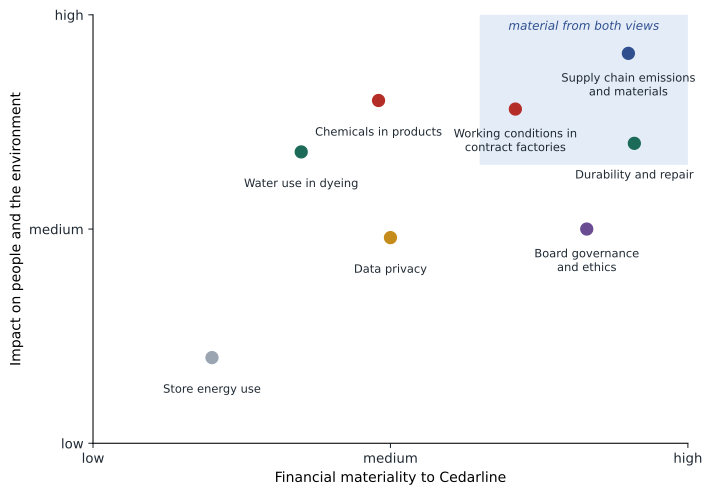
Cedarline must decide which sustainability topics to focus on in its strategy and first sustainability report. Outline a materiality assessment and its likely results.
Show solution
- List candidate topics using the apparel industry standards and peers' reports: materials and supply chain emissions, labour conditions in contract factories, chemicals, water in dyeing and finishing, product durability and end of life, store and distribution energy, data privacy, diversity and governance.
- Assess financial materiality with finance, risk and the board: which topics could affect costs, revenue, access to capital or the value of the brand over short, medium and long horizons.
- Assess impact materiality with input from stakeholders: contract factory workers' representatives, customers, repair members, environmental groups and employees, using evidence on the scale, scope and irremediability of impacts.
- Plot the results and set thresholds: topics high on either axis are reported; those high on both shape the strategy.
Answer: Supply chain emissions and materials, labour conditions in contract factories and product durability and repair are material from both perspectives and should be the core of Cedarline's sustainability strategy; chemicals and water are significant impacts to manage and report; store energy is minor.
Common mistakes
MistakeESG ratings measure how good a company is for the world.
InsteadMost measure how well a company manages ESG risks to its own value relative to industry peers.
MistakeA high ESG rating from one provider means others will agree.
InsteadCorrelations between providers are low because of differences in scope, measurement and weights.
MistakeMateriality is the same in every reporting framework.
InsteadISSB standards use financial materiality; European standards use double materiality.
MistakeEnvironmental claims are marketing and need no evidence.
InsteadProduct and business claims must be supported by testing or substantiation, and penalties can be large.
Summary and key terms
- ESG emerged from a 2004 United Nations initiative and the Principles for Responsible Investment, drawing on older ethical and social responsibility traditions.
- Financial materiality looks at effects on the company; impact materiality looks at the company's effects on people and the environment; double materiality uses both.
- Material topics differ by industry, as the SASB standards identify; for apparel, sourcing, supply chain labour and chemicals stand out.
- ESG ratings from different providers correlate weakly because of differences in scope, measurement and weights; most measure risk management within industries.
- Investors use ESG through exclusion, integration, best-in-class, thematic, impact and stewardship approaches with different aims.
- Greenwashing rules require evidence for environmental claims, and penalties can be substantial.
- ESG
- Environmental, social and governance factors considered in business and investment decisions.
- Financial materiality
- The significance of a sustainability matter for a company's cash flows, cost of capital or value.
- Impact materiality
- The significance of a company's effects on people and the environment.
- Double materiality
- An approach that treats a matter as material if it is material from either perspective.
- ESG rating
- A score or grade summarizing a company's environmental, social and governance performance or risk.
- Greenwashing
- Making misleading claims about environmental performance.
Practice problems
Work each problem on paper first, then reveal the answer to check.
Why was Tesla removed from the S&P 500 ESG index while ExxonMobil remained?
Show answer
The index measured how companies managed risks in their industries, and Tesla's scores on social and governance issues had fallen.
What three sources of ESG rating divergence did Berg, Kölbel and Rigobon identify?
Show answer
Scope, measurement and weights.
In the code example, why does Cedarline's rank change so much with the weights?
Show answer
It is strong on emissions but weak on governance, so weighting one or the other reorders it.
What is dynamic materiality?
Show answer
The tendency of a matter material only for its impacts to become financially material over time, for example as regulation tightens.
Lesson quiz · 5 questions
Score 60% or more to complete this lesson.
Create a free account to save your progress, take quizzes and earn a certificate.