
MBA-612 · Lesson 5 of 12 · 21 min
Shareholders, activism and proxy voting
Owen Tremblay arrives at the fifth session with news. A hedge fund has disclosed that it owns just over 4 per cent of Prairie Ridge Energy and has sent the board a public letter. It argues that the market values Prairie Ridge's wind and solar business at almost nothing because it is buried inside a gas processing company, and demands that the board either sell the renewables business or spin it off as a separate listed company. It also wants two seats on the board and says it will nominate its own candidates at the next annual meeting if the board does not agree. At the same time, a group of pension funds has filed a shareholder proposal asking Prairie Ridge to publish a plan for reaching net-zero emissions. Owen's chief executive has asked him to estimate how the votes might go.
Dr. Holloway says that a decade ago Owen's situation would have been unusual; now it is routine. The owners of most large listed companies are not individuals but institutions, such as pension funds, mutual funds, index funds and insurance companies, and a few of them hold very large stakes. Activist investors have become a permanent part of the market. Proxy advisers shape how many institutions vote. And the rules on shareholder proposals, disclosure and voting have been rewritten repeatedly in both countries. This lesson covers who owns companies, how shareholders exercise their rights, and how activism and voting work.
Who the shareholders are
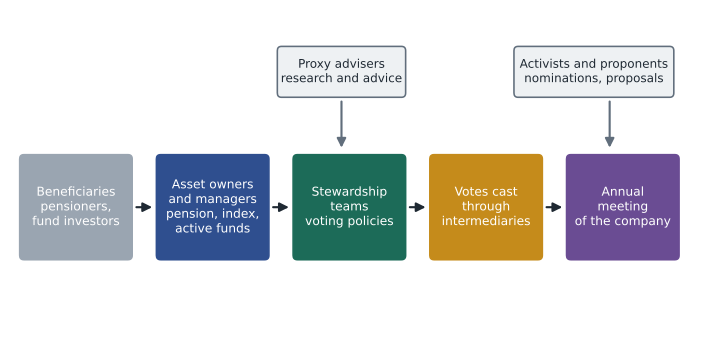
Institutional investors own the large majority of the shares of large listed companies in both Canada and the United States. Much of that ownership is concentrated. The three largest index fund managers, BlackRock, Vanguard and State Street, together hold around a fifth of the shares of a typical company in the S&P 500 index, so their votes can decide close contests. Large public pension funds, such as those that manage the Canada Pension Plan, Quebec's public sector pensions and the pensions of teachers and public employees in both countries, are also influential, and many manage some of their assets directly rather than through fund managers.
Institutional ownership changes the agency problem that Berle and Means described. Shareholders are no longer dispersed individuals with no means of acting together. But institutions are themselves agents for their own beneficiaries, such as pensioners and fund investors, and face their own conflicts and limits. Index funds hold every company in an index, compete on low fees and cannot sell a company they dislike, so they have weak financial incentives to spend money monitoring individual companies, though they have strong incentives to improve governance across the whole market. Ronald Gilson and Jeffrey Gordon described this as the agency costs of agency capitalism: institutions are rationally reticent, voting on proposals put to them but rarely starting campaigns themselves.
Shareholder rights
Shareholders' basic rights are to elect and remove directors, to vote on fundamental changes such as mergers, sales of substantially all assets and amendments to the articles, to receive information, to make proposals and to sue directors who breach their duties. Most shareholders exercise their votes by proxy, appointing someone, usually management's nominees, to vote their shares as instructed at the annual meeting. The company sends a proxy circular or proxy statement describing the matters to be voted on, including the directors standing for election, their pay and any shareholder proposals.
Canadian law has strengthened director elections. Since 2014 the Toronto Stock Exchange has required listed companies to adopt majority voting, under which a director who receives more votes withheld than in favour must offer to resign, and amendments to the Canada Business Corporations Act that took effect in 2022 require distributing corporations to elect directors individually and annually and provide that a nominee who does not receive a majority of votes cast is not elected, subject to limited exceptions. Shareholders holding 5 per cent of the shares can requisition a meeting, and those holding 1 per cent, or shares worth 2,000 dollars, for six months can submit a proposal for inclusion in the circular.
Proxy advisers and stewardship
Because large institutions hold thousands of companies and vote on tens of thousands of resolutions a year, many rely on proxy advisers, chiefly Institutional Shareholder Services and Glass Lewis, which research each meeting and recommend how to vote according to published policies or clients' custom guidelines. Their recommendations can move a meaningful share of the vote, especially on pay and contested elections, which has made them influential and controversial. Companies complain of errors, one-size-fits-all policies and too little time to respond; investors reply that they use the advice as an input rather than a substitute for their own judgment.
Asset managers and owners describe their monitoring and voting as stewardship, and many have signed stewardship codes. In Canada, the Canadian Coalition for Good Governance, whose members are institutional investors, publishes stewardship principles and engages directly with boards of large companies each year. Several large managers now offer clients voting choice, letting pension funds and some fund investors choose among voting policies rather than leaving all votes to the manager, which reduces the concentration of voting power in a few firms.
Shareholder proposals
Shareholder proposals in Canada are governed by corporate statutes, such as section 137 of the Canada Business Corporations Act, which allows eligible shareholders to have a proposal and a supporting statement of up to 500 words included in the circular. Companies may refuse proposals in limited circumstances, such as those submitted mainly to redress a personal grievance or substantially similar to one defeated recently. Proposals are typically advisory. Quebec-based shareholder groups have been especially active, filing proposals at most large banks and many other companies each year on topics from governance to climate, and investors increasingly use proposals on climate plans, human rights and lobbying disclosure.
Even advisory proposals matter. A proposal that receives a majority, or even a substantial minority, of votes puts pressure on the board to respond, and proxy advisers may recommend votes against directors who ignore one. Many proposals are withdrawn after the company agrees to some or all of what was asked, so the number that reach a vote understates their influence.
Shareholder activism
Activist investors, usually hedge funds, buy stakes in companies they believe are undervalued because of poor strategy, capital allocation or governance, and push for changes that would raise the share price. Their demands typically include selling or spinning off businesses, returning cash through buybacks or dividends, cutting costs, replacing the chief executive, selling the whole company or adding directors. They begin with private letters and meetings, may move to public letters and media campaigns, and as a last resort nominate directors in a proxy contest. Most campaigns end in settlements in which the company gives the activist one or more board seats or agrees to a strategic review.
Activism has grown steadily. Lazard, which advises companies facing activists, reported that 2025 set a third consecutive record for the number of campaigns worldwide, at 297, with demands related to mergers and acquisitions, such as selling the company or a division, among the initial objectives in 35 per cent of them. Research by Alon Brav, Wei Jiang, Frank Partnoy and Randall Thomas published in 2008 found that share prices rose by around 7 per cent around the announcement of hedge fund activist stakes, with no reversal over the following year, and that operating performance improved. Critics, notably the lawyer Martin Lipton, argue that activists force short-term actions such as buybacks and cuts in research and investment that harm companies over longer periods. The evidence on long-term effects remains contested.
Disclosure rules shape activism. In Canada, an investor that acquires 10 per cent of a class of voting shares must issue a news release promptly and file an early warning report within two business days, and must report each further 2 per cent change; the threshold falls to 5 per cent when a takeover bid is under way. Activists can therefore accumulate a larger stake quietly in Canada than in the United States.
The universal proxy and the concentration of voting power in a few large institutions mean that the outcome of a contest often depends on how index funds and large active managers vote. Both sides therefore spend weeks meeting the largest holders. The code below models the vote at Prairie Ridge if the activist nominates two candidates against the board's slate, using estimates of each holder group's size, turnout and likelihood of supporting the activist.
# Estimating support for an activist's nominees in a contested election
holders = [  # group, share of outstanding shares, turnout, probability of supporting the activist
    ("activist itself",         0.042, 1.00, 1.00),
    ("index funds",             0.210, 0.98, 0.30),
    ("large active managers",   0.260, 0.95, 0.55),
    ("pension funds",           0.110, 0.95, 0.45),
    ("other hedge funds",       0.060, 0.90, 0.80),
    ("retail investors",        0.220, 0.30, 0.20),
    ("insiders and employees",  0.020, 0.95, 0.00),
    ("other institutions",      0.078, 0.80, 0.40),
]
voted = sum(s * t for _, s, t, _ in holders)
support = sum(s * t * p for _, s, t, p in holders)
print(f"turnout {voted:.1%} of shares; activist support {support / voted:.1%} of votes cast")
for name, s, t, p in holders:
    print(f"  {name:24s} {s * t / voted:5.1%} of votes, {s * t * p / voted:5.1%} for the activist")

# How much does the index funds' choice matter?
for p_index in (0.15, 0.30, 0.50):
    sup = support - 0.210 * 0.98 * 0.30 + 0.210 * 0.98 * p_index
print(f"index funds supporting at {p_index:.0%}: activist gets {sup / voted:.1%}")turnout 80.1% of shares; activist support 46.0% of votes cast activist itself 5.2% of votes, 5.2% for the activist index funds 25.7% of votes, 7.7% for the activist large active managers 30.8% of votes, 17.0% for the activist pension funds 13.1% of votes, 5.9% for the activist other hedge funds 6.7% of votes, 5.4% for the activist retail investors 8.2% of votes, 1.6% for the activist insiders and employees 2.4% of votes, 0.0% for the activist other institutions 7.8% of votes, 3.1% for the activist index funds supporting at 15%: activist gets 42.1% index funds supporting at 30%: activist gets 46.0% index funds supporting at 50%: activist gets 51.1%
On these estimates, the activist would receive about 46 per cent of the votes cast, with turnout around 80 per cent. Retail investors, who own a fifth of the shares, cast few votes, while index funds cast more than a quarter of all votes and active managers about a third. Changing the index funds' support from 15 to 50 per cent moves the result from a clear loss to a narrow win, which is why both sides concentrate on them. Owen's recommendation to his chief executive follows from the numbers: the contest is too close to risk. The board should engage with the largest holders, commission an independent review of the renewables business, and consider offering the activist one seat in exchange for a standstill agreement, rather than fighting for every seat.
Owen also notes that the climate proposal and the activist's demands interact. The pension funds filing the proposal are long-term holders whose support the board will need against the activist; responding constructively to their request, for example by committing to publish a transition plan aligned with Canada's sustainability disclosure standards, may be both good governance and good tactics.
How boards respond
A board facing an activist has several options, and Dr. Holloway urges the cohort to think about them before an activist appears. The best defence is to act like an activist itself: to review the portfolio, capital allocation and performance against peers regularly and candidly, so that an outsider finds little to propose that the board has not already considered. Boards that know their largest holders, meet them regularly outside of crises and can explain their strategy in terms those holders understand are far better placed when a campaign begins. Once one has begun, the board's duty is to evaluate the activist's proposals on their merits, with independent advice, rather than to treat them as an attack to be repelled.
Canadian law limits the defences available against hostile takeovers more than American law does. Since 2016, securities rules have required takeover bids to remain open for at least 105 days, unless the target's board agrees to a shorter period, and to be accepted by holders of more than half of the shares not owned by the bidder before any shares can be taken up. Because the rules already give boards time to seek alternatives, regulators will usually cease-trade a shareholder rights plan, or poison pill, that tries to block a bid for longer. Staggered boards, in which only a fraction of directors stand for election each year, are not permitted for distributing corporations under the federal statute, which requires annual elections.
Worked problem
Planning Cedarline's shareholder base for a listing
If Cedarline lists its shares in three years, the family wants to keep control, and Halcyon Ridge wants to sell most of its stake. Investors in a listing will ask about voting rights. What structure should the board consider?
Show solution
- Option 1, a single class of shares: the family would hold perhaps 40 per cent after the listing, enough to block most changes and influence elections, but not to control them alone.
- Option 2, dual-class shares: the family would hold multiple-voting shares and keep control with a smaller economic stake. Many investors and index providers dislike the structure, and it may reduce the price.
- Option 3, dual-class shares with protections: multiple-voting shares that convert to ordinary shares after a fixed period, such as ten years, or when the family's economic stake falls below a threshold, with a majority of independent directors and a coattail provision protecting ordinary shareholders in a takeover.
- Weigh the trade-off: control protects the durable strategy from short-term pressure, but investors will pay less for shares with weaker rights, and the family's own wealth depends on the price.
Answer: Cedarline should prefer a single class, with the family as an anchor shareholder of about 40 per cent and a strong independent board; if the family insists on control, dual-class shares should have a sunset, a coattail and a majority of independent directors.
Common mistakes
MistakeInstitutional investors are passive owners.
InsteadThey vote on everything and engage privately, though index funds rarely start campaigns themselves.
MistakeShareholder proposals have no effect because they are advisory.
InsteadVotes and withdrawals after negotiation change many companies' practices.
MistakeActivists always destroy long-term value.
InsteadThe evidence on long-term effects is contested; announcement returns and operating improvements have been found.
MistakeRetail investors decide close contests.
InsteadMost retail holders do not vote; large institutions usually decide.
Summary and key terms
- Institutions own most shares of large listed companies, and a few index fund managers and pension funds hold very large stakes.
- Shareholders elect directors, vote on fundamental changes and can make proposals and sue; most vote by proxy.
- Majority voting, universal proxies and individual director elections have strengthened shareholders' influence over boards.
- Proxy advisers and stewardship teams shape votes, and both have come under political pressure.
- Shareholder proposals are advisory but influential; the American rules are being reconsidered.
- Activists push for strategic, financial and governance changes, mostly ending in settlements; disclosure thresholds differ between the two countries.
- Proxy
- An authorization for another person to vote a shareholder's shares at a meeting.
- Majority voting
- A rule or policy under which a director must receive a majority of votes cast to be elected or must offer to resign.
- Proxy adviser
- A firm that researches shareholder meetings and recommends how to vote.
- Shareholder proposal
- A resolution submitted by a shareholder for a vote at the annual meeting.
- Activist investor
- An investor that buys a stake and campaigns for changes to raise the company's value.
- Standstill agreement
- An agreement by an investor not to increase its stake or launch a contest for a period.
Practice problems
Work each problem on paper first, then reveal the answer to check.
Why do index funds have weak incentives to monitor individual companies?
Show answer
They cannot sell companies they dislike and compete on low fees, so spending on monitoring one company brings little benefit relative to its cost.
What did the universal proxy change in contested elections?
Show answer
Shareholders can vote for a mix of company and dissident nominees on one card, making it easier for activists to win some seats.
In the code example, why do index funds matter so much?
Show answer
They cast more than a quarter of the votes, so a change in their support swings the result.
What is a coattail provision?
Show answer
A protection ensuring that holders of ordinary shares can participate in a takeover offer made to holders of multiple-voting shares.
Lesson quiz · 5 questions
Score 60% or more to complete this lesson.
Create a free account to save your progress, take quizzes and earn a certificate.