
MBA-603 · Lesson 9 of 12 · 21 min
Digital customer experience and omnichannel
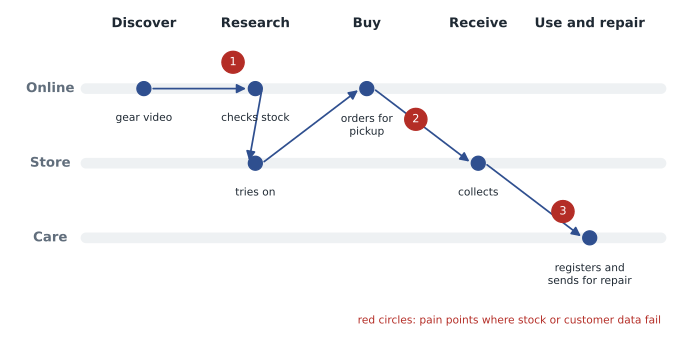
A Cedarline customer in Toronto wants a particular insulated jacket in a medium, in green, before a trip that leaves on Friday. The website shows it as out of stock. She calls the nearest store, which says its system shows two in stock, but after a search the associate finds only a large. Another store across the city has a medium, but cannot hold it or send it, because store stock is not available for online orders. She buys a rival brand's jacket online with next-day delivery. On Saturday, the medium green jacket is found in the first store's back room, mislabelled, and goes into the end-of-season clearance three weeks later at 30 per cent off.
Dr. Marchetti tells the story at the start of the ninth session because every element of it is common, and because each is a data and process problem rather than a problem of effort or goodwill. The website, the stores and the warehouse each know part of the truth. The associate's system is wrong, the product is in the wrong place, and the company's own rules prevent it from using stock it owns to make a sale. The customer experiences one brand; the company presents her with three separate businesses. This lesson examines what customers expect across channels, the operational capabilities behind a good omnichannel experience, the economics of the main fulfilment options, and how to measure and design the experience.
From multichannel to omnichannel
Retailers moved first from single channels to multichannel operations, in which stores, catalogues and websites ran as separate businesses with their own inventory, pricing and teams. Customers, meanwhile, began to move freely among them: researching online and buying in store, browsing in store and buying online, buying online and returning in store. Peter Verhoef, P. K. Kannan and Jeffrey Inman, introducing a 2015 special issue of the Journal of Retailing, defined omnichannel management as the synergetic management of the numerous available channels and customer touchpoints so that the customer experience across channels and the performance across channels are optimized. The key word is synergetic: the channels are managed as one system, with shared inventory, consistent prices and policies, and measures that credit the whole relationship rather than each channel separately.
Some retailers now speak of unified commerce, meaning that a single platform for orders, inventory, customers and payments underlies every channel, rather than separate systems linked by overnight data transfers. Whatever the label, the customer's expectations are simple. She expects to see accurate availability wherever she looks, to buy wherever is convenient and receive the product however she prefers, to return it anywhere, and to be recognized as the same customer whether she is in a store, on the website or talking to customer care.
The operational capabilities behind omnichannel
Four capabilities underlie most omnichannel services. The first is accurate, timely inventory visibility: the firm must know what is on each shelf, in each back room and in each warehouse, and show it to customers and staff within minutes. Research by Nicole DeHoratius and Ananth Raman, published in 2008, found that about 65 per cent of the inventory records they examined at a large retailer did not match the physical stock, and later studies have found similar problems. Errors accumulate from theft, damage, misplaced items, receiving mistakes and scanning errors, and they matter more when a firm promises a customer that a particular item is in a particular store. Radio-frequency identification tags on each item, now common in apparel, let stores count stock quickly and accurately, and several large apparel retailers have credited them with large improvements in inventory accuracy.
The second capability is order management: a system that receives orders from every channel and decides how to fill each one, from which location, by which method, at what cost, given the promise made to the customer. The third is store operations designed for fulfilment: space and staff for picking and packing online orders, pickup counters or lockers, and processes that do not disrupt service to shoppers in the store. The fourth is customer identity: a single record of each customer across channels, the subject of lesson 4, so that care staff, store associates and the website see the same history.
None of these is glamorous, and all are prerequisites. A retailer that launches buy online, pick up in store with inaccurate inventory will disappoint customers who arrive to find their order cannot be filled, which is worse than not offering the service at all.
The economics of fulfilment options
Dr. Marchetti asks the cohort to compare the contribution of an average 142-dollar online order fulfilled three ways: shipped from the main warehouse, shipped from a store, and bought online for pickup in store. Shipping from a store costs more to pick, because store staff are less efficient than warehouse staff, but less to ship, because the store is usually closer to the customer. It also sells store stock that might otherwise end up marked down, which the cohort estimates at a quarter of the items shipped from stores, each of which would have been cleared at 30 per cent off. Pickup has no shipping cost, lower return costs because customers can try items on at the counter, and brings customers into the store, where some buy more.
# Cost to fill one online order (dollars) and why inventory accuracy matters
order_value, margin = 142, 0.48
markdown_avoided = 0.25 * 0.30 * order_value   # store stock that would otherwise be cleared at 30 off
paths = {   # pick and pack, shipping or handling, returns cost, extra sales at pickup, markdown avoided
    "ship from main warehouse":     (6.50, 13.00, 4.20, 0.0, 0.0),
    "ship from store":              (9.00, 10.50, 4.20, 0.0, markdown_avoided),
    "buy online, pick up in store": (7.00, 0.00, 2.60, 31.0, markdown_avoided),
}
for name, (pick, ship, ret, extra, saved) in paths.items():
    contrib = order_value * margin - pick - ship - ret + extra * margin + saved
    print(f"{name:30s} contribution per order {contrib:6.2f}")
# Ship from store only works if the system knows what is on the shelf
for accuracy in (0.65, 0.80, 0.95):
    cancel = 1 - accuracy                  # item not actually there: order dropped or rerouted
    cost_of_failure = 18.0                 # rerouting, apology credit and lost future spending
    expected = order_value * margin - 9.00 - 10.50 - 4.20 + accuracy * markdown_avoided - cancel * cost_of_failure
print(f"record accuracy {accuracy:.0%}: expected contribution of a ship-from-store order {expected:6.2f}")ship from main warehouse contribution per order 44.46 ship from store contribution per order 55.11 buy online, pick up in store contribution per order 84.09 record accuracy 65%: expected contribution of a ship-from-store order 45.08 record accuracy 80%: expected contribution of a ship-from-store order 49.38 record accuracy 95%: expected contribution of a ship-from-store order 53.68
On these assumptions, a warehouse order contributes about 44 dollars, a ship-from-store order about 55 and a pickup order about 84, because pickup saves shipping and brings an average of 31 dollars of extra purchases. The comparison explains why many retailers push pickup hard, with prominent buttons, faster promises and incentives. But the second half of the output shows the condition. When store records are only 65 per cent accurate, a third of ship-from-store orders fail and must be rerouted or dropped, and the expected contribution falls to about 45 dollars, little better than shipping from the warehouse, before counting the harm to the customer relationship. At 95 per cent accuracy it rises to almost 54. Accuracy is the capability; the fulfilment option is the payoff.
Grace Mwangi notes that grocers face a sharper version of the same trade-off. Fairway fills most online grocery orders by having staff pick them in stores, which is cheap to start but slow and crowded at busy times, and it is considering a dedicated picking facility, sometimes called a dark store, for its largest city. The facility would pick faster and more accurately but would need high, steady volumes to pay back its fixed costs. The cohort's operations course gave them the tools to analyse that choice; the point here is that the customer promise, such as delivery within two hours, determines which operations are needed.
Returns and reverse logistics
Returns are a large and growing part of omnichannel economics, especially in apparel, where customers ordering online often buy several sizes and return those that do not fit. Online return rates in apparel are commonly reported to be several times those of store purchases. Each return costs shipping, handling, inspection and often a markdown, and some returned items cannot be resold at all. Retailers have responded with better size guidance, using data on what customers with similar measurements kept, with fees for mail returns in some cases, and by encouraging returns in stores, where the item can be restocked immediately and the customer may buy something else.
For Cedarline, returns connect to the durability strategy. Returned items that cannot be sold as new are candidates for Cedarline Renewed, the resale marketplace from lesson 3, after inspection and refurbishment by the repair workshops. A single product record that follows each item through returns, repairs and resale lets Cedarline know which products come back most often and why, which feeds back into design and size guidance.
Designing and measuring the experience
Customer experience is the sum of a customer's interactions with a firm, and it can be designed. Journey mapping, which the cohort used in the marketing course, traces a customer's steps, goals and feelings through a task such as buying a jacket for a trip, and identifies where the experience breaks down. Service blueprinting adds the front-stage and back-stage processes and systems that support each step, which shows why a break occurs. In the opening story, the blueprint would show that the store's stock count comes from a nightly file, that no process checks back-room locations, and that online orders cannot draw on store stock.
Firms use several measures of experience. Net Promoter Score, introduced by Frederick Reichheld in a 2003 Harvard Business Review article, asks how likely a customer is to recommend the firm and subtracts the share of detractors from the share of promoters. Customer satisfaction scores ask about satisfaction with a particular interaction. Customer effort scores ask how easy it was to get something done, on the argument that reducing effort predicts loyalty better than delighting customers. Each has critics, and Dr. Marchetti's advice is to use such scores to find problems rather than as targets, because scores used as targets are easily gamed, for example by staff asking customers for high ratings. Behavioural measures, such as repeat purchase, retention, the share of customers buying in several channels and the time taken to resolve problems, are harder to manipulate.
Accessibility is part of experience design and increasingly part of the law. The Web Content Accessibility Guidelines, published by the World Wide Web Consortium and updated to version 2.2 in October 2023, set out how to make websites and apps usable by people with disabilities, for example by supporting screen readers, keyboard navigation and sufficient contrast between text and background. In Canada, Ontario's accessibility law requires many organizations' websites to meet these guidelines, and the federal Accessible Canada Act applies to federally regulated organizations. Beyond compliance, accessible design usually improves the experience for everyone.
Organizing for omnichannel
The hardest omnichannel problems are organizational. If store managers are paid on store sales, they have little reason to give up floor space for online pickups or to ship their stock to online customers in other regions. If the online team is paid on online sales, it will not encourage customers to buy in stores. Retailers that have made omnichannel work have usually changed measures and incentives: crediting stores with online sales to customers in their area and with orders picked up or shipped from them, setting shared targets for total customer spending, and placing stores and online under a single leader for each region or customer group. Dr. Marchetti says the incentive change was the decision that unlocked progress at the retailer where she worked, more than any system.
For Cedarline, the cohort sketches a sequence. First, fix product codes and stock accuracy, beginning with item-level tags in the stores with the largest assortments; second, launch pickup in store, which is the most valuable option and the least demanding operationally; third, enable ship-from-store in stores whose accuracy passes a threshold; and throughout, change store measures to credit online sales in their areas. The single inventory view becomes the foundation of the roadmap's first phase.
Worked problem
Fixing the opening story
Using the ideas of this lesson, list the changes that would have let Cedarline sell the green medium jacket to the customer in the opening story, and say which comes first.
Show solution
- Inventory accuracy: item-level tags and regular counts would have shown the jacket in the back room and corrected the false count of two.
- Real-time visibility: a single inventory view updated within minutes would have shown the website and the call centre which stores had the jacket.
- Order management: rules allowing online orders to draw on store stock, with a ship-from-store or hold-for-pickup option, would have let the second store send or hold it.
- Incentives: crediting the second store for the sale would have given its staff a reason to fill it quickly.
Answer: Accuracy comes first, because visibility and fulfilment rules built on wrong counts produce failed promises. With accurate counts, real-time visibility, order rules that use store stock and store incentives that credit the sale, Cedarline would have sold the jacket at full price instead of clearing it at 30 per cent off and losing the customer to a rival.
Common mistakes
MistakeOmnichannel means being present in many channels.
InsteadIt means managing channels as one system with shared inventory, consistent policies and measures that credit the whole relationship.
MistakeShip-from-store always beats warehouse fulfilment.
InsteadIts advantage depends on accurate inventory records; with poor accuracy, failed orders erase the benefit.
MistakeA high Net Promoter Score target improves experience.
InsteadScores used as targets are easily gamed; use them to find problems and track behavioural measures too.
MistakeOmnichannel is mainly a technology project.
InsteadIncentives, measures and store operations often decide whether it works.
Summary and key terms
- Omnichannel management treats channels as one system so that the customer experience and total performance are optimized.
- Four capabilities underlie it: accurate and timely inventory visibility, order management, store operations designed for fulfilment, and a single customer identity.
- Inventory records are often inaccurate, and item-level tags can improve accuracy greatly.
- Pickup in store and ship-from-store can earn more than warehouse fulfilment, but only when inventory records are accurate.
- Returns are a major cost in apparel and can feed resale and design improvements when products are tracked.
- Experience should be designed with journey maps and blueprints, measured with both survey and behavioural measures, and supported by incentives that credit cross-channel sales.
- Omnichannel
- Managing all channels and touchpoints as one system to optimize the customer experience and total performance.
- Unified commerce
- A single platform for orders, inventory, customers and payments underlying every channel.
- Order management system
- Software that receives orders from all channels and decides how and from where to fill them.
- Inventory record accuracy
- The share of item-location records whose system quantity matches the physical stock.
- Net Promoter Score
- The share of customers who would recommend a firm minus the share who would not.
- Service blueprint
- A map of a customer journey that adds the front-stage and back-stage processes and systems behind each step.
Practice problems
Work each problem on paper first, then reveal the answer to check.
Why does pickup in store earn the most per order in the cohort's model?
Show answer
It has no shipping cost, lower return costs and brings extra purchases in the store.
What happens to ship-from-store contribution when record accuracy falls to 65 per cent, and why?
Show answer
It falls to about 45 dollars, close to warehouse fulfilment, because a third of orders fail and must be rerouted or dropped.
Give one change to store incentives that supports omnichannel.
Show answer
Credit stores with online sales to customers in their area and with orders shipped or picked up there.
What does a service blueprint add to a journey map?
Show answer
The back-stage processes and systems that support each customer step, which explain why breakdowns occur.
Lesson quiz · 5 questions
Score 60% or more to complete this lesson.
Create a free account to save your progress, take quizzes and earn a certificate.