
MBA-603 · Lesson 6 of 12 · 24 min
Artificial intelligence and generative AI in business
By the sixth session every member of the cohort has a story about generative AI at work. Leo Brandt's engineers use coding assistants every day and estimate that they write routine code noticeably faster, though they spend more time reviewing it. Hana Kowalski's clinics are piloting an ambient documentation tool that listens to a patient visit, with consent, and drafts the clinical note for the physician to review. Grace Mwangi's team uses a chat assistant to draft product descriptions and supplier emails. Daniel Osei has been asked by Northfield's owner to find ten uses for AI by the end of the quarter, which he thinks is the wrong way round. Owen Tremblay's company has banned staff from pasting company documents into public chat tools after an engineer did exactly that.
Dr. Marchetti says the range of stories captures where most organizations are. AI tools are everywhere, individual productivity gains are real in some tasks, and enterprise-level value is still elusive. In McKinsey's global survey fielded in mid-2025, 88 per cent of respondents said their organizations used AI in at least one business function, but only about a third said they were scaling AI programs across the enterprise, 23 per cent said they were scaling at least one AI agent system, and 39 per cent reported any effect on enterprise earnings before interest and taxes. Meanwhile, the four largest cloud providers guided in 2026 to combined capital spending on the order of 700 billion US dollars, much of it for AI data centres. The gap between investment and measured business value is the subject of this lesson: what AI is, where it creates value, what it costs, what can go wrong and how to govern it.
What AI and machine learning are
Artificial intelligence is a broad label for computer systems that perform tasks that normally require human intelligence, such as recognizing images, understanding language, making predictions or choosing actions. Most of the AI in business today is machine learning: systems that learn patterns from data rather than following rules written by software developers. Supervised learning learns to predict a known outcome from examples, such as whether a transaction is fraudulent or how many units will sell. Unsupervised learning finds structure in data without a target, such as customer segments. Reinforcement learning learns actions that maximize a reward through trial and error, as in some pricing and robotics systems. Deep learning uses many-layered neural networks and is behind most advances in image, speech and language processing since the early 2010s.
Much valuable AI is unglamorous prediction. Forecasting demand, detecting fraud, predicting machine failures, scoring credit and estimating delivery times are all supervised learning problems, and many firms have used them for years. At its core, a forecasting model is a statistical relationship between an outcome and its drivers, estimated from data. The simplest version, which Cedarline's planners could build in a spreadsheet, is a linear regression of weekly sales on a few drivers. The code below fits one from scratch for a winter parka, using temperature and whether a promotion ran.
# 1. A demand model fitted from scratch: weekly parka sales against temperature and promotion
weeks = [  # (average temperature in degrees Celsius, promotion 1/0, units sold)
    (8, 0, 455), (5, 0, 490), (3, 1, 820), (1, 0, 590), (-2, 0, 780), (-4, 1, 930),
    (-6, 0, 790), (-9, 0, 1010), (-11, 1, 1150), (-7, 0, 960), (-3, 0, 660), (0, 1, 905)]
X = [[1.0, t, p] for t, p, _ in weeks]
y = [float(u) for _, _, u in weeks]
def solve(A, b):                                   # Gaussian elimination for the normal equations
    n = len(A); M = [row[:] + [b[i]] for i, row in enumerate(A)]
    for c in range(n):
        piv = max(range(c, n), key=lambda r: abs(M[r][c])); M[c], M[piv] = M[piv], M[c]
        for r in range(n):
            if r != c:
                f = M[r][c] / M[c][c]
                M[r] = [a - f * b for a, b in zip(M[r], M[c])]
    return [M[i][n] / M[i][i] for i in range(n)]
XtX = [[sum(X[k][i] * X[k][j] for k in range(len(X))) for j in range(3)] for i in range(3)]
Xty = [sum(X[k][i] * y[k] for k in range(len(X))) for i in range(3)]
b0, b_temp, b_promo = solve(XtX, Xty)
pred = [b0 + b_temp * t + b_promo * p for t, p, _ in weeks]
mean_y = sum(y) / len(y)
r2 = 1 - sum((a - f) ** 2 for a, f in zip(y, pred)) / sum((a - mean_y) ** 2 for a in y)
mape = sum(abs(a - f) / a for a, f in zip(y, pred)) / len(y)
print(f"units = {b0:.0f} {b_temp:+.1f} x temperature {b_promo:+.0f} x promotion")
print(f"R-squared {r2:.2f}, mean absolute error {mape:.1%} of actual")
print(f"forecast for a -8 degree week without promotion: {b0 + b_temp * -8:.0f} units")units = 669 -29.6 x temperature +194 x promotion R-squared 0.92, mean absolute error 7.0% of actual forecast for a -8 degree week without promotion: 905 units
The fitted model says that each degree colder adds about 30 parkas a week and a promotion adds about 194. It explains 92 per cent of the variation in these twelve weeks, with an average error of 7 per cent, and it forecasts about 905 parkas for a minus-eight-degree week without a promotion. Real forecasting systems use many more drivers, such as price, store, size, weather forecasts, stock availability and web traffic, and more flexible models such as gradient-boosted trees or neural networks. But the logic is the same, and so are the traps: a model fitted on one season may fail when conditions change, a promotion effect estimated when stores had plenty of stock overstates what a promotion can do when sizes are missing, and twelve weeks are far too few for confidence.
Generative AI and large language models
Generative AI refers to models that produce new content, such as text, images, code, audio or video, rather than only predictions or labels. The most important for business are large language models, trained on enormous amounts of text to predict the next small piece of text, called a token, given what came before. The transformer architecture, introduced by researchers at Google in a 2017 paper, made it practical to train such models at scale, and the release of ChatGPT in November 2022 brought them to the general public. Because predicting text well requires capturing a great deal about language, facts and reasoning patterns, these models can summarize, translate, draft, classify, answer questions and write code with impressive fluency.
Managers need to understand a few properties. First, the models generate plausible text, not verified facts. They can state falsehoods confidently, a behaviour usually called hallucination, especially about specific facts, numbers and citations. Second, they know only what was in their training data, up to a cutoff date, plus whatever is placed in the prompt. Third, the prompt, including instructions, examples and documents, has a large effect on quality. Fourth, they are priced and limited by tokens: each request costs money in proportion to the text sent and received, and each model has a maximum context window. Fifth, quality varies across tasks in ways that are hard to predict, so every use needs testing.
Research on early workplace deployments suggests where gains come from. A study of more than 5,000 customer support agents by Erik Brynjolfsson, Danielle Li and Lindsey Raymond found that an AI assistant raised the number of issues resolved per hour by about 14 per cent on average, with much larger gains for novice and lower-skilled agents and little gain for the most experienced. A 2023 experiment with consultants at Boston Consulting Group, led by Fabrizio Dell'Acqua and colleagues, found that consultants using a language model completed more tasks, faster and with higher quality on tasks within the model's capabilities, but did worse than those without AI on a task deliberately chosen to fall outside them. The authors called the uneven boundary of AI capability a jagged frontier. The practical lesson is that AI helps most where tasks are well defined and quality can be checked, and that users need to know where the frontier lies.
Patterns for using generative AI
Dr. Marchetti describes four patterns, in rising order of complexity. The first is individual assistance: staff use a general chat or writing assistant licensed by the company for drafting, summarizing and analysis. It is quick to deploy and its value depends on adoption and on training people to use it well and to check its work. The second is retrieval-augmented generation, usually shortened to RAG. When a user asks a question, the system searches the company's own documents or data for relevant passages and places them in the prompt, and the model answers from them, ideally citing the sources. RAG lets a model answer questions about a company's policies, products or orders without retraining, and it reduces but does not eliminate hallucination.
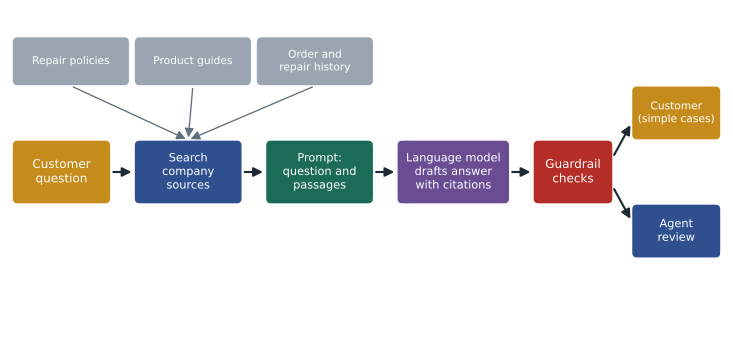
The third pattern is workflow integration: generative AI embedded in a business process, such as drafting replies inside the customer service system, extracting fields from supplier invoices or generating first drafts of product descriptions from structured data. Value is easier to measure here because the process has existing metrics. The fourth is agents: systems in which a model plans a series of steps and uses tools, such as searching, calling a company system, filling a form or sending a message, to complete a goal with less human direction. Agents are promising for multi-step work but raise new risks, because an agent that can take actions can take wrong ones, and because instructions hidden in a document or email can manipulate it, a technique called prompt injection. Most firms in 2026 are using agents in narrow, supervised workflows.
Firms also choose how to obtain models. They can use frontier models from large providers through an application programming interface, paying per token; use open-weight models that they run themselves or through a cloud provider, which gives more control over data and cost at the price of more engineering; or fine-tune a model on their own examples to improve performance on a narrow task. For most business uses, a capable model through a reputable provider with RAG over company data is the practical starting point, with attention to contract terms on data retention and use.
The economics of an AI assistant
Cedarline's care team handles about 38,000 customer contacts a month, about questions on orders, sizing, warranty and repairs. Dr. Marchetti asks the cohort to estimate the monthly economics of an assistant that resolves some simple contacts end to end and drafts replies for agents on the rest.
# 2. A generative AI assistant for Cedarline's customer care team: monthly economics
contacts = 38_000                    # customer contacts a month (chat, email, phone)
minutes_per_contact = 7.5
cost_per_agent_minute = 0.75         # wages, benefits and overhead
tokens_per_contact = 6_000           # prompt with retrieved policy and order data, plus the answer
price_per_million_tokens = 4.00      # blended input and output price, an assumption to check with the vendor
platform_fee = 9_000                 # monthly subscription, monitoring and evaluation tooling
def month(share_resolved, minutes_saved_on_rest):
    model_cost = contacts * tokens_per_contact / 1e6 * price_per_million_tokens
    resolved = contacts * share_resolved                      # handled end to end by the assistant
    assisted = contacts - resolved                            # agent answers with a drafted reply
    saved = resolved * minutes_per_contact + assisted * minutes_saved_on_rest
    benefit = saved * cost_per_agent_minute
    return model_cost, benefit, benefit - model_cost - platform_fee
for share, mins in ((0.10, 1.0), (0.25, 1.5), (0.40, 2.0)):
    m, b, net = month(share, mins)
print(f"resolve {share:.0%}, save {mins} min on the rest: model {m:7,.0f} benefit {b:8,.0f} net {net:8,.0f} a month")resolve 10%, save 1.0 min on the rest: model 912 benefit 47,025 net 37,113 a month resolve 25%, save 1.5 min on the rest: model 912 benefit 85,500 net 75,588 a month resolve 40%, save 2.0 min on the rest: model 912 benefit 119,700 net 109,788 a month
The striking number is the model cost: under 1,000 dollars a month at these assumptions, small beside the platform fee and tiny beside the benefit. In a cautious case, where the assistant resolves 10 per cent of contacts and saves a minute on the rest, the net benefit is about 37,000 dollars a month; in an ambitious case, about 110,000. The model cost is rarely what makes or breaks an AI business case. What matters is the share of work the assistant can reliably handle, which must be measured on real contacts; the cost of building the integration with order and repair systems, keeping the knowledge base current and evaluating quality; and whether the saved time turns into value. Minutes saved are worth money only if the firm hires fewer agents as volume grows, handles more contacts with the same team, or uses the time for something valuable, such as following up on repairs. Lesson 7 returns to that question.
Risks and governance
The risks of AI fall into a few groups. Accuracy risks include hallucination, errors on unusual cases and models that degrade as conditions change. Fairness risks include biased outcomes for groups of people. Privacy and security risks include confidential data leaking into prompts or outputs, prompt injection and manipulation of agents. Legal risks include intellectual property questions about training data and outputs, consumer protection rules on what AI tells customers, and sector rules, such as those for medical devices. Reputational risks include customer-facing mistakes that spread quickly; in a 2024 decision, a Canadian tribunal held an airline responsible for incorrect information about a bereavement fare refund that its website chatbot had given a customer.
Dr. Marchetti recommends a governance approach based on two widely used frameworks. The US National Institute of Standards and Technology published its AI Risk Management Framework in January 2023, organized around four functions: govern, which sets policies, roles and culture; map, which establishes the context and identifies risks of each system; measure, which assesses and tracks the risks; and manage, which prioritizes and acts on them. ISO/IEC 42001, published in late 2023, sets out requirements for an AI management system that organizations can be certified against. In practice, a firm like Cedarline needs an inventory of its AI uses, a simple risk tiering so that low-risk internal tools move fast while customer-facing and people-affecting uses get more review, an approved set of tools and data rules for staff, testing and monitoring of quality for each deployed system, human review where errors would be costly, and a clear owner for each use.
Regulation is developing quickly and differs by jurisdiction. The European Union's AI Act entered into force in August 2024, with bans on certain practices applying from February 2025 and obligations for providers of general-purpose AI models from August 2025. Its obligations for high-risk systems, such as AI used in hiring or credit, were due from August 2026, but in May 2026 the European Parliament and Council reached a provisional agreement, as part of a digital omnibus package, to delay them to December 2027 for most stand-alone high-risk systems and August 2028 for AI built into regulated products; the Parliament approved the deal in June 2026. The Act matters to North American firms that sell into Europe or whose AI systems are used there.
Canada has no AI-specific law. The proposed Artificial Intelligence and Data Act, part of Bill C-27, died when Parliament was prorogued in January 2025. The federal government appointed its first minister responsible for artificial intelligence and digital innovation in 2025, and in June 2026 it launched a national AI strategy, AI for All, built around public protection, skills, wider adoption including by small businesses, sovereign computing infrastructure, scaling Canadian companies and international partnerships, with plans to update privacy and online safety law. In the meantime, privacy law, human rights law, consumer protection and sector regulators apply to AI uses, and Quebec's Law 25 requires notice when decisions about individuals are made solely by automated processing.
Worked problem
Choosing where to start with AI
Daniel Osei must propose AI uses for Northfield. Candidates include a chat assistant licensed for all salaried staff, a model that predicts press die failures from sensor data, an AI tool that drafts quotes from customer drawings, and an agent that negotiates prices with steel suppliers by email. How should he prioritize?
Show solution
- Start from value and decisions: die failures cause costly unplanned downtime on the bottleneck press, so better prediction has a large, measurable value; quoting speed affects win rates.
- Check data and feasibility: Northfield already collects press sensor data, which makes failure prediction feasible; quotes need drawings and past quote data, which exist but are messy.
- Assess risk: an agent negotiating with suppliers takes consequential actions with external parties, and errors would be costly and hard to reverse; a licensed assistant for staff is low risk if data rules are clear.
- Sequence for learning: start with one high-value operational use and one broad low-risk tool, measure results, then expand.
Answer: Daniel should begin with die failure prediction on the bottleneck press, where the value and data are clear, and a licensed chat assistant with usage rules for salaried staff. Quote drafting is a good second step once drawing data are organized. The supplier negotiation agent should wait until Northfield has experience and controls for AI that takes actions.
Common mistakes
MistakeAI value comes mainly from choosing the best model.
InsteadValue depends on the use case, data, integration, process change and adoption; model cost is often a small part of the total.
MistakeA language model's answer is a verified fact.
InsteadModels generate plausible text and can be wrong; important answers need sources, testing and review.
MistakeMinutes saved are money saved.
InsteadSaved time creates value only if the firm reduces cost, handles more work or uses the time well.
MistakeAI regulation is settled.
InsteadRules differ by jurisdiction and are changing quickly; firms need a governance process that can adapt.
Summary and key terms
- Most business AI is machine learning that predicts outcomes from data; generative AI produces new content and is built mainly on large language models.
- Language models generate plausible text token by token, can hallucinate, depend on their prompts and are priced by tokens.
- Studies find meaningful productivity gains on well-defined tasks within the models' capabilities, especially for less experienced workers, and losses outside that jagged frontier.
- Usage patterns range from individual assistance through retrieval-augmented generation and workflow integration to agents that take actions.
- AI business cases depend more on resolution rates, integration costs and how saved time is used than on model prices.
- Governance frameworks such as the NIST AI RMF and ISO/IEC 42001 guide risk management, while regulation differs across the EU, Canada and the United States.
- Machine learning
- Methods by which computer systems learn patterns from data rather than following explicit rules.
- Large language model
- A model trained on large amounts of text to predict the next token, able to generate and analyse language.
- Hallucination
- A model output that is fluent and confident but false.
- Retrieval-augmented generation
- Supplying a model with relevant passages retrieved from a company's own sources so that it answers from them.
- AI agent
- A system in which a model plans steps and uses tools to pursue a goal.
- Prompt injection
- Manipulating an AI system through instructions hidden in the content it processes.
Practice problems
Work each problem on paper first, then reveal the answer to check.
Why does retrieval-augmented generation reduce hallucination?
Show answer
The model answers from relevant company sources placed in the prompt rather than from memory alone, and can cite them.
In the care assistant example, what was the model cost per month and why does it matter little?
Show answer
Under 1,000 dollars; the benefit depends far more on resolution rates, integration costs and how saved time is used.
What did the BCG experiment mean by a jagged frontier?
Show answer
AI capability is uneven across tasks that look similar, so it helps on some and hurts on others.
Name the four functions of the NIST AI Risk Management Framework.
Show answer
Govern, map, measure and manage.
Lesson quiz · 5 questions
Score 60% or more to complete this lesson.
Create a free account to save your progress, take quizzes and earn a certificate.