
MBA-603 · Lesson 11 of 12 · 22 min
Leading technology change and digital culture
Six weeks ago, Cedarline gave its 620 store staff a new mobile app. It shows each item's stock in every store and the warehouse, lets associates order an item for a customer on the spot, checks a customer's purchase and repair history, and books repair drop-offs. The head of stores reports the adoption numbers at the start of the eleventh session, which Cedarline's executives have agreed to share with the cohort as a live case. In the first week, 4 per cent of staff used the app daily; by the sixth week, 35 per cent. The project team is pleased with the trend. Dr. Marchetti asks the cohort to look more carefully.
import math
# Adoption of the new store app by Cedarline's 620 store staff: weekly share of staff using it daily
observed = [0.04, 0.07, 0.12, 0.19, 0.27, 0.35]        # first six weeks after launch
def logistic(week, ceiling, mid, speed):
    return ceiling / (1 + math.exp(-speed * (week - mid)))
best = None
for ceiling in [x / 100 for x in range(40, 101, 5)]:      # simple grid search for the best-fitting curve
    for mid in [x / 2 for x in range(8, 31)]:
        for speed in [x / 20 for x in range(4, 21)]:
            err = sum((logistic(w + 1, ceiling, mid, speed) - o) ** 2 for w, o in enumerate(observed))
            if best is None or err < best[0]:
                best = (err, ceiling, mid, speed)
_, ceiling, mid, speed = best
print(f"fitted ceiling {ceiling:.0%}, halfway at week {mid}, speed {speed}")
for week in (8, 12, 16):
    print(f"week {week}: forecast {logistic(week, ceiling, mid, speed):.0%} of staff")
target_week = next(w for w in range(1, 200) if logistic(w, ceiling, mid, speed) >= 0.8 * ceiling)
print(f"80% of the ceiling reached in week {target_week}")fitted ceiling 55%, halfway at week 5.0, speed 0.65 week 8: forecast 48% of staff week 12: forecast 54% of staff week 16: forecast 55% of staff 80% of the ceiling reached in week 8
An S-shaped adoption curve fitted to the six weeks of data levels off at about 55 per cent of staff, reached within a few more weeks. Six weeks of data cannot pin down the ceiling precisely, and the curve is only a description of the trend so far. But it raises the question that matters: if nothing changes, will almost half the store staff never use the app? The data from the stores suggest why. Usage is high among younger, part-time associates and in the large city stores, and low among experienced full-time staff and in smaller stores, several of which report that the app is slow on the store's wireless network and that the stock figures are sometimes wrong. Store managers' bonuses still depend only on store sales, so ordering an item from another store for a customer does nothing for the store that serves her.
Dr. Marchetti says this pattern is typical. A technology launch produces early adoption among people who find it easy and useful, then stalls when it reaches people for whom it is harder, less obviously useful or in conflict with how they are measured. The final half of adoption is where most of the value lies, and it is won by management, not by the technology. This lesson covers why people adopt or resist new technology, how leaders manage change, and what a digital culture is and how it is built.
Why people adopt technology
Fred Davis's technology acceptance model, published in 1989, proposed that people's intention to use a new system depends mainly on two beliefs: perceived usefulness, whether the system will help them do their job better, and perceived ease of use, whether using it will be free of effort. Later research added social influence, such as whether managers and peers expect people to use it, and facilitating conditions, such as training, support and working equipment. The model is simple, but it organizes the diagnosis. At Cedarline, experienced associates doubt the app's usefulness because they know the stock and customers in their own store well, ease of use suffers from slow wireless and wrong stock figures, social influence is weak because managers are not rewarded for its use, and support is thin in smaller stores.
Everett Rogers, whose 1962 book Diffusion of Innovations remains the classic study of how new ideas spread, grouped adopters by when they adopt: innovators, the first 2.5 per cent; early adopters, the next 13.5 per cent; the early majority, 34 per cent; the late majority, 34 per cent; and laggards, the last 16 per cent. He identified attributes of innovations that speed adoption, including relative advantage, compatibility with existing values and practices, low complexity, trialability and observability, meaning that others can see the results. The categories are idealized, but the attributes are a useful checklist for designing a rollout.
Trust in algorithms deserves a special note, because many digital initiatives ask experienced people to rely on a model's recommendation. Berkeley Dietvorst, Joseph Simmons and Cade Massey found in a 2015 study that people tend to stop relying on an algorithm after seeing it make a mistake, even when it is more accurate than they are, a pattern they called algorithm aversion. A later study by the same authors found that letting people adjust the algorithm's output, even slightly, made them much more willing to use it. Grace Mwangi says Fairway saw both effects when it introduced automated store ordering: managers ignored the recommendations after a few visible errors, and adoption recovered only when the system let them override quantities within limits and showed why it recommended what it did.
Leading change
John Kotter's eight-step model, set out in a 1995 Harvard Business Review article and his 1996 book Leading Change, remains the most widely used framework for leading organizational change: establish a sense of urgency, form a powerful guiding coalition, create a vision, communicate the vision, empower others to act on it, create short-term wins, consolidate improvements and produce still more change, and institutionalize the new approaches in the culture. Kotter's central observation was that most change efforts fail not in the plan but in the people: complacency, a weak coalition, too little communication, obstacles left in place and victory declared too early.
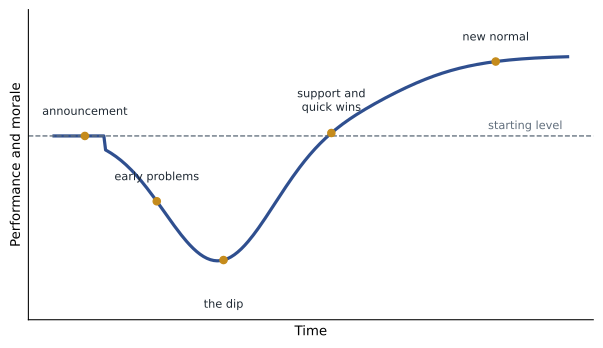
The individual counterpart is the change curve, adapted from Elisabeth Kübler-Ross's work on grief, which describes how people often move through shock, resistance and exploration before they commit to a change. Performance often dips during this period, as the cohort saw with the productivity J-curve in lesson 1 and with Northfield's welding robots in lesson 7. Leaders cannot avoid the dip entirely, but they can make it shallower and shorter by preparing people, providing support and fixing problems quickly. The Prosci ADKAR model, developed by Jeff Hiatt, frames individual change as five outcomes that must be achieved in order: awareness of the need for change, desire to participate, knowledge of how to change, ability to implement the change and reinforcement to sustain it. Its value is diagnostic. A change that stalls usually stalls at one of these points, and the remedy differs: more training does not fix a lack of desire.
Resistance is often treated as an obstacle to be overcome. Dr. Marchetti prefers to treat it as information. When experienced associates say the app's stock figures are wrong, they are right, and their resistance is protecting customers from false promises. When managers resist because their bonuses do not credit the app's sales, they are responding rationally to the incentives the company set. Listening to resistance often finds the real problems faster than any survey.
Applying the ideas: getting the store app past the plateau
Using these frameworks, the cohort drafts a plan for Cedarline's head of stores. The plan begins with the problems that resistant users have identified, because fixing them is both useful and a signal that the company listens. Stock accuracy improves as item-level tags reach the stores in the roadmap's first phase; until then, the app shows a confidence indicator next to stock counts that are older or less reliable, and associates can flag wrong counts in one tap. Wireless networks in the smaller stores are upgraded within a month. These are the facilitating conditions and ease of use in Davis's model.
Next, the plan addresses usefulness and social influence. Store managers' measures change to credit them with online sales to customers in their area, orders placed through the app for customers in the store, and repair drop-offs, as lesson 9 recommended. A network of app champions, one experienced associate in each store, receives extra training and a small stipend to help colleagues and report problems. Short-term wins are made visible: each week, the head of stores shares stories of sales saved through the app, with the associates named. Experienced staff are invited to suggest features, such as notes on a customer's preferences for repeat visits, so that the tool reflects their knowledge. The plan sets a target of 80 per cent daily use by the end of the season and measures it by store, with follow-up for stores that lag.
What a digital culture is
Digital culture is a loose term, and Dr. Marchetti defines it narrowly as the habits and norms that let an organization use digital tools and data to learn and improve quickly. She identifies five. Customer focus means starting from customer problems rather than internal processes or technologies. Experimentation means testing ideas cheaply and treating failed tests as learning, as lesson 5 described. Data-informed decisions means that claims are tested where possible and that people at all levels can read and question data. Collaboration across functions means that business, technology and data people work in shared teams rather than handing work between departments. And speed with responsibility means that teams can act quickly within clear limits on risk, security and ethics.
Psychological safety underpins most of these habits. Amy Edmondson, who introduced the concept in a 1999 study of work teams, defined it as a shared belief that a team is safe for interpersonal risk taking: that people will not be punished or humiliated for raising problems, admitting mistakes or proposing ideas. Google's internal research on team effectiveness, known as Project Aristotle and described publicly in 2015 and 2016, found psychological safety to be the most important of the factors it studied. In digital work, where experiments fail often and problems must surface quickly, its absence is fatal: teams hide failed tests, pilots are declared successes and problems surface only at launch.
Culture changes mainly through what leaders do, not what they say. Satya Nadella, after becoming Microsoft's chief executive in 2014, is widely credited with shifting the company's culture toward what he called a learn-it-all rather than know-it-all mindset, drawing on Carol Dweck's research on growth mindsets, and toward collaboration across a company whose divisions had been known for rivalry. The changes were reinforced by decisions about strategy, structure and rewards, not only by speeches. For Cedarline's executives, the equivalent signals would include asking for test results rather than opinions in meetings, celebrating a well-run experiment that failed, joining store visits to watch the app in use, and changing the measures by which they judge managers.
Building skills
Digital transformation needs new skills at three levels. Specialists, such as data engineers, data scientists, software engineers, product managers and security staff, are scarce and expensive, and mid-sized firms like Cedarline must decide which to hire, which to rent from partners and which to develop. Business staff need enough digital and data literacy to work with specialists, read dashboards critically, design experiments and use AI tools responsibly. Leaders need enough understanding to make good investment decisions, ask the right questions and model the culture. Many firms run internal academies with tracks for each group, combined with rotations in which business staff spend time on digital teams and the reverse.
Dr. Marchetti cautions against treating training as the main lever. People learn digital skills mostly by doing real work with support, so the most effective programs attach training to live projects: the merchandising planners learn to use forecasts while their first forecast-driven buying decisions are made, with an analyst beside them. Training detached from work fades within months.
Governance for transformation
Finally, a transformation needs governance that keeps it on track without smothering it. A transformation office, small and reporting to the chief executive, tracks the roadmap, dependencies, benefits and risks, and prepares decisions for an executive steering group that meets monthly. The steering group decides priorities and resolves conflicts between units, such as the store incentive change. Product teams have authority over how they deliver within their outcomes and budgets. The board reviews progress quarterly, with a short set of capability and outcome measures, and receives the security and AI risk reports described in lessons 6 and 8.
Worked problem
Diagnosing a stalled AI rollout
Lakeview Health licensed an ambient documentation tool for 120 physicians. After three months, 38 use it regularly. Interviews find that some physicians do not trust the drafts after seeing errors in medication names, some find it awkward to ask patients for consent, a few clinics have poor microphones, and the medical leaders of two departments have not used it themselves. Using the frameworks in this lesson, diagnose the problem and propose actions.
Show solution
- Use ADKAR to locate the stall: awareness is high, but desire is weak in some departments, knowledge of how to obtain consent smoothly is missing, and ability is limited by equipment in some clinics.
- Apply the acceptance model: perceived usefulness suffers from visible errors, which is a form of algorithm aversion; ease of use suffers from consent awkwardness and microphones.
- Address social influence: department leaders who do not use the tool signal that it is optional.
- Treat resistance as information: medication name errors are a real safety issue that should go back to the vendor and into the tool's review settings.
Answer: Lakeview should fix the equipment, give physicians a short consent script and patient handout, work with the vendor on medication name accuracy and highlight uncertain terms in drafts for review, recruit respected physicians in each department as champions and ask department leaders to use the tool visibly. It should share measured time savings and quality results, and let physicians edit drafts easily, which preserves their control.
Common mistakes
MistakeAdoption will continue to rise on its own after launch.
InsteadAdoption often stalls when it reaches people for whom the tool is harder, less useful or at odds with their incentives.
MistakeResistance is an obstacle to overcome.
InsteadResistance often points to real problems, such as wrong data or misaligned incentives.
MistakeMore training fixes slow adoption.
InsteadTraining fixes lack of knowledge, not lack of desire, poor tools or wrong incentives.
MistakeCulture changes through value statements.
InsteadCulture changes through what leaders do, measure and reward.
Summary and key terms
- Adoption depends on perceived usefulness and ease of use, social influence and facilitating conditions, and often stalls short of full use.
- Diffusion research identifies adopter groups and attributes, such as relative advantage and observability, that speed adoption.
- Algorithm aversion makes people abandon models after visible errors; letting them adjust outputs and explaining recommendations helps.
- Kotter's eight steps, the change curve and the ADKAR model help leaders plan change and diagnose where it stalls.
- A digital culture combines customer focus, experimentation, data-informed decisions, cross-functional collaboration and speed with responsibility, built on psychological safety.
- Skills grow best through real work with support, and transformation needs light governance from a transformation office, a steering group and the board.
- Technology acceptance model
- Davis's model in which intention to use a system depends on its perceived usefulness and ease of use.
- Diffusion of innovations
- Rogers' theory of how new ideas spread through adopter groups over time.
- Algorithm aversion
- The tendency to stop relying on an algorithm after seeing it err, even when it outperforms people.
- ADKAR
- A model of individual change: awareness, desire, knowledge, ability and reinforcement.
- Psychological safety
- A shared belief that a team is safe for interpersonal risk taking.
- Change champion
- A respected employee who helps colleagues adopt a change and reports problems.
Practice problems
Work each problem on paper first, then reveal the answer to check.
Why might the store app's adoption level off near 55 per cent?
Show answer
The remaining staff find it less useful or harder to use, stock data are unreliable, wireless is slow in some stores and managers' incentives do not reward its use.
Which ADKAR stage does more training address?
Show answer
Knowledge, and to some extent ability; it does not fix lack of awareness, desire or reinforcement.
How did Fairway overcome algorithm aversion in store ordering?
Show answer
It let managers override quantities within limits and showed why the system recommended what it did.
Give two actions that signal a digital culture from Cedarline's executives.
Show answer
Any two of: asking for test results rather than opinions, celebrating well-run failed experiments, visiting stores to watch the app in use and changing managers' measures.
Lesson quiz · 5 questions
Score 60% or more to complete this lesson.
Create a free account to save your progress, take quizzes and earn a certificate.