
MBA-603 · Lesson 2 of 12 · 23 min
Digital strategy and business model innovation
Dr. Marchetti opens the second session with two slides. The first shows Adobe's revenue in the years around 2013, when the company stopped selling boxed versions of its Creative Suite software for a large one-time price and moved its customers to Creative Cloud subscriptions. Revenue dipped and profits fell for about two years, because a customer who used to pay a large sum once now paid a modest amount each month, and investors watched nervously. Then revenue climbed well above its old path, became far more predictable, and the company's market value rose many times over. The second slide shows a long list of firms that tried similar shifts and abandoned them halfway because the dip was too painful or because customers would not pay for the new model.
The lesson she draws is that digital technology changes business models, not only products and processes, and that changing a business model is a strategic decision with a predictable shape: an investment period, a risk that customers or the organization will reject the change, and a payoff that depends on execution. This lesson covers what a digital strategy is, the main patterns of digital business model innovation, how to evaluate a new model with simple unit economics, and how established firms manage the conflict between an old model that pays the bills and a new one that may replace it.
From IT strategy to digital business strategy
For decades, companies wrote an information technology strategy that followed the business strategy: the business decided what it wanted to do, and the IT function decided which systems would support it. In a 2013 article in MIS Quarterly, Anandhi Bharadwaj, Omar El Sawy, Paul Pavlou and N. Venkatraman argued that this separation no longer made sense for many firms, because digital technology had become part of what the firm sells and how it competes. They proposed the idea of a digital business strategy, an organizational strategy formulated and executed by using digital resources to create differential value, and they suggested looking at its scope, scale, speed and sources of value.
David Rogers, in his 2016 book The Digital Transformation Playbook, offered a practical framework of five domains in which digital technology changes the rules of strategy. Customers are no longer only a market to be reached through mass media but a network that shares, reviews and influences. Competition increasingly comes from outside the industry and from platforms that coordinate other firms. Data become a strategic asset rather than a by-product of operations. Innovation moves from large, finished launches toward rapid experiments. Value propositions must keep changing, because a firm's current offer can be unbundled or replaced. Dr. Marchetti finds the framework useful as a checklist: for each domain, a management team should ask what has changed in its market and what that change requires of the strategy.
For Cedarline the checklist produces a short list. Customers now research outdoor gear online, read reviews and watch repair and gear videos before they visit a store, and a growing minority care about how long a product lasts and what happens to it afterward. Competition comes not only from other outdoor brands but from online marketplaces that sell used gear and from direct-to-consumer brands that started online. Data on how customers use and repair their gear, which Cedarline has never collected systematically, could inform design, inventory and service. Innovation could include small experiments with services rather than only new jackets. And the value proposition, durable gear repaired for life, is itself a digital opportunity, because tracking a product over its life needs software.
Patterns of digital business model innovation
A business model describes how a firm creates, delivers and captures value. Alexander Osterwalder and Yves Pigneur's Business Model Canvas, published in 2010, breaks it into nine building blocks, from customer segments and value propositions to revenue streams and cost structure, and the cohort will use it in their entrepreneurship course. Here Dr. Marchetti focuses on the patterns that digital technology has made more common.
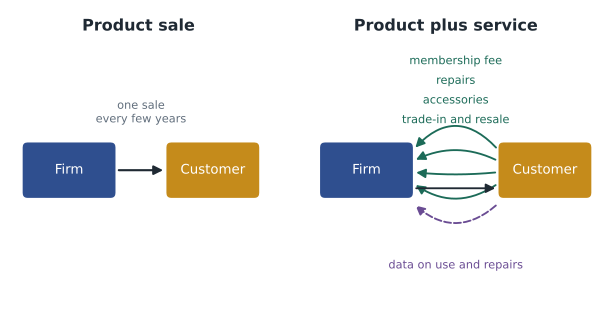
Subscription and membership models charge a recurring fee for access to a product, service or set of benefits. Software, media, meal kits and car washes have all moved this way, and the economics depend on acquisition cost, retention and the margin on each period of service. Usage-based or outcome-based pricing charges for use or results rather than ownership, as when Rolls-Royce charges airlines for engine flying hours under its long-running TotalCare arrangements, or when tire makers sell fleets a cost per kilometre or mile driven. Servitization, the broader move by manufacturers toward selling services wrapped around their products, depends on connected products that report their condition, because the provider must be able to predict and manage the cost of keeping them running.
Freemium models give away a basic version and charge for premium features; they work when the cost of serving a free user is very low and a small share of users will pay. Marketplaces and platforms match buyers and sellers and earn a commission or fee; they are the subject of lesson 3. Data-driven models earn money from information generated by the core business, such as retailers that sell advertising on their websites and apps to the brands they stock, a business usually called a retail media network. Ecosystem models combine products and services from several firms into an offer that no single firm could make, with one firm acting as orchestrator.
Grace Mwangi says Fairway has launched a small retail media business, selling sponsored placements in its app and targeted offers to the suppliers whose products it carries. The margins are high because Fairway already has the customers and the data, and the revenue is a welcome addition in a business where store margins are thin. But she has also seen the tension. Suppliers ask why they should pay for placement on top of the trade spending they already give Fairway, and the merchandising team worries that sponsored products will crowd out the private-label ranges that earn Fairway the best margins.
Evaluating a new model: the economics of Cedarline Care
Cedarline's strategy includes a service unit, Cedarline Care, that repairs its products. The question for this course is how Care should earn money. One option is to charge for each repair, as most repair shops do. Another, which the cohort's marketing course raised, is an annual membership that covers repairs and gives members benefits such as early access to new products and trade-in credit. A membership would earn a modest fee each year and might change how often members buy, but it would also commit Cedarline to repair costs whether or not members use them often.
Dr. Marchetti asks the cohort to compare the value of a customer under each model with a simple calculation. The numbers are assumptions drawn from the cohort's earlier work on Cedarline: a jacket contributes 84 dollars after variable costs, a product-only customer has a 55 per cent chance of buying another jacket in four years, and a member pays 49 dollars a year against an expected repair and service cost of 22 dollars, buys about 30 dollars a year more of accessories and smaller items, and replaces a jacket after six years instead of four because repairs keep it going longer.
# Cedarline Care: one-time product sale versus a repair membership (per customer, dollars)
def pv(cash, rate=0.09):
    return sum(c / (1 + rate) ** t for t, c in enumerate(cash))   # year 0 is today
years = 8
# Product only: a jacket today (contribution 84); 55 per cent buy again in year 4
product_only = [84] + [0] * (years - 1)
product_only[4] = 0.55 * 84
def membership(fee=49, service_cost=22, retain=0.80, extra_buying=30, extra_margin=0.45):
    cash, alive = [84], 1.0                   # same jacket today
    for t in range(1, years):
        jacket = 84 if t == 6 else 0          # members keep a jacket longer: replace in year 6
        cash.append(alive * (fee - service_cost + extra_buying * extra_margin + jacket))
        alive *= retain
    return cash
base = pv(product_only)
print(f"product only: {base:.1f}")
for retain in (0.60, 0.75, 0.90):
    print(f"membership, {retain:.0%} renew each year: {pv(membership(retain=retain)):.1f}")
fee = 0
while pv(membership(fee=fee, retain=0.75)) < base:
    fee += 1
print("break-even fee at 75% renewal:", fee)product only: 116.7 membership, 60% renew each year: 169.3 membership, 75% renew each year: 206.3 membership, 90% renew each year: 271.0 break-even fee at 75% renewal: 17
Over eight years at a 9 per cent cost of capital, a product-only customer is worth about 117 dollars. A member is worth 169 dollars if only 60 per cent renew each year, 206 dollars at 75 per cent and 271 dollars at 90 per cent. Even though members replace jackets less often, which lowers jacket sales, the recurring margin on the membership and the extra buying more than make up for it. At 75 per cent renewal, Cedarline would match the product-only value with a fee of only 17 dollars, below the expected service cost, because the extra purchases carry the model.
The calculation is crude, and Dr. Marchetti asks the cohort to list what it leaves out. Members may be customers who would have been loyal anyway, so part of the extra value is not caused by the membership; a test in a few regions, with a comparison group, would measure the real effect. Heavy users of repairs are the most likely to join, which could make the service cost much higher than average, a problem insurers call adverse selection. The model ignores the cost of building the app and systems to manage memberships, track products and schedule repairs, which lesson 12 includes. And it ignores what the membership does to the brand: a visible promise to repair products for life is the strategy's core message, and the membership turns it into a relationship that the company can measure.
The cohort concludes that the membership is promising enough to test, provided Cedarline can identify each product and each customer reliably. That condition, which sounds technical, is the strategic crux. A repair membership without a record of which customer owns which product, when it was bought and what has been repaired is unmanageable. This is one reason the data foundations in lesson 4 come before the services in the roadmap.
Incumbents and the cannibalization problem
Established firms face a particular difficulty with new business models: the new model often competes with the old one. Adobe's subscriptions replaced its own boxed software sales. A grocer's online service draws some customers away from its stores. A manufacturer that sells uptime instead of machines sells fewer spare parts. Managers who are measured on the old business resist, and investors who value the old profits may punish the transition. Clayton Christensen's research on disruptive innovation, which the cohort met in MBA-514, explained why incumbents often lose to entrants with new models: the new model looks unattractive by the incumbent's existing measures until it is too late.
Clark Gilbert, Mark Eyring and Richard Foster, in a 2012 Harvard Business Review article and later book, described a response they called dual transformation. Transformation A repositions the core business to be more resilient, often by cutting costs and focusing on the customers it serves best. Transformation B builds a new growth business, usually with a separate team, its own measures and a leader with authority to make different choices. A capabilities link connects the two so that the new business can use the core's assets, such as its brand, customers and supply chain, without being captured by the core's processes. Charles O'Reilly and Michael Tushman's work on ambidextrous organizations, also discussed in MBA-514, makes a similar argument.
For Cedarline, the new models are not yet large enough to threaten the core, but the conflicts are already visible. A resale marketplace for used Cedarline gear, which the cohort will examine in lesson 3, would sell some customers a used jacket instead of a new one. A repair membership lengthens product life. Store managers might see online pickups as extra work without credit. Dr. Marchetti's advice is to make the trade-offs explicit and to measure the whole customer relationship rather than each channel. If the resale marketplace brings in younger customers who later buy new gear, or keeps existing customers loyal, the brand gains even if some new sales are replaced.
Making choices: where digital fits in the strategy
A digital strategy is not a separate document. It is the part of the business strategy that answers how digital technology will help the firm win where it has chosen to play. Dr. Marchetti offers four questions. What customer problems will digital solve that we cannot solve otherwise? Which parts of our operating model must change to deliver the strategy at a cost that works? Which new revenue models fit our position and which would dilute it? And which digital capabilities must we own because they are central to our advantage, and which can we rent from vendors and partners?
The last question is easily overlooked. A firm does not need to build its own payment processing, email system or cloud infrastructure, because those are commodities available from many suppliers. But it may need to own the capabilities that make it different. For Cedarline, the record of every product's life, from manufacture through repairs to resale, is close to the heart of the strategy and is something rivals do not have. The firm might use standard software to store it, but it should own the data and the design of how they are used. Lesson 10 returns to the build-or-buy decision in detail.
Worked problem
Choosing a revenue model for a connected product
Northfield Components is considering adding sensors to the heavy-duty brackets it supplies to a farm-equipment maker, so that the maker can detect cracks before parts fail in the field. Daniel Osei sees three options: sell the sensor-equipped bracket at a higher price, sell the bracket at the usual price and charge an annual monitoring fee per machine, or license the crack-detection software to the equipment maker. How should Northfield choose?
Show solution
- Start from the customer problem: the equipment maker wants fewer field failures and lower warranty costs, and its own customers want machines that do not break down at harvest.
- Compare who captures the value: a higher price captures value once; a monitoring fee captures it over the machine's life but requires Northfield to run a data service; a licence captures less but needs fewer new capabilities.
- Check capabilities and fit: Northfield has stamping and welding skills but no software operations or customer support for data services, and its customer may prefer to own the data.
- Consider strategy: if detection data could make Northfield the preferred supplier for safety-critical parts across several equipment makers, owning the service could become a lasting advantage.
Answer: A reasonable path is to start with a higher-priced sensor-equipped bracket, with data provided to the equipment maker under a clear agreement, and to pilot a monitoring service with one customer to learn the costs before committing to a recurring model. The choice depends less on the technology than on which capabilities Northfield wants to build.
Common mistakes
MistakeA digital strategy is a plan for the IT department.
InsteadIt is the part of the business strategy that explains how digital technology helps the firm win where it has chosen to compete.
MistakeA subscription is always better than a one-time sale.
InsteadIt depends on acquisition cost, retention, service cost and adverse selection; it must be tested, not assumed.
MistakeCannibalization should always be avoided.
InsteadIf a new model will replace the old one anyway, it is better to cannibalize yourself than to be cannibalized by a rival; measure the whole customer relationship.
MistakeA firm should build every digital capability itself.
InsteadOwn the capabilities central to the advantage and rent the commodities.
Summary and key terms
- Digital business strategy treats digital resources as part of how the firm competes, not as support for a separate business plan.
- Rogers' five domains, customers, competition, data, innovation and value, form a useful checklist for what has changed in a market.
- Common digital model patterns include subscriptions, usage and outcome pricing, servitization, freemium, marketplaces, data and retail media, and ecosystems.
- Simple unit economics of customer value under each model help screen ideas, but tests with comparison groups are needed to measure the real effect.
- Incumbents must manage cannibalization, often through dual transformation that strengthens the core while building a new business with its own measures.
- A firm should own the digital capabilities that are central to its advantage and rent the rest.
- Business model
- How a firm creates, delivers and captures value.
- Servitization
- A manufacturer's move toward selling services and outcomes wrapped around its products.
- Retail media network
- A retailer's business of selling advertising on its own websites, apps and stores to the brands it stocks.
- Adverse selection
- The tendency for the customers most likely to use a service heavily to be the most likely to buy it.
- Dual transformation
- Repositioning the core business while building a separate new growth business, linked by shared capabilities.
- Cannibalization
- Sales of a new offer that replace sales of the firm's existing offers.
Practice problems
Work each problem on paper first, then reveal the answer to check.
Why did Adobe's profits fall when it moved to subscriptions?
Show answer
Customers who once paid a large up-front price now paid smaller monthly amounts, so revenue recognized in the early years fell before the subscriber base grew.
In the Cedarline Care model, why does a fee below the service cost still match the product-only value at 75 per cent renewal?
Show answer
Members buy more accessories and smaller items, and that margin covers the gap.
Name two things the membership calculation leaves out.
Show answer
Any two of: members who would have been loyal anyway, adverse selection among heavy repair users, system and app costs, and brand effects.
What are the two transformations in dual transformation?
Show answer
Repositioning the core business, and building a new growth business, linked by shared capabilities.
Lesson quiz · 5 questions
Score 60% or more to complete this lesson.
Create a free account to save your progress, take quizzes and earn a certificate.