
MBA-603 · Lesson 3 of 12 · 23 min
Platforms, ecosystems and network effects
Leo Brandt arrives at the third session with news. Kestrel Analytics, the inventory forecasting software company he co-founded, has signed its four-hundredth retail customer, and the marketplace for suppliers that the cohort analysed in the strategy course has gone live. Suppliers can now see anonymized demand forecasts for their products across Kestrel's retail customers and bid to fill predicted shortfalls. Two hundred suppliers joined in the first month, but only a third have made a transaction, and some of Kestrel's largest retail customers are asking whether they want their suppliers to see forecasts at all. Leo wants to know how to get the marketplace past the stage where nobody is quite sure it is worth joining.
His question is the central problem of platform strategy. A platform is a business that creates value mainly by enabling interactions between two or more groups of users, such as buyers and sellers, drivers and riders, or app developers and phone owners, rather than by making a product and selling it through a chain of steps. Platforms have produced some of the largest firms of the past two decades, and they have changed the competitive position of many traditional firms, which find that they must decide whether to build a platform, join one or compete against one. This lesson explains how network effects work, how platforms solve the problem of attracting both sides at once, how they price and govern, and when an established firm like Cedarline should build one.
Pipelines and platforms
In a 2016 Harvard Business Review article, Marshall Van Alstyne, Geoffrey Parker and Sangeet Paul Choudary contrasted pipelines with platforms. A pipeline firm creates value by controlling a linear series of activities: it designs a product, buys inputs, makes the product and sells it, and its advantage comes from controlling scarce resources and optimizing each step. A platform creates value by facilitating exchanges between external producers and consumers, and its advantage comes from the size and engagement of its community and the quality of the matches it makes. Pipelines focus on the customer's lifetime value; platforms must focus on the value of the whole ecosystem. Pipelines grow by adding capacity; platforms grow by adding participants, often without owning the assets that are exchanged.
Most firms are not purely one or the other. Amazon runs a pipeline retail business in which it buys and sells products itself and a marketplace in which independent sellers account for more than half of the units sold. Apple makes phones in a pipeline but earns a large and growing share of its profit from the platform of apps and services built on them. Kestrel sells software in a pipeline and is now trying to add a platform. Cedarline is a pipeline that is considering a small platform: a marketplace in which customers sell their used Cedarline gear to other customers.
Network effects
A network effect exists when a product or service becomes more valuable to each user as more people use it. Direct, or same-side, network effects occur within one group: a messaging app is more useful when more of one's friends use it. Indirect, or cross-side, network effects occur between groups: more sellers on a marketplace attract more buyers, and more buyers attract more sellers. Network effects can also be negative. Too many sellers competing for the same buyers may reduce each seller's sales, and too many users can congest a service or attract fraud and spam.
How much more valuable does a network become as it grows? A rule associated with Robert Metcalfe, the co-inventor of Ethernet, says that a network's value grows with the number of possible connections between users, roughly the square of the number of users. Andrew Odlyzko and others argued in the 2000s that this overstates the effect, because most users value only a small number of other users, and proposed that value grows more like n times the logarithm of n. The difference is large, as the first part of the code below shows, and it matters for strategy: a firm that assumes Metcalfe's rule will overpay for growth.
import math
# 1. How network value grows with users under three common rules of thumb
for n in (100, 1_000, 10_000):
    metcalfe = n * (n - 1) / 2            # every pair of users is a possible connection
    odlyzko = n * math.log(n)             # most users value only a few others
    linear = n                            # no network effect at all
    print(f"n={n:6d}  linear {linear:9,.0f}  n log n {odlyzko:11,.0f}  pairs {metcalfe:14,.0f}")

# 2. Cedarline Renewed: which side should the trade-in credit subsidize?
def month(credit):
    listings = 300 + 45 * credit                       # sellers respond to trade-in credit (dollars)
    buyers = 4_000 * (1 - math.exp(-listings / 1_200))  # buyers come when there is choice
    sold = min(listings, 0.30 * buyers)                # each visiting buyer buys 0.3 items
    resale_margin = 38                                 # average resale price 95, refurbishing 57
    profit = sold * (resale_margin - credit)
    new_gear = 0.20 * buyers * 60                      # a fifth of buyers also buy new gear, margin 60
    return listings, buyers, sold, profit + new_gear
for credit in (0, 10, 20, 30):
    l, b, s, p = month(credit)
print(f"credit {credit:2d}: listings {l:5.0f}, buyers {b:5.0f}, sold {s:5.0f}, monthly contribution {p:8,.0f}")n= 100 linear 100 n log n 461 pairs 4,950 n= 1000 linear 1,000 n log n 6,908 pairs 499,500 n= 10000 linear 10,000 n log n 92,103 pairs 49,995,000 credit 0: listings 300, buyers 885, sold 265, monthly contribution 20,704 credit 10: listings 750, buyers 1859, sold 558, monthly contribution 37,923 credit 20: listings 1200, buyers 2528, sold 759, monthly contribution 43,996 credit 30: listings 1650, buyers 2989, sold 897, monthly contribution 43,036
At 10,000 users, the number of possible pairs is about 50 million, while n log n is about 92,000. Neither number is a value in dollars; they are indexes of how value scales. The point is that real networks often show strong effects at first, as a platform reaches enough users to be useful, and weaker effects later, as additional users add less. A ride-hailing service in one city benefits greatly from going from 50 to 500 drivers, because waiting times fall sharply, and much less from going from 5,000 to 5,500. Network effects are also usually local. A rider in Toronto gains nothing from more drivers in Chicago, which is why ride-hailing markets did not tip to one global winner and why local rivals survived in many countries.
The chicken-and-egg problem
A new platform faces a problem that pipelines do not: neither side wants to join until the other side is there. Buyers will not visit a marketplace with few listings, and sellers will not list on a marketplace with few buyers. Jean-Charles Rochet and Jean Tirole, whose 2003 paper helped establish the economics of two-sided markets, showed that platforms often solve this by charging one side less, sometimes less than nothing, to attract the other. Which side to subsidize depends on which side is more sensitive to price and which side's presence is more valuable to the other. Newspapers historically charged readers little and advertisers much; video game console makers sold consoles cheaply and earned royalties from game publishers; payment card networks charge merchants and reward cardholders.
Other tactics include seeding one side directly, as when a marketplace lists its own inventory at the start; focusing on a small market where it can reach critical mass, as Facebook did with university campuses; piggybacking on an existing network; and offering one side a useful single-user tool that does not depend on the other side at all, which Andrei Hagiu has called coming for the tool, staying for the network. Kestrel's forecasting software is exactly such a tool: retailers already use it for their own purposes, so the forecasts exist before any supplier joins.
Cedarline Renewed: designing a small marketplace
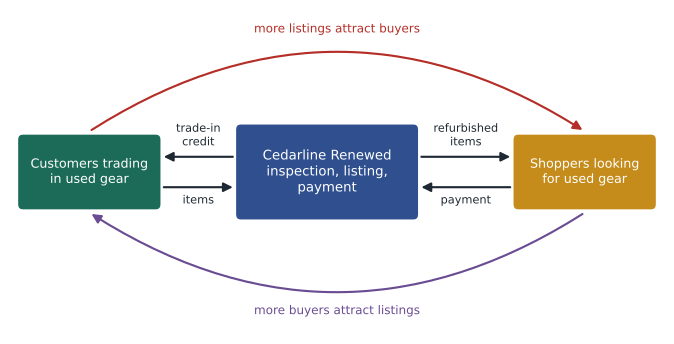
Cedarline's strategy already includes trade-in credit for used gear, refurbished by its repair workshops and resold. The cohort's question is whether to run this as a simple resale shop, in which Cedarline buys used items and sells them, or as a marketplace in which customers list their own items and Cedarline earns a fee. Dr. Marchetti suggests a middle path that many apparel brands have used: customers send in items, Cedarline inspects and refurbishes them, lists them on a branded site called Cedarline Renewed, and pays the seller a trade-in credit when the item sells. The design keeps quality control in Cedarline's hands, which matters for a brand built on durability, while letting supply grow with customer participation.
The second part of the code models the key decision: how generous the trade-in credit should be. A higher credit brings more listings. More listings attract more buyers, though with diminishing returns once there is plenty of choice. Each sale earns Cedarline a resale margin of 38 dollars before the credit, and a fifth of visiting buyers also buy new gear. With no credit, few people bother to send items and the marketplace earns about 21,000 dollars a month. A credit of 20 dollars more than doubles that to about 44,000, because the extra listings bring enough buyers to more than pay for the subsidy. At 30 dollars the contribution starts to fall, because the extra listings bring fewer new buyers while each sale earns less.
The numbers are invented, but the shape is typical and the lesson is general. The subsidy is worth paying because of the cross-side effect: listings attract buyers, and buyers buy new gear as well as used. A firm that judged the trade-in program only by the margin on each resold jacket would set the credit too low and the marketplace would never reach the scale at which it pays.
Pricing, multi-homing and tipping
Once a platform has both sides, its pricing problem becomes more subtle. The total price level determines how much value the platform captures, while the price structure, how the total is split between the sides, determines how many of each side participate. Raising the fee charged to sellers may increase revenue per sale but drive sellers to other channels, which reduces choice and drives away buyers. Platforms therefore watch participation and engagement on both sides, not just revenue.
Whether a platform market tips toward a single winner depends on a few conditions. Strong network effects favour concentration, as do high costs of using several platforms at once. Multi-homing, when users participate in several platforms at the same time, weakens tipping. Drivers and riders often use two ride-hailing apps, and sellers list on several marketplaces, so no single platform can take all the value. Differentiated needs also weaken tipping, because different groups of users prefer different platforms. Thomas Eisenmann, Geoffrey Parker and Marshall Van Alstyne also showed in a 2011 article that a platform can be enveloped by a rival that bundles its function into another platform with an overlapping user base, as operating systems absorbed many standalone utilities.
Grace Mwangi describes Fairway's position as a seller on delivery platforms. Fairway lists its stores on two grocery delivery apps as well as running its own online service, because the apps bring customers Fairway would not otherwise reach. But the apps charge Fairway a commission, own the customer relationship and see Fairway's sales data, and one of them has begun promoting a rival grocer in its app. Multi-homing gives Fairway some bargaining power; the question it faces is how much of its online business to keep on its own service, where it owns the data and the customer, and how much to accept through platforms that bring scale at a price.
Ecosystems and governance
An ecosystem, in the sense used by Ron Adner and by Michael Jacobides, Carmelo Cennamo and Annabelle Gawer in a 2018 article, is a set of firms whose products or services must work together to deliver value to a customer, coordinated without a single firm owning them all. Electric vehicles need charging networks, smartphones need apps, and a connected home needs devices that talk to each other. Adner's point is that a firm's innovation can fail not because its own product is weak but because a complementary product it depends on is late or missing. A firm must ask which partners must adopt or co-innovate for its offer to work, and whether it should be the orchestrator of the ecosystem or a complementor within someone else's.
Platforms and ecosystems need governance: rules about who can join, what they may do, how disputes are settled and how data are shared. Strict rules protect quality and trust, while open rules encourage participation and innovation. Kestrel's marketplace shows the tension. Retailers are Kestrel's paying customers and own the sales data behind the forecasts, so they must be able to choose which suppliers see what. Suppliers will join only if they see enough to act on. Leo's team concludes that it should let each retailer set sharing rules, show suppliers aggregated forecasts by default and detailed forecasts only with the retailer's permission, and charge suppliers a fee only on completed transactions until the marketplace has proved its value.
Governments are also paying closer attention to platforms. The European Union's Digital Markets Act, which began to apply to designated gatekeeper platforms in 2024, prohibits some forms of self-preferencing and requires interoperability and data access. In Canada, amendments to the Competition Act in 2023 and 2024 strengthened the rules on abuse of dominance and gave the Competition Bureau more tools to examine digital markets. For a brand like Cedarline that sells through large marketplaces as well as its own channels, the practical lesson is to understand the platform's rules and incentives and to keep a direct relationship with as many customers as it can.
Should an established firm build a platform?
Dr. Marchetti offers a short test. A platform makes sense when there are many fragmented producers and consumers whose interactions the firm can make easier, when the firm has something that gives it a head start on one side, such as an existing customer base, a trusted brand or a single-user tool, and when the platform strengthens rather than undermines the core business. It makes less sense when the firm would be competing against an established platform with stronger network effects, when the firm's customers would see the platform as a threat, or when the firm lacks the skills to run a two-sided business, including trust and safety, payments and dispute resolution.
Cedarline Renewed passes the test modestly. Cedarline has a brand and customers, the platform supports the durability strategy, and quality control through its workshops gives it an advantage over general marketplaces for used gear. But it should start small, in a few product categories and regions, measure both sides and the effect on new-gear sales, and avoid the temptation to become a general marketplace for other brands' gear, which would pit it against much larger rivals.
Worked problem
Diagnosing a stalled marketplace
Kestrel's supplier marketplace has 200 suppliers after one month, but only 70 have made a transaction, and retailers have posted only 40 shortfall requests. Suppliers complain that the forecasts they see are too general to act on. Retailers say they are not sure suppliers will respond reliably. What should Kestrel do?
Show solution
- Identify the side that limits the market: retailers create the requests, so their participation is the bottleneck; suppliers will follow if requests appear.
- Use the single-user tool: Kestrel's software already predicts shortfalls for each retailer, so it can propose requests automatically for retailers to approve with one click.
- Reduce risk for the hesitant side: let retailers pick which suppliers can respond and offer them a service guarantee during a pilot.
- Focus to reach density: concentrate on two product categories and one region where many retailers share the same suppliers, so each supplier sees enough requests to act on.
Answer: Kestrel should subsidize and simplify the retailer side, which is scarcer, by generating requests automatically from its forecasts, reducing retailers' risk and focusing on dense categories until the marketplace is useful, charging suppliers only on completed transactions.
Common mistakes
MistakeNetwork value grows with the square of users without limit.
InsteadMost networks show strong effects at first and weaker ones later, and effects are often local.
MistakeA platform should charge both sides the same price.
InsteadThe side that is more price-sensitive or more valuable to the other side is often subsidized.
MistakeNetwork effects guarantee a single winner.
InsteadMulti-homing, differentiated needs and local effects can keep several platforms viable.
MistakeA resale program should be judged by the margin on each resold item.
InsteadCross-side effects and extra purchases by buyers can make a subsidy to sellers worth paying.
Summary and key terms
- Platforms create value by enabling interactions between groups of users, while pipelines create value through a linear chain of activities.
- Network effects can be same-side or cross-side and positive or negative; they are often strong early, weaker later and local.
- The chicken-and-egg problem is solved by subsidizing one side, seeding supply, focusing on a small market or offering a single-user tool.
- Price structure between the sides matters as much as the price level; multi-homing and differentiation weaken tipping.
- Ecosystems require complementors to adopt and co-innovate, and platforms need governance that balances openness and quality.
- An established firm should build a platform when it has a head start on one side and the platform strengthens its core business.
- Platform
- A business that creates value mainly by enabling interactions between two or more groups of users.
- Network effect
- An increase in a product's value to each user as the number of users grows.
- Cross-side network effect
- An effect in which more users on one side of a platform make it more valuable to the other side.
- Multi-homing
- Using several competing platforms at the same time.
- Tipping
- The tendency of a platform market to concentrate on one dominant platform.
- Ecosystem
- A set of firms whose offers must work together to deliver value, coordinated without common ownership.
Practice problems
Work each problem on paper first, then reveal the answer to check.
Why did ride-hailing not tip to a single global winner?
Show answer
Network effects are local to each city, and drivers and riders multi-home across apps.
In the Cedarline Renewed model, why does a 20-dollar credit earn more than no credit?
Show answer
More listings attract more buyers, who buy both used and new gear, and the extra sales more than pay for the credit.
Give an example of coming for the tool, staying for the network.
Show answer
Kestrel's forecasting software is useful to each retailer alone, and the forecasts then seed a supplier marketplace.
What does Adner mean by co-innovation risk?
Show answer
The risk that an innovation fails because complementary products or partners it depends on are not ready.
Lesson quiz · 5 questions
Score 60% or more to complete this lesson.
Create a free account to save your progress, take quizzes and earn a certificate.