
MBA-513 · Lesson 3 of 12 · 21 min
Process design and layout for products and services
Grace arrives at the third session with a question from Fairway's board. The chain bakes bread in each of its 46 stores, using frozen dough, small ovens and a baker on the early shift. A consultant has proposed closing the in-store bakeries and building a central bakery that would make every loaf, bun and croissant on a high-speed line and deliver them to stores twice a day. The central bakery would cut the cost per loaf by about a third. The store managers object that freshness, variety and the smell of baking bread are why many customers walk in. Dr. Raman says that the question is not really about bread. It is about which kind of process fits which kind of demand, and it is one of the oldest questions in operations.
Process types
Processes for making goods can be arranged along a spectrum from flexible and low-volume to rigid and high-volume. At one end is the project, a one-off undertaking such as building a gas plant for Prairie Ridge or a new hospital wing, in which resources come to a fixed site and each job is unique. Next is the job shop, which makes small quantities of many different products, each following its own route through general-purpose equipment, as in a machine shop or a print shop. Batch processes make moderate quantities of a range of products, moving each batch through a sequence of steps; bakeries, apparel factories and Northfield's stamping presses are batch processes. Line processes, such as assembly lines, make high volumes of a few standard products that all follow the same sequence. At the far end, continuous flow processes, such as refineries, paper mills and Prairie Ridge's gas processing plants, run around the clock on a single product or a narrow family.
Moving along the spectrum trades flexibility for efficiency. Job shops can make almost anything, but each order waits in queues in front of busy machines, flow times are long, and unit costs are high. Lines and continuous processes have very low unit costs and short flow times, but they require high and stable volumes to justify their investment, and changing the product is slow and expensive. Robert Hayes and Steven Wheelwright of Harvard captured this in their product-process matrix of 1979. One axis describes the product structure, from one-of-a-kind to high-volume commodities; the other describes the process, from job shop to continuous flow. Firms that sit on the diagonal, matching a process to its product, tend to perform best. A firm that makes standard, high-volume products in a job shop pays too much; one that tries to make unique products on a dedicated line cannot respond to its customers.
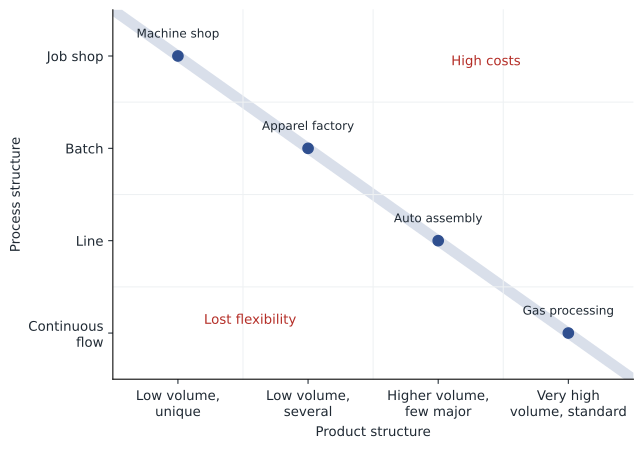
The matrix explains the bakery debate. A central bakery is a line process: very efficient for high volumes of a few standard breads, much less so for the wide variety and small batches of specialty items that Fairway's customers value. The in-store bakeries are small batch processes, expensive per loaf but flexible and close to the customer. Grace's team settles on a hybrid that the matrix suggests: a central line for the eight sandwich loaves and buns that make up about 70 per cent of volume, and smaller in-store finishing ovens for croissants, specialty breads and anything the customer can smell. The decision is a reminder that one firm may need several processes, each on the diagonal for its part of the product range.
Layout
Layout is the physical arrangement of resources, and each process type has a natural layout. A fixed-position layout keeps the product in one place and brings workers and equipment to it, as in shipbuilding or construction. A process layout, also called a functional layout, groups similar resources together: all the lathes in one department, all the presses in another, the radiology department in one part of the hospital and the laboratory in another. It suits job shops and hospitals, because each job can take its own route, but units travel long distances, are handled many times and wait in front of each department. A product layout arranges resources in the sequence in which the product needs them, as in an assembly line, so that units flow from step to step with little travel or waiting. It suits high-volume standard products.
Cellular layout is a compromise. Products are grouped into families with similar processing needs, a practice called group technology, and each family gets a cell, a small group of different machines arranged close together in the order of processing, often in a U shape so that a few workers can tend several machines. Cells bring some of the flow of a line to batch production. Daniel's plant is moving the low-volume brackets it makes for agricultural equipment makers out of the main functional departments and into two cells, each with a small press, a welding fixture and a packing bench. In a pilot, flow time for those orders fell from about nine days to two, because parts no longer waited in queues behind the high-volume automotive work.
Balancing a line
When work is divided among the stations of a line, it must be balanced: each station should take close to the takt time, because the slowest station sets the pace and every other station is idle for the difference. The designer lists the tasks, their times and the precedence constraints that say which tasks must come before others. The minimum possible number of stations is the total work content divided by the takt time, rounded up. A heuristic such as assigning, at each station, the longest task whose predecessors are done and which still fits within the takt time usually gives a good balance, though not always the best one. Balance efficiency is the total work content divided by the number of stations times the takt time.
import math

def balance(tasks, takt):
    """Assign tasks to stations: longest eligible task that still fits."""
    work = sum(t for t, _ in tasks.values())
    done, stations = set(), []
    while len(done) < len(tasks):
        load, st = 0, []
        while True:
            ready = [k for k, (t, pre) in tasks.items()
                     if k not in done and set(pre) <= done and load + t <= takt]
            if not ready:
                break
            k = max(ready, key=lambda x: tasks[x][0])
            st.append(k); done.add(k); load += tasks[k][0]
        stations.append((st, load))
    print(f"Work content {work} s, takt {takt} s, minimum stations {math.ceil(work / takt)}")
    for i, (st, load) in enumerate(stations, 1):
        print(f"  Station {i}: {'+'.join(st):8} {load:3} s, idle {takt - load:2} s")
    print(f"  {len(stations)} stations, balance efficiency {work / (len(stations) * takt):.0%}")

# Northfield's new subassembly line: task -> (seconds, predecessors)
tasks = {'A': (20, ''), 'B': (30, 'A'), 'C': (25, 'A'), 'D': (15, 'BC'), 'E': (35, 'D'),
         'F': (20, 'D'), 'G': (25, 'EF'), 'H': (10, 'G')}
balance(tasks, 48)
print("With a fixture that cuts the final check G to 18 seconds:")
tasks['G'] = (18, 'EF')
balance(tasks, 48)Work content 180 s, takt 48 s, minimum stations 4 Station 1: A+C 45 s, idle 3 s Station 2: B+D 45 s, idle 3 s Station 3: E 35 s, idle 13 s Station 4: F+G 45 s, idle 3 s Station 5: H 10 s, idle 38 s 5 stations, balance efficiency 75% With a fixture that cuts the final check G to 18 seconds: Work content 173 s, takt 48 s, minimum stations 4 Station 1: A+C 45 s, idle 3 s Station 2: B+D 45 s, idle 3 s Station 3: E 35 s, idle 13 s Station 4: F+G+H 48 s, idle 0 s 4 stations, balance efficiency 90%
The first balance needs five stations although the minimum is four, because the bushing insertion, task E, takes 35 seconds and nothing else fits beside it, and packing ends up alone at the last station with 38 seconds of idle time in every 48. The second run shows why industrial engineers look for small changes in task times rather than accepting a poor balance. A simple fixture that cuts the final check from 25 to 18 seconds lets labelling, final check and packing share a station, the line needs four people instead of five, and balance efficiency rises from 75 to 90 per cent.
Make to stock, make to order
Process design also depends on when production happens relative to demand. A make-to-stock process produces in advance and serves customers from inventory, which gives instant delivery but requires a forecast and risks unsold stock; Cedarline's jackets are made to stock. A make-to-order process starts only when an order arrives, which eliminates finished inventory but makes the customer wait; Northfield's custom brackets and Prairie Ridge's gas plants are made to order. Assemble-to-order processes, such as many computer makers, hold components and finish products to order. The point in a supply chain where production switches from forecast-driven to order-driven is the decoupling point. Moving it later, a strategy called postponement that lesson 10 will develop, lets a firm hold inventory in a generic form and customize it only when demand is known.
Designing service processes
Services differ from manufacturing in ways that shape their processes. They are usually produced and consumed at the same time, so they cannot be stored in inventory; capacity that is not used in an hour is lost. The customer is often part of the process, supplying information, labour or even their own body, as at Lakeview. Richard Chase argued in 1978 that the efficiency of a service process falls as the share of time the customer is present rises, because customers bring variability that cannot be scheduled away. He recommended separating high-contact front-office work from low-contact back-office work and running the back office like a factory. Banks process cheques and applications in back offices; Lakeview's laboratory runs batches of tests out of patients' sight.
Frances Frei of Harvard identified five kinds of variability that customers introduce: arrival variability, when they come; request variability, what they ask for; capability variability, how well they can do their part; effort variability, how much they are willing to do; and subjective preference variability, what they consider good service. Each can be accommodated, with spare capacity, flexible staff and generous service, or reduced, with appointments, restricted menus and self-service, and the right mix depends on the firm's position. Hana realizes that Lakeview's evening clinic has accommodated everything and reduced nothing. Simple steps, such as letting patients reserve an arrival window online and register on their phones before arriving, would reduce arrival and capability variability at little cost.
Roger Schmenner's service process matrix of 1986 classifies services by labour intensity and the degree of interaction and customization. Service factories, such as airlines and parcel carriers, combine low labour intensity with low customization. Service shops, such as hospitals and repair garages, have low labour intensity but high customization. Mass services, such as retail stores and schools, are labour-intensive with low customization. Professional services, such as law firms and consulting, combine high labour intensity with high customization. As in manufacturing, the management challenges differ by type: capital decisions and demand smoothing in service factories, scheduling and flow in service shops, staffing and training in mass services, and managing expert professionals in professional services.
Cedarline's distribution centre
Cedarline's single distribution centre runs three very different processes under one roof, and Dr. Raman asks the cohort to see them as such. Wholesale orders from sporting goods chains ship as full cartons and pallets, a high-volume process close to a line. Replenishment of Cedarline's own stores ships mixed cartons a few times a week. Online orders ship as individual items, called eaches, to households, often one or two items per order, a high-variety, low-volume process that behaves more like a job shop. When the website grew from 12 to 25 per cent of sales, online orders were squeezed into a building laid out for cartons, and pickers now walk most of a shift. Volume in the building has more than doubled while its layout has stayed the same.
One inexpensive change is slotting: placing items in the building according to how often they are picked. Online demand is highly skewed, with roughly a fifth of the stock-keeping units accounting for four-fifths of picks. In Cedarline's building, storage locations lie at distances from 0 to 150 metres from the packing stations. If items are placed at random, an average pick is 75 metres away. If the fastest-moving fifth of items is placed in the nearest fifth of locations, an average pick by those items is about 15 metres away and the rest about 90 metres, so the expected distance falls to 0.8 × 15 + 0.2 × 90 = 30 metres, a 60 per cent reduction in walking. A separate zone for eaches, with its own packing stations and carton sizes, would go further, giving the online process a layout of its own.
Worked problem
A central or local process
A chain of 20 veterinary clinics does its own blood tests in each clinic using small analyzers that cost about 22 dollars per test and give results in 15 minutes. A central laboratory would cost about 9 dollars per test but return results the next morning. The clinics run about 60,000 tests a year, of which 15 per cent are urgent, mostly for sick animals whose treatment depends on the result. Recommend a process design.
Show solution
- Classify the work. Routine tests, such as annual wellness panels, are standard and not time-sensitive: they fit a high-volume central process. Urgent tests are time-sensitive and their value depends on speed: they need a local process.
- Cost of all tests in clinics: 60,000 × 22 = 1.32 million dollars a year. All central: 60,000 × 9 = 0.54 million, but urgent cases would wait overnight, which is clinically unacceptable.
- Hybrid: 51,000 routine tests centrally at 9 dollars = 459,000 dollars; 9,000 urgent tests locally at 22 dollars = 198,000 dollars. Total about 657,000 dollars, a saving of about 663,000 dollars a year against the current design.
- Check the effect on the local analyzers: with only 9,000 tests a year across 20 clinics, the fixed cost per test may rise, so the clinics should confirm the 22 dollar figure at lower volume.
Answer: Separating the standard back-office work from the urgent front-office work gives most of the central saving without sacrificing speed where it matters, the same logic as Fairway's hybrid bakery and Chase's front office and back office.
Common mistakes
MistakeOne process type should serve the whole product range.
InsteadDifferent parts of the range may need different processes; firms often run several, each matched to its volume and variety.
MistakeA line is always more efficient than a batch process.
InsteadA line is efficient only with high, stable volume; with low volume or high variety it sits off the diagonal and loses flexibility.
MistakeLine balancing only requires dividing total work by takt time.
InsteadPrecedence constraints and task sizes usually force more stations than the minimum; small task changes can improve the balance.
MistakeService quality requires accommodating every customer request.
InsteadCustomer variability can also be reduced, with appointments, self-service and clear options, often improving service and cost together.
Summary and key terms
- Processes range from projects and job shops through batch and line processes to continuous flow, trading flexibility for efficiency.
- The product-process matrix shows that firms perform best when their process matches their products' volume and variety.
- Layouts are fixed-position, process, product or cellular; cells bring flow to batch production.
- Line balancing assigns tasks to stations within the takt time, subject to precedence; efficiency is work content divided by stations times takt time.
- Make-to-stock, make-to-order and assemble-to-order processes differ in where the decoupling point lies.
- Service processes must manage customer-introduced variability, by accommodating it or reducing it, and benefit from separating front office and back office.
- Job shop
- A process making small quantities of varied products, each with its own route through general-purpose resources.
- Product-process matrix
- Hayes and Wheelwright's matrix matching process type to product volume and variety.
- Cellular layout
- Small groups of different machines arranged to process a family of similar products.
- Balance efficiency
- Total work content divided by the number of stations times the takt time.
- Decoupling point
- The point where production switches from forecast-driven to order-driven.
- Customer-introduced variability
- Frei's five kinds: arrival, request, capability, effort and subjective preference.
- Slotting
- Assigning storage locations according to how often items are picked.
Practice problems
Work each problem on paper first, then reveal the answer to check.
Tasks with times 12, 18, 9, 21, 15 and 11 seconds must be performed on a line with a takt time of 30 seconds. What is the minimum number of stations?
Show answer
Work content = 86 seconds; 86 / 30 = 2.87, so at least 3 stations.
If the line in the previous question actually needs 4 stations, what is its balance efficiency?
Show answer
86 / (4 × 30) = 72 per cent.
Classify an airline, a hospital emergency department and a management consulting firm on Schmenner's service process matrix.
Show answer
Airline: service factory; emergency department: service shop; consulting firm: professional service.
Why does a process layout tend to have long flow times?
Show answer
Units travel between departments and wait in queues in front of each one, behind other jobs with different routes.
Lesson quiz · 5 questions
Score 60% or more to complete this lesson.
Create a free account to save your progress, take quizzes and earn a certificate.