
MBA-513 · Lesson 1 of 12 · 24 min
Why operations matter: strategy, trade-offs and the operations frontier
The first-year cohort of the weekend EMBA at the Lakeshore School of Business in Toronto starts its operations course on a cold Friday afternoon in January, in the same winter term as Corporate Finance and Marketing Management. Dr. Priya Raman spent eleven years at an auto parts supplier that made seat frames for Toyota, Honda and General Motors, rising from shift engineer to plant manager, and then seven years as head of supply chain planning at a national retailer before she joined the faculty. She opens with a photograph of two loading docks taken on the same morning. At one, trucks wait in a line that stretches out to the road. At the other, a single trailer is being unloaded while the next one is still on the highway, timed to arrive as the first leaves. She asks the cohort which dock belongs to the more profitable company, and why the answer is not obvious.
Daniel Osei, plant controller at Northfield Components, says the busy dock might be the better business if the trucks are full of orders. Grace Mwangi of Fairway Grocers points out that waiting trucks cost money, because drivers are paid by the hour and fresh food loses value in a trailer. Hana Kowalski of Lakeview Health says the line of trucks reminds her of her emergency department on a Monday morning. Leo Brandt of Kestrel Analytics asks whether the quiet dock is quiet because demand is low. Owen Tremblay of Prairie Ridge Energy says that in his business the expensive mistake is not a waiting truck but a stopped plant. Dr. Raman writes all five answers on the board. Each, she says, is about the same three things this course will measure: how much flows through a process, how long it takes, and how much inventory and capacity it ties up while it does so.
What operations management is
Operations management is the design, running and improvement of the processes that turn inputs into the goods and services a firm sells. Inputs include materials, energy, information, equipment and people's time and skill. The transformation may be physical, as when Northfield stamps steel coil into brackets; locational, as when Fairway moves lettuce from a farm in California to a shelf in a suburban store; informational, as when Kestrel turns sales histories into forecasts; or a change in the customer, as when Lakeview treats a patient. Every organization has operations, even those that think of themselves as marketing or technology companies, because every promise made to a customer must eventually be kept by a process.
Operations matter financially because they account for most of what a firm spends and owns. In a typical manufacturer or retailer, the cost of goods sold is half or more of revenue, and inventory, plant and equipment make up most of the balance sheet. A small proportional improvement in the cost of operations often adds more to profit than a large improvement in sales, because it falls straight to the bottom line without the extra costs that growth brings. The cohort met this idea in MBA-501 as the DuPont identity: return on invested capital is the product of operating margin and capital turnover. Operations drives both. It sets the cost of producing and delivering what is sold, and it decides how much inventory, equipment and space are needed to do so.
Dr. Raman adds a second reason. Operations is where strategy becomes real. A firm can announce that it competes on speed, reliability or customization, but customers judge it by what arrives, when, and in what condition. Many strategies fail not because the idea was wrong but because the processes behind it were never designed to deliver it. The course therefore treats operations not as a back-office function but as a set of choices about capabilities that must fit the firm's chosen position in the market.
Competitive priorities and trade-offs
Operations strategy begins with the dimensions on which a firm's processes can excel. The standard list has five: cost, quality, speed, flexibility and dependability. Cost means producing and delivering at low unit cost. Quality has two parts: design quality, the features and performance built into the product, and conformance quality, how consistently each unit matches its design. Speed means short lead times from order to delivery and short development times for new products. Flexibility means the ability to change volume, mix or product design without large penalties. Dependability means keeping promises: delivering on the date quoted, every time. Many firms now add sustainability, the ability to deliver with lower emissions, waste and social risk, as a sixth.
A firm cannot be best at all of them at once, at least not with a given set of processes and technology. A plant designed for very low cost runs long batches of a few standard products, which makes it inflexible. A clinic designed for very short waits must keep spare capacity, which raises cost. Wickham Skinner of Harvard made this point in a famous 1969 article, Manufacturing: missing link in corporate strategy, and in 1974 he argued for the focused factory: a plant that concentrates on a limited set of products, technologies and markets, organized around one or two priorities, will usually outperform a plant that tries to serve every customer with every capability. Skinner observed that many plants were unfocused because they had accumulated products and demands over time without anyone asking what the plant was for.
Terry Hill of the London Business School added a practical distinction between order qualifiers and order winners. Order qualifiers are the dimensions on which a firm must meet a threshold to be considered at all; falling below the threshold loses the business, but exceeding it wins nothing extra. Order winners are the dimensions on which customers choose among qualified suppliers. For Northfield's automotive customers, conformance quality and on-time delivery are qualifiers, assessed through strict supplier scorecards, and price is often the order winner. For Hana's evening clinics, clinical quality is a qualifier and short, predictable waits may be the order winner. Daniel notes that qualifiers change: what won orders ten years ago is now merely expected.
The operations frontier
The trade-offs can be pictured as a frontier. Suppose we plot firms in an industry by their cost on one axis and their performance on some other priority, such as responsiveness, on the other. Each firm sits at a point determined by its processes. The best firms form a curve, the operations frontier, beyond which no current firm operates: to move along it, a firm gives up some of one priority to gain more of another. Firms inside the frontier are simply inefficient; they could improve on both dimensions at once by adopting better practice.
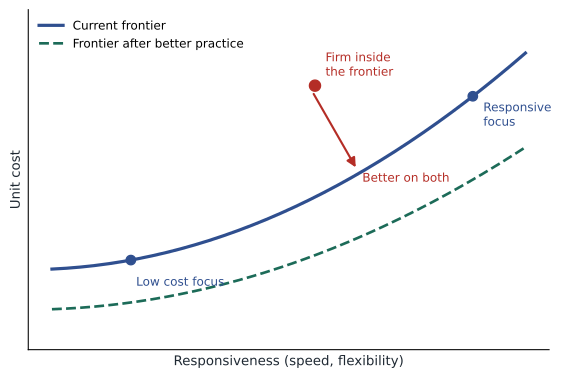
The distinction matters for managers because the right response depends on where a firm is. Michael Porter, in his 1996 article What is strategy?, warned that operational effectiveness, doing the same activities better than rivals, is necessary but not a strategy, because good practices spread and the frontier moves for everyone. Strategy, in his view, is choosing a distinct position and accepting the trade-offs that come with it. But Dr. Raman stresses the other half of the lesson: most firms are well inside the frontier, so the first job of operations is often to get closer to it, where improvements in cost and quality can come together. The Toyota Production System, which the cohort will study in lesson 5, is the classic case of a firm that moved the frontier outward, producing higher quality at lower cost than its rivals thought possible.
Kasra Ferdows and Arnoud De Meyer suggested in 1990 that capabilities can be built cumulatively in a particular order, like a cone of sand: first quality, then dependability, then speed, then cost efficiency, with each layer resting on the last. Their evidence was suggestive rather than conclusive, but the logic is useful. A process that produces many defects cannot be dependable, because rework and scrap disrupt schedules; a process that is not dependable cannot be fast, because it needs buffers of time and inventory; and a process that needs large buffers cannot be cheap. Daniel says this matches Northfield's history. Its costs fell only after a quality program cut scrap and unplanned rework.
Measuring a process
The course uses a small set of measures again and again. Throughput, or flow rate, is the number of units a process completes per unit of time: brackets per hour, patients per evening, orders shipped per day. Flow time is how long a unit spends in the process from start to finish, including waiting. Inventory is the number of units inside the process at a moment: work in process in a plant, patients in a waiting room, orders not yet shipped. Capacity is the maximum sustainable flow rate, and utilization is the actual flow rate divided by capacity. Lesson 2 will show that these measures are tied together by Little's law, and that the slowest step, the bottleneck, sets the capacity of the whole process.
Productivity is the ratio of outputs to inputs. Labour productivity, such as units per labour hour, is the most common measure, but it can mislead when one input is substituted for another. A plant that buys robots raises labour productivity while possibly lowering total productivity if the robots cost more than the labour they replace. Multifactor productivity divides output by a weighted combination of inputs and is a better guide to whether a process has truly improved. Dr. Raman warns that local productivity measures can also be gamed. A department measured on its own output per hour may produce what is easy rather than what is needed, building inventory that no one wants. The right test of a local improvement is whether it raises the throughput or lowers the cost of the whole system.
Cedarline's operations
The cohort will again work on Cedarline Outdoor, the maker and retailer of outdoor clothing and equipment that it diagnosed in MBA-501. Cedarline designs its products in-house and buys them finished from contract manufacturers in Vietnam, Bangladesh and China. Orders for a winter season are placed in the spring, about eight months before the goods reach stores. Everything flows through a single distribution centre that serves Cedarline's own stores, its website and the sporting goods chains that sell its products wholesale. In fiscal 2026, Cedarline had revenue of 468 million dollars and a gross margin of 49.8 per cent, so its cost of goods sold was about 235 million dollars, and it held inventory of 128 million dollars.
Those figures imply that an average item sat in inventory for about 199 days, against about 147 days in fiscal 2022. Inventory turned over fewer than twice a year. Much of the stock was in the wrong place or the wrong size: the merchandising team found that the slowest tenth of its styles accounted for over a quarter of its inventory, and stores ran out of popular sizes while the distribution centre held cartons of others. Promotions cleared some of the excess at deep discounts, which is one reason gross margin fell. Dr. Raman reads the cohort's MBA-501 conclusion back to them: Cedarline's problem was not mainly a marketing problem or a financing problem. It was an operations problem that showed up in the accounts as falling margins and swelling working capital.
| Measure | Fiscal 2022 | Fiscal 2026 |
|---|---|---|
| Revenue (millions of dollars) | 312 | 468 |
| Gross margin | 54.0 per cent | 49.8 per cent |
| Cost of goods sold (millions) | 143.5 | 235.0 |
| Inventory (millions) | 58 | 128 |
| Days of inventory | 147 | 199 |
| Inventory turns per year | 2.5 | 1.8 |
| Return on invested capital | 12.1 per cent | 8.0 per cent |
# Cedarline: how much of the fall in ROIC is an operations problem? (millions of dollars)
revenue, gm = 468.0, 0.498
cogs = revenue * (1 - gm)
inventory = 128.0
ebit, tax = 39.8, 0.265
nopat = ebit * (1 - tax)
invested = nopat / 0.080          # invested capital implied by an ROIC of 8.0%

print(f"Cost of goods sold: {cogs:.1f}")
print(f"Days of inventory: {inventory / cogs * 365:.0f}   turns: {cogs / inventory:.2f}")
print(f"NOPAT: {nopat:.1f}   invested capital: {invested:.0f}")

# Suppose better operations cut days of inventory to a target, with sales unchanged
for days in (199, 160, 130):
    inv = cogs * days / 365
    released = inventory - inv
    ic = invested - released
    print(f"{days:>3} days: inventory {inv:6.1f}, cash released {released:5.1f}, ROIC {nopat / ic:.1%}")

# A one-point gain in gross margin from fewer markdowns adds to NOPAT
extra = revenue * 0.01 * (1 - tax)
print(f"Each point of gross margin adds {extra:.1f} of NOPAT, about {extra / invested:.1%} of ROIC")Cost of goods sold: 234.9 Days of inventory: 199 turns: 1.84 NOPAT: 29.3 invested capital: 366 199 days: inventory 128.1, cash released -0.1, ROIC 8.0% 160 days: inventory 103.0, cash released 25.0, ROIC 8.6% 130 days: inventory 83.7, cash released 44.3, ROIC 9.1% Each point of gross margin adds 3.4 of NOPAT, about 0.9% of ROIC
The code separates two operations levers. Bringing days of inventory down from 199 to 130, which would still be slower than many specialty retailers, releases about 44 million dollars of cash and lifts return on invested capital from 8.0 to about 9.1 per cent without selling a single extra jacket. Each point of gross margin regained by needing fewer markdowns adds about 3.4 million dollars of after-tax operating profit. Dr. Raman points out that the two levers are linked: inventory that arrives closer to demand needs fewer markdowns, so the same operational changes improve both margin and turnover. That is the frontier argument in miniature. Cedarline is inside the frontier, so it can gain on several dimensions at once.
The cohort and the course
Dr. Raman asks each manager to bring an operations problem from work. Daniel's is a press line at Northfield that runs at full capacity while orders wait, though other machines stand idle. Hana's is the patient flow in Lakeview's emergency department and new evening clinics, where waits are long even though staff are rarely idle. Grace's is fresh-food waste and empty shelves at Fairway, which seem to happen at the same time. Leo's is Kestrel's customer support queue and the way Kestrel's own software is used by retailers to plan inventory. Owen's is maintenance planning and spare parts at Prairie Ridge's gas plants, where a missing part can stop a plant for days, and the sourcing of solar panels in a world of tariffs. The course moves from processes inside one building, in lessons 2 to 7, to planning and inventory, in lessons 8 and 9, to supply chains that cross borders, in lessons 10 and 11, and ends with a redesign of Cedarline's supply chain.
Worked problem
Order winners at two grocers
Fairway competes with a discount grocer whose stores carry about 4,000 products, open 9 to 9, and are known for low prices but frequent gaps on the shelves. Fairway's stores carry about 25,000 products, including a large fresh section, and its customers say they come for freshness and a full range. Grace's operations director proposes copying the discounter's narrow-range, full-pallet replenishment to cut costs by 2 per cent of sales. Use order qualifiers, order winners and the frontier to evaluate the proposal.
Show solution
- Identify Fairway's order winners: freshness and range, according to its own customers. Price is a qualifier: Fairway must be close enough to rivals, but it does not win by being cheapest.
- The discounter sits at a different point on the frontier: very low cost, low flexibility and range, adequate dependability. Its processes, such as full-pallet replenishment and a narrow range, are designed for that point.
- Copying those processes would move Fairway along the frontier toward low cost, giving up range and freshness, the very dimensions that win its customers. A 2 per cent cost saving is small compared with the margin at risk if customers who value range defect.
- A better question is whether Fairway is inside its own frontier: whether it can cut waste and stockouts in fresh food, where it is weak, without sacrificing range. That would improve cost and freshness together.
Answer: The proposal confuses operational effectiveness with strategic position. Fairway should reject a wholesale move toward the discounter's model, which trades away its order winners, and instead look for improvements that move it toward its own frontier, which lessons 8 and 9 will show is possible for fresh food.
Common mistakes
MistakeOperations is a back-office cost centre separate from strategy.
InsteadOperations delivers the firm's promises and determines both its margins and the capital it needs; strategy is only as good as the processes behind it.
MistakeA good plant should be best at cost, quality, speed and flexibility at once.
InsteadWith given technology, processes involve trade-offs; focus on the priorities that win orders in the chosen market.
MistakeAny firm can only trade one priority for another.
InsteadFirms inside the frontier can improve several priorities at once; trade-offs bind only at the frontier.
MistakeHigher labour productivity always means a better process.
InsteadJudge improvements by total productivity and their effect on the throughput and cost of the whole system.
Summary and key terms
- Operations management designs, runs and improves the processes that turn inputs into goods and services.
- Operations drives both terms of ROIC: operating margin and capital turnover.
- Competitive priorities are cost, quality, speed, flexibility, dependability and, increasingly, sustainability; focused processes outperform unfocused ones.
- Order qualifiers must meet a threshold; order winners decide among qualified suppliers.
- The operations frontier shows the best performance achievable with current practice; most firms are inside it and can improve on several dimensions together.
- Operations management
- The design, running and improvement of the processes that produce and deliver goods and services.
- Competitive priorities
- The dimensions on which processes can excel: cost, quality, speed, flexibility, dependability and sustainability.
- Focused factory
- Skinner's idea of a plant concentrating on a limited set of products and priorities.
- Order winner
- A dimension on which customers choose among suppliers that meet the qualifiers.
- Order qualifier
- A dimension on which a supplier must meet a threshold to be considered.
- Operations frontier
- The best combinations of performance on competing priorities achievable with current practice.
- Days of inventory
- Inventory divided by cost of goods sold, times 365: how long an average item is held.
Practice problems
Work each problem on paper first, then reveal the answer to check.
A retailer has cost of goods sold of 300 million dollars and inventory of 75 million. What are its days of inventory and inventory turns?
Show answer
Days of inventory = 75 / 300 × 365 ≈ 91 days; turns = 300 / 75 = 4 per year.
If the retailer in the previous question cuts days of inventory to 73, how much cash is released?
Show answer
New inventory = 300 × 73 / 365 = 60 million, releasing 15 million dollars.
For a hospital emergency department, name one likely order qualifier and one likely order winner.
Show answer
Clinical quality and safety are qualifiers; short, predictable waits or a good patient experience may be order winners, where patients have a choice.
Why might a plant manager's high utilization figures hide a poor operation?
Show answer
Machines may be busy producing unneeded inventory or the wrong products; what matters is throughput of what customers want and total cost, not local busyness.
Lesson quiz · 5 questions
Score 60% or more to complete this lesson.
Create a free account to save your progress, take quizzes and earn a certificate.