
LSAT-130 · Lesson 8 of 12 · 19 min
Structuring the essay
▶ Video coming soon A video version of this lesson is on the way.
Saturday, October 31 was Halloween, and Harriet opened the session by showing a photograph of a jack-o'-lantern carved without a plan: one eye much larger than the other, the mouth sliding off one side. 'This is what an essay looks like when you start writing before you know its shape,' she said. 'Today we fix the shape.'
Why structure matters so much here
In a long paper, a writer can revise structure several times. In 35 minutes, there is no time to reorganize. The structure has to be decided in the prewriting stage and followed. A predictable structure also helps the reader. An admissions reader skimming a sample in a minute or two will understand an essay that follows a familiar pattern far more quickly than one that invents its own.
Harriet emphasized that a standard structure is not a sign of weak writing. Legal writing relies heavily on predictable structures, such as the IRAC pattern of issue, rule, application and conclusion, precisely because readers process them quickly. Originality belongs in the reasoning, not in the layout.
The five-paragraph pattern, adapted
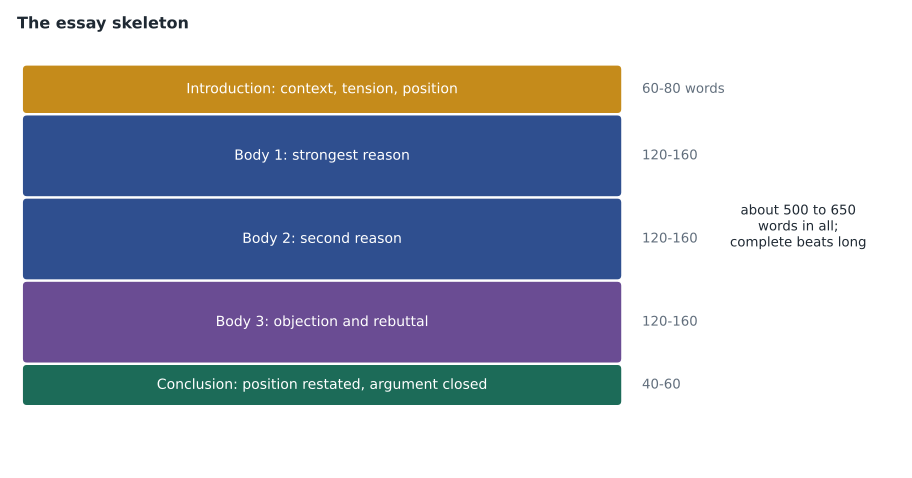
The structure Harriet recommended has five parts, which correspond directly to the five-line plan from Lesson 4.
- Introduction: context, the tension, the position. Three or four sentences.
- Body paragraph 1: your strongest reason.
- Body paragraph 2: a second, different reason.
- Body paragraph 3: the strongest objection and your rebuttal.
- Conclusion: restate the position in fresh words and close the argument. Two or three sentences.
Some students had learned a rigid five-paragraph essay in high school and found it mechanical. Harriet said the adaptation matters: the third body paragraph is a rebuttal, not a third reason, and each paragraph serves a distinct purpose in an argument. The pattern is a skeleton, and the reasoning gives it life.
How long should it be?
LSAC sets no word count. What matters is a complete, well-organized argument. But a rough target helps with planning. In 35 minutes, after rereading time, most typists who know what they want to say can produce somewhere between 450 and 650 words. Harriet suggested aiming for an introduction of 60 to 80 words, three body paragraphs of 120 to 160 words each and a conclusion of 40 to 60 words. That is about 500 to 650 words.
Thomas, who types slowly and edits as he goes, said his first essay had come to about 380 words and ended abruptly. Harriet said that a complete essay of 400 words is better than an unfinished one of 600, and that the solution for him was to separate drafting from editing: write the whole essay first, then fix sentences in the final minutes. Marcus, whose first essay was 410 words, said his problem was the opposite: he had finished early because each paragraph made its point in two sentences and stopped. Harriet said his paragraphs needed one more step of explanation each, which Lesson 9 would discuss.
Topic sentences
Each body paragraph should open with a topic sentence that states the paragraph's point and connects it to the position. A topic sentence is a promise: it tells the reader what the paragraph will show. A reader who reads only the topic sentences should be able to follow the argument.
Harriet showed topic sentences for an essay on prompt A arguing to drop daily fines.
- Body 1: "The strongest reason to drop daily fines is that they work against the library's central purpose of providing access to everyone."
- Body 2: "Daily fines also make poor practical sense, because the modest sums they raise come at a real cost in staff time and lost goodwill."
- Body 3: "The most serious objection is that, without fines, other borrowers will wait longer for popular items."
Read together, those three sentences outline the whole argument. That is the test of good topic sentences.
Building a body paragraph
After the topic sentence, a body paragraph develops its point. Harriet described a simple internal pattern: claim, reason, illustration, link.
The claim is the topic sentence. The reason explains why the claim is true. The illustration makes it concrete, with a short example or a scenario drawn from the prompt or from ordinary experience. The link ties the paragraph back to the position, often in the final sentence.
She showed a body paragraph for reason 1:
"The strongest reason to drop daily fines is that they work against the library's central purpose of providing access to everyone. A fine of a few dollars may be trivial to one borrower and a real barrier to another, and once fines accumulate and a card is blocked, the borrower who most needs free books and internet access is the one shut out. Consider a parent working two jobs who returns a stack of picture books a week late: the result is not a lesson in responsibility but a child who can no longer borrow. A policy that turns away the library's most dependent users undermines the very reason public libraries exist."
The paragraph is about 110 words. The first sentence is the claim, the second is the reason, the third is the illustration and the last is the link. Harriet pointed out that the illustration is a hypothetical, not a statistic. Hypotheticals are safe on this task because they illustrate reasoning without asserting facts that could be wrong.
Transitions
Transitions guide the reader between ideas. Between paragraphs, the topic sentence usually provides the transition: "Daily fines also..." signals a second reason; "The most serious objection is..." signals the counterargument. Within paragraphs, a small set of transitional words does most of the work: "because," "for example," "however," "therefore," "even so," "as a result."
Élodie had prepared a short list of transitions that felt natural to her in English, a habit Harriet had suggested on October 3. She said that having five or six ready, rather than reaching for unfamiliar ones under pressure, made her sentences smoother. Harriet said that was exactly right, and warned against overusing formal connectors such as "furthermore" and "moreover," which can make an essay sound stiff when every paragraph begins with one.
The conclusion
The conclusion should restate the position in fresh words and close the argument. It should not introduce new reasons, because there is no space to develop them, and it should not reverse or soften the position. A conclusion of two or three sentences is enough.
Harriet showed one: "Overdue fines ask the library to choose between access and responsibility, but it need not choose. By dropping daily fines and protecting waiting borrowers with reminders, renewal limits and replacement charges, libraries can keep both commitments, and keep their doors open to the people who need them most."
The first sentence echoes the tension from the introduction. The second restates the position and summarizes how the essay resolved the objection. Ji-won noticed that it refers back to all three paragraphs without listing them. Harriet said that is the ideal: a conclusion that feels like an ending, not a summary table.
Variations
The five-part pattern is a default, not a rule. Harriet described two common variations. The first combines a reason with a concession: a body paragraph that presents a reason, acknowledges a limit, and explains why the reason still holds. This works when an objection attaches naturally to a particular reason. The second uses two body paragraphs instead of three, one for your main reason and one for the objection, with a longer development of each. That suits writers who think deeply but type slowly.
Thomas decided to try the two-body-paragraph version for his next essay. Harriet said that was sensible, provided each paragraph was substantial and the essay still engaged at least two perspectives.
Planning the structure in the prewriting stage
The structure should be decided before the essay begins. In practice, the five-line plan already is the structure: position becomes the introduction, the two reasons become two body paragraphs, the objection and reply becomes the third, and the closing idea becomes the conclusion. Writing the topic sentences in the prewriting notes, in rough form, saves time later and ensures the paragraphs have clear points.
For the rest of the session, each member wrote rough topic sentences for prompt B in five minutes, then expanded one into a full body paragraph using claim, reason, illustration, link. Dani said the pattern made body paragraphs much less intimidating. "It is like filling out a form I designed myself," she said, which made everyone laugh, given her paralegal work.
Paragraph length on screen
An essay typed in a plain text box can look different from one on paper. Long paragraphs become dense blocks of text that are hard to read on a screen. Harriet suggested keeping paragraphs between about 100 and 170 words and separating them with a blank line, so a reader can see the structure at a glance. A paragraph that grows past 200 words usually contains two points and should be split, or contains repetition that should be cut.
Thomas's 250-word paragraph from October 17 was a case in point. When he looked at it again, it contained two ideas: weighing by alternatives and weighing by purpose. Splitting it into two paragraphs would have been fine in a longer essay, but in a 35-minute essay it was better to keep the stronger idea, the alternatives argument, and cut the other to a single sentence. The paragraph dropped to 150 words and lost nothing important.
The order of the reasons
Which reason should come first? Harriet recommended putting the strongest reason first, for two reasons of her own. First, if time runs short, the strongest point is already on the page. Second, readers form impressions early; an essay that opens its body with a powerful point earns attention for what follows. The second reason can be a different kind of point, such as a practical consideration after a principled one, which gives the essay variety.
Ji-won asked whether it was ever better to save the strongest point for last, as some writing teachers recommend. Harriet said that in a longer piece with plenty of time, building to a climax can work. In a timed essay, the risk of never reaching the climax outweighs the benefit. Put the strongest point where it is safest: first.
Signposting
Signposting means telling the reader where the essay is going. The last sentence of the introduction can preview the reasons: "Libraries should drop daily fines, because they undermine access and because better tools exist to protect waiting borrowers." Topic sentences then fulfil the preview. A reader who sees a preview and then finds paragraphs that follow it trusts the writer. Harriet warned against over-signposting, such as "In this essay I will first discuss X, then Y, and finally Z," which wastes words. A single preview clause is enough.
Structure under pressure
Under time pressure, structure is the first thing to go. Writers who feel behind start adding sentences wherever they occur to them. Harriet suggested a simple guard: before writing each paragraph, glance at the plan line for it and type the topic sentence first. Only then write the rest. That habit keeps each paragraph tied to the plan even when the clock feels tight.
Élodie said that typing the topic sentence first also helped her language, because once the main point was on the screen, the supporting sentences came more naturally. Dani said it reminded her of writing the subject line of an email before the body. Marcus said it was how he wrote test reports: result first, details after.
A structural checklist
Harriet gave the group a checklist to use when reviewing practice essays for structure. Does the introduction end with the position? Does each body paragraph open with a topic sentence that supports the position or addresses an objection? Is there a paragraph that answers the strongest objection? Does the conclusion restate the position without new reasons? Is the essay finished? An essay that passes all five checks has a sound structure, whatever its other strengths or weaknesses.
For homework, each member applied the checklist to their first practice essay from October. Every essay passed at least three checks. Ji-won's failed the third, since it had no rebuttal, and Thomas's failed the fourth, since his counterargument appeared in the conclusion. Both said the checklist made the fix obvious.
Harriet closed the session by reminding the group that structure is a servant of the argument, not a substitute for it. A perfectly organized essay with thin reasons is still thin. But a well-reasoned essay that is hard to follow wastes its own quality, because a busy reader may never see it. The structure in this lesson is designed to make good reasoning visible quickly, which is all a writing sample can ask of it.
Common mistakes
MistakeDeciding the structure while typing.
InsteadFix the structure in the prewriting stage from the five-line plan.
MistakeWriting a long introduction.
InsteadKeep it to three or four sentences; put most words in the body.
MistakeBody paragraphs without topic sentences.
InsteadOpen each with a sentence that states its point and links to the position.
MistakeIntroducing a new reason in the conclusion.
InsteadRestate the position in fresh words and close the argument.
MistakeStarting every paragraph with "Furthermore" or "Moreover."
InsteadLet topic sentences carry the transition; use a small set of natural connectors.
Summary and key terms
- Use an adapted five-part structure: introduction, two reasons, objection and rebuttal, conclusion.
- A rough target is 500 to 650 words, but a complete shorter essay beats an unfinished longer one.
- Topic sentences read together should outline the whole argument.
- Build body paragraphs as claim, reason, illustration, link; hypotheticals illustrate safely.
- Variations, such as two body paragraphs, work if the argument stays complete and engages the perspectives.
- Topic sentence
- The first sentence of a paragraph, stating its point and linking it to the position.
- Claim, reason, illustration, link
- An internal pattern for a body paragraph.
- Transition
- A word or sentence that shows how one idea connects to the next.
- Hypothetical
- An imagined example used to illustrate reasoning without asserting facts.
Practice problems
Work each problem on paper first, then reveal the answer to check.
What are the five parts of the recommended structure?
Show answer
Introduction, body 1 (reason), body 2 (reason), body 3 (objection and rebuttal), conclusion.
What is a rough word target?
Show answer
About 500 to 650 words; completeness matters more than length.
What test checks your topic sentences?
Show answer
Reading only the topic sentences should reveal the whole argument.
Why are hypotheticals useful illustrations?
Show answer
They make reasoning concrete without asserting facts that could be wrong.
What should the conclusion avoid?
Show answer
New reasons and any reversal or softening of the position.
Lesson quiz · 5 questions
Score 60% or more to complete this lesson.
Create a free account to save your progress, take quizzes and earn a certificate.