
LSAT-130 · Lesson 5 of 12 · 19 min
Taking a position
▶ Video coming soon A video version of this lesson is on the way.
On Saturday, October 17, Harriet began by reading two opening sentences aloud without saying who wrote them. The first: "There are many arguments on both sides of the question of library fines, and each perspective raises important points." The second: "Public libraries should stop charging daily overdue fines, while keeping a charge for items that are never returned." She asked which essay the group would rather read. Everyone chose the second.
'The first sentence is not wrong,' Harriet said. 'It is just empty. It tells the reader nothing they did not already know from the prompt. The second tells the reader exactly where the essay is going. That is what a position does.'
What a position is
A position is your answer to the question the issue asks, stated so clearly that a reader could summarize it in one sentence. It is not a description of the debate, a list of considerations or a promise to explore the topic. It answers the question.
LSAC's description of the task asks you to take a position, and readers will look for it. The most common failure Harriet saw in practice essays was not a weak position but no position at all: essays that summarized each perspective in turn, concluded that "each has merit," and stopped. Such essays may be well written, but they have not done the task.
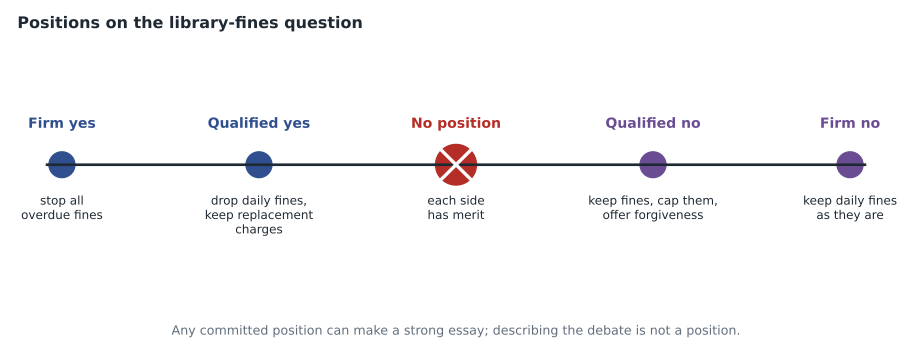
Firm and qualified positions
Positions come in two broad kinds. A firm position answers the question without conditions: "Libraries should stop charging overdue fines." A qualified position answers it with a limit, an exception or a condition: "Libraries should stop charging daily fines for children's materials, but keep fines for adults." Both are legitimate. The question is which you can defend best.
Qualified positions are often stronger on this task, for a simple reason. The perspectives are written to have genuine merit, and a firm position has to explain away everything good about the opposing perspectives. A qualified position can accept part of an opposing perspective and build it into the answer. That shows the reader you have weighed the perspectives rather than ignored them.
But qualification has a cost. A position with too many conditions stops being a position. "Libraries should consider dropping fines in some circumstances, depending on local factors, after study" has become so hedged that it answers nothing. Harriet's rule: one main qualification, clearly stated, is usually enough.
The test of a clear position
Harriet gave the group a quick test for any position statement. Could someone who read only that sentence answer the question "So what should the library do?" If yes, the position is clear. If they would have to say "the writer did not really say," it is not.
She put several candidate statements on screen and asked the group to apply the test.
- "Fines raise questions of fairness and responsibility." Fails: it describes the debate.
- "Libraries should eliminate overdue fines." Passes: firm.
- "Libraries should replace daily fines with automatic renewals and a charge for unreturned items." Passes: qualified and specific.
- "There is no simple answer, but fines may sometimes be appropriate." Fails: hedged into nothing.
- "Libraries should keep modest fines but forgive them for anyone who asks." Passes, though Thomas pointed out it nearly undoes itself: if anyone can ask for forgiveness, the fine is almost voluntary. Harriet said that was a good catch, and that the position needed a clearer limit, perhaps forgiveness for children and through a volunteer or reading program for adults.
Positions that reframe
Sometimes one perspective, often the third, reframes the issue. In prompt A, the practical management perspective says the question should be settled by results, not principles. You can build a position on a reframing perspective, but only if you still answer the question. "Libraries should decide by data" is not yet an answer. "Libraries should drop daily fines on a trial basis for a year, tracking return rates and waiting times, and restore them only if waiting lists grow substantially" is a clear, qualified answer that uses the reframing.
Marcus liked that structure, and said it resembled how engineers make decisions: implement, measure, adjust. Harriet said it was a strong position as long as the essay explained why dropping fines should be the default for the trial, rather than keeping them. Otherwise the position would be neutral in disguise.
Choosing between firm and qualified
How do you decide? Harriet suggested asking two questions in the prewriting stage. First, is there an opposing point I cannot honestly deny? If the responsibility perspective is right that other borrowers suffer when items are late, a firm "drop all fines and do nothing else" position leaves that point unanswered, and a qualified position that adds other tools may be stronger. Second, can I state the qualification in one clause? If the qualification needs a paragraph of conditions, the position may be too complicated to defend in 35 minutes.
Dani asked whether taking a firm position looked more confident. Harriet said confidence comes from the reasoning, not from the absence of qualifications. A firm position defended carelessly looks less confident than a qualified one defended carefully. But a firm position defended well is excellent. There is no penalty for either.
Stating the position early
Where should the position go? Harriet recommended stating it in the first paragraph, usually in its last sentence, and then restating it in the conclusion in slightly different words. A reader skimming the essay should find the position within the first few lines.
Some writers prefer to build up to the position, presenting the debate first and revealing their view at the end. That structure can work in a long essay with plenty of time. In 35 minutes it is risky: if you run short of time, the essay may end before the position is clear. An early position also guides your own writing. Every paragraph can be checked against it.
A simple introduction
Harriet showed a three-sentence introduction for prompt A that the group could adapt to any prompt.
"Public libraries promise free access to knowledge, but they also depend on borrowers returning shared materials so that others can use them. Overdue fines sit where those two commitments meet, and the case for keeping them rests on fairness to other borrowers. Libraries should nonetheless stop charging daily fines, because fines undermine access for the people who most need the library, and because other tools can protect waiting borrowers more effectively."
The first sentence gives context. The second names the tension and shows the writer understands the opposing view. The third states the position and previews the two reasons. That is all an introduction needs to do. Harriet said that writing longer introductions on this task is one of the most common ways to run out of time: three or four sentences are enough.
Élodie said she had been taught in French-language schooling to open with a broad general statement before narrowing to the subject. Harriet said the context sentence serves that purpose in miniature, but warned against openings that are too broad, such as "Since the dawn of civilization, people have borrowed books." Readers have seen that opening many times, and it uses words without saying anything.
Sticking with the position
A position is a commitment. The essay should support it throughout, and the conclusion should not reverse it. Harriet had seen practice essays that argued for dropping fines for three paragraphs and then concluded that "perhaps fines are necessary after all." Readers find that confusing, and it suggests the writer changed their mind while writing, which is exactly what happens when the prewriting stage is skipped.
Conceding a point is different from abandoning the position. You can acknowledge that an opposing perspective is right about something, as Lesson 7 explains, while explaining why your position still holds. The difference is that a concession is followed by "but" or "nonetheless," and the position remains standing.
Ji-won asked what to do if, halfway through writing, she realized she disagreed with her own position. Harriet said to keep the position and adjust its qualification if needed, rather than start over. A realization like that usually means an opposing point is stronger than expected, and the fix is to address it in the objection paragraph, perhaps adding a qualification to the position in the introduction. Starting over with twenty minutes left almost never produces a better essay.
Exercise
Harriet ended the first half of the session with an exercise. Each member wrote three different position statements for prompt B, the statistics requirement: one firm yes, one firm no and one qualified. Then they applied the test of a clear position to each, and chose the one they could defend best. Thomas chose a qualified yes: require a short data reasoning course, but let departments substitute an approved course in their own discipline. Dani chose a firm yes. Marcus chose the integration approach as a qualified no to a stand-alone course. Harriet said all three were good starting points, and that the next lesson would show how to bring the perspectives into each.
Positions that combine two perspectives
Some of the strongest positions combine elements of two perspectives. In prompt A, a writer might accept the access perspective's concern about excluding the poor and the responsibility perspective's concern about other borrowers, and propose a policy that addresses both: no daily fines, but limits on how many items an account with long-overdue materials can borrow until they are returned. That position takes something from each perspective and adds a mechanism of the writer's own.
Harriet said combined positions work well when the combination is coherent, meaning the parts fit together into one policy. They work badly when they simply split the difference without a reason, such as "fines should be half as large." The test is whether you can explain why the combination is better than either pure position. If you can, it shows the kind of judgment readers value. If you cannot, choose one side and answer the other.
Practising position statements quickly
Because the position must be chosen within about ten minutes, Harriet recommended a drill the group could do in spare moments: take any debatable question from the news or daily life, set a timer for two minutes, and write a firm position, a qualified position and the strongest objection to each. The questions need not be formal prompts. "Should my building ban bicycles from the elevator?" works as well as any. The drill trains the habit of committing quickly and testing the commitment against an objection.
Dani tried it on her commute and reported that her first attempts produced positions like "it depends on the building." By the end of the week she was writing "Bicycles should be allowed in the elevator outside the morning rush, when it is crowded" without thinking twice. Harriet said that was exactly the habit: a clear answer with one clear limit.
How a position shapes the rest of the essay
A clear position makes every later decision easier. Once Ji-won had written "Universities should require a data reasoning course, with departments allowed to substitute an approved course in their own discipline," she knew her reasons (civic competence, and the integration perspective's point about learning in context, which her substitution clause absorbed), her objection (student choice) and her answer (the substitution option limits the loss of choice). Her plan took four minutes. Without the position, she said, she would have spent those minutes going back and forth between perspectives.
Harriet said that was why the position comes before everything else in the plan. A position is a filter. Ideas that support it or answer objections to it belong in the essay; ideas that do neither, however interesting, do not. Ji-won said that this was the most useful idea in the course for her, because her problem had always been including every idea she had.
Thomas asked whether he should ever change his position after planning. Harriet said only in the prewriting stage, if the plan test revealed a problem. Once the essay stage begins, the position is fixed, and any doubts should go into the objection paragraph, where they belong.
Élodie asked whether a qualified position needed to say why the qualification sits where it does. Harriet said yes, briefly. If you draw a line between children and adults, the essay should give a reason for that line, such as children's dependence on adults to return items. A qualification with no reason looks arbitrary; a qualification with a reason looks like judgment. One sentence in the introduction or in the first body paragraph is usually enough.
Common mistakes
MistakeDescribing the debate instead of taking a position.
InsteadAnswer the question so clearly that a reader could summarize your view in one sentence.
MistakeHedging a position until it says nothing.
InsteadUse one main qualification, stated in a clause.
MistakeBuilding a position on a reframing perspective without answering the question.
InsteadTurn the reframing into a concrete answer, such as a trial with stated conditions.
MistakeWithholding the position until the end.
InsteadState it in the first paragraph and restate it in the conclusion.
MistakeReversing the position in the conclusion.
InsteadConcede points with "but" or "nonetheless" while keeping the position standing.
Summary and key terms
- A position answers the question the issue asks; describing the debate is not a position.
- Firm and qualified positions are both legitimate; qualified positions often handle strong opposing points better.
- Test a position by asking whether a reader could say what the writer recommends from that sentence alone.
- State the position early, usually at the end of a short introduction, and restate it in the conclusion.
- Concede points without abandoning the position; adjust a qualification rather than start over mid-essay.
- Position
- Your answer to the question posed by the issue.
- Firm position
- A position stated without conditions.
- Qualified position
- A position with one limit, exception or condition.
- Concession
- Acknowledging that an opposing view is right about something while maintaining your position.
Practice problems
Work each problem on paper first, then reveal the answer to check.
Does "Each perspective raises important points" state a position?
Show answer
No. It describes the debate without answering the question.
Why are qualified positions often strong on this task?
Show answer
They can accept part of an opposing perspective and build it into the answer.
Where should the position usually appear?
Show answer
At the end of the first paragraph, restated in the conclusion.
How long should the introduction be?
Show answer
Three or four sentences: context, the tension and the position.
What should you do if you start doubting your position mid-essay?
Show answer
Keep it, adjust the qualification if needed and address the opposing point in the objection paragraph.
Lesson quiz · 5 questions
Score 60% or more to complete this lesson.
Create a free account to save your progress, take quizzes and earn a certificate.