
LSAT-130 · Lesson 2 of 12 · 19 min
What law schools do with the writing sample
▶ Video coming soon A video version of this lesson is on the way.
The second half of the October 3 session turned to a question every member had asked in some form: if nobody scores the essay, does anyone read it? Harriet said the honest answer was that it depends on the school and the file, and that candidates should neither panic about the essay nor dismiss it.
What LSAC says
LSAC states on its LawHub page about the task that most law schools view the writing sample as an important part of the admission process. The sample is sent to the schools you apply to as part of your law school report through the Credential Assembly Service in the United States and through the application systems Canadian schools use. LSAC does not attach a score, a percentile or a rating. What a school receives is your essay, as you wrote it.
Because there is no score, there is no single policy. Each school decides how its readers use the sample: whether every file's sample is read, whether it is read only in close cases, and what weight it carries. Some schools publish a sentence or two about it; most do not. The safest assumption, Harriet said, is that your essay will be read by someone at some point, and that it should not give that person a reason to doubt your file.
Published policies: an example
A few schools say something specific. Western University's Faculty of Law, in London, Ontario, states in its admission information that it places great weight on the writing sample, because it regards writing as essential to the study and practice of law. That is an unusually direct statement. It does not tell you how a Western reader would weigh a strong sample against a weaker LSAT score, or the reverse, but it removes any doubt that the sample is read there.
Thomas, who plans to apply to Ontario schools through OLSAS as well as to Dalhousie, asked whether other Canadian schools said similar things. Harriet said practices vary and published statements are few. Some schools describe a holistic review in which every part of the file may be considered, without singling out the writing. The University of Toronto and Osgoode, discussed in LSAT-101, describe their LSAT policies in detail but candidates should read each school's current admission pages for anything about the writing sample rather than rely on forum posts. Élodie added that McGill does not require the LSAT at all, but that any LSAT she has written must be disclosed, so if she writes the LSAT her writing sample travels with it.
Dani asked about American schools. Harriet said the same pattern holds: a handful mention the writing sample, most say nothing specific, and the LSAC statement that most schools treat it as important is the best general guide. Admissions deans have said in interviews over the years that the sample matters most when something else in the file raises a question about writing ability, but that is commentary, not policy.
How readers might use it
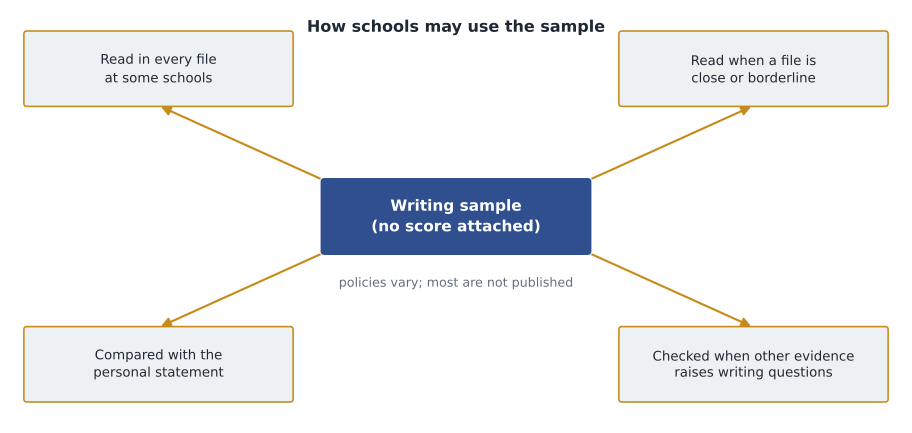
From published statements and the nature of the document, Harriet described four common ways a reader might use a sample.
First, as a check on the personal statement. A personal statement can be drafted over months with feedback from friends, advisers and paid consultants. The writing sample is written in 35 minutes with no help. A reader who sees a polished statement and a disorganized sample may wonder which reflects the applicant's real writing. A reader who sees two documents of similar quality has no such question.
Second, as a tiebreaker in close files. When two applicants have similar numbers and similar experience, a clear and thoughtful writing sample can be one of the things that distinguishes them.
Third, as evidence where other evidence is thin. An applicant whose undergraduate program involved little writing, or who has been out of school for years, may have few other signs of how they write. Dani, who earned her degree online in 2021 and has worked as a paralegal since, said that described her. Harriet said her paralegal experience would show in her application, but that the sample was her chance to show essay writing directly.
Fourth, as a check on English proficiency or on writing ability more generally. This matters for any applicant, including those whose first language is not English. Élodie asked whether readers would hold her bilingualism against her. Harriet said no reader is looking for a native speaker's idioms; they are looking for clear reasoning in correct, readable English. A plain, correct style serves a second-language writer as well as anyone.
What the sample cannot do
It is equally important to understand the limits. A brilliant essay will not rescue an application that is weak in other ways, and an ordinary but competent essay will not sink a strong one. The sample is not a second personal statement: readers are not looking for your life story, and inserting personal anecdotes in place of argument usually weakens the essay. Nor is it a test of knowledge. The prompt supplies everything you need.
Marcus asked whether a weak sample from an earlier test would follow him forever. Harriet said that LSAC's rules govern which writing samples on file are sent to schools and for how long a sample remains in the reportable period, and that those rules have changed before. The reliable approach is to read LSAC's current statement about writing samples in your file and plan around it, not around rumours. For Marcus, who has a sample on file from April 2025, the practical point was that he did not need to write again to receive his November score.
The reader's position
Harriet asked the group to imagine an admissions reader opening a file. The reader has the transcript, the LSAT score, the personal statement, letters of recommendation, perhaps a résumé and a diversity statement, and the writing sample. They may be reading their thirtieth file of the day. What do they need from the sample?
They need to see, quickly, that the applicant understood the issue, took a position and defended it in an organized way. A reader skimming a sample in a minute or two will notice a clear thesis in the first paragraph, topic sentences that announce each point and a conclusion that ties the argument together. They will also notice an essay that circles, never commits, or stops mid-sentence when time ran out.
That picture explains several of the habits this course teaches. State the position early. Use paragraphs with clear first sentences. Finish, even if the final paragraph is short. A reader who can follow your argument in a quick read will form a good impression; a reader who has to work to find your point may not bother.
How much preparation is enough
Given all this, Harriet proposed a proportionate plan. The multiple-choice score carries far more weight in admissions than the writing sample, so most study time should stay on Logical Reasoning and Reading Comprehension. But a few hours spread over several weeks are enough to make the writing reliable: learning the method, writing three or four timed practice essays with review, and doing a final warm-up essay a day or two before the real one.
She also pointed out that the skills overlap. Logical Reasoning trains you to find conclusions, premises and assumptions; an argumentative essay requires you to build those deliberately. Reading Comprehension trains you to identify viewpoints and the author's position; the writing task asks you to do the same with the perspectives. Time spent on the writing is not entirely time taken from the rest of the test.
Ji-won asked whether her extended time for the multiple-choice sections also applied to the writing. Harriet said accommodations are decided by LSAC and described in each candidate's approval, and that LawHub notes that timing for the prewriting stage may differ for candidates with approved accommodations. Ji-won should check exactly what her approval says about the writing and practise under that timing.
A note on honesty
Because the writing is completed remotely, candidates sometimes wonder how strictly it is monitored. Harriet was direct. The session is proctored by webcam and microphone, the room must be shown at the start, and the rules forbid notes, other people, phones and outside help. Breaking those rules risks a misconduct finding that is reported to schools, which is far worse than any weak essay. The only sound strategy is to prepare well and write honestly.
Dani asked whether she could use a phrase bank she had memorized. Harriet said a few practised transitional phrases in your head are just good preparation; bringing written material into the room is not allowed. The method in this course is designed to be carried in memory: a handful of steps and a simple structure, nothing that needs to be written down in advance.
The group's plan
By the end of the session each member had written a short plan. Thomas would write his first timed essay in mid-October and aim for four before April. Élodie would write three before January, focusing on natural phrasing. Dani would write four, starting with untimed essays to learn the structure and then moving to strict timing. Ji-won would practise under the timing in her approval. Marcus, with a sample already on file, would write two for practice and use them to tighten his habit of saying too little.
Reading a school's admission pages for clues
Because few schools say much about the writing sample directly, Harriet showed the group how to read admission pages for indirect clues. A school that describes its review as holistic, emphasizes writing skills in its description of the first-year program, or mentions that every part of the application is read by a committee member is signalling that the sample may matter. A school that states a formula, such as an index combining grades and test scores, may rely less on the sample for most applicants, though even such schools often read files in full when decisions are close.
Thomas tried this with Dalhousie's and several Ontario schools' pages during the session. He found statements about holistic review and about the importance of writing, but nothing that described the sample's weight precisely. Harriet said that was the typical result and the reason the course recommends writing as if the sample will be read. Thomas added the pages to his application spreadsheet so he could check them again when the next admission cycle's information appeared.
Applicants with something to show
Some applicants have particular reasons to treat the sample seriously. An applicant whose grades were uneven early in university but strong later may want every part of the file to show the strengths of the later years. An applicant returning to school after years of work, like Dani or Marcus, may have few recent academic writing samples. An applicant who studied in another language, like Élodie for much of her schooling, can use the sample to show clear academic English. For all of them, a well-organized essay is a small but genuine piece of evidence.
Harriet was careful not to overstate the point. 'Nobody gets admitted because of a writing sample,' she said. 'But an applicant can remove a doubt with one, and that is worth a few hours of preparation.'
What readers do not expect
Dani asked whether readers expect perfect grammar in 35 minutes. Harriet said no reasonable reader expects a timed essay to read like a polished paper. Occasional typos and an imperfect sentence or two are normal. What readers notice is a pattern: frequent errors that make sentences hard to follow, or a structure that falls apart. The goal is an essay that a busy reader can follow without effort, not one without a single flaw.
Marcus summed up the discussion in an engineer's terms: the sample is a low-weight input most of the time and a decisive one occasionally, and since you cannot know which kind of file yours will be, you design for the occasional case. Harriet said she had never heard it put better.
Common mistakes
MistakeAssuming an unscored essay is never read.
InsteadWrite as if it will be read; LSAC says most schools treat it as important, and some say so directly.
MistakeTreating the sample as a second personal statement.
InsteadArgue the issue in the prompt; save your story for the personal statement.
MistakeSpending weeks on the writing at the expense of the multiple-choice sections.
InsteadUse a proportionate plan: the method, three or four timed essays and a warm-up.
MistakeRelying on forum posts about which samples schools see.
InsteadRead LSAC's current rules and each school's admission pages.
MistakeBringing memorized phrases on paper into the room.
InsteadCarry a few practised transitions in memory; no written material is allowed.
Summary and key terms
- LSAC says most law schools view the writing sample as an important part of admission; schools receive the essay without a score.
- School policies vary and are mostly unpublished; Western Law, for example, says it places great weight on the sample.
- Readers may use the sample to check the personal statement, separate close files, supply evidence of writing and confirm clear English.
- The sample cannot rescue a weak file or sink a strong one, and it is not a place for personal narrative.
- A proportionate plan keeps most study time on the scored sections while making the writing reliable.
- Writing sample
- The essay produced in LSAT Argumentative Writing and sent to schools with your law school report.
- Holistic review
- An admission approach in which every part of the file may be considered, without fixed formulas.
- Reportable period
- The period during which LSAC reports test results and samples to schools under its current rules.
- Proctoring
- Supervision of a test session; for the writing, by webcam and microphone.
Practice problems
Work each problem on paper first, then reveal the answer to check.
What does LSAC say about how schools view the writing sample?
Show answer
That most law schools view it as an important part of admission.
Give one example of a school that publishes a specific statement about the writing sample.
Show answer
Western University's Faculty of Law says it places great weight on it.
Why might a reader compare the sample with the personal statement?
Show answer
The statement may be revised with help; the sample is written under controlled conditions in 35 minutes.
What should a candidate with accommodations check about the writing?
Show answer
What their LSAC approval says about timing for the writing, then practise under that timing.
Why is breaking the remote rules a poor gamble?
Show answer
Misconduct findings are reported to schools and are far more damaging than a weak essay.
Lesson quiz · 5 questions
Score 60% or more to complete this lesson.
Create a free account to save your progress, take quizzes and earn a certificate.