
LSAT-130 · Lesson 11 of 12 · 19 min
Practice prompts
▶ Video coming soon A video version of this lesson is on the way.
The second half of the November 14 session was devoted to reading essays rather than writing them. Harriet had written two sample essays for the course on a new practice prompt: one strong, one weak. Neither was a real candidate's essay, and neither was based on an LSAC prompt. She asked the group to read the prompt first, then each essay, and to annotate both using everything from the previous six Saturdays.
'Reading other essays critically is one of the fastest ways to improve your own,' she said. 'It is easier to see a missing rebuttal in someone else's work than in yours. Once you can see it there, you start seeing it in your own drafts.'
Practice prompt C: monitoring remote workers (written for this course)
Issue. Software now allows employers to record the screens, keystrokes and active hours of employees who work from home. Should employers use such monitoring tools for remote employees?
Perspective 1: Accountability. An employer pays for working time and is entitled to confirm that it receives it. In an office, a manager can see who is working; monitoring tools simply restore that visibility at a distance. Employees who do their jobs have nothing to fear from records that confirm it.
Perspective 2: Trust and dignity. Constant recording treats every employee as a suspect. It measures activity rather than results, rewards looking busy over thinking well, and intrudes into homes where family life goes on in the next room. Workplaces built on surveillance lose the trust that makes good work possible.
Perspective 3: Proportion. Some monitoring is reasonable and some is not. Tracking access to sensitive client data may be justified; recording every keystroke rarely is. Employers should use the least intrusive tool that meets a specific, stated need, and tell employees exactly what is collected and why.
Sample essay 1 (written for this course)
The first essay took a qualified position. Harriet asked the group to read it once straight through, as an admissions reader would, before annotating.
"Remote work has made it harder for employers to see how employees spend their time, and monitoring software promises to restore that visibility. The case for it rests on a fair point: employers pay for working time and are entitled to some assurance that they receive it. Employers should nonetheless limit monitoring to specific, stated needs, such as protecting sensitive data, rather than recording screens and keystrokes across the board, because broad surveillance measures the wrong things and costs more in trust than it gains in control.
The strongest reason to limit monitoring is that keystroke and screen recording measure activity rather than results. A tool that counts keystrokes rewards the employee who types constantly over the one who spends an hour thinking through a difficult problem and then writes a short, correct answer. Most knowledge work is judged by its product: a report that is accurate, code that runs, a client who is satisfied. An employer that manages by activity data will tend to get more activity, which is not the same thing as better work.
Broad monitoring also damages the trust that remote work depends on. Remote arrangements work when employers trust employees to manage their own time and employees trust employers to judge them fairly. Recording every screen sends the opposite message: that every employee is presumed to be wasting time until proven otherwise. That message falls on the diligent as heavily as on the idle, and it intrudes into homes where family life continues in the next room. An employee who feels watched has less reason to go beyond the minimum.
The most serious objection is that employers are entitled to accountability, and that in an office a manager could see who was working. That concern is legitimate; an employer that could not tell whether work was being done would have a real problem. But office supervision was never a record of every keystroke. Managers judged employees mainly by what they produced and by regular conversation, and those tools work at a distance too: clear goals, regular check-ins and review of finished work. Where a specific risk justifies closer monitoring, such as access to confidential client files, a targeted tool that logs that access, disclosed to employees in advance, meets the need without treating everyone as a suspect.
Monitoring tools can serve legitimate purposes, but their breadth should match the need. Employers who measure results, explain what they monitor and why, and reserve close tracking for specific risks will gain the accountability they want without paying for it in the trust that makes remote work possible."
Annotating essay 1
The group annotated the essay in pairs, then compared notes. Their observations, with Harriet's additions, followed the four qualities from Lesson 1.
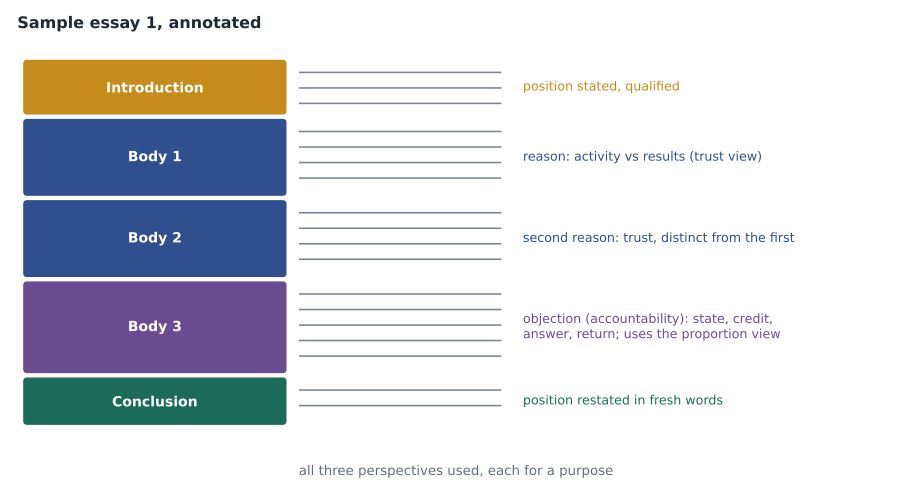
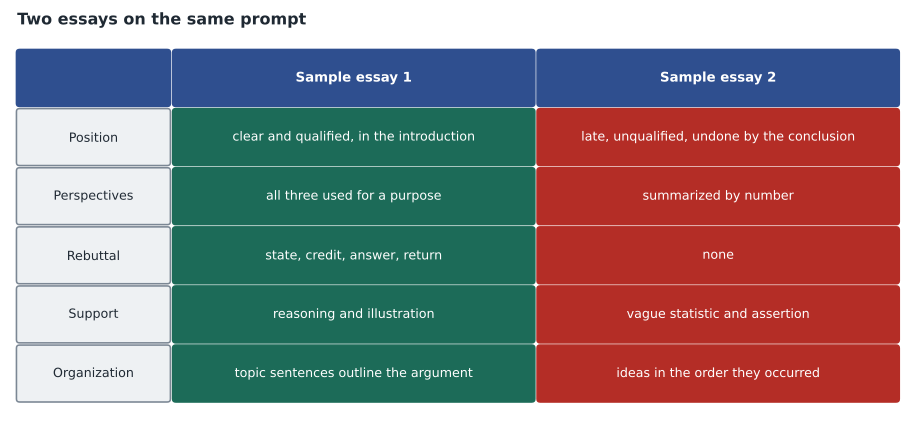
Position. The introduction states a clear, qualified position in its last sentence: limit monitoring to specific, stated needs. A reader could summarize it in one sentence. The conclusion restates it in fresh words without reversing it.
Reasons. Body paragraph 1 argues that broad monitoring measures the wrong thing, which draws on the trust and dignity perspective's point about activity versus results and develops it with the contrast between typing and thinking. Body paragraph 2 argues that monitoring damages trust, drawing on the same perspective and extending it with the point about diligent employees. Dani noticed that the two reasons were related but different: one is about measurement, the other about relationships. Harriet agreed, and said that two reasons drawn from the same perspective are fine as long as they are genuinely distinct.
Engagement. The third body paragraph addresses the accountability perspective with state, credit, answer, return. It credits the concern, then answers that office supervision never meant total recording, and that results-based tools work remotely. It also incorporates the proportion perspective by proposing targeted monitoring for specific risks. All three perspectives are used, each for a purpose.
Organization. Topic sentences outline the argument: measurement, trust, objection. The paragraphs follow claim, reason, illustration, link. The essay is about 540 words.
Ji-won asked whether anything could be improved. Harriet said the second body paragraph's final sentence, "An employee who feels watched has less reason to go beyond the minimum," states a likely effect as a fact. A slightly more careful phrasing, "may have less reason," would be more precise. Marcus noticed that the essay used no statistics at all, and was more persuasive for it. Élodie liked the transition at the start of the third paragraph, "The most serious objection is," and said she would add it to her list.
Sample essay 2 (written for this course)
The second essay was shorter. Harriet asked the group to read it the same way.
"In today's modern world, technology is changing everything about how we work. There are many different opinions about monitoring software. Some people think it is good and some people think it is bad, and there are also people who think it depends.
The first perspective says employers should be able to monitor employees because they pay them. This is a good point because employers do pay employees. The second perspective says monitoring is bad because it is not respectful and people do not like being watched. The third perspective says some monitoring is okay but not too much.
I think monitoring is bad. Studies show that most employees who are monitored are less happy at work. Also, nobody likes being watched all the time, and it is obviously an invasion of privacy. Employers should trust their employees.
In conclusion, there are many sides to this issue and each perspective has good points. Employers will have to decide for themselves what is best for their company."
Annotating essay 2
The group found the weaknesses quickly, which Harriet said was the point of the exercise: each was a mistake from the list of ten in the first half of the session.
Opening. The first sentence is a broad generalization that says nothing specific. The rest of the paragraph describes the debate without taking a position.
Summary instead of engagement. The second paragraph restates each perspective by number, adding only "this is a good point because employers do pay employees," which repeats the perspective rather than evaluating it.
Late, unsupported position. The position, "monitoring is bad," appears only in the third paragraph and is a firm position with no qualification, despite the proportion perspective's reasonable middle ground. It is supported by a vague statistic, "studies show that most employees who are monitored are less happy," that the writer cannot verify, and by assertion, "obviously an invasion of privacy."
No rebuttal. The accountability perspective is acknowledged as "a good point" and never answered. The essay leaves the strongest objection standing.
Contradictory conclusion. The conclusion says each perspective has good points and leaves the decision to employers, which undoes the position stated in the third paragraph.
Dani said that six weeks earlier she might have written something like essay 2, and that reading it now felt like reading a checklist of what not to do. Harriet said that was progress, and that essay 2 was not written by someone who could not argue. It was written by someone without a method.
Rewriting essay 2
For the final exercise, each member rewrote essay 2's argument, keeping its basic view that monitoring is harmful, into a strong essay plan. They had ten minutes. Thomas produced a firm position, "employers should not use screen and keystroke recording for remote employees," with reasons about measurement and trust and a rebuttal of the accountability perspective using results-based management. Ji-won produced a qualified version close to essay 1. Marcus took the opposite side for practice, arguing that monitoring is justified for roles handling sensitive data, and found that the trust perspective was the objection he had to answer.
Harriet said all three plans were strong, and that the exercise showed again that the same prompt can support different good essays. The difference between essay 1 and essay 2 was not the opinion. It was the method.
How to use practice prompts
Harriet ended with advice for practising on prompts between now and test day. Use a mix of sources: LSAC's sample prep session in LawHub, which uses the real interface, and original prompts like the ones in this course. Write under strict timing, typed, with no grammar checker. After each essay, wait a day, then annotate it as the group had annotated the samples: position, reasons, engagement, organization, and your personal error list. Keep a short log of what you found, and before the next essay, read the log.
She also recommended exchanging essays with a study partner. Reading a partner's essay is as useful as having yours read, because it trains the critical eye. Élodie and Dani agreed to exchange one essay each in December, and Thomas and Marcus did the same.
Annotating your own essays
After the samples, Harriet asked each member to annotate their own most recent practice essay the same way, using simple labels in brackets: [POSITION], [REASON], [PERSPECTIVE], [REBUTTAL]. The exercise revealed patterns quickly. Thomas found that he had labelled two different sentences [POSITION], one in the introduction and a slightly different one in the conclusion; his position had drifted. Dani found three [PERSPECTIVE] labels in her first body paragraph and none in the rebuttal, which meant she had summarized early and engaged late. Ji-won's essay had no [REBUTTAL] label at all, confirming what Harriet had told her on October 24.
Harriet said labelling your own essay is uncomfortable but efficient. In five minutes it shows you the same things a tutor would point out, and once you have seen a pattern in your own work, you are much more likely to avoid it next time.
A final word on samples
Harriet reminded the group that the sample essays in this lesson were written for the course to illustrate common strengths and weaknesses, not to be memorized. Readers have seen many essays that follow familiar patterns, and memorized phrases from someone else's essay tend to sound out of place. The value of studying samples lies in the habits they demonstrate: a clear position early, distinct reasons, a full rebuttal and a finished conclusion. Those habits transfer to any prompt; memorized sentences do not.
Thomas asked whether it would help to write his own model essay on each practice prompt after the timed attempt, with no time limit. Harriet said that was an excellent exercise once in a while, because it shows the gap between what you produce under pressure and what you can produce with time, and the gap itself tells you what to practise. She suggested doing it once in December and once before his April test.
Common mistakes
MistakeReading practice essays only for their opinions.
InsteadAnnotate position, reasons, engagement and organization.
MistakeWriting practice essays and never reviewing them.
InsteadWait a day, annotate your essay and log what you find.
MistakeOpening with a broad statement about "today's modern world."
InsteadOpen with specific context and move quickly to the position.
MistakeAcknowledging an objection as "a good point" and moving on.
InsteadAnswer it with state, credit, answer, return.
MistakeEnding with "each perspective has good points."
InsteadRestate your position in fresh words.
Summary and key terms
- Annotating sample essays trains you to see strengths and weaknesses in your own writing.
- Strong essays state a clear position early, develop distinct reasons, answer the strongest objection and use the perspectives for a purpose.
- Weak essays summarize, take a late or unsupported position, skip the rebuttal and end by undoing their own view.
- The same prompt supports different strong essays; method, not opinion, makes the difference.
- Practise with LawHub's sample session and original prompts, then review each essay with a log.
- Annotation
- Notes on an essay identifying its position, reasons, engagement and organization.
- Sample essay
- An example essay used for study; in this course, written for the course.
- Essay log
- A running record of what you find when reviewing your practice essays.
- Study partner exchange
- Swapping practice essays with another candidate for critical reading.
Practice problems
Work each problem on paper first, then reveal the answer to check.
What position does sample essay 1 take?
Show answer
Employers should limit monitoring to specific, stated needs rather than recording screens and keystrokes broadly.
How does sample essay 1 use the proportion perspective?
Show answer
In the rebuttal, proposing targeted, disclosed monitoring for specific risks.
Name three weaknesses of sample essay 2.
Show answer
Any three of: no early position, summary by number, vague statistic, assertion, no rebuttal, contradictory conclusion.
What is the main difference between the two essays?
Show answer
Method: essay 1 follows a clear plan; essay 2 does not.
How should you review a practice essay?
Show answer
Wait a day, annotate it for position, reasons, engagement, organization and personal errors, and log the findings.
Lesson quiz · 5 questions
Score 60% or more to complete this lesson.
Create a free account to save your progress, take quizzes and earn a certificate.