
LSAT-130 · Lesson 6 of 12 · 19 min
Using and weighing the perspectives
▶ Video coming soon A video version of this lesson is on the way.
The second half of the October 17 session addressed what Harriet called the heart of the task. 'The perspectives are not decoration,' she said. 'LSAC built the prompt around them, and the description asks you to engage with their arguments and ideas. An essay that states a position and then argues as if the perspectives did not exist has missed half the assignment. But an essay that does nothing except summarize the perspectives has missed the other half.'
Engaging versus summarizing
Engaging with a perspective means using it in your argument: drawing on it as support, testing it, conceding part of it or answering it. Summarizing means restating it. The difference shows up in the verbs. A summarizing sentence says "The access perspective argues that fines fall hardest on the poor." An engaging sentence says "The access perspective is right that fines fall hardest on the poor, and that point matters more than any modest revenue, because a library that turns away its neediest users has failed at its central purpose." The second sentence takes the perspective's idea and does something with it.
Harriet's rule of thumb: whenever you mention a perspective, the same sentence or the next should say what you make of it. Agree and extend, agree in part, or disagree and explain why.
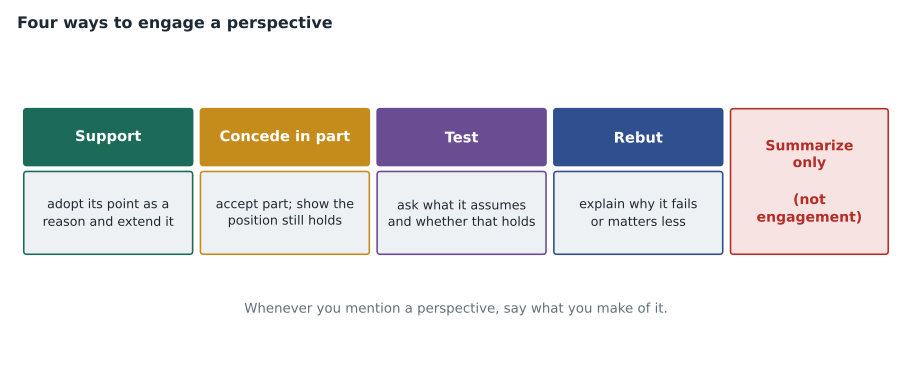
Four ways to use a perspective
Harriet described four moves, using the group's second practice prompt, which they had restated at the end of the October 10 session.
Practice prompt B: a statistics course for every first-year student (written for this course)
Issue. A university is considering a rule that every first-year undergraduate, whatever their program, must complete one course in statistics and data reasoning. Should the university adopt the requirement?
Perspective 1: Civic competence. Citizens are asked to judge claims built on numbers every day: polls, medical risks, economic forecasts. A graduate who cannot tell a meaningful difference from noise is poorly equipped for public life, whatever their major. A university that grants degrees without this skill is failing at a basic task.
Perspective 2: Student choice. Students come to university to pursue particular interests, and their programs already contain many required courses. Adding a universal requirement crowds out electives that may serve a student better, and a reluctant student in a compulsory course often learns little.
Perspective 3: Integration. Data reasoning matters, but a stand-alone course is the wrong tool. Students learn statistics best when it is woven into the subjects they care about: a history student analysing census records, a nursing student reading clinical trials. Departments should be required to teach it within their own courses.
Support. A perspective that agrees with your position can supply a reason. Dani, who chose a firm yes, could draw on the civic competence perspective: "Graduates will spend their lives weighing claims built on numbers, from medical risks to election polls. A university that does not equip them to tell a real difference from random variation leaves them exposed." That is not a quotation; it is the perspective's idea put to work in Dani's own words.
Concede in part. A perspective that opposes your position may still be partly right. Dani could concede that the student choice perspective has a point: required courses do crowd out electives. Then she shows why her position survives: "One course in four years is a small cost for a skill every graduate will use."
Test. You can examine what a perspective assumes. The student choice perspective assumes that a reluctant student learns little. Is that always true? Many students arrive skeptical of courses that later prove valuable. Testing an assumption is a precise way to weaken a perspective without dismissing it.
Rebut. You can argue that a perspective is wrong, or that it matters less than it seems. Marcus, arguing for integration instead of a stand-alone course, could rebut the civic competence perspective in part: it shows that data reasoning matters, but it does not show that a separate course is the best way to teach it.
Weighing
The perspectives usually rest on different values, so the deepest question is often which value should prevail and why. Harriet called this weighing. An essay that weighs explains why one consideration outweighs another, rather than simply listing considerations on each side.
There are several common ways to weigh. One is scope: which consideration affects more people, or more important interests? Another is reversibility: which harm is harder to undo? A third is alternatives: can one value be protected in another way, so that the conflict is smaller than it seems? A fourth is the institution's purpose: which consideration fits what the institution exists to do?
For prompt B, Thomas tried weighing by alternatives. The student choice perspective values electives. But if departments could count an approved statistics course in their own discipline, students would lose less choice than the perspective fears. The conflict shrinks, and the requirement becomes easier to justify. Harriet said that was a strong move, because it shows the writer thinking about how to reconcile values instead of simply picking one.
How many perspectives to use
Do you need to engage every perspective? LSAC's description asks you to address some of the arguments and ideas from the perspectives, which does not require all of them. In practice, Harriet said, a strong essay usually uses at least two and often all three, because each perspective was written to bring out something important. Ignoring a perspective entirely can look like avoiding a difficulty, especially if that perspective contains the strongest objection to your position.
But using a perspective does not mean giving it equal space. A typical strong essay builds its main reasons on one or two perspectives and answers the most important opposing one at length. A third perspective might appear in a single sentence, conceded or set aside. Proportion should follow importance.
Ji-won asked whether she could bring in ideas that were not in any perspective. Harriet said yes, as long as they are reasons, not outside facts presented as certain. "Universities already require writing courses on the theory that every graduate needs to write clearly; the same reasoning applies to data" is an original argument that does not depend on any statistic. It strengthens the essay because it shows independent thought.
Referring to perspectives clearly
Readers have the prompt, but they should not have to look back at it to follow you. Harriet suggested naming a perspective by its idea the first time: "Those who stress student choice argue that..." After that, a short reference is enough: "the student choice view." Avoid referring only to numbers. "Perspective 2 is wrong" forces the reader to remember which one that was.
Élodie asked whether to quote the perspectives directly. Harriet said a short quoted phrase can be effective when the exact wording matters, but most references should be paraphrased. Long quotations waste time and space, and paraphrasing shows that you understood the idea.
Avoiding false balance
One trap is giving every perspective a paragraph of praise followed by a paragraph of criticism, regardless of strength. That structure looks thorough but avoids judgment. Harriet called it false balance. If one perspective is much stronger, say so. If one is weak, a sentence may be enough. The essay should reflect your assessment, not a template that treats all views as equally weighty.
Another trap is the opposite: treating opposing perspectives with contempt. "Anyone who thinks students should choose their own courses simply does not understand the modern world" may feel persuasive to the writer but reads as unfair. The perspectives in a prompt are written to be reasonable. Treating them as foolish suggests you misread them.
The group tries it
For the last part of the session, each member wrote a single body paragraph for prompt B that used at least two perspectives with at least two of the four moves. They had ten minutes. Harriet then read the paragraphs aloud anonymously.
Dani's paragraph drew on civic competence for support, conceded the cost to electives and weighed: one required course against a lifetime of decisions involving numbers. Harriet said it was clear and well proportioned. Marcus's paragraph rebutted the stand-alone course by testing the civic competence perspective's unstated assumption that a separate course is the best way to teach data reasoning, and then supported integration with an example of a nursing student reading clinical trials. Harriet said it was strong, but the example belonged to the perspective, so he should add a sentence of his own explaining why learning in context sticks. Élodie's paragraph was well reasoned but referred to the perspectives as "the first, second and third perspectives" throughout. Changing those references to the ideas themselves made it noticeably easier to follow.
Thomas wrote the most ambitious paragraph, weighing by alternatives and by purpose. Harriet said it was excellent but nearly 250 words, too long for one paragraph in a 35-minute essay. He would need to cut, which Lesson 9 addresses.
Homework
Harriet assigned the group's first full timed essay, on prompt A, to be written at home before the next Saturday under strict timing: 15 minutes of prewriting, 35 minutes of writing, no grammar checker. Each member would send it to her by Thursday, October 22, and she would return comments the following Saturday.
Weighing in a single sentence
Weighing does not have to take a paragraph. Often a single sentence does it, placed where two considerations meet. Harriet showed several examples for prompt B, each using one of the four methods.
- Scope: "A lost elective affects one semester; the inability to judge a statistical claim affects decisions for a lifetime."
- Reversibility: "A student who misses an elective can take a similar course later; a graduate who never learned data reasoning rarely goes back to learn it."
- Alternatives: "If departments may substitute their own data course, the conflict with student choice largely disappears."
- Purpose: "A university exists to prepare graduates for informed participation in public life, and that purpose is served more directly by data reasoning than by any single elective."
Each sentence takes a side and gives a reason for preferring one consideration over another. An essay with two or three sentences like these reads as reasoned judgment rather than a list of points.
When the perspectives share a value
Sometimes two perspectives share a value but disagree about how to serve it. In prompt B, the civic competence and integration perspectives both value data reasoning; they disagree about method. That kind of disagreement calls for a different approach from a clash of values. Instead of weighing values, you compare methods: which approach is more likely to achieve the shared goal, at what cost, and with what risks?
Marcus, arguing for integration, compared methods in this way: a stand-alone course reaches every student but risks feeling disconnected from their interests; integration connects data reasoning to each subject but depends on every department teaching it well. He then argued that the risk of uneven teaching could be managed by requiring departments to meet a common standard, while the risk of disconnection was built into the stand-alone model. Harriet said this was an excellent example of comparing methods rather than values, and that it showed he had read the perspectives closely enough to see that they agreed on the goal.
Using the perspectives' own words carefully
The perspectives contain vivid phrases, and it is tempting to borrow them. Harriet said a short borrowed phrase in quotation marks is fine, especially when you are about to challenge it: the student choice perspective's claim that "a reluctant student in a compulsory course often learns little" is worth quoting precisely because the essay will test it. But an essay built mostly from the perspectives' sentences reads as summary. The ideas should be the perspectives'; most of the words should be yours.
How many perspectives the group used
When Harriet tallied the group's practice paragraphs, every member had used two perspectives and three had used all three. She said that was the right range, and added that the number matters less than the purpose: each perspective that appears should be doing a job, either supporting the position, being answered or being absorbed into a qualification.
Dani said the hardest part of weighing for her was committing to the claim that one value outweighs another, because it felt presumptuous. Harriet said that the task asks for exactly that commitment, and that a weighing sentence is not a claim to certainty. It is a reasoned judgment, offered with its reason, which a reader is free to reject. Readers respect a writer who weighs openly far more than one who lists considerations and leaves the reader to decide.
Common mistakes
MistakeSummarizing the perspectives without using them.
InsteadWhenever you mention a perspective, say what you make of it.
MistakeGiving every perspective equal praise and criticism.
InsteadLet space and judgment follow each perspective's strength.
MistakeListing considerations without weighing them.
InsteadExplain why one consideration outweighs another, by scope, reversibility, alternatives or purpose.
MistakeReferring to perspectives only by number.
InsteadName each by its idea the first time, then use a short reference.
MistakeTreating opposing perspectives with contempt.
InsteadEngage them as reasonable views; they were written to be.
Summary and key terms
- Engaging a perspective means using it: support, concede in part, test its assumptions or rebut it.
- Weighing explains why one value or consideration should prevail; scope, reversibility, alternatives and purpose are common methods.
- Strong essays usually use at least two perspectives, with space proportional to importance.
- Original reasons that are not outside facts can strengthen an essay.
- Avoid false balance and avoid contempt; refer to perspectives by their ideas.
- Engagement
- Using a perspective's idea in your argument rather than only restating it.
- Weighing
- Explaining why one consideration should outweigh another.
- False balance
- Treating all perspectives as equally strong regardless of merit.
- Testing an assumption
- Examining an unstated premise a perspective relies on.
Practice problems
Work each problem on paper first, then reveal the answer to check.
Name the four ways to engage a perspective.
Show answer
Support, concede in part, test, rebut.
What assumption does the student choice perspective in prompt B make?
Show answer
That a reluctant student in a compulsory course learns little.
How did Thomas weigh by alternatives on prompt B?
Show answer
By letting departments substitute an approved course in their discipline, which shrinks the loss of choice.
Must you use every perspective?
Show answer
No; LSAC asks you to engage some of them, but strong essays usually use at least two and often all three.
How should you refer to a perspective the first time?
Show answer
By its idea, for example "those who stress student choice."
Lesson quiz · 5 questions
Score 60% or more to complete this lesson.
Create a free account to save your progress, take quizzes and earn a certificate.