
LSAT-121 · Lesson 9 of 12 · 23 min
EXCEPT questions and the hardest question types
▶ Video coming soon A video version of this lesson is on the way.
On Monday, November 9, three days before Marcus's test, Harriet kept the session light for him: he would listen and skip the timed set. 'Tonight is about the questions that cost strong readers their last few points,' she said. 'Not because they need new skills, but because they twist familiar skills in ways that cause careless errors.' She listed five on the screen: EXCEPT and LEAST questions, "provides information to answer" questions, principle questions in Reading Comprehension, author-to-author inference questions, and questions about the function of a passage within a comparative pair.
EXCEPT and LEAST questions
An EXCEPT question reverses the usual task. "Each of the following is mentioned in the passage EXCEPT" means that four answers are mentioned and one is not; the credited answer is the one that is not. "The author would be LEAST likely to agree with" means you are looking for the answer with the weakest support, which is usually one the author would reject.
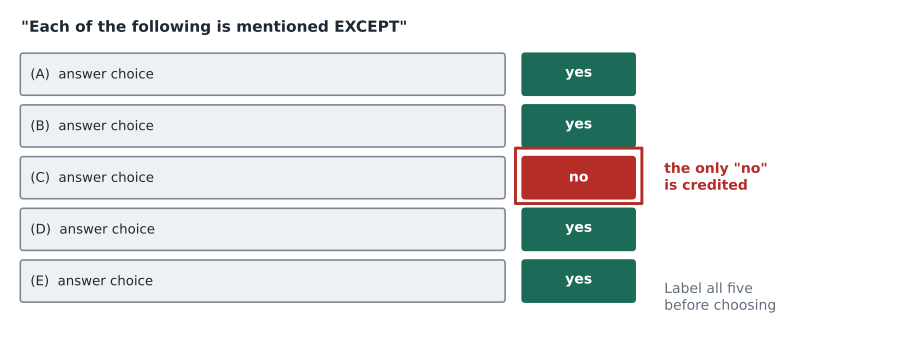
Most errors on EXCEPT questions are not errors of reading but of bookkeeping. Halfway through checking the choices, students forget that they are looking for the odd one out and choose the first answer that is supported. Harriet's method is mechanical: label each choice as you test it. For "each of the following is mentioned EXCEPT," mark each choice "yes" (mentioned) or "no." The credited answer is the only "no." Never choose an answer until you have labelled it.
Ji-won said this was the same as tagging test cases "pass" or "fail" before deciding which one revealed the bug. Dani said she had already adopted the habit from the Sunday clinic on cannot-be-true questions, and that it had cut her EXCEPT errors in half. Harriet said the Logical Reasoning and Reading Comprehension versions were identical in logic.
A pair for the hardest types
Harriet brought back pair H from the first session, so that the group could focus on the questions rather than the passages.
Comparative pair H (law): the fine print (written for this course)
This pair first appeared in lesson 1. Use your comparison map from that lesson or build a new one.
Passage A
Consumer law has long relied on disclosure. If a business must state its terms clearly before a customer agrees, the reasoning goes, the customer can compare offers, avoid unfair bargains and hold the business to what it promised. Legislatures have responded to nearly every new consumer problem by requiring more disclosure: longer notices, mandatory summaries, highlighted boxes and checkboxes confirming that the customer has read the terms.
The difficulty is that almost no one reads them. Studies of online shoppers have found that only a tiny fraction open the terms of service at all, and that those who do rarely stay long enough to read more than a few lines. This is not laziness. A typical consumer agrees to dozens of standard-form contracts a year, many of them thousands of words long, and could not read them all without giving up much of their working life. Adding more disclosure to this pile does not inform consumers; it buries the few terms that matter under many that do not.
The persistence of disclosure rules, then, owes less to their effectiveness than to their convenience. They are cheap for legislatures to enact and easy for businesses to satisfy, and they allow courts to say that a consumer who clicked "I agree" consented. Protecting consumers from unfair terms requires something disclosure cannot supply: rules that forbid certain terms outright, whatever the fine print says.
Passage B
Critics of mandatory disclosure are right that few consumers read contract terms, but they draw the wrong conclusion from that fact. Disclosure need not work by persuading every customer to read every word. It works if enough informed readers exist to discipline the market: consumer advocates, journalists, regulators and a small minority of careful buyers who publicize bad terms and steer others away from them.
Disclosure can also be redesigned. A short, standardized summary that presents the price, the cancellation terms and the few other provisions most consumers care about, in the same format across competing businesses, can be read in less than a minute. Machine-readable disclosure goes further, allowing comparison tools to read terms on a consumer's behalf and flag unusual ones.
Outright bans on particular terms have a place, but they are blunt. A term that is unfair in one market may be reasonable in another, and legislatures are slow to update lists of prohibited clauses. Well-designed disclosure, by contrast, lets markets adjust while keeping terms open to scrutiny. The goal should be better disclosure, not its abandonment.
Worked problem
Sample question (written for this course)
Question: "Each of the following is presented in Passage B as a way disclosure can protect consumers EXCEPT" (A) informed minorities who publicize bad terms. (B) short standardized summaries of key terms. (C) machine-readable terms that comparison tools can analyse. (D) regulators and journalists who scrutinize terms. (E) a requirement that consumers confirm they have read every term.
Show solution
- (E) is correct, because it is the only "no." Passage B never proposes confirmation checkboxes; Passage A mentions them as part of the disclosure pile that does not work.
- (A) is in B: consumer advocates and careful buyers who publicize bad terms.
- (B) is in B: short, standardized summaries.
- (C) is in B: machine-readable disclosure read by comparison tools.
- (D) is in B: regulators and journalists are among the informed readers.
Answer: (E). Label each choice yes or no; the only "no" is credited.
"Provides information to answer" questions
Some questions ask: "The passage provides information that most helps to answer which one of the following questions?" Four of the questions in the answer choices cannot be answered from the passage; one can. The trap is a question that is about the passage's topic and feels as if it ought to be answered, but is not.
For pair H, "According to Passage A, why do disclosure rules persist?" can be answered: they are cheap to enact, easy to satisfy and let courts find consent. "How many words long is a typical terms-of-service agreement?" cannot be answered; Passage A says "thousands of words" for many contracts, but gives no typical figure. "Which legislatures have banned particular contract terms?" cannot be answered; neither passage names any.
Thomas said these questions felt like detail questions run backwards. Harriet agreed and suggested he test each choice by trying to point to the sentence that answers it. If he could not point, the choice was wrong.
Principle questions in Reading Comprehension
Principle questions ask which general principle underlies an author's argument or would justify a position in the passage. They work like the principle questions from the Sunday clinic, with one difference: the reasoning is spread across a passage, so you must first identify which argument the stem is about. For Passage A in pair H, the underlying principle might be stated: "A legal protection should be judged by whether it actually achieves its purpose, not by whether it is easy to adopt or comply with." That principle explains why A dismisses disclosure despite its convenience.
Worked problem
Sample question (written for this course)
Question: "Which one of the following principles most helps to justify the reasoning of the author of Passage B?" (A) A policy that fails for most of the people it affects should always be abandoned. (B) A remedy that works through a minority of informed participants can be effective even if most people never use it directly. (C) Legislatures should never prohibit contract terms. (D) Consumers are responsible for reading every term of every contract they sign. (E) Any policy that is inexpensive to enforce should be retained.
Show solution
- (B) is correct. B argues that disclosure works if enough informed readers discipline the market, even though most consumers do not read.
- (A) would support Passage A's conclusion, not B's.
- (C) is too strong: B says bans have a place, though they are blunt.
- (D) is not B's argument; B accepts that few consumers read and does not blame them.
- (E) is closer to A's description of why disclosure persists, and B does not rely on cost.
Answer: (B). The principle must match the specific reasoning the stem names.
Author-to-author inference
Harder comparative questions ask what one author would say about a specific claim or example in the other passage, or which statement one author would accept and the other would reject. These combine response questions and the voting test. The credited answer must be strongly supported by one author's reasoning and clearly rejected by the other's.
For pair H: "The author of Passage A would most likely regard the informed-minority argument in Passage B as" — A says almost no one reads the terms and that adding disclosure buries the few terms that matter. A would likely think the informed minority is too small, or too easily outweighed by the volume of terms, to protect ordinary consumers. An answer saying A would find the argument "persuasive" contradicts A's conclusion; an answer saying A "would not address it" ignores the clear implications of A's reasoning.
The function of a passage within a pair
A final hard type asks what role one passage plays relative to the other: "Passage B functions primarily to..." or "The second paragraph of Passage B serves to..." The answer comes from your relationship sentence, translated into abstract terms. For pair H: "Passage B accepts a premise of Passage A's kind of argument but challenges the conclusion drawn from it." Wrong answers misstate the role ("provides evidence for A"), misjudge the strength ("refutes every claim in A") or describe a role neither passage plays ("proposes a compromise both authors accept").
Why hard questions are often easy
Harriet ended the first half with an observation from years of tutoring. The questions students call "hard" are often not harder to reason through than ordinary questions. They are harder to keep track of. EXCEPT questions demand bookkeeping, "provides information" questions demand checking five separate claims, and author-to-author questions demand holding two positions at once. The skills from the comparison map and the labelling method make them manageable, and practising the bookkeeping until it is automatic matters more than any clever insight.
Élodie said that this was reassuring, because she had assumed the hardest questions required a talent she did not have. Harriet said that the best readers she had taught were not more brilliant than others; they were more methodical, and their methods ran automatically under pressure.
The November 9 set
Thomas, Élodie, Dani and Ji-won worked eight hard-type questions in twelve minutes (Ji-won eighteen). Ji-won answered eight, Thomas seven, Élodie seven and Dani six. Dani's misses were one "provides information" question, where she picked a question the passages seemed to address but did not, and one author-to-author question. Marcus listened and said he would do the set after his test. Harriet told him to sleep well on Wednesday night and not to do any new questions after Tuesday's workshop.
LEAST questions
LEAST questions are close relatives of EXCEPT questions but call for judgment rather than a simple yes or no. "Which one of the following would the author of Passage B be LEAST likely to accept?" means that some answers might be partly acceptable; you want the one furthest from B's view. Rank the choices instead of labelling them. For pair H, "Outright bans on unfair terms should replace all disclosure requirements" is a strong candidate: B says bans have a place but argues against abandoning disclosure.
Thomas said that ranking felt slower than labelling. Harriet agreed and suggested he label first (yes, no, maybe) and rank only the "no" and "maybe" choices. That keeps the bookkeeping light while still respecting the judgment the question requires.
Hard questions late in a set
Hard question types tend to cluster near the end of a set, after the main point and detail questions. That means you meet them when time is shortest. Knowing this, some students budget a little extra for the last two questions of each set. Harriet said that was sensible, provided the extra time came from faster decisions on earlier questions, not from rushing the reading.
Common mistakes
MistakeChoosing the first supported answer on an EXCEPT question.
InsteadLabel every choice and choose the odd one out.
MistakeChoosing a question that the passage seems to address but does not answer.
InsteadPoint to the sentence that answers the question; if you cannot, eliminate it.
MistakeChoosing a principle that supports the wrong argument.
InsteadIdentify which author or argument the stem names before testing principles.
MistakeTreating an author's silence as having no implications.
InsteadApply each author's reasoning to the other's claims when a question asks.
MistakeThinking hard questions need special talent.
InsteadThey need bookkeeping; practise the methods until they are automatic.
Summary and key terms
- EXCEPT and LEAST questions reverse the task; label every choice before choosing.
- "Provides information" questions require a passage sentence that answers the question in the choice.
- Principle questions require first identifying the argument the stem is about.
- Author-to-author questions combine response questions and the voting test.
- Questions about the function of a passage come from the relationship sentence on your map.
- EXCEPT question
- A question whose credited answer is the one choice that does not fit the stem's description.
- LEAST question
- A question asking for the choice with the weakest support or fit.
- Labelling method
- Marking each answer choice yes or no before choosing, to avoid bookkeeping errors.
- Principle question
- A question asking which general rule underlies or justifies an argument.
Practice problems
Work each problem on paper first, then reveal the answer to check.
In an EXCEPT question asking what is mentioned, which answer is credited?
Show answer
The only answer that is not mentioned.
Can the passages in pair H answer "Why do disclosure rules persist, according to Passage A?"
Show answer
Yes: they are cheap to enact, easy to satisfy and let courts find consent.
State a principle underlying Passage A's reasoning.
Show answer
A legal protection should be judged by whether it achieves its purpose, not by how easy it is to adopt.
How would the author of Passage A likely regard B's informed-minority argument?
Show answer
As inadequate: too few people read terms to protect ordinary consumers.
What makes hard questions hard, according to Harriet?
Show answer
Bookkeeping: keeping track of reversed tasks, several claims or two positions at once.
Lesson quiz · 5 questions
Score 60% or more to complete this lesson.
Create a free account to save your progress, take quizzes and earn a certificate.