
LSAT-121 · Lesson 12 of 12 · 51 min
Capstone: a timed comparative set and single passage
▶ Video coming soon A video version of this lesson is on the way.
The second hour of the November 16 session was the capstone of the Monday series. Harriet set the conditions: one comparative pair and one single passage, thirteen questions, 17 minutes 30 seconds on the timer (Ji-won 26 minutes 15 seconds), no pausing, and a checkpoint call at 9 minutes (13 minutes 30 seconds for Ji-won). After the timer, each student would rebuild their maps in blind review, rework flagged questions without the answers, and then compare. Marcus, four days after his test, said he would take it for the practice, and because he wanted to know whether the humanities habit had stuck.
Work the set yourself under the same conditions before reading the explanations. Use a timer, build a comparison map for the pair and a roadmap for the single passage, and use the seatbelt checks from lesson 10. All passages and questions were written for this course.
The set
Capstone pair O (urban policy): charging drivers to enter the city (written for this course)
Passage A
Road space in a busy city centre is a valuable resource that is usually given away. When something valuable is free, it is overused, and the result on urban roads is congestion: buses stuck in traffic, delivery vehicles idling and drivers losing hours each week. Congestion pricing, which charges drivers a fee to enter a central zone at busy times, treats road space as the scarce resource it is.
Cities that have adopted such charges have generally reported fewer vehicles in the charged zone, faster bus journeys and cleaner air. Just as important, the revenue can be used to improve public transit, giving people who stop driving a better alternative. Opposition is often fierce before a charge is introduced, but in several cities public support has grown once residents experienced the results.
Passage B
Congestion pricing is often defended as simple economics, but who pays matters as much as how much traffic falls. A flat charge takes a much larger share of a low-income worker's earnings than of a high earner's. Those with the least flexibility, such as shift workers whose hours fall outside transit schedules, or tradespeople who must carry tools, may have no practical alternative to driving and simply pay.
These concerns can be addressed, but only if they are taken seriously from the start. Discounts for low-income residents, exemptions for certain workers and a firm commitment to spend the revenue on transit serving the neighbourhoods where affected drivers live would make a charge fairer. Without such measures, a policy that improves the city centre for those who can afford it may do so at the expense of those who cannot.
Questions 1 to 7 refer to the comparative pair.
1. Which one of the following most accurately describes the relationship between Passage A and Passage B? (A) Passage B rejects congestion pricing, which Passage A defends. (B) Passage B accepts that congestion pricing can work but argues that its burden on some drivers must be addressed. (C) Passage B provides statistical evidence for the results described in Passage A. (D) Passage A responds to an objection raised in Passage B. (E) The passages discuss different cities' transport policies.
2. The authors of the two passages would be most likely to agree with which one of the following? (A) A congestion charge should be the same for all drivers. (B) Public opposition to congestion charges always declines after they are introduced. (C) Congestion pricing has no effect on traffic. (D) Revenue from a congestion charge can be used to improve public transit. (E) Shift workers should be exempt from all road charges.
3. Passage B, unlike Passage A, discusses which one of the following? (A) the effect of a flat charge on drivers who have no practical alternative to driving (B) the reduction in traffic in charged zones (C) the use of revenue for transit (D) public opinion before a charge is introduced (E) the overuse of resources that are given away
4. The attitude of the author of Passage B toward congestion pricing is best described as (A) unreserved enthusiasm. (B) complete indifference. (C) conditional support, dependent on measures to address fairness. (D) outright opposition. (E) amused detachment.
5. The relationship between the two passages is most analogous to the relationship between which one of the following pairs of documents? (A) Two engineers' reports that disagree about whether a bridge is structurally sound. (B) A history of a toll road and a map of its exits. (C) A proposal to build a library and a report that it has opened. (D) Two reviews of a restaurant that agree the food is poor. (E) A report endorsing a new bridge toll to fund repairs, and a second report accepting the toll but proposing discounts for low-income commuters who have no other route.
6. Which one of the following, if true, would most weaken the concern expressed in Passage B? (A) Congestion charges in most cities are set at the same level for all vehicles. (B) In a city with a congestion charge, low-income residents rarely drove into the charged zone even before the charge, and transit improvements funded by the charge mainly served their neighbourhoods. (C) Some tradespeople carry tools that are too heavy to take on public transit. (D) Air quality improved in the charged zone after the charge was introduced. (E) Opposition to congestion charges is often fierce before they are introduced.
7. Which one of the following principles is most clearly relied on in the first paragraph of Passage A? (A) A valuable resource that is provided free of charge tends to be overused. (B) Public resources should always be distributed equally. (C) Governments should not charge for the use of roads. (D) Every policy that reduces traffic is justified. (E) Drivers are responsible for congestion only during holidays.
Capstone passage P (history): the invention of standard time (written for this course)
Until the late nineteenth century, most towns kept their own local time, set by the position of the sun. When it was noon in one town, it might be a few minutes before or after noon in a town some distance to the east or west. For most of history the differences hardly mattered, since few people travelled fast enough to notice them.
Railways changed that. A traveller crossing North America might pass through dozens of local times, and railway companies kept their own times, often different from those of the towns they served. Timetables became bewildering, and the danger of collisions on single-track lines made consistent timekeeping a matter of safety as well as convenience. In November 1883, the railways of the United States and Canada adopted a system of standard time zones, each an hour apart, on their own initiative and without legislation.
The Canadian engineer Sandford Fleming had campaigned for a worldwide system of time zones based on a single prime meridian. At an international conference held in Washington in 1884, delegates agreed to adopt the meridian passing through Greenwich, England, as the prime meridian for longitude, though the conference did not itself impose standard time on the countries attending. Adoption of time zones by national law came gradually, over decades.
Standard time is so familiar today that it is easy to forget it was once controversial. Some objected that it replaced the authority of the sun with that of the railway companies; others worried about the confusion of changing clocks. The system prevailed because the coordination it offered became indispensable to a society increasingly organized around schedules, and because its arbitrariness, once accepted, mattered less than the fact that everyone shared it.
Questions 8 to 13 refer to Passage P.
8. Which one of the following most accurately expresses the main point of the passage? (A) Sandford Fleming invented the system of time zones used throughout the world today. (B) The International Meridian Conference of 1884 required all nations to adopt standard time. (C) Standard time arose from the coordination needs of railways and prevailed despite objections because a shared system of time became indispensable. (D) Local solar time was more accurate than standard time and should not have been abandoned. (E) Railway collisions were the only reason standard time was adopted.
9. According to the passage, the 1884 conference in Washington (A) imposed standard time on the countries attending. (B) rejected the idea of a single prime meridian. (C) was organized by the railway companies of the United States and Canada. (D) adopted the meridian through Greenwich as the prime meridian but did not itself impose standard time. (E) was the first occasion on which time zones were used anywhere.
10. It can be inferred from the passage that in North America (A) standard time zones were used by railways before laws required their use. (B) every town adopted standard time on the same day by law. (C) local solar time was abolished by the 1884 conference. (D) the railways opposed standard time. (E) time zones were two hours apart.
11. The first paragraph of the passage functions primarily to (A) present the author's main argument. (B) criticize local timekeeping as irrational. (C) describe an objection to standard time. (D) introduce Sandford Fleming's proposal. (E) describe the system that standard time replaced and explain why its differences seldom mattered.
12. The author's attitude toward the arbitrariness of standard time is best described as (A) indignation that it replaced the authority of the sun. (B) acceptance that it is arbitrary, together with the view that this matters less than its being shared. (C) belief that it is not arbitrary at all. (D) alarm at its effect on daily life. (E) uncertainty about whether standard time has been adopted.
13. Each of the following is mentioned in the passage as a problem that local time created for railways EXCEPT (A) bewildering timetables. (B) the danger of collisions on single-track lines. (C) telegraph companies' refusal to transmit time signals. (D) railway times that differed from the times of the towns they served. (E) travellers passing through many different local times.
Comparison map and roadmap
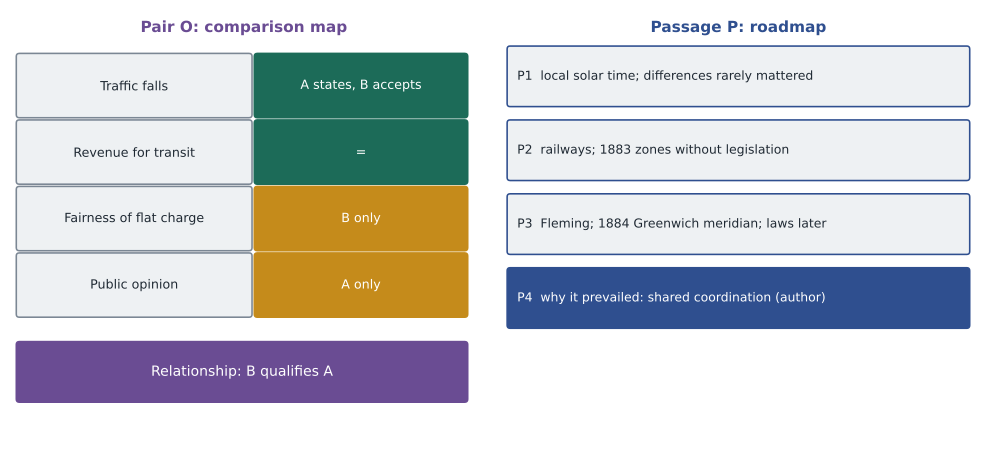
Harriet's comparison map for pair O:
- Position A: Road space is a valuable resource given away and therefore overused; charging for it reduces congestion and funds transit; support tends to grow after introduction.
- Position B: Who pays matters; a flat charge burdens low-income and inflexible drivers; with discounts, exemptions and transit spending where affected drivers live, a charge can be fair.
- Points of contact: traffic reduction (A states it; B accepts it implicitly: "as much as how much traffic falls"); revenue for transit (both, agreement); fairness of a flat charge (only B); public opinion (only A); economic rationale (A states it; B says the policy is "often defended as simple economics" without rejecting it).
- Relationship: B accepts that the policy can work but argues that its distributional burden must be addressed from the start. Claim and qualification.
Harriet's roadmap for Passage P:
- P1: Before standard time, towns kept local solar time; differences rarely mattered.
- P2: Railways made differences matter (timetables, safety); in 1883 North American railways adopted time zones on their own initiative.
- P3: Fleming's worldwide proposal; 1884 conference adopted Greenwich meridian but did not impose standard time; legal adoption came gradually.
- P4: Standard time was controversial; it prevailed because shared coordination became indispensable and its arbitrariness mattered less than its being shared (author's judgment).
Explanations
Worked problem
Drill question 1
Relationship between the passages.
Show solution
- (B) is correct. B accepts that the policy can work and argues that fairness must be addressed from the start.
- (A) is too strong: B never rejects congestion pricing.
- (C) is wrong: B provides no statistics and is not supporting A's results.
- (D) reverses the order: A does not respond to B.
- (E) is wrong: both discuss the same policy in general terms.
Answer: (B). Claim and qualification; match the strength.
Worked problem
Drill question 2
Agreement.
Show solution
- (D) is correct. A says revenue can improve transit; B calls for a firm commitment to spend it on transit. Both support it.
- (A) contradicts B, which proposes discounts and exemptions.
- (B) is too strong even for A, which says support grew "in several cities."
- (C) contradicts A and B's implicit acceptance that traffic falls.
- (E) is too strong: B proposes exemptions for certain workers, not all road charges, and A does not address it.
Answer: (D). Both authors must support the answer.
Worked problem
Drill question 3
What only Passage B discusses.
Show solution
- (A) is correct. Only B discusses drivers with no practical alternative, such as shift workers and tradespeople.
- (B) is discussed in A (fewer vehicles) and accepted in B.
- (C) is discussed in both.
- (D) is discussed only in A.
- (E) is A's economic rationale.
Answer: (A). The "only B" rows of the map answer this directly.
Worked problem
Drill question 4
Attitude of Passage B.
Show solution
- (C) is correct. B says the concerns "can be addressed" and that with such measures a charge would be fairer.
- (A) is too positive.
- (B) is wrong: B engages seriously with the policy.
- (D) is too negative; B never opposes the policy outright.
- (E) is not supported by B's serious tone.
Answer: (C). Tone is cautious, but the position is conditional support.
Worked problem
Drill question 5
Analogy to the relationship.
Show solution
- (E) is correct. One report endorses a charge for its benefits; the second accepts it but proposes protections for those with no alternative. Same structure as pair O.
- (A) describes disagreement about the facts.
- (B) describes two documents with different purposes.
- (C) describes a proposal and its implementation.
- (D) describes simple agreement.
Answer: (E). Use the relationship sentence as the abstract description.
Worked problem
Drill question 6
Weakening B's concern.
Show solution
- (B) is correct. If low-income residents rarely drove into the zone and gained most from transit improvements, the flat charge would not burden them as B fears.
- (A) supports B's premise that charges are flat.
- (C) supports B's concern about tradespeople.
- (D) concerns air quality, which does not bear on who pays.
- (E) concerns public opinion, an issue B does not raise.
Answer: (B). Target the specific concern: who bears the cost.
Worked problem
Drill question 7
Principle in Passage A's first paragraph.
Show solution
- (A) is correct. "When something valuable is free, it is overused."
- (B) is an equity principle closer to B's concerns, and too strong.
- (C) contradicts A.
- (D) is too strong; A argues for a particular policy, not every traffic-reducing policy.
- (E) is irrelevant.
Answer: (A). Locate the argument the stem names and find its general rule.
Worked problem
Drill question 8
Main point of Passage P.
Show solution
- (C) is correct. It covers the railway origins, the gradual adoption and the author's explanation of why the system prevailed.
- (A) overstates Fleming's role; he campaigned for a worldwide system, and the North American railways adopted zones on their own initiative.
- (B) contradicts the passage: the conference did not impose standard time.
- (D) is not the author's view.
- (E) is too strong: collisions were one reason among others.
Answer: (C). The main point must cover the whole passage and match the author's judgment.
Worked problem
Drill question 9
Detail about the 1884 conference.
Show solution
- (D) is correct. The third paragraph says delegates adopted the Greenwich meridian but the conference did not impose standard time.
- (A) contradicts the passage.
- (B) contradicts it: the conference adopted a single prime meridian.
- (C) is unsupported: the passage does not say who organized it.
- (E) is false: the railways adopted zones in 1883.
Answer: (D). Locate, read, predict, match.
Worked problem
Drill question 10
Inference about North America.
Show solution
- (A) is correct. The railways adopted zones in 1883 "without legislation," and adoption by law "came gradually, over decades."
- (B) contradicts the gradual legal adoption.
- (C) contradicts the passage: the conference did not impose standard time.
- (D) contradicts the passage: the railways adopted the zones.
- (E) contradicts "each an hour apart."
Answer: (A). An inference must be strongly supported by the passage.
Worked problem
Drill question 11
Function of the first paragraph.
Show solution
- (E) is correct. The paragraph describes local solar time and says the differences hardly mattered.
- (A) is wrong: the main argument appears in the final paragraph.
- (B) is unsupported: the paragraph does not call local time irrational.
- (C) is wrong: objections appear in the fourth paragraph.
- (D) is wrong: Fleming appears in the third paragraph.
Answer: (E). Function questions come from the roadmap.
Worked problem
Drill question 12
Author's attitude toward arbitrariness.
Show solution
- (B) is correct. The author says the system's "arbitrariness, once accepted, mattered less than the fact that everyone shared it."
- (A) attributes to the author an objection the passage reports from others.
- (C) contradicts the author's acknowledgment of arbitrariness.
- (D) is unsupported.
- (E) is unsupported; the passage says standard time prevailed.
Answer: (B). Separate the author's voice from reported objections.
Worked problem
Drill question 13
EXCEPT: problems local time created for railways.
Show solution
- (C) is correct, as the only "no." The passage never mentions telegraph companies.
- (A) is mentioned: timetables became bewildering.
- (B) is mentioned: the danger of collisions on single-track lines.
- (D) is mentioned: railway times often differed from the towns' times.
- (E) is mentioned: a traveller might pass through dozens of local times.
Answer: (C). Label every choice; the only "no" is credited.
Answer key: 1 B, 2 D, 3 A, 4 C, 5 E, 6 B, 7 A, 8 C, 9 D, 10 A, 11 E, 12 B, 13 C.
Results
Timed and blind review scores, of 13:
- Thomas: 12 timed, 13 blind review. He missed question 13, the EXCEPT question, choosing (D) before labelling every choice. He finished with 90 seconds to spare and said he should have spent them on a second check of the EXCEPT question.
- Ji-won: 12 timed, 13 blind review. She missed question 6, choosing (C), a half-relevant answer, and found the error immediately in blind review when she wrote out the target concern.
- Élodie: 11 timed, 12 blind review, with no guesses. She reached the checkpoint at 8 minutes 50 seconds, ten seconds ahead, and finished with twenty seconds left. She missed question 4, choosing (D), and question 8, choosing (A). In blind review she corrected question 4 but kept (A) on question 8, and only on comparing it with Harriet's roadmap saw that Fleming's campaign was for a worldwide system, while the North American zones came from the railways.
- Marcus: 11 timed, 12 blind review. He answered all six Passage P questions correctly, including the humanities-style attitude question, which he said proved the habit of reading the last paragraph for evaluative language had stuck. His misses were questions 2 and 5.
- Dani: 10 timed, 11 blind review. Her map called the relationship direct disagreement at first, which led to wrong answers on questions 1 and 4; she corrected question 4 in blind review. Her third miss was question 9.
Debrief
Harriet led the debrief by asking each student for one sentence on what they would change. The sentences went straight into the error logs.
- Thomas: "Spend spare time on a second check of EXCEPT and relationship questions."
- Ji-won: "Write the target concern before reading new-information choices."
- Élodie: "On main point questions, test each name in the answer against the roadmap's exact role for it."
- Marcus: "On agreement questions, find both authors' support before choosing."
- Dani: "Before labelling a relationship, ask whether B rejects A or only qualifies it."
Harriet pointed out that four of the five sentences were about habits the Monday series had taught, and that every miss could be traced to a line on the maps. 'That is what a method buys you,' she said. 'When you miss a question, you know why, and you know what to do next time.'
After the capstone
The Monday series ended that night. The group's Reading Comprehension work continued in the Wednesday lab's final week and in the capstones scheduled for the end of the month. Harriet set each student a plan for the weeks after the Monday series: two timed comparative sets a week, one full practice test a week from early December for the January test takers, and a rolling error log review every Sunday. Marcus would wait for his December 2 score before deciding whether he needed a January attempt.
Common mistakes
MistakeLabelling a qualification as direct disagreement.
InsteadAsk whether B rejects A or only limits it before naming the relationship.
MistakeChoosing an EXCEPT answer before labelling every choice.
InsteadLabel all five; choose the only "no."
MistakeAccepting a main point answer that overstates one person's role.
InsteadCheck each named person or event against its exact role in the roadmap.
MistakeChoosing a half-relevant answer on a new-information question.
InsteadWrite the target claim or concern before reading the choices.
MistakeReviewing only the answer key after a timed set.
InsteadRebuild maps in blind review, compare them with your timed maps and log a specific next step.
Summary and key terms
- The capstone combined one comparative pair and one single passage under timed conditions.
- Every question could be answered from the comparison map or the roadmap.
- Misses traced to specific habits: relationship labelling, EXCEPT bookkeeping, target claims and roles of named people.
- Blind review with rebuilt maps showed which errors were pressure errors and which were knowledge errors.
- Each debrief ends with one specific sentence entered in the error log.
- Capstone set
- A timed set that combines the skills of the course under test conditions.
- Debrief
- A structured review after a timed set.
- Checkpoint call
- A time signal partway through a timed set.
- Answer key
- The list of credited answers, consulted only after blind review.
Practice problems
Work each problem on paper first, then reveal the answer to check.
What relationship does pair O illustrate?
Show answer
Claim and qualification: B accepts congestion pricing can work but argues its burden on some drivers must be addressed.
Which issue in pair O does only Passage A discuss?
Show answer
Public opinion before and after a charge is introduced.
According to Passage P, how did the 1883 time zones come about in North America?
Show answer
The railways adopted them on their own initiative, without legislation.
What is the author's judgment in Passage P's final paragraph?
Show answer
Standard time prevailed because shared coordination became indispensable, and its arbitrariness mattered less than its being shared.
Why was question 13 an EXCEPT trap for Thomas?
Show answer
He chose an answer before labelling every choice; the only unmentioned item was (C).
Lesson quiz · 5 questions
Score 60% or more to complete this lesson.
Create a free account to save your progress, take quizzes and earn a certificate.