
LSAT-121 · Lesson 5 of 12 · 23 min
Analogy questions
▶ Video coming soon A video version of this lesson is on the way.
On Monday, October 26, Harriet started with a question that had nothing to do with the LSAT. 'A carpenter keeps a set of jigs, templates she has built so she can cut the same joint quickly and identically every time. Which of these is most like her jigs: a novelist's thesaurus, a chef's pre-measured spice mixes, or a gardener's compost?' Thomas said the spice mixes. Dani said the thesaurus. After a minute, everyone agreed on the spice mixes, and Harriet asked why.
Ji-won put it best: 'The jigs and the spice mixes are both things prepared in advance so a repeated task can be done fast and the same way each time. The thesaurus helps you find a word, but it does not make the work faster or more uniform. The compost is prepared in advance but it is an ingredient, not a tool.' Harriet said that was the whole method for analogy questions in one paragraph.
What analogy questions ask
Analogy questions ask you to find a situation, outside the passage, that has the same structure as something in the passage. Typical stems include:
- "Which one of the following is most analogous to the oral poets' use of repeated phrases, as described in the passage?"
- "The relationship between the traditional view and Parry's explanation is most similar to which one of the following?"
- "Which one of the following situations is most analogous to the relationship between Passage A and Passage B?"
The answer choices describe situations from completely different fields: business, music, sports, medicine, cooking. The content is deliberately unfamiliar. What must match is the structure: the relationships between the parts.
Abstract first, then match
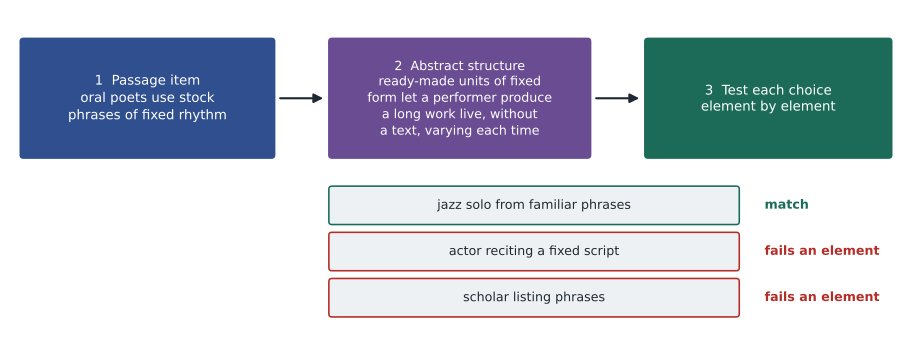
The method has two steps. First, describe the item in the passage in abstract terms that strip away its subject matter. Second, test each answer choice against that abstract description, element by element.
The abstract description should capture the features that matter: who does what, to what, for what purpose, with what result. It should not include features that are specific to the subject matter, such as "ancient Greek" or "poetry," because no answer choice will share them.
A passage for analogies
Harriet handed out a humanities passage. Read it and then describe, in abstract terms, what Parry claimed the repeated phrases were.
Passage N (humanities): composing without writing (written for this course)
For centuries, readers of the Iliad and the Odyssey were puzzled by features of the poems that seemed to sit uneasily with the idea of a single author carefully crafting a text. The same phrases recur constantly: dawn is "rosy-fingered," Achilles is "swift-footed," and ships are "hollow" whether or not the context calls for the description. Whole lines and even longer passages are repeated nearly word for word. Some scholars took these repetitions as evidence that the poems were stitched together by later editors; others dismissed them as minor blemishes in great works.
In the 1920s and 1930s, the American scholar Milman Parry offered a different explanation. Parry argued that the repeated epithets were not ornaments but tools: ready-made phrases of fixed metrical shape that allowed a poet to compose verse aloud, at the speed of performance, without writing. To test the idea, Parry and his assistant Albert Lord recorded living oral poets in Yugoslavia, singers who could perform long narrative songs, sometimes thousands of lines, and who never sang the same song exactly the same way twice. Their techniques closely resembled what Parry had inferred from Homer.
Parry's work transformed Homeric scholarship, though it did not settle every question. If the poems arose from an oral tradition, how did they come to be written down, and did writing change them? Some scholars argue that the poems as we have them reflect a single exceptional singer, perhaps one who dictated to a scribe; others see them as the product of a tradition that continued to evolve until the text was fixed much later. What few now dispute is that the repetitions once treated as flaws are evidence of a craft that readers accustomed to written literature had failed to recognize.
Building the abstract description
Harriet asked each student for an abstract description of the repeated epithets as Parry understood them. The group refined them together into this version: "A performer uses a store of ready-made units, each fitting a fixed form, so that a long work can be produced live and at speed, without a written text, and with variation from one performance to the next."
Each part of that description matters. "Ready-made units" captures the stock phrases. "Fitting a fixed form" captures their metrical shape. "Produced live and at speed" captures performance. "Without a written text" captures orality. "Variation from one performance to the next" captures the finding that the singers never sang a song the same way twice.
Marcus pointed out that not every element would necessarily appear in the credited answer. Harriet agreed: the credited answer must match the essential elements and must not contradict any. If an answer choice describes a performer who memorizes a fixed text word for word, it contradicts the variation element, and that is enough to eliminate it.
Worked problem
Sample question (written for this course)
Question: "Which one of the following is most analogous to the use of repeated epithets by oral poets, as Parry understood it?" (A) An actor memorizes a playwright's script exactly and delivers it the same way at every performance. (B) A novelist revises a manuscript many times, removing repeated words that an editor has flagged as careless. (C) A scholar compiles a catalogue of every phrase in an ancient manuscript. (D) A jazz musician improvises a long solo by drawing on a repertoire of familiar phrases that fit the song's chord structure, so that no two performances are identical. (E) A public speaker reads a prepared speech from a teleprompter.
Show solution
- (D) is correct. A performer (the musician) produces a long work live, using ready-made units (familiar phrases) that fit a fixed form (the chord structure), with variation between performances.
- (A) contradicts the variation and the absence of a fixed text: the actor delivers a memorized script identically.
- (B) reflects the view Parry rejected, that repetitions are blemishes to be removed, and involves writing, not performance.
- (C) is about studying phrases, not using them to compose.
- (E) relies on a written text, the opposite of oral composition.
Answer: (D). Every essential element matches, and nothing contradicts the passage's account.
Analogies to a relationship between views
Some analogy questions ask about the relationship between two views or two parts of a passage. In Passage N, the relationship between the earlier view and Parry's explanation can be described abstractly: "a feature long regarded as a defect is shown to be a functional part of a method that observers had not recognized." An analogous situation might be: "Doctors once regarded fever as simply a harmful symptom to be suppressed; researchers later argued that it is part of the body's defence against infection."
Thomas noticed that this relationship appeared in the passage's last sentence: "the repetitions once treated as flaws are evidence of a craft that readers accustomed to written literature had failed to recognize." Harriet said the last sentence of a passage often hands you the abstract structure of its central relationship.
Analogies to the relationship between two passages
In comparative sets, analogy questions sometimes ask which relationship is most like the relationship between Passage A and Passage B. Your comparison map's relationship sentence is your abstract description. For pair H on disclosure, the relationship was: "Both accept a shared fact; one concludes a remedy should be replaced, the other that it should be improved." An analogous pair might be two reviews of a city's bus system, both agreeing that few people use the current routes, with one concluding the routes should be abolished in favour of on-demand vans and the other that the routes should be redesigned.
Worked problem
Sample question (written for this course)
Question: "The relationship between Passage A and Passage B of pair H (disclosure) is most analogous to the relationship between which one of the following pairs of documents?" (A) A report that a bridge is safe and a second report confirming it with new measurements. (B) A history of a city's parks and a guide to its restaurants. (C) Two reports that disagree about whether a factory's emissions exceed legal limits. (D) A report proposing a new library and a later report announcing that it has opened. (E) Two reports that agree a school's tutoring program is little used, one recommending it be replaced with smaller classes and the other recommending it be scheduled and advertised better.
Show solution
- (E) is correct. Shared fact (little use); one concludes the program should be replaced, the other that it should be improved. Same structure as pair H.
- (A) is agreement and support, not a shared premise with opposite conclusions.
- (B) describes unrelated subjects, like the "different angles" relationship taken to an extreme.
- (C) describes disagreement about the facts; pair H's authors agree on the facts and disagree about the remedy.
- (D) describes a proposal and its implementation.
Answer: (E). Use the relationship sentence from your comparison map as the abstract description.
Common traps
Wrong answers to analogy questions usually fall into four types.
- Topic match, structure mismatch: an answer about poetry, scholarship or the ancient world that shares the passage's subject matter but not its structure. Test writers include these because they feel familiar. In the first sample question, the scholar cataloguing phrases is such a trap.
- Partial match: an answer that matches most elements but contradicts one essential element, such as the actor in the first sample, who performs without the variation that defines oral composition.
- Reversed roles: an answer in which the relationship runs in the opposite direction, such as a defect being discovered in something long thought functional.
- Wrong relationship strength: an answer that turns a qualification into a refutation, or partial agreement into full agreement.
Dani said she had fallen for the topic-match trap often, because familiar words made an answer feel right. Harriet suggested a habit: when an answer choice shares the passage's subject matter, treat that as a reason for extra scrutiny, not a reason to choose it.
Writing your own analogies
Harriet ended the first half with an exercise: each student wrote one analogy for a relationship they had seen in an earlier passage, then swapped with a partner to test it element by element. Ji-won wrote an analogy for pair I on assisted migration: "Two engineers agree an old bridge needs strengthening; one proposes replacing its supports at once, the other proposes strengthening one span at a time and monitoring the results." Marcus tested it and said every element matched: shared problem, agreement that action is needed, one bold plan and one graduated plan.
The group then worked six analogy questions in nine minutes. Ji-won and Marcus answered all six correctly, Thomas and Élodie five, and Dani four, with both misses being topic-match traps. Dani said she would start her abstract description by deliberately removing every content word.
Analogies to the author's method
A rarer analogy question asks which situation is most like the author's own method of argument. In Passage N, the author explains a puzzling feature of a text by showing it served a purpose in the conditions under which the text was produced. An analogous method: an archaeologist explains why a building's walls are unusually thick by showing that the builders lacked mortar and relied on mass for stability. The structure is "a puzzling feature is explained by the practical conditions of its making." When a question asks about method, describe what the author does, not what the passage is about.
Thomas said that this was the hardest version of analogy questions for him, because he was used to describing content. Harriet suggested he practise by writing one sentence beginning "The author explains..." or "The author argues by..." for every passage he read that week.
Élodie said she found it helpful to imagine explaining the structure to someone who knew nothing about the passage's subject. If the explanation still made sense, it was abstract enough to test the choices.
Common mistakes
MistakeChoosing an answer because it shares the passage's subject matter.
InsteadAnalogies match structure, not topic; treat a topic match as a reason for scrutiny.
MistakeMatching only some elements.
InsteadThe credited answer matches the essential elements and contradicts none.
MistakeComparing choices to the passage's content instead of its structure.
InsteadWrite an abstract description first, then test each choice against it.
MistakeMissing a reversed relationship.
InsteadCheck the direction: which element acts on which, and which view replaces which.
MistakeIgnoring the relationship sentence on your comparison map.
InsteadFor questions about how two passages relate, the relationship sentence is your abstract description.
Summary and key terms
- Analogy questions ask for a situation outside the passage with the same structure as something inside it.
- Describe the passage item abstractly, removing subject matter, then test each choice element by element.
- The credited answer matches the essential elements and contradicts none.
- For relationships between two passages, use the relationship sentence from your comparison map.
- Traps: topic match without structure, partial match, reversed roles and wrong relationship strength.
- Analogy question
- A question asking for a situation that has the same structure as something in the passage.
- Abstract description
- A statement of an item's structure without its subject matter.
- Essential element
- A feature of the passage item that the credited analogy must share.
- Topic-match trap
- A wrong answer that shares the passage's subject but not its structure.
- Epithet
- A descriptive word or phrase attached to a name, such as "swift-footed Achilles."
Practice problems
Work each problem on paper first, then reveal the answer to check.
Give an abstract description of Parry's account of the repeated epithets.
Show answer
A performer uses ready-made units of fixed form to produce a long work live, at speed, without a written text, varying it from one performance to the next.
Why is an actor delivering a memorized script a poor analogy for oral composition?
Show answer
It relies on a fixed text delivered identically, contradicting the variation and absence of a written text.
What relationship does the last sentence of Passage N describe?
Show answer
A feature long regarded as a defect is shown to be part of an unrecognized method.
Why should a topic match make you more careful?
Show answer
Test writers use familiar subject matter to make structurally wrong answers attractive.
What should you use as the abstract description for a question about how two passages relate?
Show answer
The relationship sentence from your comparison map.
Lesson quiz · 5 questions
Score 60% or more to complete this lesson.
Create a free account to save your progress, take quizzes and earn a certificate.