
LSAT-121 · Lesson 4 of 12 · 25 min
Author's attitude
▶ Video coming soon A video version of this lesson is on the way.
In the second half of the October 19 session, Harriet wrote a list of words on the shared screen: "ambivalent, sanguine, dismissive, guarded, unreserved, indignant, measured, wistful." She asked the group to sort them into those an LSAT author might plausibly hold and those that would almost never describe an LSAT author's attitude. The group agreed on most of them quickly. "Indignant" and "wistful" went into the second group. "Measured" and "guarded" went into the first. They argued about "dismissive."
'That argument is the lesson,' Harriet said. 'Attitude questions are about calibration. You are not asking whether the author likes or dislikes something. You are asking exactly how much, in which direction, and toward what.'
What attitude questions ask
Attitude questions ask about the author's feelings or evaluative stance toward a subject, a view, a person or a development discussed in the passage. Typical stems include:
- "The author's attitude toward the revisionist account can most accurately be described as..."
- "Which one of the following most accurately describes the attitude of the author of Passage B toward the claims made in Passage A?"
- "The tone of the passage can best be described as..."
- "The author would be most likely to describe the pilot results as..."
In comparative sets, attitude questions often ask how one author regards the kind of view expressed in the other passage, or compare the authors' attitudes toward the same subject.
Two dimensions: direction and strength
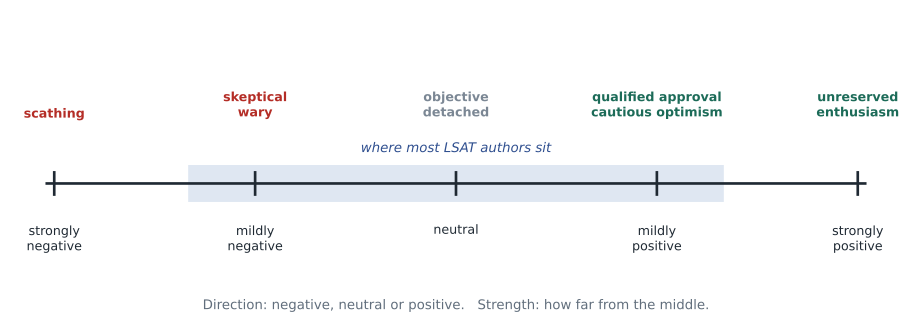
Every attitude has a direction (positive, negative or neutral) and a strength (strong, moderate or mild). Most LSAT authors write in measured academic prose, so moderate and mild attitudes are far more common than strong ones. An author who supports a view usually does so with qualifications; an author who criticizes usually acknowledges something of value. This is why answers such as "qualified approval," "cautious optimism," "measured skepticism" and "respectful disagreement" are so often credited, and why "unreserved enthusiasm" and "contemptuous dismissal" so rarely are.
That pattern is a tendency, not a rule. Harriet warned the group against choosing the mildest answer automatically. 'If an author says a view is "simply mistaken" and "has no support in the evidence," then mild disagreement understates the attitude. You calibrate to the text, not to the test's habits.'
Where attitude shows in the text
An author's attitude appears in particular kinds of language.
- Evaluative adjectives and adverbs: "striking," "notoriously hard," "understandable," "reckless," "modest."
- Hedges and boosters: "may," "perhaps," "it seems" weaken claims; "clearly," "undoubtedly," "simply" strengthen them.
- Concessions: "Critics are right that..." or "None of this shows that..." signal that the author grants part of another view.
- Framing of other views: whether an author calls an objection "serious" or a "misunderstanding" reveals how the author regards it.
- Conclusions and recommendations: the final paragraph often states the author's evaluation most directly.
Élodie said she found attitude easier to hear in French than in English, because she knew the register of French words better. Harriet suggested she pay special attention to adverbs in English, which often carry attitude quietly: "merely," "simply," "only," "even."
Attitude toward what?
A common error is identifying the author's attitude correctly but toward the wrong target. In Passage A of pair J from the previous session, the author approves of careful cleaning but is mildly critical of the viewers who call cleaned paintings garish: their reactions are "understandable" but "say more about viewers' habits than about the paintings." An answer describing the author's attitude toward critics of cleaning as "enthusiastic" would mix up the targets.
Before answering, name the target in the stem precisely: the subject (the four-day week), a view about it (the claim that pilots prove it works), a group (the pilots' promoters), or a method (employee surveys).
A pair for attitude
Harriet handed out a social science pair. As you read, note each author's attitude toward the four-day week and toward the pilot evidence.
Comparative pair K (social science): the shorter working week (written for this course)
Passage A
In recent years, pilot programs in several countries have invited employers to move staff to a four-day week with no reduction in pay. The reported results have been striking. Participating organizations commonly report that output held steady or improved, while employees describe less stress, better sleep and fewer sick days. Most participating employers chose to keep the shorter schedule after the pilot ended.
These outcomes are less surprising than they first appear. Much of the working week is spent in meetings that could be shorter, in interruptions and in tasks that expand to fill the time available. Faced with a fixed and shorter week, teams cut low-value work and protect time for concentration. Rested employees also make fewer errors. The shorter week, on this view, is not a cost employers bear for their employees' sake but a reorganization that benefits both.
Passage B
The pilots of the four-day week deserve attention, but their results cannot simply be extended to the economy as a whole. Organizations volunteered to take part, and those most likely to volunteer were those whose leaders already believed the change would work and whose work could be reorganized easily: offices, software firms and professional services. Hospitals, schools, factories and retailers, where output depends on hours of staffed coverage, were scarcely represented.
Measurement poses a second problem. Much of the evidence comes from surveys of employees and managers who knew they were taking part in a high-profile experiment and had reason to want it to succeed. Productivity in knowledge work is notoriously hard to measure, and a pilot lasting several months may capture an initial burst of effort that fades once the novelty wears off.
None of this shows that the shorter week fails. It shows that the pilots answer a narrower question than their promoters suggest: whether some organizations, chosen by themselves, can make the change work for a time. Answering the broader question will require longer studies across a wider range of workplaces.
Calibrating each author
Passage A is clearly positive toward the four-day week. The language is strong for an LSAT passage: the results are "striking," and the shorter week "benefits both" employers and employees. Its attitude toward the pilot evidence is confident; it reports the results without questioning how they were obtained. A fair description is "confident endorsement" or "enthusiastic support." Notice that this is one of the less common cases where a strong positive answer can be correct, because the text earns it.
Passage B is more complex. Toward the pilots themselves, it is respectful: they "deserve attention." Toward the claim that the pilots prove the shorter week would work across the economy, it is skeptical, citing self-selection and measurement problems. Toward the four-day week as such, it is neutral: "None of this shows that the shorter week fails." A fair description of B's attitude toward the pilots' broader claims is "measured skepticism," and toward the shorter week itself "open-minded" or "noncommittal."
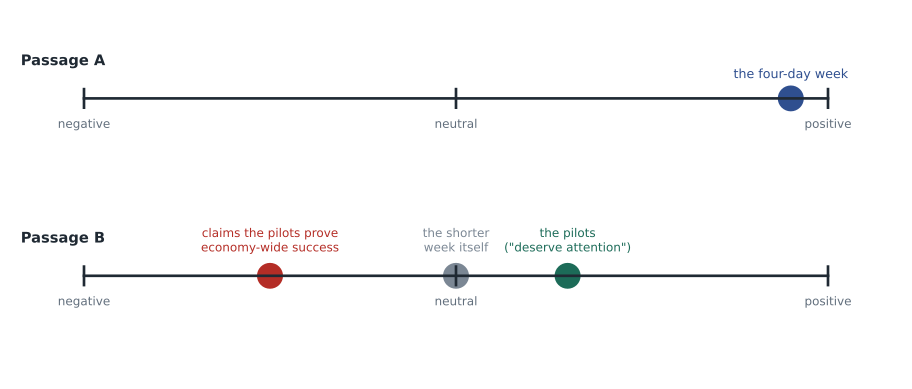
Marcus said Passage B sounded like a peer reviewer: interested in the result, unconvinced by the method, open to being persuaded. Harriet said that peer reviewer was a very common LSAT voice, and worth recognizing.
Worked problem
Sample question (written for this course)
Question: "The attitude of the author of Passage B toward the conclusions drawn from the pilot programs is best described as" (A) scornful rejection of the programs as worthless. (B) skepticism about extending the results beyond the organizations studied. (C) enthusiastic agreement with the programs' promoters. (D) indifference to the question of working hours. (E) alarm at the economic harm the programs have caused.
Show solution
- (B) is correct. B says the pilots "deserve attention" but "cannot simply be extended" to the whole economy.
- (A) is too strong; B says the pilots deserve attention and does not call them worthless.
- (C) is the attitude of Passage A, not B.
- (D) is wrong; B engages seriously with the question and calls for longer studies.
- (E) is unsupported; B never claims the programs caused harm.
Answer: (B). Match the direction, the strength and the target.
Comparing attitudes across passages
In comparative sets, questions often ask how the authors' attitudes compare. "Which one of the following most accurately describes how the authors' attitudes toward the pilot programs differ?" A credited answer for pair K would say that A treats the results as strong evidence that the shorter week works, while B treats them as promising but limited evidence. Wrong answers commonly exaggerate the difference, making B hostile, or erase it, saying both authors are cautiously optimistic.
Worked problem
Sample question (written for this course)
Question: "Which one of the following most accurately describes a difference between the two authors' attitudes toward the evidence from the pilot programs?" (A) The author of Passage A regards it as conclusive, while the author of Passage B regards it as fabricated. (B) Both authors regard it as unreliable. (C) The author of Passage A treats it as persuasive, while the author of Passage B treats it as suggestive but limited. (D) The author of Passage B regards it as more persuasive than does the author of Passage A. (E) Neither author expresses an attitude toward it.
Show solution
- (C) is correct. A reports the results as striking and draws a general conclusion; B says they answer a "narrower question" and calls for further study.
- (A) overstates B: B questions how the evidence was gathered but never suggests it was fabricated.
- (B) misdescribes A, which relies on the evidence confidently.
- (D) reverses the authors.
- (E) is false: both evaluate the evidence explicitly.
Answer: (C). Comparative attitude answers must get both authors right.
A vocabulary list worth knowing
Attitude answers draw on a limited vocabulary. Harriet gave the group a list to review, grouped by direction. Positive: approving, appreciative, admiring, supportive, optimistic, sanguine (hopeful). Negative: skeptical, critical, disapproving, wary, dismissive, disdainful. Neutral or mixed: objective, detached, ambivalent (holding both positive and negative views), noncommittal, balanced. Strength modifiers: qualified, measured, cautious, guarded on the mild side; unreserved, unqualified, wholehearted, vehement on the strong side.
Dani said "sanguine" was a word she had never used, and "ambivalent" one she had used wrongly, to mean "indifferent." Harriet said that was common, and that ambivalence means having mixed feelings, not no feelings. An author who praises some features of a proposal and criticizes others may be ambivalent; an author who does not care is indifferent, which LSAT authors almost never are.
The second October 19 set
The session closed with eight attitude questions. Élodie answered all eight correctly. Ji-won and Thomas answered seven, Marcus six and Dani six. Marcus's misses were both answers that described B as more negative than it was. He said he had been reading B as "against" because it criticized evidence, and would now ask what B was against, exactly. Élodie said her perfect set was the first time attitude had felt like a strength rather than a guess.
Attitude words inside reported views
A frequent trap places an evaluative word from a reported view into an answer about the author. In Passage A of pair J, the word "garish" belongs to the critics, not the author. In pair K, the word "striking" belongs to the author of Passage A, who uses it about the results. An answer saying the author of Passage B finds the results "striking" would borrow A's word and give it to B. Before choosing an attitude answer, ask whose word each evaluative term in the answer echoes.
Worked problem
Sample question (written for this course)
Question: "The author of Passage A would most likely describe the critics who call cleaned paintings garish as" (A) responding understandably to unfamiliar colours rather than to any harm. (B) correct about the damage cleaning causes. (C) dishonest in their objections. (D) expert conservators. (E) indifferent to the paintings.
Show solution
- (A) is correct. A calls such reactions "understandable" but says they reflect viewers' habits rather than damage.
- (B) contradicts A, which says a painting cleaned with care is not damaged.
- (C) is too strong; A never questions their honesty.
- (D) is unsupported; A describes them as viewers.
- (E) is unsupported; they care enough to complain.
Answer: (A). Match the strength of the author's attitude toward the specific target.
Ji-won added one more check: when two attitude answers both seem right, compare the strength words. "Skeptical" and "dismissive" point in the same direction, but "dismissive" is much stronger. Choose the one whose strength matches the author's actual language.
Common mistakes
MistakeGetting the direction right but the strength wrong.
InsteadCalibrate strength to the language; most LSAT authors are moderate, but not all.
MistakeIdentifying the attitude toward the wrong target.
InsteadName the target in the stem: the subject, a view, a group or a method.
MistakeChoosing the mildest answer automatically.
InsteadIf the author uses strong language, a strong answer can be credited.
MistakeTreating criticism of evidence as opposition to the conclusion.
InsteadAn author can doubt the evidence and stay neutral on the claim.
MistakeConfusing ambivalent with indifferent.
InsteadAmbivalent means mixed feelings; indifferent means no interest.
Summary and key terms
- Attitude questions ask about the author's evaluative stance toward a subject, view, group or method.
- Attitudes have direction and strength; most LSAT authors are moderate, but calibrate to the text.
- Attitude appears in evaluative words, hedges and boosters, concessions, framing of other views and conclusions.
- An author can hold different attitudes toward different targets, as Passage B of pair K does.
- Comparative attitude questions require getting both authors right.
- Attitude
- An author's evaluative stance toward something discussed in the passage.
- Tone
- The overall manner of a passage, such as objective, critical or enthusiastic.
- Ambivalent
- Holding both positive and negative views.
- Sanguine
- Hopeful or optimistic.
- Qualified approval
- Approval limited by reservations.
Practice problems
Work each problem on paper first, then reveal the answer to check.
Describe Passage A's attitude toward the four-day week.
Show answer
Confident or enthusiastic support.
What is Passage B's attitude toward the four-day week itself?
Show answer
Neutral or open-minded: "None of this shows that the shorter week fails."
What two dimensions does every attitude have?
Show answer
Direction and strength.
Which word means having mixed feelings?
Show answer
Ambivalent.
In Passage A of pair J, what is the author's attitude toward viewers who call cleaned paintings garish?
Show answer
Mildly critical but understanding: their reactions are "understandable" but reflect habit.
Lesson quiz · 5 questions
Score 60% or more to complete this lesson.
Create a free account to save your progress, take quizzes and earn a certificate.