
LSAT-121 · Lesson 7 of 12 · 25 min
Science and law passages
▶ Video coming soon A video version of this lesson is on the way.
On Monday, November 2, Harriet asked each student which passage type they would choose to skip if the rules allowed it. Dani and Élodie said science. Marcus said humanities. Thomas said law, which surprised everyone, since he planned to become a lawyer. 'I keep bringing in what I think the law is,' he explained, 'and the questions punish me for it.' Harriet said both answers pointed to the same lesson: science and law passages each have a characteristic danger, and each has a characteristic shape that makes them easier than they look.
Why passage types matter
LSAC describes Reading Comprehension passages as drawn from the humanities, the social sciences, the biological and physical sciences, and areas related to law. Every section includes a range of subject areas. No outside knowledge is required, and every question can be answered from the passage. Still, each subject area tends to use certain structures and to create certain difficulties, and knowing them in advance helps you read efficiently.
Science passages: the danger of detail
Science passages intimidate many readers with terminology: proteins, isotopes, enzymes, wavelengths. The terminology is rarely the point. Science passages usually follow one of a few structures: a phenomenon and competing explanations; a hypothesis, its predictions and the evidence; or a long-held view overturned by new findings. Passage L on bird navigation, from the previous session, was a classic "competing explanations" passage: two mechanisms, the evidence for each, and a closing suggestion that both might be at work.
Harriet's advice for science passages has three parts.
- Label terms, do not learn them. When a technical term appears, give it a short label and note its role: "cryptochrome = eye protein, radical-pair mechanism." You do not need to understand the chemistry.
- Track the hypotheses and evidence. Most science questions ask which evidence supports which hypothesis, what a hypothesis predicts, or what the author concludes. Keep those relationships clear on your roadmap.
- Watch the hedges. Scientists write carefully: "suggested," "may," "remains uncertain," "has not been abandoned." Science answers are often eliminated for being too strong. In Passage L, the magnetite hypothesis is weakened but "not abandoned"; an answer saying it has been disproved is too strong.
Élodie said she now understood why she had found science hard: she had been trying to understand every sentence fully before moving on. Harriet said that habit, admirable elsewhere, cost time in science passages. 'Understand the structure fully. Understand the chemistry only as much as the questions require, which is usually not at all.'
Law passages: the danger of outside knowledge
Law passages pose the opposite problem. The vocabulary feels familiar, especially to students who work in legal settings or plan to study law, and that familiarity tempts readers to fill gaps with what they believe the law to be. The passage may describe a doctrine differently from how you learned it, may describe one jurisdiction's rule rather than another's, or may present a scholar's view of the law rather than settled doctrine. The questions are answered only from the passage.
Law passages also have characteristic structures: a legal rule and its justifications; a doctrine and criticisms of it; a problem the law faces and proposed reforms; or a comparison of two jurisdictions' approaches. They often distinguish carefully between what a court held, what a court said in passing, what critics argue and what the author concludes. Keeping those voices apart is essential.
Dani, who works in an immigration practice, said that law passages felt easy and that she was surprised by her errors on them. Harriet said that was common among legal professionals. 'You read the passage, recognize the territory, and stop reading carefully. The passage is a map of a particular piece of the territory. Read the map, not your memory.'
A law passage
Harriet handed out a law passage. As you read, separate the voices: what courts have held, what critics say, what defenders reply and what the author concludes.
Passage M (law): when courts revisit precedent (written for this course)
Common law courts generally follow their own earlier decisions and those of higher courts, a practice known as stare decisis. The practice serves several purposes at once. It allows people to plan their affairs knowing how the law will be applied, it treats like cases alike, and it restrains judges from substituting their own preferences for settled law. Yet no common law system treats precedent as absolutely binding, and the question of when a court may depart from an earlier decision has become one of the most contested in modern jurisprudence.
Highest courts in both Canada and the United States regard themselves as free to overrule their own decisions, but only for compelling reasons. The United States Supreme Court has described a set of considerations it weighs, including the quality of the earlier decision's reasoning, whether its rule has proven workable, its consistency with related decisions, and the extent to which people have relied on it. The Supreme Court of Canada has likewise said that it will overrule its precedents only with great care, when there are compelling reasons to do so.
More distinctive is the Canadian approach to lower courts. In decisions concerning prostitution and assisted dying, the Supreme Court of Canada held that a trial judge may reconsider a precedent of a higher court in limited circumstances: where a new legal issue is raised, or where a significant change in the circumstances or evidence fundamentally shifts the parameters of the debate. The court reasoned that constitutional questions sometimes depend on social facts that change over time, and that a trial court is best placed to hear new evidence about them.
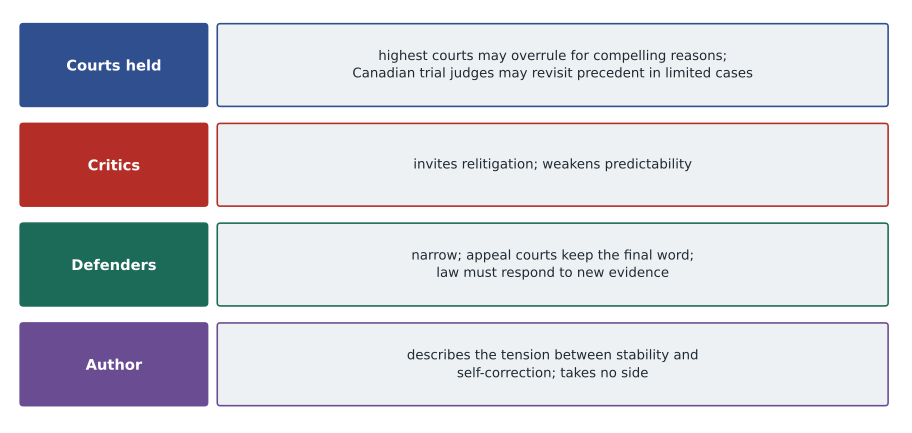
Critics worry that this exception, however carefully framed, invites relitigation of settled questions and weakens the predictability that stare decisis exists to protect. Defenders reply that the exception is narrow, that appellate courts retain the final word, and that a doctrine of precedent unable to respond to new evidence would bind constitutional law to the facts of a past era. The debate reflects a tension present in every system of precedent: the law must be stable enough to rely on and flexible enough to correct itself.
A roadmap for Passage M
- P1: Stare decisis defined; its purposes; no system treats precedent as absolutely binding; when to depart is contested.
- P2: Highest courts in both countries may overrule their own precedents for compelling reasons; the US Supreme Court's considerations; the Supreme Court of Canada's similar caution.
- P3: Distinctive Canadian rule for lower courts: a trial judge may revisit a higher court's precedent if a new legal issue arises or changed circumstances or evidence fundamentally shift the debate; the reasons.
- P4: Critics (relitigation, unpredictability) versus defenders (narrow, appellate control, need to respond to new evidence); the author frames it as a tension between stability and correction.
The author does not take a side in the final paragraph. The author presents critics and defenders and then describes the underlying tension. Answers claiming the author endorses or rejects the Canadian exception are unsupported.
Worked problem
Sample question (written for this course)
Question: "According to the passage, the Supreme Court of Canada has held that a trial judge may reconsider a precedent of a higher court when" (A) the trial judge believes the precedent was wrongly decided. (B) the precedent is more than twenty years old. (C) a new legal issue is raised or a significant change in circumstances or evidence fundamentally shifts the parameters of the debate. (D) the parties to the case agree that the precedent should be reconsidered. (E) the precedent conflicts with a decision of the United States Supreme Court.
Show solution
- (C) is correct. It restates the two circumstances in the third paragraph.
- (A) is broader than the passage's rule and is the kind of personal preference stare decisis is meant to restrain.
- (B) is not mentioned; the age of a precedent is not one of the passage's circumstances.
- (D) is not mentioned.
- (E) is not mentioned and confuses the two countries' systems.
Answer: (C). A detail answer must match what the passage says, not what you know or assume about the law.
Worked problem
Sample question (written for this course)
Question: "The author's primary purpose in the passage is to" (A) argue that the Canadian approach to lower courts should be adopted in the United States. (B) describe how courts approach departures from precedent and present a debate about one distinctive approach. (C) criticize the United States Supreme Court for overruling its precedents. (D) explain why stare decisis should be abandoned in constitutional cases. (E) defend trial judges who refuse to follow higher courts.
Show solution
- (B) is correct. The passage explains stare decisis and the overruling approaches, then presents critics and defenders of the Canadian exception without taking a side.
- (A) attributes a recommendation the author never makes.
- (C) is unsupported; the passage describes the US court's considerations neutrally.
- (D) is too strong and contradicts the passage's emphasis on stability.
- (E) distorts the passage; the exception is narrow and subject to appellate review.
Answer: (B). Law passages often describe a debate; check whether the author actually takes a side.
Comparative sets on science and law
Science and law topics are common in comparative sets. Science pairs often present a hypothesis and a skeptical response, as in pair I on assisted migration. Law pairs often present two views of a doctrine or reform, as in pair H on disclosure. The comparison map works the same way, but the characteristic dangers double: in a science pair, both passages may hedge differently, and in a law pair, both may describe the law in ways that differ from your knowledge.
Thomas said he would add one check to his routine for law passages: before choosing any answer about what the law is, find the sentence in the passage that says it. Harriet said that one check would fix most of his errors.
The November 2 set
The first half ended with a timed law passage and a timed science passage, seven questions each. On the law passage, Ji-won answered seven; Élodie, Marcus and Thomas six; Dani five. On the science passage, Marcus answered seven; Ji-won six; Thomas and Élodie six; Dani five. Thomas said his law score was his best yet, and that he had caught himself twice about to choose an answer that matched what he believed rather than what the passage said.
Comparing jurisdictions in law passages
Passage M discusses both Canada and the United States, and law passages that compare jurisdictions are common. They create a particular risk: attributing one jurisdiction's rule to the other. In Passage M, both highest courts may overrule their own precedents; only the Canadian approach to lower courts is described as distinctive. An answer saying that "United States trial judges may revisit Supreme Court precedent when evidence changes" attributes the Canadian rule to the American system and has no support in the passage.
Dani suggested a habit for comparative law passages: a two-column note, one column per jurisdiction, with each rule placed in its column as it appears. Harriet said that was the same idea as the comparison map, applied inside a single passage, and that it would prevent the most common law passage error she saw.
Worked problem
Sample question (written for this course)
Question: "The passage indicates which one of the following about the highest courts of Canada and the United States?" (A) Neither may ever overrule its own decisions. (B) Only the Canadian court may overrule its own decisions. (C) Both require trial judges to reconsider precedent whenever evidence changes. (D) The United States Supreme Court has abandoned stare decisis. (E) Both regard themselves as free to overrule their own decisions, but only for compelling reasons.
Show solution
- (E) is correct. The second paragraph says both highest courts regard themselves as free to overrule, but only for compelling reasons.
- (A) contradicts the passage.
- (B) contradicts it: both may overrule.
- (C) misattributes and overstates the Canadian lower-court rule.
- (D) is far too strong.
Answer: (E). Keep each jurisdiction's rules in its own column.
Élodie said that the jurisdiction trap reminded her of reading federal and provincial rules at school in Ottawa: the same words often meant different things depending on which level of government wrote them. Harriet said that habit of asking "whose rule is this?" was exactly the one law passages reward.
Common mistakes
MistakeTrying to understand every technical term in a science passage.
InsteadLabel terms by role and track the hypotheses and evidence.
MistakeChoosing science answers that ignore hedges.
InsteadMatch the strength of the passage's claims; "weakened" is not "disproved."
MistakeAnswering law questions from your own knowledge.
InsteadFind the sentence in the passage that supports every answer about the law.
MistakeMixing up what courts held, what critics argue and what the author concludes.
InsteadSeparate the voices on your roadmap.
MistakeAssuming a law passage author takes a side.
InsteadCheck the final paragraph; many law authors describe a debate neutrally.
Summary and key terms
- Science passages: label terms by role, track hypotheses and evidence, and watch the hedges.
- Law passages: read the map, not your memory; answer only from the passage.
- Both types have characteristic structures that make them easier to roadmap.
- Separate the voices: what courts held, what critics and defenders argue, what the author concludes.
- In comparative sets on these subjects, the characteristic dangers apply to both passages.
- Stare decisis
- The practice of following earlier judicial decisions.
- Precedent
- An earlier decision that guides later cases.
- Overrule
- For a court to declare that one of its earlier decisions is no longer good law.
- Hedge
- A word or phrase that limits the strength of a claim, such as "may" or "suggests."
Practice problems
Work each problem on paper first, then reveal the answer to check.
What is the characteristic danger of law passages?
Show answer
Bringing in outside knowledge of the law instead of answering from the passage.
In Passage L, how strong is the passage's judgment of the magnetite hypothesis?
Show answer
Weakened but not abandoned; an answer saying it was disproved is too strong.
Does the author of Passage M take a side on the Canadian exception?
Show answer
No; the author presents critics and defenders and describes the underlying tension.
Name two considerations the passage says the US Supreme Court weighs before overruling.
Show answer
Any two of: the quality of the reasoning, workability, consistency with related decisions, reliance.
What should you do with technical terms in science passages?
Show answer
Give each a short label and note its role.
Lesson quiz · 5 questions
Score 60% or more to complete this lesson.
Create a free account to save your progress, take quizzes and earn a certificate.