
LSAT-101 · Lesson 9 of 12 · 18 min
A diagnostic test
▶ Video coming soon A video version of this lesson is on the way.
In the week of September 10, 2026, every member of the Thursday Circle took a full official practice test under real conditions. Harriet had asked them to do it before reading any strategy, watching any videos or learning any question types. Thomas protested that he would do badly. 'That is the point,' Harriet said. 'I need to see how you think when nobody has told you how to think about this test.'
This lesson explains what a diagnostic test is, how to take one properly, how to score it and, most importantly, how to read the results so they point you toward a study plan.
What a diagnostic is for
A diagnostic test is a full-length practice LSAT taken at the start of preparation. It does three jobs:
- It gives you a baseline score, so you can measure progress and set a realistic target.
- It shows where your points are coming from and where they are being lost, by question type and by section.
- It shows how you behave under time pressure: where you rush, where you stall, and how your accuracy changes as a section goes on.
Of the three, the second and third matter most. A single number tells you less than you might think, because one test carries normal variation of a few points. The pattern of errors tells you what to study.
Use an official test
Use a real, previously administered LSAT published by LSAC. LSAC calls these PrepTests and provides them through LawHub. A small number are available free with an LSAC account; a LawHub Advantage subscription gives access to the full library, and it is included in LSAC fee waivers. Official tests matter because the questions were written and tested to LSAC's standards and come with official conversion charts. Practice tests written by other companies can be useful for drilling, but their scores are not reliable predictors.
Use a test in the current format: two Logical Reasoning sections and one Reading Comprehension section, with no logic games. LSAC has made older PrepTests available in versions that match the current structure. To imitate the unscored section and its effect on stamina, you can add a fourth section from another official test. Harriet had the group take four sections so they could see the effect of fatigue.
Take it under real conditions
A diagnostic is only useful if it measures what will happen on test day. Recreate the real conditions as closely as you can:
- Use the LawHub interface on a computer, not a printout.
- Take all the sections in one sitting, with the official timing and a ten-minute break after section 2.
- Work in a quiet place without your phone. Do not pause the timer, look anything up or check answers between sections.
- Use only plain scratch paper.
- Answer every question before time runs out. There is no penalty for guessing.
Candidates with approved accommodations should take the diagnostic under those conditions. Ji-won, who at that point was still waiting for LSAC's decision, took her diagnostic twice in one week: once with standard timing and once with 50 percent extra time, so she could see the difference. Her standard-time score was well below her extended-time score, which confirmed for her why she had applied. Once her accommodation was approved, she used only the extended timing.
Score it and look up the conversion
When you finish, LawHub scores the test and shows your raw score, the scaled score from that test's official conversion chart, and which questions you got right and wrong. Record the question type of each question too (many prep tools label them; otherwise learn to classify them yourself) and, if you can, how long each one took. Save all of this. You will use it repeatedly.
The group's diagnostic scores were: Thomas 151, Élodie 156, Dani 148, and Ji-won 160 with extended timing. Marcus, who had tested officially in 2025, took a fresh practice test anyway and scored 157.
Read the results by question type
Harriet showed the group how to turn a list of right and wrong answers into a picture. She sorted Thomas's answers by question type and calculated the percentage correct in each.
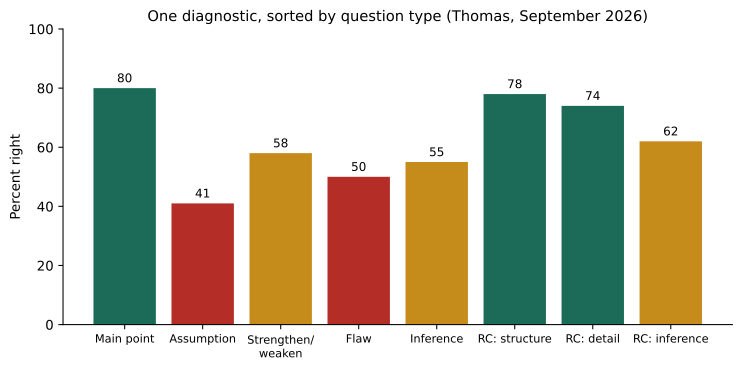
The picture was clearer than the score. Thomas was strong at finding main points and at Reading Comprehension structure and detail questions. He was weak at assumption and flaw questions, which make up a large share of Logical Reasoning. Because assumption-related reasoning underlies several other question families, Harriet predicted that improving there would lift his strengthen, weaken and flaw results as well.
| Member | Diagnostic | Strongest area | Weakest area |
|---|---|---|---|
| Thomas | 151 | Reading Comprehension structure; main point | Assumption and flaw questions |
| Élodie | 156 | Logical Reasoning accuracy | Reading Comprehension timing: last passage unfinished |
| Dani | 148 | Real-world argument sense; weaken questions | Conditional language; inference questions |
| Marcus | 157 (practice) | Logical Reasoning first half of each section | Accuracy falls late in sections |
| Ji-won | 160 (extended time) | Inference and detail questions | Second-guessing; answer changes from right to wrong |
Read the results by time
The time data is just as revealing. If your practice tool records time per question, use it; if not, note the time remaining at every fifth question as you work. Look for three patterns.
- Rushing: very short times on questions you got wrong. Thomas averaged 50 seconds on the assumption questions he missed, well below the roughly 84 seconds available per Logical Reasoning question. He was choosing answers before he had found the gap in the argument.
- Stalling: very long times on single questions, often four or five minutes, that eat time needed later. Élodie spent so long on her first three Reading Comprehension passages that she guessed on most of the last one.
- Fade: accuracy that drops toward the end of a section or in later sections. Marcus got 90 percent of the first 15 questions in each Logical Reasoning section right, and about 55 percent of the last ten. Some of that was harder questions, which tend to cluster later, but some was rushing to finish.
Read the results by cause
The deepest layer of analysis asks why each question was missed. Harriet introduced a simple set of causes that the group would use all year:
| Cause | What it looks like | Typical fix |
|---|---|---|
| Misread | Missed a word such as "not", "most" or "only if"; answered a different question | Slow down on the stem and qualifiers |
| Concept gap | Did not know how to approach the question type | Learn the type untimed, then drill |
| Trap answer | Chose an attractive wrong answer of a known kind | Study wrong-answer patterns |
| Time | Rushed or guessed because the clock ran down | Pacing plan and skipping strategy |
| Second-guessing | Changed a right answer to a wrong one | Change only for a specific reason |
To find the cause, you have to review each missed question carefully, ideally before looking at the correct answer. Lesson 11 explains this "blind review" method in full. For the diagnostic, Harriet asked each member to go back through every question they had flagged or felt unsure about, without the timer, and decide on an answer again. Then they checked. Questions they got right untimed but wrong under time pointed to timing problems. Questions they got wrong either way pointed to concept gaps.
Ji-won's review turned up something surprising. On four questions, she had originally chosen the right answer and then changed it to a wrong one. Her extended-time score would have been 162 without those changes. 'My problem is not finding the answer,' she said. 'It is trusting it.'
Worked problem
Working out what a diagnostic says
Dani's diagnostic shows she got 9 of 10 weaken questions right, but only 4 of 10 must-be-true inference questions. In her blind review she fixed only 1 of the 6 inference errors. Her average time on inference questions was 80 seconds. What does this suggest?
Show solution
- Her weaken results are strong, so general argument reading is not the problem.
- She fixed only one inference error untimed, so most errors are not caused by time pressure.
- Her time per question was normal, so she was not rushing.
- That pattern points to a concept gap: how to decide what must follow from a set of statements, often involving conditional language.
Answer: Dani should study inference questions and conditional reasoning untimed before drilling them under time. Faster practice alone would not help.
Setting a target
With a baseline and a pattern, you can set a target. Start with the score ranges of the schools you want, as Lesson 6 described, and translate them into a target score. Then compare it with your diagnostic and your time until test day.
There is no reliable formula for how many points a student can gain per week, and claims of guaranteed improvements should be treated with suspicion. Many students who study steadily for three to six months improve substantially, often by several points and sometimes by much more. Students starting lower on the scale often have more room to grow quickly, while gains near the top come more slowly. Students who already score in the high 160s can still improve, but each point takes more work.
Harriet helped each member set a target with a stretch goal. Thomas aimed for 162, stretch 165, with more than six months available. Élodie aimed for 162 by January. Dani aimed for 156, which would put her inside the middle range at her preferred school. Marcus had a target of 163 for November. Ji-won aimed for 165.
What a diagnostic does not mean
A low diagnostic score is not a prediction. It is a measurement of an untrained skill. Dani had been nervous about sharing her 148 with the group, the lowest score in the room. Harriet asked her to compare it with Thomas's pattern. Dani's errors were concentrated in a few learnable areas; her strengths, reading arguments carefully and spotting weaknesses, were exactly the ones that take longest to teach. 'I would rather start with your strengths and your 148,' Harriet said, 'than with a 155 built on luck and speed.'
Equally, a high diagnostic is not a guarantee. Ji-won's 160 left her with less room to grow, and her second-guessing habit was a real risk on test day. A diagnostic is a map, not a destination.
Turning the diagnostic into a first month
A diagnostic is only useful if it changes what you do next. Harriet asked each member to write three lines after their review: the two question types to study first, the one timing habit to fix, and the one review habit to start. Dani's read: "Study conditional language and must-be-true inference untimed. Stop rereading stimuli more than twice. Blind review every flagged question the same day."
For the first month, most of Dani's study time went to those two question types, using official questions sorted by type and working untimed until her accuracy rose. She kept a little general practice in each week so she would not lose her strengths. At the end of the month, she took a timed Logical Reasoning section and compared her results by type with her diagnostic.
How often to re-diagnose
You do not need a full diagnostic every week. During the foundations phase, timed sections every week or two and a full practice test every three or four weeks are enough to show progress. From the skills phase onward, a weekly full test becomes useful, provided you review it. Re-sorting results by question type every few weeks shows whether your targeted work is paying off or whether a weak area needs a different approach.
Élodie found her next full test, five weeks after the diagnostic, encouraging but uneven: her Logical Reasoning had improved and her Reading Comprehension timing had not. That told her to keep working on reading for structure, which she did for another four weeks before it clicked.
Common mistakes
MistakeYou should study for a few weeks before taking a diagnostic so it looks better.
InsteadA diagnostic is most useful as an honest baseline taken before preparation.
MistakeAny full-length practice test will give an accurate diagnostic score.
InsteadUse an official LSAC PrepTest with its official conversion chart.
MistakeThe score is the most important result of a diagnostic.
InsteadThe pattern of errors by question type, time and cause matters more.
MistakeIf you got a question wrong, you need more timed practice on it.
InsteadIf you also get it wrong untimed, the problem is a concept gap that needs learning first.
Summary and key terms
- A diagnostic is a full official practice test taken before preparing, to set a baseline and reveal patterns.
- Take it in LawHub, in one sitting, with official timing, the ten-minute break and no interruptions; use your accommodation timing if you have one.
- Analyse results by question type, by time (rushing, stalling, fade) and by cause (misread, concept gap, trap, time, second-guessing).
- Questions right untimed but wrong under time point to pacing; questions wrong either way point to concept gaps.
- Set a target from school ranges, treating the diagnostic as a starting point rather than a prediction.
- Diagnostic test
- A full-length practice test taken at the start of preparation to measure a baseline.
- PrepTest
- An official, previously administered LSAT published by LSAC.
- Fade
- A drop in accuracy toward the end of a section or test.
- Concept gap
- A missed question caused by not knowing how to approach that question type.
- Blind review
- Reworking uncertain or missed questions untimed before checking the answers.
Practice problems
Work each problem on paper first, then reveal the answer to check.
Élodie got 3 of 7 questions right on her last Reading Comprehension passage, guessing on 4. In blind review she got all 7 right. What is her main issue?
Show answer
Timing: she understood the passage but ran out of time, so she needs a pacing plan.
Why should a diagnostic use an official PrepTest?
Show answer
Official tests match real LSAT questions and come with official conversion charts, so the score is a reliable baseline.
Ji-won changed four right answers to wrong ones. What simple rule might help?
Show answer
Change an answer only for a specific, nameable reason, not a vague feeling.
Lesson quiz · 5 questions
Score 60% or more to complete this lesson.
Create a free account to save your progress, take quizzes and earn a certificate.