
LSAT-101 · Lesson 10 of 12 · 19 min
Building a study plan
▶ Video coming soon A video version of this lesson is on the way.
After the diagnostics, Harriet gave each member of the Thursday Circle the same homework: write a study plan on one page. Dani's came back first, colour-coded, with every evening of the week filled from 7 to 10. Thomas's was three lines long. Marcus's listed the number of practice tests he would take and nothing else. Harriet sent all three back. 'One of these will burn out, one will drift and one will repeat last year,' she said. 'Let's build plans that will actually get you to test day.'
This lesson shows how to build a realistic LSAT study plan: how long to prepare, how to divide the time into phases, what a week should contain, which materials to use when, and how to adjust as you go.
How long to prepare
There is no single right length. Many students prepare for three to six months, studying around ten to twenty hours a week, but the right amount depends on your starting point, your target, your schedule and how efficiently you study. Someone who needs a large gain and works full time may need longer. Someone close to their target may need less. What matters more than the total is consistency: several focused sessions a week beat one exhausting weekend binge.
Start with three questions:
- How far is your target from your diagnostic?
- How many weeks until your test date, and how many until your last realistic retake before application deadlines?
- How many hours a week can you honestly study, after work, school, family and rest?
Thomas had seven months until his planned April 2027 test and could study about eight hours a week. Dani had about fifteen weeks until January and could manage about twelve hours a week, mostly evenings and Saturday mornings. Élodie, a full-time student, could study ten hours a week until December and more over the winter break. Ji-won could study about ten hours. Marcus, with only eight weeks until November, could find fifteen.
Three phases
Phase 1: foundations
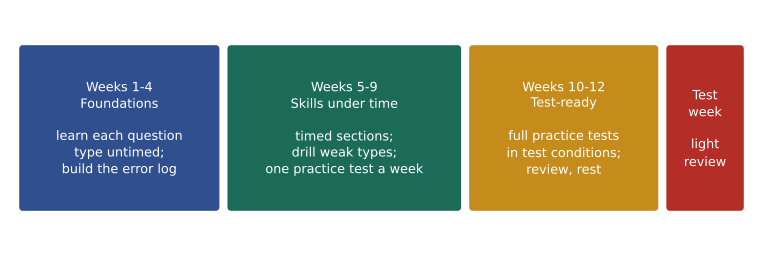
In the first phase, learn how each question type works, without a timer. For Logical Reasoning, that means understanding argument structure and each question family from Lesson 3. For Reading Comprehension, it means practising reading for structure and building passage maps. Work slowly and accurately. Write out why each right answer is right and why each wrong answer is wrong. Start your error log from the first day.
Students often want to skip this phase because untimed work feels slow and unrealistic. It is the phase where the largest improvements usually begin. Speed built on accurate reasoning lasts; speed built on guessing collapses under pressure.
Phase 2: skills under time
In the second phase, add timing gradually. Start with timed sets of a few questions, move to full timed sections, and take a full practice test about once a week. Spend more time reviewing than testing. Use your error log to choose drills: if assumption questions are your weakest type, do focused sets of assumption questions several times a week until your accuracy rises.
Phase 3: test-ready
In the final weeks, take full practice tests under real conditions, including the break and, if you will test early in the day, the same start time. Review each one thoroughly. Keep drilling weak areas, but taper the volume. In the last week, do light work and rest. Plan your Argumentative Writing session for early in the eight-day window.
| Phase | Main goal | Typical activities | Practice tests |
|---|---|---|---|
| Foundations | Accuracy and understanding | Learn question types untimed; passage mapping; error log | The diagnostic only |
| Skills under time | Accuracy at pace | Timed sets and sections; targeted drills; review | About one a week |
| Test-ready | Stamina and consistency | Full tests in real conditions; review; light drilling | One or two a week, then taper |
| Test week | Rest and readiness | Light review; writing session; logistics | None in the last few days |
What a good week looks like
A week in phase 2 might look like this for someone studying about twelve hours:
| Day | Session | Time |
|---|---|---|
| Monday | Timed Logical Reasoning section; blind review | 1.5 hours |
| Tuesday | Targeted drill on weakest question type; log errors | 1 hour |
| Wednesday | Two timed Reading Comprehension passages; passage map review | 1.5 hours |
| Thursday | Study group or tutor session | 2 hours |
| Friday | Rest | None |
| Saturday | Full practice test under real conditions | 3 hours |
| Sunday | Review the practice test; update error log; plan next week | 3 hours |
Notice the balance: about as much time reviewing as testing, at least one rest day, and every session with a specific purpose. Notice too that the full practice test is followed by a long review session the next day. A practice test without review is mostly a waste of a valuable test.
Materials: use official questions wisely
Official LSAC material is the best practice material because it is the real thing. Through LawHub, LSAC offers a large library of previously administered tests, with a few free and the full library through LawHub Advantage. Although the library is large, it is finite, and in the current format it is worth thinking about how to use it.
- Use older or less-needed official questions for phase 1 drilling, sorted by question type.
- Keep some recent full tests untouched for phase 3, so your final practice tests feel like the real thing and give realistic scores.
- Use third-party books, courses and explanations for teaching and strategy, but rely on official tests for practice scores.
- Avoid any material centred on logic games unless it also teaches skills you need for the current test.
Harriet also cautioned the group about questions shared online. LSAC owns its test questions, and sharing or reproducing them outside LSAC's own materials and licensed partners can violate its rules. Use official channels.
Each member's plan
| Member | Weeks | Hours a week | Plan highlights |
|---|---|---|---|
| Thomas | About 30 (to April 2027) | 8 | Long foundations phase focused on assumptions and flaws; full tests from February |
| Élodie | About 18 (to January 2027) | 10, more over the winter break | Reading Comprehension pacing from week 1; full tests in December and January |
| Dani | About 15 (to January 2027) | 12 | Conditional reasoning and inference untimed for 5 weeks, then timed work |
| Marcus | 8 (to November 2026) | 15 | Short foundations review; error log; late-section accuracy drills |
| Ji-won | About 15 (to January 2027) | 10 | All timed work at 52.5-minute sections; answer-change discipline |
Marcus's plan was the most compressed, and Harriet was frank about it. Eight weeks was enough to fix some habits, especially his late-section fade, but probably not enough to make large gains in every area. That was one reason he bought Score Preview: if the November score did not beat 158, he would cancel it and keep preparing for a later test.
Checkpoints and adjustments
A plan should change when the evidence changes. Build in checkpoints every three or four weeks. At each one, look at your rolling average of the last three practice tests, your accuracy by question type, and your error log. Ask:
- Which question types have improved? Can I reduce drilling on those?
- Which have not? Do I need to go back to untimed learning, or is the problem timing?
- Am I on track for my target by test day? If not, is the gap small enough to close, or should I consider a later test?
Moving a test date is not a failure. LSAC lets you change your test date without charge through the registration deadline, with fees after that, as Lesson 7 explained. Taking a test you are not ready for, when every reportable score may be seen, can cost more than a delay. On the other hand, endless postponement is its own trap. Harriet's rule: postpone only if your recent practice average is well below your target and you have a concrete plan for the extra time.
Protecting your health
LSAT preparation is a marathon, often alongside a job or a full course load. Students who sleep badly, skip exercise and study every evening tend to plateau. Build rest into the plan, keep at least one day a week free of LSAT work, and watch for signs of burnout: dreading every session, scores dropping across several tests, or constant fatigue. A week of lighter work often restores progress faster than pushing harder.
Dani's first colour-coded plan had no rest days. Her revised plan kept Friday free and moved one weekday session to a lighter thirty-minute review. 'I thought rest was for people who were not serious,' she said. 'It turns out rest is part of being serious.'
Worked problem
Building a backward plan
Élodie tests on Saturday, January 16, 2027. Starting the week of September 14, 2026, how might she divide her time into phases, leaving a test week?
Show solution
- Count the weeks: from mid-September to mid-January is about 17 weeks.
- Reserve the final week (January 9 to 15) as test week, with the writing session early in the eight-day window.
- Phase 3 (test-ready): roughly 4 weeks, mid-December to early January, using the winter break for full tests.
- Phase 2 (skills under time): roughly 7 weeks, late October to mid-December.
- Phase 1 (foundations): roughly 5 weeks, mid-September to late October, with Reading Comprehension pacing started early because it is her main weakness.
Answer: About 5 weeks of foundations, 7 of timed skills, 4 of test-ready work and a final test week, with checkpoints at the end of each phase.
Studying with others
Study groups, tutors and courses can all help, but none replaces your own practice and review. A good study group, like the Thursday Circle, gives you accountability, a place to explain your reasoning aloud, and other people's mistakes to learn from. Explaining why an answer is right to someone else is one of the best tests of whether you understand it.
If you are choosing a course or tutor, look for a few things. Do they use official LSAC questions? Do they teach a method for reviewing mistakes, not just strategies for answering? Do they update their materials for the current format? Be wary of guaranteed score increases, which no honest provider can promise, and of courses that still devote large amounts of time to logic games.
Free resources can take you a long way. LSAC's free LawHub material and official practice tests, LSAC's explanations of question types and the writing task, and public library study guides give many students what they need, especially when combined with a disciplined review routine. Dani, with a fee waiver that included LawHub Advantage, built her whole preparation around official material and Harriet's group.
Planning around a possible retake
Many candidates take the LSAT more than once. A good plan builds that possibility in from the start without assuming it. That means choosing a first test date early enough that a retake would still fit before your application deadlines, and deciding in advance what score would make you keep a result, retake, or both.
| Step | Marcus's plan |
|---|---|
| First attempt this cycle | November 2026 test, with Score Preview |
| Decision rule | Keep the score if it is above 158; cancel if not |
| If kept | Apply to Ohio and Pennsylvania schools in December 2026 |
| If cancelled | Continue the error log and plan, and retest in a later administration |
Deciding the rule in advance protects you from making a decision in the emotional hours after a score arrives. It also makes it easier to keep studying in the weeks between the test and the release date, rather than stopping and losing momentum.
When life interrupts the plan
Almost every plan meets a bad week: a work deadline, an illness, a family event. The worst response is to abandon the plan or to try to make up every missed hour at once. A better response is to protect the core: keep one short session going, even thirty minutes of review, so the habit survives, and push the rest of the schedule back by a week. If several weeks are lost, revisit your test date at the next checkpoint rather than cramming.
Thomas had a busy month at the credit union in October and managed only three hours a week. Instead of falling behind and giving up, he kept a twenty-minute assumption drill on three weekday mornings and moved his foundations phase back two weeks. With an April test date, the delay cost him almost nothing.
Common mistakes
MistakeThe best plan is to take as many practice tests as possible.
InsteadReview drives improvement; spend at least as much time reviewing as testing.
MistakeSkip untimed work because the real test is timed.
InsteadUntimed learning builds the accuracy that timed speed depends on.
MistakeA good plan fills every available evening.
InsteadInclude rest days; burnout stalls progress.
MistakeNever change your test date once registered.
InsteadUse checkpoints; moving a date can be wise if you are well below target with a concrete plan.
Summary and key terms
- Base your plan on the gap between diagnostic and target, the weeks available and the hours you can honestly study.
- Divide preparation into foundations (untimed learning), skills under time (timed sets and weekly tests) and test-ready work (full tests in real conditions), then a light test week.
- Balance testing with equal or greater review time, and keep at least one rest day a week.
- Use official LSAC material for practice scores, saving recent tests for the final phase.
- Check progress every few weeks and adjust drills, or the test date, based on evidence.
- Foundations phase
- The first phase of preparation, focused on learning question types accurately without a timer.
- Rolling average
- The average of your most recent few practice test scores, used to judge progress.
- Checkpoint
- A scheduled review of progress that may lead to changes in the plan.
- Targeted drill
- Focused practice on one question type identified as weak.
Practice problems
Work each problem on paper first, then reveal the answer to check.
Why did Harriet send back Marcus's plan, which listed only the number of practice tests?
Show answer
Because taking tests without planned review and targeted drills is what kept him from improving the first time.
In a twelve-hour week, roughly how much time should go to review compared with testing?
Show answer
At least as much as testing, and often more.
Give one reason to keep some recent official tests for the final weeks.
Show answer
So final practice tests are unfamiliar and give realistic scores in real conditions.
Lesson quiz · 5 questions
Score 60% or more to complete this lesson.
Create a free account to save your progress, take quizzes and earn a certificate.