
LSAT-101 · Lesson 7 of 12 · 18 min
Registering and accommodations
▶ Video coming soon A video version of this lesson is on the way.
By early October 2026 the Thursday Circle had a registration problem, though only one member knew it. Ji-won had requested testing accommodations in September and was waiting for LSAC's decision. Dani had applied for a fee waiver and was gathering tax documents. Élodie had registered for January but had not yet looked at which test centres were near her. Thomas had not registered for anything. Marcus had registered for November in September and felt smug about it until Harriet asked whether he had scheduled his test centre appointment. He had not.
This lesson covers the administrative side of the LSAT: creating an account, choosing a date, registering, paying or getting fees waived, requesting accommodations, and understanding the limits on how many times you can test. None of it is difficult, but almost all of it runs on deadlines that do not move.
Your LSAC account
Everything starts with an LSAC JD Account, created on LSAC's website. You use it to register for the LSAT, request accommodations, apply for a fee waiver, complete Argumentative Writing, view your scores and, for US applicants, manage your Credential Assembly Service file. The name on your account should match the government-issued identification you will show on test day exactly. A mismatch, such as a missing middle name or a different spelling, can cause problems at check-in, so fix it early.
Choosing a test date
LSAC offers the LSAT several times a year. Each administration runs over a window of several days, and you choose a day and time within the window when you schedule. For the 2026 to 2027 testing year in the US and Canada, LSAC lists these administrations.
| Administration | Test dates | Registration deadline | Score release |
|---|---|---|---|
| October 2026 | October 7 to 10, 2026 | August 27, 2026 | October 28, 2026 |
| November 2026 | November 11 to 14, 2026 | October 1, 2026 | December 2, 2026 |
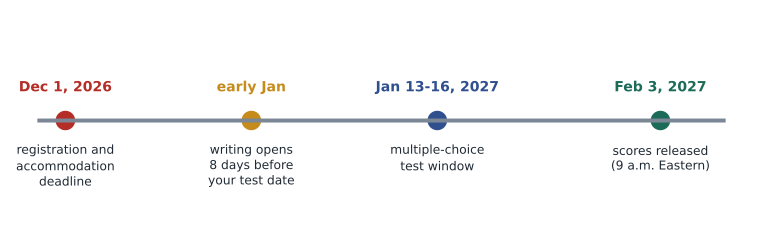
| January 2027 | January 13 to 16, 2027 | December 1, 2026 | February 3, 2027 |
| February 2027 | February 12 to 13, 2027 | December 29, 2026 | March 3, 2027 |
| April 2027 | April 8 to 10, 2027 | February 25, 2027 | April 28, 2027 |
| June 2027 | June 9 to 12, 2027 | April 29, 2027 | June 30, 2027 |
When choosing a date, work backward from your application deadlines. Leave time for scores to be released and, ideally, for one retake before your deadlines. Many US schools have rolling admission, which means they make decisions as applications arrive, so applying earlier in the fall can help. Many Canadian schools have fixed deadlines in the fall and winter and specify the last LSAT they will accept for the cycle.
Thomas, planning for fall 2028 entry, decided to test in April 2027, with June 2027 as a backup and the fall of 2027 for a retake if needed. Harriet approved: 'You have a long runway. Use it to prepare, not to delay.'
Registering and scheduling
Registration and scheduling are two separate steps. First you register for an administration and pay the fee by the registration deadline. Then, during a scheduling period LSAC announces, you choose your specific test day, time and test centre. Since August 2026, when testing moved to test centres for almost everyone, centre seats can fill up, particularly on weekends and in busy cities. Scheduling early gives you the best choice.
Marcus learned this the hard way. When he finally logged in to schedule, the centre nearest his home was full on the Saturday he wanted, and he took a Thursday morning slot at a centre across town instead. It worked out, but he had to take a day off work.
Fees
For the August 2026 to June 2027 testing year, LSAT registration costs 253 US dollars. The fee includes LSAT Argumentative Writing, which cannot be bought separately. Other fees you may meet are listed below.
| Item | Amount (US dollars) |
|---|---|
| LSAT registration, including Argumentative Writing (2026-27) | 253 |
| Test date change through the registration deadline | No charge |
| Test date change up to 7 days after the registration deadline | 153 |
| Test date change from 8 days after the deadline to the day before testing | 253 |
| Score Preview, bought before testing begins / after testing ends | 46 / 87 |
| Credential Assembly Service (US applicants) | 219 |
| Law school report, each | 45 |
Canadian candidates pay in US dollars too. With exchange rates and possible bank fees, the cost in Canadian dollars is noticeably higher than the listed amounts. Budget for at least one retake when you plan.
Fee waivers
LSAC offers fee waivers to candidates who cannot afford its fees. They are available to US citizens and nationals, US permanent residents and some other groups, including people with Temporary Protected Status, DACA recipients and applicants, and certain asylum seekers, and to Canadian citizens, permanent residents and people recognized as protected persons or Convention refugees. Eligibility depends on income and assets, assessed against thresholds tied to poverty guidelines, and on whether you are financially independent or a dependent.
There are two tiers. LSAC unlocks the benefits in stages, and each stage is independent:
- At final approval: a one-year LawHub Advantage subscription (full access to official practice tests) and law school reports, six for Tier 1 and three for Tier 2.
- After you complete two unique practice tests in LawHub's exam mode: LSAT registrations, two for Tier 1 and one for Tier 2, each including Argumentative Writing and Score Preview.
- After you complete LSAC's short course "How Do I Apply to Law School?" in LawHub: a five-year Credential Assembly Service subscription.
You apply through your LSAC account and upload supporting documents, such as tax returns, within 45 days. Decisions usually come within a few business days of LSAC receiving everything. Fees you have already paid cannot be refunded through a waiver, so apply before you register. LSAC recommends applying at least six months before the registration deadline for your planned test.
Dani's waiver was approved at Tier 1 in October 2026. That gave her a year of LawHub Advantage immediately. She completed two practice tests in exam mode the same month, which unlocked her LSAT registration, and she registered for January without paying the fee. 'The milestones are actually good for me,' she said. 'They made me do the practice tests I was putting off.'
Testing accommodations
LSAC provides testing accommodations for candidates with disabilities. Accommodations can include extended testing time, extra or longer breaks, alternative formats such as screen-reader compatibility or large print, a human reader for candidates who are blind or severely visually impaired, and adjustments to the testing environment. Some everyday medical items, such as eyeglasses, hearing aids and medication, are allowed without a request, though Bluetooth-enabled medical devices must be approved in advance.
How to request
- Submit your request through your LSAC JD Account. The online form tells you what information and documents to provide.
- The deadline is the same as the registration deadline for your test. LSAC states there are no exceptions to this deadline, though documentation that arrives after the deadline in support of a request made on time may be considered.
- Documentation requirements depend on your situation. LSAC publishes guidance on what it needs and on common reasons documentation is found insufficient, such as missing information about current functional limitations.
- If a request is not fully approved, LSAC posts its reasons in your account. You then have two business days to say you intend to appeal and five calendar days to submit supporting documents. Appeal results generally come within about a week.
After approval
Once approved, accommodations carry forward: candidates previously approved for an LSAT accommodation are automatically approved for the same or an equivalent accommodation on future LSATs, with some exceptions LSAC notes in its policy. LSAC does not mark score reports of candidates who tested with accommodations, and it does not tell law schools that a candidate tested with accommodations.
Ji-won's request, filed in September with a recent report from her clinician describing her ADHD and its effect on sustained timed reading, was approved in October for 50 percent extra time. She changed her practice immediately: every timed section from then on used 52 minutes and 30 seconds. 'If I practise at 35 minutes, I am training for a test I am not taking,' she said.
One more point for anyone testing in 2027 or later: LSAC has said that a few accommodations tied to the four-section format, such as an extra break between sections three and four, will not exist in the three-section format that begins in August 2027, while extra-time accommodations continue.
Limits on testing
LSAC limits how many times you can take the LSAT:
- Five times within the current reportable score period, which LSAC dates from July 2021.
- Seven times over your lifetime.
- Not again at all if you have scored 180 within the current reportable score period.
Cancelled scores count toward these limits, including scores cancelled through Score Preview. Absences and withdrawals do not. Tests taken before September 2019 do not count, and the LSAT-Flex administrations of May to August 2020 are also excluded. You can ask LSAC for an exemption in unusual circumstances, with an explanation and supporting documents, by a deadline before the registration deadline of the test you want.
Marcus counted. His April 2025 test was one attempt; November 2026 would be his second. He had room for three more within the current period. 'Plenty,' he said. Harriet reminded him that for Canadian schools that see every score, and for US schools that notice patterns, more attempts are not free even when they are allowed.
Worked problem
Withdrawing versus cancelling
Thomas registers for April 2027, then falls ill the week before. What are his options, and how do they differ for the testing limits?
Show solution
- He can change his test date. A change through the registration deadline is free; afterward, LSAC charges a date-change fee that rises closer to the test.
- He can withdraw from the administration. Withdrawals do not count toward the testing limits, and no score appears.
- If he sits the test feeling unwell, he can cancel within six calendar days after his test date, but a cancellation counts toward the limits.
Answer: Changing the date or withdrawing before testing does not use up an attempt; cancelling after testing does. Check LSAC's current deadlines and refund rules before deciding.
Withdrawals, absences and refunds
If you cannot test, LSAC's rules on withdrawing, changing dates and refunds depend on timing. LSAC no longer offers partial refunds of the CAS fee, and its refund rules for the LSAT itself are set out on its refunds page. Read them before the deadline for the administration you registered for, because options narrow quickly after it passes.
A registration checklist
| When | Task |
|---|---|
| Six months or more before | Create your LSAC account; apply for a fee waiver if you may qualify; gather accommodation documentation |
| Before the registration deadline | Register (or redeem a waiver); submit any accommodation request; check that your account name matches your ID |
| During the scheduling period | Choose your test day, time and centre as early as possible; request a distance exception in its window if needed |
| Two weeks before | Confirm your appointment and travel; install and test the writing software |
| In the eight days before | Complete Argumentative Writing |
| After the test | Decide within six days whether to cancel, or within six days of release if you have Score Preview |
Harriet asked each member to put these dates in a calendar on the day they registered. Thomas, who had not yet registered for anything, put the April 2027 registration deadline, February 25, at the top of his calendar with a reminder a month earlier.
Common mistakes
MistakeYou can request accommodations any time before test day.
InsteadThe accommodation request deadline is the registration deadline for your test, with no exceptions.
MistakeRegistering automatically gives you a seat at the nearest test centre.
InsteadRegistration and scheduling are separate; you choose a day, time and centre during the scheduling period, and seats can fill.
MistakeA fee waiver will refund fees you already paid.
InsteadWaivers cannot be applied retroactively; apply before registering.
MistakeLaw schools are told when a candidate tested with accommodations.
InsteadLSAC does not annotate score reports or tell schools about accommodations.
MistakeWithdrawals count toward the five-test limit.
InsteadAbsences and withdrawals do not count; cancellations do.
Summary and key terms
- You register, request accommodations and apply for fee waivers through an LSAC JD Account whose name should match your ID.
- Registration and test centre scheduling are separate steps; the 2026-27 LSAT fee is 253 US dollars, including Argumentative Writing.
- Fee waivers for eligible US and Canadian candidates cover LSATs, a CAS subscription, reports and a year of LawHub Advantage, unlocked in stages.
- Accommodation requests are due by the registration deadline; approvals carry forward and are not reported to schools.
- You can test five times in the reportable period since July 2021 and seven times in your lifetime; cancellations count, withdrawals and absences do not.
- JD Account
- Your LSAC account for registration, writing, scores and applications.
- Registration deadline
- The last day to register for an administration, also the deadline for accommodation requests.
- Fee waiver
- An LSAC program that covers fees for eligible candidates with limited income.
- LawHub Advantage
- LSAC's paid subscription giving access to its full library of official practice tests.
- Testing accommodation
- An adjustment to testing conditions, such as extra time, for a candidate with a disability.
- Reportable score period
- The period whose scores LSAC reports to schools: the current and five past testing years.
Practice problems
Work each problem on paper first, then reveal the answer to check.
Élodie wants accommodations for a January 2027 test. What is her deadline?
Show answer
December 1, 2026, the January registration deadline.
Dani has Tier 1 fee waiver approval. What must she do to unlock her LSAT registrations?
Show answer
Complete two unique practice tests in LawHub's exam mode.
Marcus has tested in April 2025 and November 2026. How many more attempts does he have within the current reportable score period?
Show answer
Three, since the limit is five within the period that began in July 2021 (and seven in a lifetime).
Lesson quiz · 5 questions
Score 60% or more to complete this lesson.
Create a free account to save your progress, take quizzes and earn a certificate.