
LSAT-101 · Lesson 12 of 12 · 27 min
Capstone: a mini diagnostic and debrief
▶ Video coming soon A video version of this lesson is on the way.
On Thursday, November 19, 2026, the Thursday Circle met for the last session of the course's first stage. Harriet had prepared a mini diagnostic: twelve Logical Reasoning questions in 17 minutes and one Reading Comprehension passage with seven questions in 9 minutes, all written by her in the style of the LSAT. Ji-won worked to her extended timing. Marcus, still waiting for his November score, took it too. 'Think of it as a dress rehearsal for the habits, not the score,' Harriet said.
This capstone walks through part of that set, shows how the group debriefed it, and ends with what each member planned next. The questions below were written for this course. They are not LSAT questions, but they test the same skills, and you can try each one before reading the explanation.
The rules Harriet set
- Time each part strictly, using a timer you cannot see unless you look at it.
- Flag any question you are less than confident about.
- Answer every question.
- Afterward, blind review every flagged question before checking any answers.
- Log every error with a type, a cause and a lesson.
Selected Logical Reasoning questions
Question 3 (main conclusion)
Worked problem
Question 3
Stimulus: "Some residents oppose the proposed bike lanes on Elm Street because they would remove forty parking spaces. But a survey of Elm Street businesses found that most of their customers arrive on foot or by bus, and cities that have added similar lanes have generally seen local retail sales hold steady or rise. The parking concern, then, does not justify rejecting the proposal." Which one of the following most accurately expresses the main conclusion of the argument? (A) Most customers of Elm Street businesses arrive on foot or by bus. (B) The concern about lost parking is not a good reason to reject the bike lane proposal. (C) Bike lanes increase retail sales. (D) Residents should support all bike lane proposals. (E) Forty parking spaces would be removed.
Show solution
- Find the claim the other statements support. "Then" signals the conclusion in the last sentence.
- The survey and the comparison with other cities are evidence for it.
- (B) restates the last sentence. (A) and (E) are premises or background. (C) overstates the evidence ("hold steady or rise"). (D) goes far beyond the argument.
Answer: (B). Four of the five members got it right. Dani was the exception: she chose (A) because it was the most concrete fact. Her log entry: "A conclusion is supported by other claims, not just the most specific statement."
Question 6 (necessary assumption)
Worked problem
Question 6
Stimulus: "Our town should switch its street lights to LED bulbs. LED bulbs use far less electricity than our current bulbs, so the switch would lower the town's energy costs." The argument depends on which one of the following assumptions? (A) LED bulbs last longer than any other kind of bulb. (B) The savings in electricity would not be outweighed by other added costs of the LED lights, such as installation or maintenance. (C) Residents prefer the colour of LED light. (D) Other towns have already switched to LED bulbs. (E) The town currently spends more on street lights than on any other service.
Show solution
- Conclusion: the switch would lower energy costs, and the town should switch.
- Gap: using less electricity lowers costs only if other costs do not cancel the savings.
- Negation test: if (B) were false, and installation or maintenance costs outweighed the savings, the argument would collapse. So (B) is required.
- (A), (C), (D) and (E) might be interesting, but the argument survives if any of them is false.
Answer: (B). Thomas got it right in 55 seconds, using the negation test, and said afterward that two months earlier he would have chosen (A) because it sounded like a reason to buy LEDs.
Question 9 (flaw)
Worked problem
Question 9
Stimulus: "Students who eat breakfast every day earn higher grades, on average, than students who skip breakfast. So if the school provides free breakfast to every student, grades will rise." The reasoning is most vulnerable to criticism on the grounds that it (A) relies on a survey of too few students (B) takes for granted that a correlation between two things shows that one causes the other (C) assumes that all students like the same foods (D) confuses grades with test scores (E) ignores the cost of providing breakfast.
Show solution
- The evidence is a correlation: breakfast eaters earn higher grades on average.
- The conclusion is causal: providing breakfast will raise grades.
- Other factors could explain both, such as family routines or income. The argument assumes the link is causal. That is (B).
- (E) is a practical objection, not a flaw in the reasoning toward this conclusion; the argument is about grades, not cost. (A) is not mentioned in the stimulus.
Answer: (B). Everyone got this one, which Harriet said reflected how often they had now seen the correlation-causation pattern.
Question 11 (must be true)
Worked problem
Question 11
Stimulus: "Every member of the chess club who competed in the regional tournament practised at least five hours a week. Some members of the chess club who practised at least five hours a week also play in the school orchestra. No member of the school orchestra competed in the regional tournament." If the statements above are true, which one of the following must also be true? (A) Some members who practised at least five hours a week did not compete in the regional tournament. (B) Every member who practised at least five hours a week competed in the regional tournament. (C) No orchestra member practised chess at all. (D) Most chess club members play in the orchestra. (E) Some tournament competitors play in the orchestra.
Show solution
- Some members who practised five hours a week play in the orchestra (statement 2).
- No orchestra member competed in the tournament (statement 3).
- So those orchestra players practised five hours a week but did not compete. At least one such person exists, so (A) must be true.
- (B) reverses statement 1. (E) contradicts statement 3. (C) and (D) are not supported.
Answer: (A). Dani got it right in blind review but not under time, a sign that her conditional reasoning had improved but was not yet fast. Élodie and Ji-won got it right under time.
The Reading Comprehension passage
Harriet's passage, about 430 words, discussed a debate among historians about whether nineteenth-century public libraries mainly served working people seeking self-improvement or middle-class readers seeking entertainment. The author reviewed borrowing records that favoured the second view, then argued that the records undercounted working readers, who often read in reading rooms rather than borrowing books, and concluded that both groups were served in ways the records capture unevenly. Two of the seven questions show the skills involved.
Worked problem
Two of the passage questions
Question 15: The author mentions reading rooms primarily in order to (A) describe the architecture of public libraries (B) explain why borrowing records may understate use by working readers (C) argue that reading rooms should be restored today (D) show that working readers preferred newspapers (E) prove that the middle class did not use libraries. Question 18: Which one of the following best describes the author's position on the borrowing-record evidence? (A) It is decisive and should end the debate. (B) It is worthless. (C) It is useful but incomplete. (D) It was fabricated. (E) It supports the self-improvement view.
Show solution
- Question 15 is a function question. The reading rooms appear right after the borrowing records, as a reason the records miss working readers. (B).
- (E) is too strong, and nothing in the passage proposes restoring reading rooms (C).
- Question 18 is an attitude question. The author accepts the records as evidence but argues they capture use unevenly: useful but incomplete, (C).
- (E) reverses what the records favoured, the entertainment view.
Answer: Question 15: (B). Question 18: (C). Élodie finished the passage with ninety seconds to spare, her first time finishing a passage on schedule in a timed set.
Results
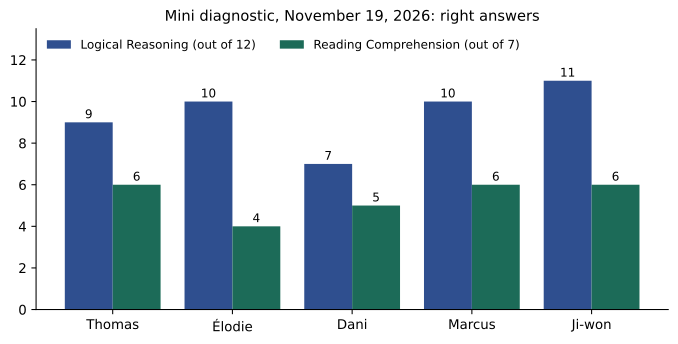
| Member | Logical Reasoning (of 12) | Reading Comprehension (of 7) | Blind review total (of 19) |
|---|---|---|---|
| Thomas | 9 | 6 | 17 |
| Élodie | 10 | 4 | 17 |
| Dani | 7 | 5 | 15 |
| Marcus | 10 | 6 | 17 |
| Ji-won | 11 | 6 | 18 |
Harriet reminded everyone that 19 questions are far too few to convert into an LSAT score. The value of the set was in the debrief.
The debrief
Harriet ran the debrief the way she wanted them to run their own reviews for the rest of their preparation. Each member answered four questions aloud.
- What was the gap between your timed and blind review results, and what does it tell you?
- Which question types appear most in your error log this week?
- What single habit improved most since September?
- What is the one thing you will work on next?
Thomas
Thomas's timed and blind review scores were close in Logical Reasoning, which told him his assumption work was paying off and that his remaining errors were mostly concept gaps in harder flaw questions. His Reading Comprehension stayed strong. With five months until his April test, he planned to start parallel reasoning and principle questions in December and to begin full practice tests in February.
Élodie
Élodie got 10 of 12 in Logical Reasoning but only 4 of 7 in Reading Comprehension. Her blind review lifted the passage to 6 of 7. She had finished on time, but she had rushed the last three questions to do it. The habit had changed, from rereading the passage to reading it once and mapping it, but the speed was not yet comfortable. With her test on January 16, she would do two timed passages every weekday in December and full tests over the winter break.
Dani
Dani scored 7 of 12 under time and 10 of 12 in blind review in Logical Reasoning. Her conditional reasoning had improved a great deal, but it was still slow. Her rolling practice average had risen from 148 to 153. Her target of 156 was close. Her plan for the last seven weeks before January: daily mixed sets of ten Logical Reasoning questions, with must-be-true questions in every set, and one full practice test a week until a lighter final week.
Ji-won
Ji-won had the highest score and the smallest gap. Her change log showed one answer change, from wrong to right. 'For the first time,' she said, 'I changed an answer because I found a reason, not because I got scared.' Her plan was to keep her routine steady, take full tests at her extended timing every Saturday, and protect her sleep.
Marcus
Marcus's debrief was the most interesting. His accuracy on the last four Logical Reasoning questions, which were the hardest in the set, was three out of four, compared with about half in his September diagnostic. He had used Harriet's checkpoints and skipped one question early. Whatever his November score turned out to be on December 2, he said, he now understood why his first attempt had stalled. If the score beat 158, he would keep it and start applications. If not, he would cancel it within the six-day Score Preview window and aim for a later test, building on the error log he wished he had started in 2025.
What this course has covered
Over twelve lessons, the Thursday Circle went from not knowing what the LSAT tests to running their own debriefs. Looking back, Harriet summarized the essentials:
| Area | What you now know |
|---|---|
| The test | Four 35-minute sections through June 2027: two scored Logical Reasoning, one scored Reading Comprehension, one unscored; three longer sections from August 2027 |
| Writing | Argumentative Writing: separate, online, unscored, required on file for score release |
| Scores | 120 to 180, equated across forms; percentiles from LSAC's current table; Score Preview and six-day cancellation |
| Schools | CAS in the US, OLSAS in Ontario, direct applications elsewhere in Canada; policies on multiple scores vary |
| Logistics | Registration and accommodation deadlines match; fee waivers; testing limits; in-centre testing with limited remote exceptions |
| Preparation | Diagnostic, phased study plan, blind review, error log, spacing, pacing checkpoints |
The next courses in the LSAT Prep program build on this foundation: three courses on Logical Reasoning, from argument structure through assumptions and inference, two on Reading Comprehension, one on Argumentative Writing, and two on full-length practice and test-day strategy.
A last word from Harriet
At the end of the session, Harriet shared her screen one more time. It showed the five rectangles from the second week, the four sections and the break. 'You know what goes in every box now,' she said. 'What you do with the next few months decides what comes out. Read what is there, not what you expected to be there. And review everything.'
Common mistakes
MistakeA short practice set can predict your LSAT score.
InsteadSmall sets are for practising habits and spotting patterns; use full official tests for score estimates.
MistakeThe debrief is about the score.
InsteadThe debrief is about causes: timed versus blind review gaps, error types and next steps.
MistakeOnce you get a question type right, you can stop practising it.
InsteadKeep it in mixed sets and retest it later to make the skill stick.
Summary and key terms
- A mini diagnostic is a rehearsal of habits: strict timing, flagging, answering everything, blind review and logging.
- Comparing timed and blind review results shows whether to work on pacing or concepts.
- Common patterns from this set: conclusions marked by words such as "then", necessary assumptions tested by negation, correlation treated as causation, and combining "some" and "no" statements.
- Reading Comprehension function and attitude questions depend on the passage's structure and the author's qualified views.
- Each candidate should end with a specific plan: target, date, checkpoints, weak areas and a review routine.
- Mini diagnostic
- A short timed practice set used to check habits and progress.
- Debrief
- A structured review of a practice set focused on causes and next steps.
- Function question
- A Reading Comprehension question asking why the author includes a particular part of the passage.
- Correlation
- A relationship in which two things tend to occur together, which does not by itself show causation.
Practice problems
Work each problem on paper first, then reveal the answer to check.
In Question 6, why is "LED bulbs last longer than any other kind of bulb" not a necessary assumption?
Show answer
The argument still works if it is false; the conclusion depends only on the electricity savings not being outweighed by other costs.
Dani scored 7 of 12 timed and 10 of 12 in blind review. What should she focus on?
Show answer
Speed and fluency in reasoning she already understands, through timed mixed practice, while logging the two remaining concept gaps.
Why did Harriet refuse to convert the mini diagnostic into LSAT scores?
Show answer
Nineteen questions are far too few for a reliable score; the set was for habits and patterns.
Lesson quiz · 5 questions
Score 60% or more to complete this lesson.
Create a free account to save your progress, take quizzes and earn a certificate.