
LSAT-101 · Lesson 2 of 12 · 18 min
Test format and sections
▶ Video coming soon A video version of this lesson is on the way.
At the second session of the Thursday Circle, Harriet shared her screen and drew five rectangles in a row. Four were the same width. The one in the middle was narrow and grey. 'This is the whole multiple-choice test,' she said. 'If you can draw this from memory and say what goes in each box, you will never be surprised on test day.'
This lesson explains the structure of the LSAT as it stands for the 2026 to 2027 testing year: how many sections there are, how long each lasts, what goes in them, how the unscored section works, what the screen looks like, and how the format has changed in recent years. It ends with the changes LSAC has announced for August 2027.
Four sections and a break
The standard LSAT is made up of four multiple-choice sections. Each section lasts 35 minutes. Every test taker gets a 10-minute break between the second and third sections. Adding it up, the multiple-choice portion takes 150 minutes of testing and break time, not counting check-in and the instructions at the start.
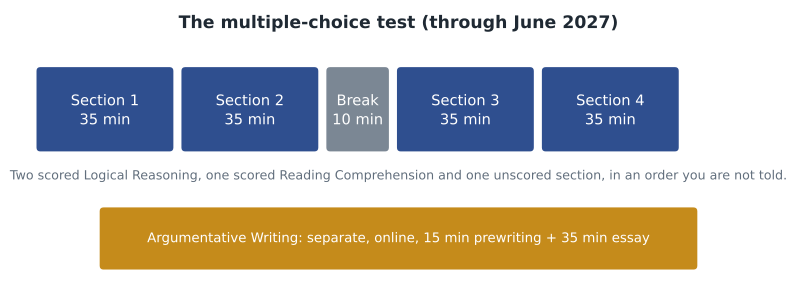
Of the four sections, three are scored: two Logical Reasoning sections and one Reading Comprehension section. The fourth is an unscored section, sometimes called the variable or experimental section. It contains either Logical Reasoning or Reading Comprehension questions that LSAC is trying out for future tests. It looks exactly like a scored section, and you are not told which section it is.
That last point surprises people. Dani asked whether there was any way to spot the unscored section. 'Sometimes people guess,' Harriet said. 'For example, if you get two Reading Comprehension sections, one of them must be unscored. But you cannot tell which one, and if you guess wrong and coast, you lose real points. Treat every section as if it counts.'
What is in each section
A Logical Reasoning section usually contains about 25 or 26 questions. Each question is based on its own short passage, so you move from topic to topic constantly: a question about a city council budget is followed by one about bird migration and then one about an art critic's claim. LSAC describes the average time available as roughly 84 seconds per Logical Reasoning question.
A Reading Comprehension section has four sets of questions, each based on a passage or a pair of shorter comparative passages, for a total of about 26 to 28 questions. Each set has five to eight questions. LSAC puts the average time at roughly 78 seconds per Reading Comprehension question, but that number hides the reading time: you need to read and understand the passage before the questions become manageable.
| Section type | How many on your test | Typical questions per section | Average time per question |
|---|---|---|---|
| Logical Reasoning | Two scored (and possibly the unscored one) | About 25 to 26 | About 84 seconds |
| Reading Comprehension | One scored (and possibly the unscored one) | About 26 to 28, in four sets | About 78 seconds |
| Unscored section | One, either type | Same as the type it copies | Same |
Because the number of questions varies slightly from form to form, your raw score (the number of scored questions you answer correctly) can be out of a slightly different total on different tests. That is one reason scores are converted to the 120 to 180 scale, as Lesson 5 explains.
Order of sections
The order of the sections is not fixed. Your first section might be Logical Reasoning or Reading Comprehension, and the unscored section can appear in any position. Plan to be ready for either kind of section first, and do not build a test-day routine that depends on a particular order.
The writing session
LSAT Argumentative Writing is completed separately from the multiple-choice sections. It is taken online with remote proctoring software on your own computer, and you can complete it as early as eight days before your multiple-choice test date. It has two timed parts: up to 15 minutes of prewriting analysis (you can move on after five minutes) and 35 minutes to write the essay. Lesson 4 covers it in detail. For now, the key fact is that you must have an approved writing sample on file before LSAC will release your score.
What the screen looks like
The LSAT is given on a computer, using the same LawHub interface you can practise with on LSAC's website. Knowing the interface well saves time and stress.
- A timer shows the time remaining in the section. You can hide it, and you get a warning near the end.
- You can move freely among the questions within a section, skip questions and come back to them, and change answers until time runs out. You cannot go back to a section once it has ended.
- You can flag a question to return to later. A navigation bar shows which questions you have answered and which you have flagged.
- You can highlight text in a passage and, in some versions of the interface, underline or eliminate answer choices by striking them out.
- Scratch materials are allowed for working notes. The details depend on how you test, and you will see them in Lesson 8.
There is no penalty for wrong answers. A blank answer and a wrong answer both earn nothing, so you should answer every question, even if you have to guess in the final seconds. Harriet made the group repeat it: 'Never leave a bubble empty.'
How the format got here
Older advice online often describes formats that no longer exist. A short history helps you sort good advice from stale advice.
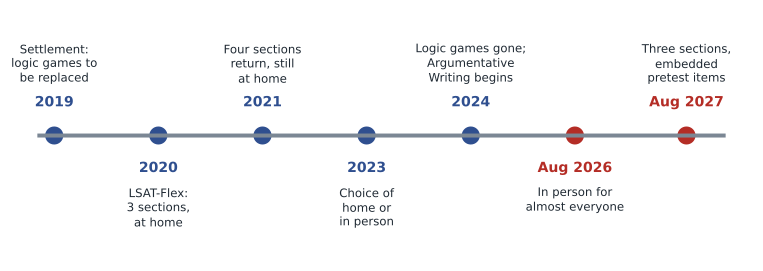
- For decades the LSAT was a paper test with five multiple-choice sections, including one scored Analytical Reasoning (logic games) section, plus a writing sample. It moved to a digital tablet format in 2019.
- In 2019 LSAC settled a lawsuit brought by two blind test takers, who argued that logic games required diagrams they could not draw. LSAC agreed to replace the section.
- In May 2020, during the COVID-19 pandemic, LSAC introduced the LSAT-Flex: a shorter, three-section test taken at home with remote proctoring. It ran through mid-2021.
- From August 2021 the four-section format with an unscored section returned, still taken at home.
- In 2023 test takers gained the choice of testing at home or at a test centre.
- In 2024 the writing task became LSAT Argumentative Writing, and from the August 2024 administration logic games were gone, replaced by the second scored Logical Reasoning section. LSAC reported that its analysis of more than 200,000 test sessions found the change barely moved average scores and kept essentially the same ability to predict first-year law school grades.
- From August 2026 the multiple-choice test moved to in-person testing at test centres for almost all test takers, with limited exceptions. Lesson 8 explains why and who can still test remotely.
Marcus had lived through part of this history. When he tested in April 2025, he took the test at home, at his dining room table. His November 2026 retake was at a test centre on the other side of Columbus.
The August 2027 format
LSAC has announced that starting with the August 2027 administration, the test will change again. The stand-alone unscored section will be removed. Instead, unscored pretest questions will be mixed into the three scored sections, a method LSAC calls embedded pretesting.
| Feature | Through June 2027 | From August 2027 |
|---|---|---|
| Sections | Four: 2 Logical Reasoning, 1 Reading Comprehension, 1 unscored | Three: Reading Comprehension first, then 2 Logical Reasoning |
| Section times | 35 minutes each | Reading Comprehension 52 minutes; Logical Reasoning 45 minutes each |
| Breaks | One 10-minute break after section 2 | Two 10-minute breaks, after sections 1 and 2 |
| Unscored questions | A whole unscored section | Embedded: 13 in Reading Comprehension, 7 in each Logical Reasoning section |
| Scored questions | About 75 to 78 | 77 (27 Reading Comprehension, 50 Logical Reasoning) |
| Score scale | 120 to 180 | 120 to 180, comparable with earlier scores |
LSAC says the question types and the average time per question stay the same, and that scores will remain on the same scale and be comparable across years. The total test gets two minutes longer and break time eight minutes longer. Some accommodations tied to the four-section format, such as an extra break between sections three and four, will no longer exist in the new format. LSAC planned to release practice tests for the new format in February 2027.
For the Thursday Circle, the 2027 change mattered mostly to Thomas. Everyone else was testing by January 2027 under the current format. Thomas was planning to test in April or June 2027, the last months of the four-section format, with the option of a retake under the new format in the fall. 'Either way,' Harriet told him, 'you are learning the same skills. The boxes change shape; what goes in them does not.'
Endurance
Two and a half hours of concentrated reading is tiring. Students who do well in single timed sections sometimes fade in the third and fourth sections of a full test. Endurance is a skill you can build, mostly by taking full-length practice tests in realistic conditions as test day gets closer, and by practising your break routine: stand up, drink water, eat a small snack, and do not replay the first two sections in your head.
Ji-won raised a different question. If LSAC approved her request for 50 percent extra time, each section would last 52 minutes and 30 seconds, and her test would run much longer. 'Then your endurance training should use your timing,' Harriet said. 'Practise in the conditions you will actually test in.'
Worked problem
Working out the test length
How long is the multiple-choice LSAT from the start of section 1 to the end of section 4 for a standard test taker, and for a test taker approved for 50 percent extra time on each section with the standard 10-minute break?
Show solution
- Standard: four sections of 35 minutes is 140 minutes; add the 10-minute break for 150 minutes, or 2 hours 30 minutes.
- With 50 percent extra time, each section is 35 plus 17.5, or 52.5 minutes.
- Four sections of 52.5 minutes is 210 minutes; add the 10-minute break for 220 minutes, or 3 hours 40 minutes.
Answer: 2 hours 30 minutes for the standard test; 3 hours 40 minutes with 50 percent extra time (assuming no other approved break changes).
Practising in the real format
Knowing the structure is one thing; being comfortable inside it is another. In the first weeks, most of your practice will be single question types or single timed sections. As test day approaches, practise the full sequence: four sections, the ten-minute break after the second, and no pauses. Harriet asked the group to build one full four-section practice test into every week from November, using official tests in LawHub and adding a fourth section from another official test to stand in for the unscored one.
Practise the transitions as well as the sections. Moving from a Reading Comprehension section, where you hold one long passage in mind, to a Logical Reasoning section, where every question is a fresh topic, takes a moment of mental reset. So does starting section 3 after the break, when it is tempting to keep thinking about section 2. A simple ritual helps: take one slow breath, read the first question's stem before its stimulus, and commit to that question alone.
Expect variety inside a single section. A Logical Reasoning section might move from an argument about a museum's funding to one about a medical study, then to a principle about fairness in hiring, then to a sequence of facts about a chemistry experiment. None of these topics requires outside knowledge. The variety is part of the challenge, because it tests whether you can switch focus quickly and still read precisely.
| Stage of preparation | Format to practise |
|---|---|
| Early weeks | Single question types, untimed |
| Middle weeks | Timed single sections; one full test a week |
| Final weeks | Full four-section tests with the break, at your real test time |
Common mistakes
MistakeThe unscored section is always the last section.
InsteadIt can appear in any position, and you are not told which section it is.
MistakeYou should skip hard questions and leave them blank to avoid a penalty.
InsteadThere is no penalty for wrong answers; answer every question.
MistakeThe writing task happens in the middle of the multiple-choice test.
InsteadArgumentative Writing is a separate online session that can be done as early as eight days before the test.
MistakeThe August 2027 format adds a new question type.
InsteadLSAC says question types and time per question stay the same; the sections and breaks are reorganized.
Summary and key terms
- Through June 2027 the LSAT has four 35-minute multiple-choice sections with a 10-minute break after section 2.
- Two Logical Reasoning sections and one Reading Comprehension section are scored; one section of either type is unscored and unidentified.
- There is no penalty for wrong answers, so every question should be answered.
- Argumentative Writing is a separate online session that must be on file before scores are released.
- From August 2027 the test has three longer sections with embedded unscored questions and two breaks, on the same 120 to 180 scale.
- Unscored section
- A section of pretest questions that does not count toward your score and is not identified to you.
- Embedded pretesting
- Placing unscored trial questions inside scored sections, the method LSAC adopts from August 2027.
- LawHub
- LSAC's online platform for official practice tests and the testing interface.
- LSAT-Flex
- The shorter, three-section remote version of the LSAT used from May 2020 into 2021.
- Raw score
- The number of scored questions you answer correctly, before conversion to the 120 to 180 scale.
Practice problems
Work each problem on paper first, then reveal the answer to check.
Draw the current test from memory: how many sections, how long, and where is the break?
Show answer
Four 35-minute sections, with a 10-minute break between sections 2 and 3.
You see two Reading Comprehension sections on test day. What can you conclude, and how should you act?
Show answer
One of them is the unscored section, but you cannot tell which, so treat both as scored.
From August 2027, which section comes first?
Show answer
Reading Comprehension, followed by the two Logical Reasoning sections.
Lesson quiz · 5 questions
Score 60% or more to complete this lesson.
Create a free account to save your progress, take quizzes and earn a certificate.