
LES-216 · Lesson 5 of 12 · 19 min
High-risk vehicle stops: verification, wrongful stops and dignity
▶ Video coming soon A video version of this lesson is on the way.
Three nights before the Harbour Pharmacy robbery, another platoon made a high-risk stop that the service now uses in training as an example of what can go wrong. At 01:15 on Tuesday, April 7, a licence plate reader in a patrol car on Lakeshore Road alerted on a dark blue SUV as stolen. The officer followed, called for backup and, eight minutes later, three officers made a high-risk stop. The driver, Grace Mbeki, was a nurse driving home from a hospital shift with her fifteen-year-old son, who had been visiting her at work. Both were ordered out of the car at gunpoint, made to kneel on the road and handcuffed. Twenty minutes later, an officer checked the plate by eye and found that the reader had misread one character. The SUV was not stolen. It was not even the same make as the stolen vehicle.
Nobody was physically hurt. But Mbeki filed a complaint, her son had nightmares for weeks, and the service's review found that the stop should never have been made as a high-risk stop without verification. Haddad, who was not involved, reviewed the footage for the training unit. 'Every one of those officers did the tactics correctly,' she says. 'They kept their distance, used one voice and stayed calm. The problem was not the tactics. The problem was that nobody spent ten seconds looking at the plate before we put a nurse and her child on the ground at gunpoint.'
Why verification matters
A high-risk stop is one of the most frightening experiences a member of the public can have with the police. Firearms are pointed at them, they are ordered out of the car, often onto the ground, and they are handcuffed in public. When the people stopped are the right people, that intrusion is justified by the danger. When they are the wrong people, it is a serious harm done by the police to innocent people, and it can be a violation of their rights. Wrongful high-risk stops also damage trust in the police, especially in communities that already experience more stops, and they create legal liability for officers and services.
Most wrongful high-risk stops come from a small number of causes. Licence plate readers misread characters, especially similar ones such as 8 and B, 0 and O, or 1 and I. Dispatchers or officers mistype a plate when they run it. Stolen vehicle records are not removed after a car is recovered. Descriptions are too vague and fit many vehicles. And officers who are focused on a serious call see what they expect to see. Almost all of these errors can be caught by verifying the alert before the stop.
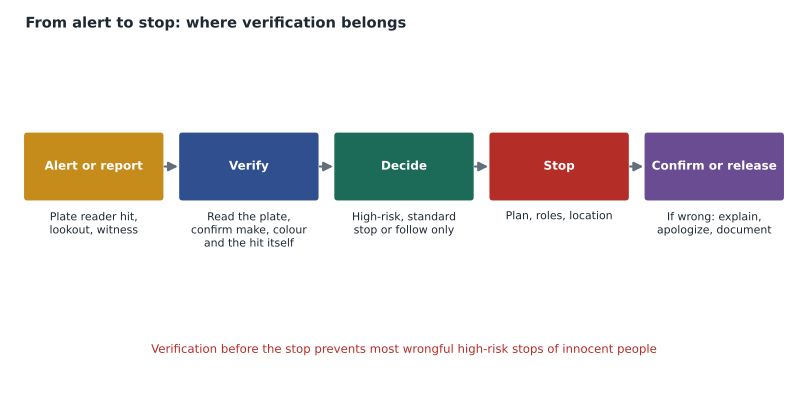
What verification means
Verification means confirming, before the stop, that the vehicle in front of the officer is the vehicle in the alert or report, and that the alert or report is current. For a plate reader alert, that means reading the plate by eye and comparing every character with the reader's result, confirming that the make, model and colour match the record, and having dispatch confirm that the stolen or wanted entry is still active. For a vehicle matching a description, it means asking which details match, which do not, and whether the match is strong enough to justify a high-risk stop or only an ordinary stop or observation.
| Check | April 7 stop | April 10 stop |
|---|---|---|
| Plate read by eye and compared character by character | Not done | Done: CKR matched the witness |
| Make, model and colour compared with the record | Not done; record was a different make | Done: grey Honda Civic, dented rear bumper |
| Record confirmed as current by dispatch | Not done | Not applicable; fresh robbery |
| Other details compared, such as occupants and direction | Not done | Two occupants, westbound from the scene |
| Decision on stop type made by a supervisor | No supervisor told | Haddad decided |
Verification takes seconds, and the officer can usually do it while following the vehicle and waiting for backup. Haddad tells the students that it should be treated as part of the tactics, not as paperwork. 'If you do it, you either confirm that you have the right car, which makes the stop safer because you know what you are dealing with, or you find out that you have the wrong car, which saves somebody from the worst night of their life.'
The law on stopping the wrong people
In Canada, a high-risk stop of the wrong vehicle is a detention, and section 9 of the Charter protects against arbitrary detention. A detention based on an honest but unreasonable belief can be arbitrary; one based on a reasonable mistake may not be. The question a court asks is whether the officers' grounds were reasonable in all the circumstances, including what they could easily have checked. In Hill v. Hamilton-Wentworth Regional Police Services Board in 2007, the Supreme Court of Canada recognized a tort of negligent investigation, under which police can be liable for harm caused by investigations that fall below the standard of a reasonable officer. People who are wrongly stopped may also complain. In Ontario, complaints about officers go to the Law Enforcement Complaints Agency, which replaced the Office of the Independent Police Review Director in 2024.
The legal lesson is the same in both countries. An officer who acts on an alert that could easily have been checked, and was not, has a much weaker legal position than an officer who checked and was still mistaken. The more intrusive the stop, the more care the officer must take to make sure it is the right vehicle.
Occupants are not all suspects
Even when the vehicle is the right one, not every occupant is necessarily involved. Passengers may be friends, family members, children or people who did not know what the driver had done. A high-risk stop treats every occupant as potentially dangerous until the scene is controlled, because the officers cannot tell who is who. But once each person is out and the facts become clearer, officers must treat each one according to what is known about them.
In Canadian law, passengers in a stopped vehicle are generally detained for the duration of the stop, and they have the same section 10 rights as the driver if they are detained for investigation. Officers need individual grounds to arrest or search a passenger, beyond the fact that they were in the car.
On April 10, the passenger, Tyler Wynn, turned out to be a nineteen-year-old friend of the driver who said he had been picked up after the robbery and did not know what had happened. Detectives later found that his account was false and charged him, but Haddad notes that the officers at the scene did not know that. They treated him as a possible suspect, because he was in the getaway car next to an apparent handgun, and they gave him the same rights and explanations as the driver.
Children, older people and people with disabilities
Some occupants are especially vulnerable on a high-risk stop. Children may freeze, cry or try to run to a parent. Older people and people with physical disabilities may not be able to kneel, walk backward or raise their arms. People who are deaf or hard of hearing may not hear instructions given by loudspeaker. People with autism or mental illness may react unpredictably to loud, repeated commands. Officers should watch for signs of these conditions, adjust their instructions, and be ready to change the plan, for example by allowing a person to remain standing or by bringing a child out with a parent.
In the April 7 stop, Mbeki's son was ordered to kneel and was handcuffed in the same way as his mother. The service's review found that once the officers could see he was a teenager and that neither occupant matched the description of the people believed to have stolen the car, there was no reason to keep him handcuffed while the plate was checked. The service changed its policy to require officers to reassess the need for handcuffs for each occupant, especially children, as soon as the scene is controlled.
When the stop turns out to be wrong
When officers realize they have stopped the wrong people, what they do next matters a great deal. The person has just been through a terrifying experience. A good response has five parts: end the detention quickly and remove handcuffs; explain clearly and honestly what happened and why; apologize; offer any help needed, such as first aid, a call to family or a ride; and give the person the officer's name, badge number and information on how to make a complaint or get a copy of the report. The supervisor should be called to the scene and should speak to the person as well.
| Step | What it means |
|---|---|
| End the detention | Remove handcuffs and return the person to their car as soon as the mistake is clear |
| Explain | Say honestly what caused the stop, without blaming the person |
| Apologize | A plain apology is appropriate and expected |
| Offer help | First aid, a call to family, time to recover, a ride if needed |
| Give information | Names, badge numbers, report number and how to complain |
| Call a supervisor | The supervisor speaks with the person and starts a review |
Haddad says the officers on April 7 did some of these things and not others. They removed the handcuffs and explained the plate error, but they did not apologize, did not call a supervisor and did not give Mbeki information about how to complain. She found out how to complain from a friend. 'An apology is not an admission that you broke the law,' Haddad says. 'It is an admission that something bad happened to somebody who did not deserve it, because of us. That is just true.'
Learning from errors
Services that take wrongful high-risk stops seriously track them. They record every high-risk stop, whether the right people were stopped, how the alert was verified and what happened afterward. They review plate reader errors and report them to the system's maintainers. And they use real cases, with permission or with identifying details removed, in training. After April 7, Port Ardent required officers to confirm every plate reader alert by eye and with dispatch before any stop, and required a supervisor to be told before any high-risk stop on a plate reader alert alone.
Data also matter for fairness. Since 2020, Ontario's use-of-force reports have recorded the officer's perception of the race of the person involved, under the province's Anti-Racism Act and its data standards, and several services have published analyses showing that Black and Indigenous people are overrepresented among people who have firearms pointed at them. A service that also records which high-risk stops involved the wrong people can see whether errors fall more heavily on some communities, and can act on what it finds.
Worked problem
How often do plate reader alerts need to be checked?
Over a month, a service's plate readers produce 1,200 stolen-vehicle alerts. When officers check each one by eye and with dispatch, 18 turn out to be misreads and 12 are records that should have been removed. How many alerts in every 100 were wrong?
Show solution
- Wrong alerts: 18 misreads plus 12 old records is 30.
- \[30 \div 1200 = 0.025\]
- That is 2.5 in every 100 alerts.
Answer: About 2.5 in every 100 alerts were wrong. That sounds small, but at 1,200 alerts a month it means 30 chances to stop innocent people, which is why every alert is verified.
Common mistakes
MistakeA plate reader alert is enough by itself for a high-risk stop.
InsteadThe alert must be verified by eye and with dispatch, and make and colour compared, before a high-risk stop.
MistakeEvery occupant of a suspect car can be treated as a suspect throughout.
InsteadAll are controlled at first, but each person is then treated according to what is known about them.
MistakeApologizing after a wrongful stop admits legal liability.
InsteadA plain apology is appropriate and is part of good aftercare.
MistakeGood tactics make a stop lawful.
InsteadA tactically perfect stop of the wrong people can still be unlawful and harmful if the alert was not verified.
Summary and key terms
- Wrongful high-risk stops do serious harm to innocent people and to trust in the police.
- Most come from plate reader misreads, typing errors, old records, vague descriptions and expectation.
- Verification means reading the plate by eye, comparing make and colour, and confirming the record is current.
- Section 9 of the Charter and the tort of negligent investigation (Hill) apply to stops that could easily have been checked.
- Passengers, children and vulnerable people must be treated according to what is known about each of them.
- When a stop is wrong, end the detention, explain, apologize, offer help, give information and call a supervisor.
- Licence plate reader
- A camera system that reads plates automatically and compares them with lists of stolen or wanted vehicles.
- Verification
- Confirming that the vehicle is the one in the alert and that the alert is current.
- Wrongful high-risk stop
- A high-risk stop of people who had no connection to the offence or alert.
- Aftercare
- What officers do for a person after a stop, especially one that turned out to be wrong.
Practice problems
Work each problem on paper first, then reveal the answer to check.
What caused the April 7 wrongful stop?
Show answer
A plate reader misread one character, and nobody checked the plate by eye or compared the make before the stop.
Name three common causes of wrongful high-risk stops.
Show answer
Any three of: plate reader misreads, typing errors, old records, vague descriptions and seeing what is expected.
What policy change did Port Ardent make after April 7?
Show answer
Every plate reader alert must be confirmed by eye and with dispatch, and a supervisor told before a high-risk stop on an alert alone.
What are the six aftercare steps after a wrongful stop?
Show answer
End the detention, explain, apologize, offer help, give information and call a supervisor.
Lesson quiz · 5 questions
Score 60% or more to complete this lesson.
Create a free account to save your progress, take quizzes and earn a certificate.