
LES-216 · Lesson 1 of 12 · 22 min
High-risk calls: what they are, principles and the evidence
▶ Video coming soon A video version of this lesson is on the way.
Professor Ray Desjardins opens the last course in the law enforcement program with a question rather than a slide. 'How many of you think a high-risk call is one where the officer has to be fast?' Most hands go up. 'Keep them up if you think it is one where the officer has to be brave.' Most stay up. He nods and writes a single word on the whiteboard: deliberate. 'Speed and courage matter,' he says. 'But the officers who handle high-risk calls well are, almost without exception, the ones who slow the call down wherever they can, who plan before they act, who know exactly what job each person has, and who keep talking to each other. This course is about that kind of policing.'
The course follows the officers of B platoon in the fictional city of Port Ardent through a series of high-risk calls in the spring of 2026. At 22:40 on the night of Friday, April 10, two masked men robbed Harbour Pharmacy on Kingsway, and one showed what looked like a handgun. Eighteen minutes later, Constable Dev Malhotra and Probationary Constable Sofia Reyes found the getaway car, and Sergeant Lisa Haddad led a high-risk vehicle stop. The second robber had left the car earlier and was found after a building search of a closed marine supply warehouse with a police service dog. Three weeks later, on Sunday, May 3, a man in crisis barricaded himself in his house on Ridley Crescent with a rifle. And on Sunday, June 7, the service held a full-scale active threat exercise at Harbour Point Mall with fire, paramedics and mall security.
Haddad joins the class as a guest throughout the course, as she did in the officer safety course. She has twenty-one years of service, supervises the platoon on nights and teaches the annual requalification on high-risk stops. 'Nobody in that pharmacy, in that car or in that house was hurt,' she tells the students. 'That was not luck, and it was not because we were faster than anyone else. It was because we had time, we used it, and we had a plan that everyone understood. Where we made mistakes, and we did, they were mistakes of planning and communication, not of courage. You will see all of them.'
What makes a call high risk
Almost every call carries some risk, and the officer safety course taught that ordinary calls can turn dangerous with little warning. A high-risk call is different in one important way: the officers have information, before or early in the call, that a serious threat is likely. That information changes the way the call is handled. Instead of approaching a car or a door in the ordinary way and adjusting if something goes wrong, the officers plan for the danger from the start, gather more resources and take more control of the encounter.
Services describe high-risk calls in slightly different words, but most definitions share the same core factors. The first is reliable information that a weapon is present or has been used, such as a report of a robbery with a firearm, a person seen with a knife or a domestic call where a rifle was mentioned. The second is a serious violent offence that has just been committed, which raises the chance that the person involved will try to escape or resist. The third is a person who may not want to be caught, such as someone with an outstanding warrant for a violent offence. The fourth is people inside or nearby who could be hurt, such as hostages, family members, staff or a crowd. The fifth is uncertainty about numbers, layout or intentions, and the sixth is a person in crisis, intoxicated or overwhelmed by emotion.
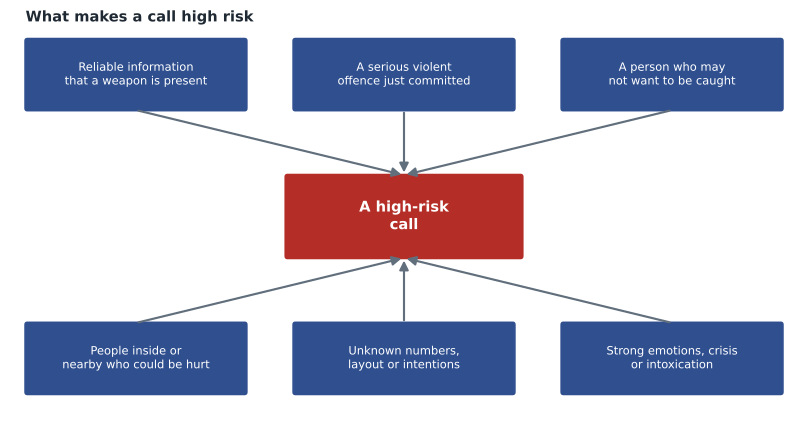
No single factor automatically makes a call high risk, and the presence of several does not guarantee danger. A report of a weapon may be wrong, a person in crisis may be frightened rather than dangerous, and a warrant may be for an old offence. The point of the list is to prompt a decision. When the factors are present, a supervisor or the senior officer decides whether to treat the call as high risk, and that decision is recorded on the radio and in the incident log. Desjardins tells the students that the decision itself is a skill. 'If you treat every call as high risk, you frighten people, you escalate ordinary encounters and you wear out the tactics so that nobody takes them seriously. If you treat no calls as high risk, sooner or later you walk up to a car with a loaded gun in it as if it were a burned-out tail light.'
The principles that run through the course
Five principles appear in every lesson. The first is that the safety of everyone matters: the officers, the public, any victims or hostages, and the suspect. A plan that safely arrests a robber but puts a bystander in the path of danger is not a good plan. The second is that time is usually on the side of the police. When a suspect is contained and no one is in immediate danger, waiting for more officers, a supervisor, a dog, a negotiator or a tactical team makes the outcome safer for everyone. Urgency has to come from facts, such as a person inside who needs help now, not from impatience or adrenaline.
The third principle is that every person needs a clear role. On a high-risk vehicle stop, one officer gives instructions, others cover, another handles communications and someone keeps traffic away. On a barricade call, the first officers contain the scene until a commander, a negotiator and a tactical team take over their parts. Confusion about roles is one of the most common findings in reviews of high-risk calls that went badly. The fourth principle is that communication must be disciplined. One voice speaks to the suspect, the radio carries short, clear updates, and the plan is briefed so that every officer hears the same thing. The fifth is that the law applies at every step: the authority to stop, detain, enter, search and use force is the same on a high-risk call as on any other call, even though the threat is greater.
| Principle | In practice |
|---|---|
| Everyone's safety matters | Plans protect bystanders, victims, officers and the suspect |
| Time is usually an ally | Contain, then wait for resources unless facts demand action now |
| Clear roles | Command, one voice, cover, arrest team, communications, perimeter |
| Disciplined communication | One voice to the suspect, short radio updates, a shared briefing |
| The law at every step | Authority to stop, detain, enter, search and use force is checked, not assumed |
What the evidence shows
Canada does not publish one national count of high-risk calls, but several sources show where the risks are. Studies of Canadian use-of-force reports, including analyses published by several large services, have found that force is used in a very small fraction of police contacts, well under one in 100, and that most force involves physical control rather than weapons. The Canadian Police and Peace Officers' Memorial honours officers who died on duty, and its records show that traffic collisions, gunfire and medical events on duty account for most deaths. High-risk calls are rare, but they are where most deliberate attacks on officers and most police shootings occur.
Reviews of police shootings and deaths in custody point in the same direction. Many of them find that the outcome was shaped well before the moment force was used: by information that was not passed on, by officers arriving without a plan, by an approach that removed the officers' time and distance, or by a lack of anyone clearly in charge. Researchers sometimes call these officer-created jeopardy or a failure to plan. Desjardins puts it more simply: 'The best use-of-force decision is often the one you made three minutes earlier, when you chose where to stop the car or decided to wait for the dog.'
Canadian inquiries have reached similar conclusions. The Mass Casualty Commission's 2023 report on the April 2020 killings in Nova Scotia found serious failures in command, communication with the public and coordination between police agencies. Ontario coroners' inquests into police shootings, such as the 2017 inquest into the death of Andrew Loku in Toronto, have repeatedly recommended training in de-escalation, crisis response and the use of time and distance. These recommendations are a large part of why today's training looks the way it does.
Two errors that reviews keep finding
Reviews of high-risk calls tend to find two opposite kinds of error. The first is rushing: officers who close the distance too quickly, who go into a building alone, who approach a car before backup arrives or who escalate a standoff because they want it over. Rushing removes time and options, and it often leaves officers with nothing but force when the situation changes. The second error is the opposite: officers who wait when they should act, such as when people inside a building are being hurt and the police remain outside. The response to the 2022 school shooting in Uvalde is now taught across North America as the clearest example of that second error.
The skill is knowing which situation you are in. Desjardins gives the students a rule that they will use throughout the course. When the danger is contained and no one is being hurt, slow down and use time. When someone is being hurt or killed and the police can stop it, act without delay. 'Everything else in this course,' he says, 'is about how to tell the difference, and how to do each one well.'
| Error | What it looks like | What it costs |
|---|---|---|
| Rushing a contained situation | Closing distance, entering alone, approaching before backup | Loss of time and options; force becomes the only choice |
| Waiting during active harm | Holding back while people inside are being hurt | Lives lost that could have been saved |
The officer's mindset
A high-risk call is stressful. The heart rate rises, vision narrows, hearing can fade and fine motor skills decline. The officer safety course covered these effects in detail, and they matter even more on high-risk calls. Training reduces their effect by making the basic steps automatic, so that the officer's attention is free for the things that cannot be rehearsed, such as what the person is saying and what the bystanders are doing. Briefings help too, because an officer who knows the plan does not have to invent one under stress.
Haddad adds a point about attitude. 'A high-risk call is not a fight you are looking for,' she says. 'The goal is that the person in the car or the house comes out safely, is taken into custody, and goes to court. If you go in wanting a confrontation, you will find one. If you go in wanting everyone to walk away, you will look for the ways to make that happen.' She also warns against the opposite attitude, the belief that nothing will happen. 'Most robbery suspects give up when a stop is done well. That is the point. But you plan for the one who does not.'
Worked problem
Is this a high-risk call?
At 02:10, dispatch sends two officers to a convenience store where the clerk reports that a man paid with a large bill, argued about the change and said he would come back. The clerk did not see a weapon. The man left on foot ten minutes ago. Should the call be treated as high risk?
Show solution
- Weapon: none reported or seen.
- Offence: an argument and a vague statement; no violent offence has been committed.
- Person: no information that he is wanted or dangerous.
- Others at risk: the clerk is alone, which is worth noting, but there is no current threat.
- Uncertainty: moderate; officers should gather more information from the clerk and any video.
Answer: No. This is an ordinary call that deserves normal officer safety habits, a careful approach and attention to the clerk. It would become high risk if new information showed, for example, that the man had a weapon or had threatened to hurt the clerk.
How the course is organized
The course moves from foundations to specific types of call and then to command and review. Lessons 2 and 3 cover the law of force and authority on high-risk calls, and the information, risk assessment and planning that come before any action. Lessons 4 and 5 cover high-risk vehicle stops, including the roles and communication that make them work, the law that governs them and the serious harm done when innocent people are stopped at gunpoint by mistake. Lesson 6 covers building and area searches, including when not to search, containment and police dogs. Lesson 7 covers barricaded persons and the work of crisis negotiators and tactical teams.
Lessons 8 and 9 cover active threats: what the research shows, why the first officers' role changed after the 1999 shooting at Columbine High School, and how police and paramedics now work together to stop the killing and stop the dying. Lesson 10 covers incident command and communication on large calls. Lesson 11 covers what happens after a high-risk call: scene security, investigation, independent oversight, reporting, debriefing and officer wellness. Lesson 12 is a capstone after-action review of the Harbour Pharmacy robbery night.
Throughout the course, the emphasis is on decision-making, planning, law, roles and communication. The physical skills that officers use on these calls are taught and practised in supervised training with qualified instructors and are not part of this course. As Haddad puts it, 'You will learn the moves at the academy and in requalification. What you learn here is when to use them, when not to, and how to make sure the team is thinking together.'
Common mistakes
MistakeA high-risk call is one that has to be handled as fast as possible.
InsteadMost high-risk calls are handled best by slowing down, containing and using time, unless someone is being hurt now.
MistakeAny call involving a weapon report must be handled as high risk.
InsteadThe supervisor or senior officer weighs all the factors and decides; the decision is recorded.
MistakeThe outcome of a high-risk call is decided at the moment of force.
InsteadReviews show outcomes are often shaped earlier by information, planning, approach and command.
MistakeWaiting is always the safest choice.
InsteadWhen people are being hurt and police can stop it, waiting is the error.
Summary and key terms
- A high-risk call is one where officers have information early on that a serious threat is likely, which changes how the call is planned and handled.
- Common factors include weapons, a recent violent offence, a person who may resist or flee, people at risk, uncertainty and crisis.
- Five principles run through the course: everyone's safety, time as an ally, clear roles, disciplined communication and the law at every step.
- Reviews find two opposite errors: rushing a contained situation and waiting during active harm.
- Planning, roles and communication shape the outcome long before any use of force.
- High-risk call
- A call where reliable information indicates that a serious threat is likely, so that officers plan for it from the start.
- Containment
- Controlling the area around a suspect or scene so that no one can enter or leave without police knowledge.
- Officer-created jeopardy
- A situation in which officers' own tactical choices remove their time and options and create the danger that leads to force.
- Briefing
- A short, shared explanation of the plan so that every officer knows the goal and their role.
Practice problems
Work each problem on paper first, then reveal the answer to check.
Name four factors that can make a call high risk.
Show answer
Any four of: a weapon, a recent violent offence, a person who may resist or flee, people at risk, uncertainty about numbers or layout, crisis or intoxication.
What rule did Desjardins give for when to slow down and when to act?
Show answer
Slow down and use time when the danger is contained and no one is being hurt; act without delay when someone is being hurt and police can stop it.
Why can treating every call as high risk be harmful?
Show answer
It frightens people, escalates ordinary encounters and wears out the tactics.
What two opposite errors do reviews of high-risk calls keep finding?
Show answer
Rushing a contained situation and waiting during active harm.
Lesson quiz · 5 questions
Score 60% or more to complete this lesson.
Create a free account to save your progress, take quizzes and earn a certificate.