
LES-216 · Lesson 11 of 12 · 19 min
After the call: scene, investigation, oversight and officer wellness
▶ Video coming soon A video version of this lesson is on the way.
At 01:10 on April 11, Reyes sat in the report room at the station with four pages of notes, a cold coffee and her body-worn camera on the charging dock. In the previous two and a half hours, she had covered a high-risk stop, seen what she believed was a handgun, helped arrest two men and held the perimeter during a dog search. She still had a use-of-force report to write for pointing her firearm, a supplementary report for the arrest, an evidence continuity form for the imitation handgun and a statement for the robbery detectives. Haddad came in, sat down across from her and asked a question that had nothing to do with any of those documents. 'How are you doing?' Reyes says it was the most useful thing anyone said to her that night.
High-risk calls do not end when the suspect is in custody or the incident commander stands the scene down. What happens afterward decides whether the evidence holds up in court, whether the public can trust the police account of what happened, whether the service learns from the call and whether the officers involved stay healthy. This lesson covers the work after a high-risk call: securing the scene and the evidence, notifications and independent oversight, reports and notes, debriefing and officer wellness.
Securing the scene and the evidence
The first job after the threat is controlled is to care for anyone injured and to secure the scene. Securing the scene means setting up a perimeter, keeping people out who do not need to be there, starting a scene log of everyone who enters and leaves, and protecting evidence from weather, traffic and well-meaning people who want to help. On a scene where police have used serious force, the scene belongs to the investigators who will examine it, and officers who were involved should not move evidence, such as a weapon on the ground, unless they must to make the scene safe. If they do, they should note exactly where it was and why it was moved.
At Kingsway Plaza, Haddad assigned Patel to start a scene log at the lot entrance at 23:12 and asked for the forensic identification unit to photograph the Civic and the imitation handgun where it lay before anyone touched them. The car was then towed to the service garage for a search under warrant. Witnesses are part of the scene too. The pharmacy staff, the alarm company operator and the keyholder were all identified and interviewed by detectives, and the camera footage from the pharmacy, the plaza and every police car and body-worn camera was preserved.
Notifications and independent oversight
In Ontario, the Special Investigations Unit, a civilian agency created in 1990 and now governed by the Special Investigations Unit Act, 2019, investigates incidents in which an officer's conduct may have caused death or serious injury, an officer discharged a firearm at a person, or a person alleges sexual assault by an officer. The police service must notify the SIU immediately, and the SIU decides whether to invoke its mandate. While it investigates, the police service must preserve the scene and evidence for it and keep the officers involved apart until they have been interviewed. The officer whose conduct is being investigated, called the subject official, is not required to give notes or an interview to the SIU, while witness officials must cooperate. The SIU director decides whether there are reasonable grounds to lay a criminal charge, and publishes a report on cases that do not lead to charges.
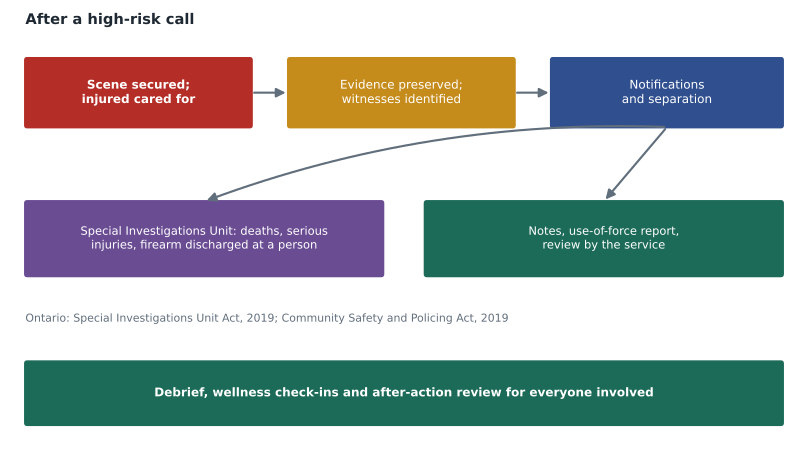
Separating officers after a serious use of force is sometimes misunderstood as a sign of suspicion. It is not. It protects the integrity of each officer's account, because people who talk about an event together soon begin to remember it the same way, and it protects the officers from any later suggestion that they agreed on a story. Officers who are separated still need support, and many services assign a peer support officer or a supervisor not involved in the incident to stay with each of them.
Reports and notes
Every officer involved in a high-risk call writes notes, and most write reports. Notes are the officer's own record, written as soon as practicable, in their own words, of what they saw, heard, did and thought, with times. Reports are the service's formal record of the incident, the arrests, the evidence and any use of force. On high-risk calls, use-of-force reports are usually required for pointing firearms, deploying a police dog and any other force. Accurate, timely, independent notes are the foundation of everything that follows: the prosecution, any oversight investigation and the service's own review.
In Ontario, use-of-force reports are submitted to the service and the information is reported to the province under the Community Safety and Policing Act, 2019 and its regulations. On April 10, Malhotra, Reyes and Patel submitted use-of-force reports for pointing firearms, and Walsh submitted one for deploying Juno, even though Juno did not bite, because the service's policy requires a report for every dog deployment to locate a person.
Body-worn camera footage has changed note-taking, but it has not replaced it. Policies differ on whether officers may view their footage before writing notes, and the question is debated. Some argue that viewing footage first makes reports more accurate; others argue that it replaces the officer's own perception, which is what the law judges, with the camera's view, which may show things the officer could not see. Whatever the policy, officers must record what they themselves perceived, and must say clearly if any part of their report is based on footage rather than memory.
| Element | Example from Reyes's notes |
|---|---|
| Information before acting, and its source | 22:41 broadcast: robbery, handgun displayed, grey car |
| Timed observations | 23:08 saw black handgun on front passenger seat |
| Reasons for each use of force | Pointed firearm: robbery suspect, handgun seen |
| When force ended and why | 23:10 holstered: occupants secured, car clear |
| Rights given and any delay | 23:09 reasons given to Pike; delayed for safety until passenger out |
| What came from memory and what from footage | Notes written from memory before viewing footage |
Debriefing
A debrief is a structured conversation among the people involved in a call, soon after it, about what happened. A short operational debrief, sometimes called a hot debrief, happens at the end of the shift or the incident and covers what went well, what did not, what needs immediate attention and whether anyone needs support. A fuller after-action review, covered in lesson 12, happens later, with more time and information. Debriefs are not disciplinary hearings. They work only if people can speak honestly about mistakes without fear that what they say will be used to punish them, which is why many services keep operational debriefs separate from investigations.
When a call involves a serious use of force that is under independent investigation, debriefs must be handled carefully so that they do not interfere with that investigation, for example by holding the operational debrief only after the officers have given their accounts. On April 10, there was no oversight investigation, and Haddad held a short hot debrief at 02:30 with everyone who had been at the plaza and the warehouse. The fuller after-action review was scheduled for two days later. The review in lesson 12 notes that it slipped by two more days because of shift schedules.
Officer wellness
High-risk calls affect officers. In the hours after a call, officers commonly feel exhausted, shaky, unusually alert or numb. They may replay the call in their minds, have trouble sleeping, feel irritable or have no appetite. These reactions are normal responses to an abnormal event, and for most officers they fade over days or weeks. For some, especially after calls involving death, serious injury, children or a sense of helplessness, they persist and can develop into post-traumatic stress injuries, depression or problems with alcohol.
Canadian research has found high rates of symptoms consistent with mental disorders among public safety personnel. A 2018 national survey led by R. Nicholas Carleton and colleagues found that about 44 in 100 respondents screened positive for one or more mental disorders, compared with about 10 in 100 in the general population. In Ontario, the Supporting Ontario's First Responders Act, 2016 created a presumption under workers' compensation law that post-traumatic stress disorder diagnosed in a police officer or other first responder is work-related, which makes it easier for officers to get treatment and benefits.
Good support after a high-risk call combines several elements. Supervisors check in personally, as Haddad did with Reyes. Peer support officers, trained to listen and to connect colleagues with help, contact everyone involved. Officers have access to confidential counselling, ideally with clinicians who understand police work. And officers are given time: time off after the most serious calls, time to talk if they want to, and time before returning to similar calls. Research has found that requiring everyone to go through a single structured group session immediately after a traumatic event, an approach once common, does not prevent later problems and may harm some people. Current guidance favours psychological first aid, which focuses on safety, calm, connection, practical help and access to further support, and on watching for people who need more.
| Support | Purpose |
|---|---|
| Supervisor check-in | Shows care and spots people who need more help |
| Peer support | A trained colleague to listen and connect to help |
| Confidential counselling | Professional help, ideally from clinicians who know police work |
| Time | Rest, recovery and a gradual return to similar calls |
| Psychological first aid | Safety, calm, connection and practical help in the first hours |
Reyes did not sleep well for three nights after April 10. She told her field training officer, Malhotra, who told her he had felt the same way after his first high-risk stop, and gave her the number for the peer support team. She called. 'The thing that helped most was hearing that it was normal,' she says. 'I had thought it meant I was not cut out for this. It meant I was a person.'
Victims, families and the community
High-risk calls affect many people besides the officers. Victims and witnesses, such as the pharmacy staff on April 10 or the neighbours evacuated on Ridley Crescent, may be frightened, shaken or traumatized. Families of people arrested or injured need accurate information. And when a call involves serious force, the wider community wants to know what happened and whether it was justified. Services handle these needs through victim services units, which connect people with support and keep them informed about the case, through family liaison officers after the most serious incidents, and through public communication that is accurate and timely but does not interfere with any investigation.
In Ontario, when the SIU has invoked its mandate, it controls what is said publicly about the incident and the investigation, and the police service must not comment on the matters under investigation. Many services now meet with community leaders after serious incidents to explain the process, and some publish data and reports about use of force each year. After Ridley Crescent, Port Ardent's victim services unit contacted Paul Ashby the next morning and arranged support for him and for the family with young children who had been walked out of their house.
Worked problem
Counting the reports from one night
On April 10, three officers pointed firearms at the stop, Walsh deployed a police dog at the warehouse, and two people were arrested. Each officer who pointed a firearm writes one use-of-force report, the dog deployment needs one, and each arrest needs an arrest report. How many use-of-force reports and arrest reports were needed in total?
Show solution
- Use-of-force reports for pointing firearms: 3.
- Use-of-force report for the dog deployment: 1.
- Arrest reports: 2.
- \[3 + 1 + 2 = 6\]
Answer: Six reports, before counting notes, evidence forms and statements. The paperwork is part of the call, and it is why supervisors plan relief and time to write after a high-risk call.
Common mistakes
MistakeOnce the suspect is in custody, the high-risk call is over.
InsteadScene security, evidence, notifications, reports, debriefs and wellness are all part of the call.
MistakeSeparating officers after serious force means they are suspected of wrongdoing.
InsteadSeparation protects the integrity of each account and protects the officers.
MistakeCamera footage makes officers' notes unnecessary.
InsteadNotes record what the officer perceived, which is what the law judges.
MistakeFeeling shaky or unable to sleep after a high-risk call means an officer is not suited to the job.
InsteadThese are normal reactions; support helps them fade, and persistent symptoms deserve care.
Summary and key terms
- After a high-risk call, the scene and evidence are secured, a scene log is kept, and witnesses and footage are preserved.
- In Ontario, the SIU investigates deaths, serious injuries, firearm discharges at people and sexual assault allegations involving officers.
- Officers involved in serious force are separated to protect the integrity of their accounts.
- Notes record each officer's own perceptions and reasons; use-of-force reports are required for pointing firearms and dog deployments.
- Hot debriefs and later after-action reviews help the team learn without fear of punishment.
- Normal stress reactions are common; supervisor check-ins, peer support, counselling, time and psychological first aid help.
- Special Investigations Unit
- Ontario's civilian agency that investigates serious incidents involving police.
- Subject official
- An officer whose conduct the SIU is investigating.
- Hot debrief
- A short operational debrief soon after a call.
- Psychological first aid
- Early support focused on safety, calm, connection, practical help and access to further care.
Practice problems
Work each problem on paper first, then reveal the answer to check.
Why did Haddad ask for the imitation handgun to be photographed before anyone touched it?
Show answer
To preserve the evidence as it was found, for the investigation and court.
Which incidents fall within the SIU's mandate?
Show answer
Death, serious injury, the discharge of a firearm at a person, and allegations of sexual assault involving officers.
Why must officers say when part of a report is based on footage?
Show answer
The law judges what the officer perceived, and footage may show things the officer could not see.
Why has guidance moved away from mandatory group sessions right after a trauma?
Show answer
Research found they do not prevent later problems and may harm some people; psychological first aid is favoured.
Lesson quiz · 5 questions
Score 60% or more to complete this lesson.
Create a free account to save your progress, take quizzes and earn a certificate.