
LES-216 · Lesson 3 of 12 · 20 min
Information, risk assessment and planning
▶ Video coming soon A video version of this lesson is on the way.
At 22:41 on April 10, the dispatcher's voice came over the radio with the first broadcast: a robbery just occurred at Harbour Pharmacy, 1180 Kingsway, two male suspects, masks, one displayed a handgun, last seen leaving westbound in a grey car. Haddad was at the station finishing a report. By the time she reached her car, she had already started doing what she would do for the next twenty-five minutes: building a picture of what was known, what was not known and what was likely, and turning that picture into a plan. 'The plan starts with the first word on the radio,' she tells the students. 'Not when you see the car.'
This lesson covers the work that comes before any action on a high-risk call: gathering information, assessing risk, deciding on a goal, choosing resources and briefing a plan. It uses the robbery night as its example because that call moved quickly, and yet almost every good decision the officers made was made before the car was stopped.
Information: what, from whom and how reliable
Information on a high-risk call comes from many sources. The caller and witnesses give descriptions and directions of travel. The dispatcher adds the history of the address, any previous calls and any information on file about the people involved. Records systems show registered owners, warrants, prohibitions and cautions. Other officers add what they see as they arrive. Cameras, licence plate readers and the business's own video can add more within minutes.
In Canada, officers query the Canadian Police Information Centre, known as CPIC, which the RCMP operates for police services across the country. It holds information on wanted persons, persons on conditions, firearms prohibitions, stolen vehicles and property, and cautions such as a history of violence or of carrying weapons. Officers also query their own service's records and, in Ontario, provincial records such as the Ministry of Transportation's vehicle and driver records.
Every piece of information has a reliability. A trained officer's observation is usually more reliable than a frightened witness's description of a car seen for two seconds. A record that a person was once caught with a knife ten years ago is less useful than a report that he threatened someone with a knife this afternoon. Desjardins teaches the students to sort information into three groups, and to say which group a fact belongs to when they pass it on: what is known, meaning confirmed by reliable sources; what is reported, meaning a source has said it but it is not confirmed; and what is unknown, meaning the gaps that matter.
| Known | Reported | Unknown |
|---|---|---|
| A robbery occurred at 22:40 | One suspect had a handgun | Whether the handgun was real |
| Two suspects, masked | Grey car, possibly a Honda | Whether a third person was driving |
| No one in the pharmacy was hurt | Plate starting with CKR, from the pharmacist | Where the car was going |
| Westbound on Kingsway at 22:41 | One suspect wore a red jacket | Who the suspects were |
Haddad also listened for information that would change the response. A report that someone in the pharmacy was hurt would have sent paramedics with priority and an officer to the store first. A report of shots fired would have raised the risk further. And a sighting of the car near a school, a crowded venue or a residential street would have shaped where any stop should happen. 'Most of the information on the radio is not new,' she says. 'You are listening for the one piece that changes the plan.'
Descriptions, bias and the wrong car
A description that fits too many people or cars is dangerous on a high-risk call, because officers may stop the wrong person at gunpoint. A lookout for two young men in dark clothing in a grey car describes a large share of the people driving in any city on a Friday night. Research and reviews in both countries have found that vague descriptions, especially those based mainly on race or age, lead to stops of people who had nothing to do with the offence and deepen distrust in the communities most often stopped. Haddad asked dispatch to broadcast every detail the pharmacist could give, including the partial plate, the red jacket and a dented rear bumper, and she told officers not to stop any grey car that did not match more than colour and make. That instruction is part of the subject of lesson 5.
Assessing risk
Risk assessment is the process of judging how likely harm is and how serious it would be, so that the response can be matched to it. On a high-risk call, officers think about risk to everyone: the victims, the public, the officers and the suspects. Many services train a simple structure. What is the threat, meaning the person, the weapon and the intent? What is the exposure, meaning who could be hurt and how close they are? What are the vulnerabilities, such as darkness, traffic, crowds or a lack of officers? And what can be controlled, such as the location, the timing and the number of officers?
In Ontario and many other parts of Canada, this kind of assessment is framed by the National Use of Force Framework, which places the officer's assessment of the situation, the subject's behaviour and the officer's perceptions and tactical considerations at the centre of every decision, and stresses that assessment is continuous. The framework is a training and reporting tool, not a legal test; the law of force in sections 25 to 27 of the Criminal Code still decides whether force was justified.
Haddad's assessment that night was straightforward. Two men had committed a robbery and shown what looked like a handgun; the threat was serious and had to be treated as real. The suspects had fled, so the exposure was mostly to the public along their route and to the officers who would find them. The vulnerabilities were darkness and a busy commercial street. The things she could control were where and when any stop happened, how many officers were there and what each one did.
Setting the goal
Every plan needs a goal that is stated in plain words. On the robbery night, Haddad's goal was to locate the car, stop it in a place where no one else could be hurt, take the occupants into custody safely if they were the suspects, and preserve the evidence. She broadcast a shorter version: 'If anyone locates the vehicle, follow, do not stop. I want three cars before we stop it, and I want to pick the spot.' That one instruction prevented the most common error on robbery calls, which is a single officer stopping a suspect vehicle alone in a poor location.
Desjardins points out that the goal included the word safely and the word custody, in that order. A plan that captures the suspects at the cost of a collision, a bystander injury or an officer injury is not a successful plan. A plan that lets the suspects go because a stop would be too risky can sometimes be the right plan, especially when the suspects are identified and can be arrested later in a safer setting.
Resources and the location
Resources on a high-risk call include more officers, a supervisor, a police dog, a helicopter or drone where one exists, paramedics on standby, a tactical team for the most serious cases, and specialists such as negotiators. The plan should name what is needed and request it early, because resources take time to arrive. On April 10, Haddad asked for three cars and a dog unit, and asked dispatch to tell paramedics that a robbery suspect stop might happen in the west end so they could stage nearby if needed.
The location of a stop is one of the most important things officers can control. A good location has few bystanders, little traffic, good lighting, room for several police cars and no easy escape routes into homes or crowds. A poor location is a busy intersection, a gas station forecourt, a school zone or a residential street with people outside. When officers can follow a suspect vehicle safely, they can choose the location rather than accepting wherever the car happens to be. That night, the car turned into the closed parking lot of Kingsway Plaza, which was empty, lit and had one main entrance. Haddad decided to stop it there.
The briefing
A plan that exists only in the supervisor's head is not a plan. Before a high-risk action, the supervisor or senior officer briefs the team, even if the briefing lasts only thirty seconds on the radio. A good briefing gives the goal, the known threat, the location, each officer's role, the signal to start and what to do if something goes wrong. Many services teach a short structure that officers can remember under stress.
| Part | What Haddad said at 23:04 |
|---|---|
| Situation | Suspect vehicle eastbound into Kingsway Plaza lot, two occupants seen |
| Goal | Stop it in the lot, take occupants out one at a time |
| Roles | Malhotra voice, Reyes and Patel cover, Walsh holds the entrance, I command |
| Signal | Lights on my word; nobody approaches the car |
| Contingency | If it runs, we do not pursue past the plaza; air and dog to track |
Reyes later said that the briefing was the moment the call stopped feeling chaotic. 'Up until then, it was voices on the radio and a car in front of me. Once Haddad said who was doing what, I knew my job. I did not have to think about anything else except my job.'
Planning when there is no time
Not every high-risk call allows twenty-five minutes of planning. Sometimes officers turn a corner and find themselves behind a car that matches a robbery description, or arrive at a call and see a person with a weapon. In those cases, the same steps happen in seconds: what do I know, what is the threat, can I wait for help, where am I, and who is with me? The single most useful decision in those moments is often to create time, for example by following instead of stopping, by moving back to a safer position or by calling for help before acting.
Haddad describes a call from early in her career when she found a suspect vehicle by chance. 'I wanted to stop it. Everything in me wanted to stop it. I followed it for four minutes, and in those four minutes two more cars arrived. Four minutes changed everything. That is what I mean when I say time is on our side.'
Worked problem
How much time does following buy?
An officer is following a suspect vehicle at about 40 kilometres per hour on a city street. Two backup cars report that they are about 2.4 kilometres and 3.0 kilometres away and can travel safely at about 60 kilometres per hour. Roughly how long must the officer follow before both backup cars can reach the area?
Show solution
- At 60 km/h, a car covers 1 km per minute.
- \[3.0 \text{ km} \div 1 \text{ km per minute} = 3 \text{ minutes}\]
- The closer car needs about 2.4 minutes.
- Because the suspect vehicle is moving, the actual time depends on direction, but about three minutes is a reasonable planning figure.
Answer: About three minutes of following lets both backup cars arrive. That is usually much safer than stopping alone at once.
Plans change
The best plans are flexible. On April 10, the plan changed twice. First, when Reyes saw only two occupants in the car rather than three, Haddad asked dispatch to check for a third suspect who might have left the car. Second, when the driver said during the stop that his friend had 'got out back by the docks,' the plan for the night became a search for a second suspect, which is the subject of lesson 6. Each change was broadcast, and each officer heard it at the same time.
Desjardins ends the lesson with a warning about plans that do not change. 'The worst plan is the one you keep following after the facts have moved on. If the car is not the car, or the man in the house is not who you thought, or the threat has ended, the plan has to change, and somebody has to say so out loud.'
Common mistakes
MistakePlanning starts when officers find the suspect.
InsteadPlanning starts with the first broadcast and continues throughout the call.
MistakeAll information on the radio is equally reliable.
InsteadOfficers should sort information into known, reported and unknown, and say which is which.
MistakeThe first officer to find a suspect vehicle should stop it immediately.
InsteadFollowing until backup arrives and a safe location is available is usually safer.
MistakeA briefing needs time and a meeting room.
InsteadA thirty-second radio briefing with goal, roles, signal and contingency is often enough.
Summary and key terms
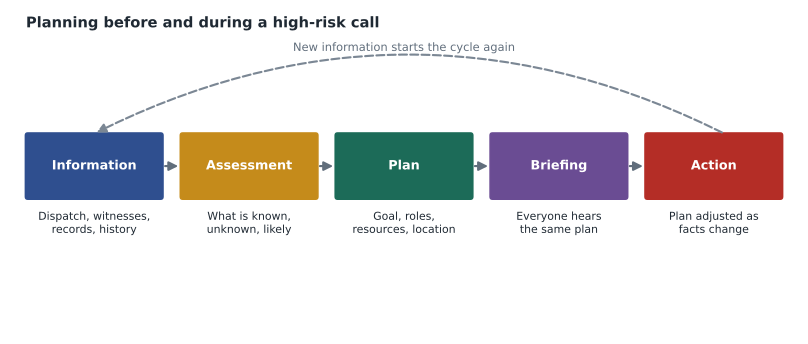
- Planning starts with the first broadcast and follows a cycle of information, assessment, plan, briefing and action.
- Information should be sorted into known, reported and unknown.
- Risk assessment considers threat, exposure, vulnerabilities and what can be controlled.
- A plan has a plain goal that puts safety before custody.
- Location, resources and a short briefing are among the most important things officers control.
- Plans must change when the facts change, and the change must be broadcast.
- Records query
- A search of police information systems for warrants, prohibitions, cautions and vehicle records.
- Risk assessment
- Judging how likely and how serious harm is, so the response can match it.
- Briefing
- A short shared statement of the goal, roles, signal and contingency.
- Contingency
- A planned response if something goes wrong, such as the vehicle fleeing.
Practice problems
Work each problem on paper first, then reveal the answer to check.
What three groups did Desjardins use to sort information?
Show answer
Known, reported and unknown.
What instruction did Haddad broadcast to prevent a single-officer stop?
Show answer
Follow, do not stop; three cars before the stop, and she would pick the spot.
What makes a good location for a high-risk vehicle stop?
Show answer
Few bystanders, little traffic, good lighting, room for several cars and no easy escape into homes or crowds.
What are the five parts of the short briefing structure?
Show answer
Situation, goal, roles, signal and contingency.
Lesson quiz · 5 questions
Score 60% or more to complete this lesson.
Create a free account to save your progress, take quizzes and earn a certificate.