
LES-216 · Lesson 10 of 12 · 19 min
Command, control and communication
▶ Video coming soon A video version of this lesson is on the way.
Ninety seconds into the Harbour Point Mall exercise, the radio channel was full. The first two officers were reporting what they saw as they moved. Five more cars were announcing that they were on the way. Fire was asking where to stage. Mall security was calling dispatch on the phone. An off-duty officer who had been shopping was calling 911 to say she was inside. At 08:49, Haddad, the first supervisor to reach the parking lot, came on the channel with nine words: 'Haddad has command. Command post at the north entrance.' Desjardins stops the recording. 'Before that moment,' he says, 'there were thirty people responding. After it, there was a response.'
Large high-risk calls bring many officers, other agencies and specialist teams to one place in a short time. Without command, they act on their own, duplicate each other's work, leave gaps, crowd the radio and sometimes put each other in danger. This lesson covers the incident command system used on large calls, the role of the first supervisor as initial incident commander, transfers of command, unified command with fire and paramedic services, radio discipline, interoperability, and communication with the public.
The incident command system
The incident command system, known as ICS, was developed in California in the 1970s after wildfires showed that agencies could not work together without a common structure. It is now used across Canada and the United States. In Canada, ICS Canada maintains a national standard, and Ontario uses the Incident Management System, a provincial doctrine based on ICS, for emergencies of all kinds. Police services use ICS for large high-risk calls, major events and emergencies, and the same structure lets police, fire, paramedics and other agencies fit together.
ICS organizes an incident around a single incident commander, who is responsible for the whole response. Under the commander, work is divided into sections: operations, which does the work on the ground, such as containment, tactical action, rescue and medical care; planning, which tracks the situation and plans the next steps; logistics, which provides people, equipment and supplies; and finance and administration, which tracks costs and records. The commander may also appoint a safety officer and a public information officer. On small incidents, the commander does most of these jobs; on large ones, each section has its own chief.
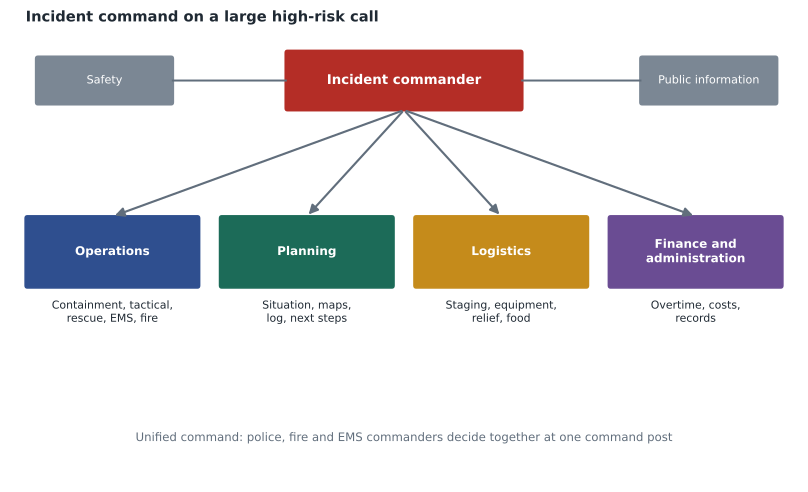
Two principles of ICS matter especially on high-risk calls. The first is span of control: one supervisor can effectively direct only a small number of people or teams, usually between three and seven, with five often given as the ideal. When more units arrive, the commander creates groups or divisions with their own supervisors rather than trying to direct everyone personally. The second is unity of command: every person reports to one supervisor, so that nobody receives conflicting orders.
The first supervisor takes command
On a fast-moving high-risk call, the first person to take command is usually not a senior officer but the first supervisor, or even the first officer, to arrive. That person becomes the initial incident commander, announces it on the radio, names a command post and starts making the first decisions: where arriving units should go, what resources are needed and who is doing what. Taking command early is one of the most important things a supervisor can do. Reviews of incidents that went badly, including the response at Uvalde, have found that nobody clearly took command for a long time, and that officers on scene did not know who was in charge.
At Harbour Point Mall, Haddad took command from the parking lot at 08:49, while the first officers were inside. In the next six minutes, she directed arriving officers into a second pair that would go to the wounded, sent one car to block the service road, asked fire and paramedics to stage at the north lot and send a commander to her, and asked dispatch to set up a separate channel for the units inside the building. She stayed outside. 'The commander's job is not to stop the attacker,' she tells the class. 'The commander's job is to make sure everyone else can.'
| Time | Decision |
|---|---|
| 08:49 | Takes command; command post at the north entrance |
| 08:51 | Arriving pair assigned to the wounded, not to the attacker |
| 08:52 | One car blocks the service road; one holds the north lot |
| 08:53 | Fire and paramedics stage at the north lot; their commanders to the command post |
| 08:54 | Separate radio channel for units inside the building |
| 08:55 | Attacker reported stopped; rescue task force requested |
Transfer of command
As senior officers arrive, command may be transferred to them. Transfers must be clear and deliberate. The outgoing commander briefs the incoming commander on the situation, the resources, the plan and any immediate concerns, and the transfer is announced on the radio so that everyone knows who is in charge. A senior officer who arrives does not automatically take command; they take it when they have been briefed and are ready. Several reviews have described incidents in which senior officers arrived and began giving orders without a formal transfer, so that two people were directing the response at once.
On Ridley Crescent, Haddad was incident commander from 15:40 until Inspector Lindqvist arrived at 16:05. Haddad briefed her at the command post, a driveway four houses away, using a whiteboard with a sketch of the street and the positions of every officer. Lindqvist asked three questions, confirmed that negotiators and the Emergency Response Unit were on the way, and then announced on the radio that she had command. Haddad became the operations section chief, responsible for the patrol officers holding the perimeter.
Unified command
When several agencies have responsibilities at the same incident, ICS uses unified command. Instead of one commander, the commanders of each agency with legal responsibility, such as police, fire and paramedics, work together at one command post, agree on objectives and a plan, and direct their own people within that plan. On an active threat, police lead while the threat is active, but fire and paramedic commanders must be at the command post from the start, because the rescue and medical response depend on decisions about zones, entry points and escorts. On incidents involving several police agencies, such as a provincial or state police service and a municipal service, unified command also prevents the confusion of several police commanders acting separately.
Unified command does not mean command by committee. It means that the people with authority make decisions together, quickly, in the same place. At Harbour Point Mall, the fire battalion chief and the paramedic superintendent arrived at the command post at 08:57. Within two minutes, the three commanders had agreed on the entry point for the first rescue task force, the casualty collection point and the transport plan.
Radio discipline and interoperability
Radio communication is the nervous system of a high-risk call, and it fails in predictable ways. Channels become overloaded with officers announcing that they are on the way. Important transmissions are blocked by others. Officers speak too fast under stress and are not understood. Agencies on different radio systems cannot talk to each other. And radios may not work inside large buildings or underground. Each of these failures has appeared in major reviews, including the Uvalde review, which found that radio problems inside the school and the absence of a common communication plan among many agencies contributed to the failed response.
Good practice addresses each failure. Officers responding to an active threat do not announce themselves unless asked; they go where the commander sends them. Units inside a building are moved to their own channel so that their transmissions are not blocked. Transmissions are short and slow, and important information is repeated. Agencies that may work together plan in advance which channels they will share. And services test radio coverage in large buildings, such as malls, hospitals and schools, before an incident happens.
| Failure | Fix |
|---|---|
| Channel overloaded with units on the way | Respond without announcing; go where directed |
| Transmissions from inside blocked | Separate channel for units inside |
| Fast, stressed speech not understood | Short, slow transmissions; repeat key facts |
| Agencies on different systems | Shared channels planned in advance |
| No coverage inside large buildings | Coverage tested before an incident; repeaters |
Self-deployment and convergence
High-risk calls, especially active threats, draw officers from everywhere. Off-duty officers, officers from neighbouring services and specialized units arrive without being asked. Their intentions are good, but uncontrolled self-deployment creates traffic jams that block ambulances, crowds the radio, and puts armed people in plain clothes at the scene where they may be mistaken for attackers. Many services now plan for convergence by naming staging areas where arriving units report and wait for assignment, and by telling off-duty officers not to self-deploy unless they are already at the scene.
Communicating with the public
On a large high-risk call, the public needs to know what to do: avoid the area, stay inside, or evacuate. Police services can use social media, the news media and, in serious emergencies, Alert Ready, Canada's national public alerting system, which sends warnings to radios, televisions and compatible cellphones. During the April 2020 attacks in Nova Scotia, the RCMP did not use Alert Ready and relied mainly on social media posts, and many people did not know that the attacker was driving a replica police car. The Mass Casualty Commission's 2023 final report recommended that police services be able to issue alerts directly and be trained to use them.
The public information officer prepares and releases information so that the commander does not have to. Information released during an incident must be accurate, must not reveal police positions or plans that the attacker could use, and must be updated regularly. Families looking for loved ones need a place to go, which is usually a reunification centre set up away from the scene and run by police, emergency management and victim services.
Planning and exercising before the incident
Command on the day of an incident is much easier when the hard thinking has been done beforehand. Services prepare pre-incident plans for large or high-risk places such as malls, schools, hospitals, arenas and industrial sites. A good plan includes floor plans and entrances, the locations of security offices and camera rooms, likely command post and staging locations, radio coverage notes, contact numbers for building managers and the planned positions of fire and paramedic staging. Plans are only useful if officers can reach them quickly, which is why many services now load them into the computers in patrol cars.
Exercises test the plans and the people. Tabletop exercises walk commanders through a scenario around a table. Functional exercises test one part, such as the command post or the radio plan. Full-scale exercises like the one at Harbour Point Mall put everyone in the field together. Each exercise ends with its own after-action review. The Harbour Point review found that the plan's command post location at the north entrance worked well, that the separate radio channel for units inside was set up two minutes later than planned because the dispatcher had to find the procedure, and that two arriving officers went to the mall's south entrance because they had not heard where staging was. All three became actions with owners and dates.
Worked problem
Span of control
At an active threat exercise, the initial incident commander has twelve patrol cars, a dog team, two supervisors, a fire company and a paramedic unit reporting to her directly. How should she reorganize to keep span of control manageable?
Show solution
- Count the units reporting to her: 12 cars, 1 dog team, 2 supervisors, 1 fire company and 1 paramedic unit, which is 17.
- Ideal span of control is about five; the maximum is about seven.
- Give each of the two supervisors a group of patrol cars, for example inside teams and perimeter.
- Bring the fire and paramedic commanders into unified command rather than directing their units herself.
Answer: She reduces her direct reports from 17 to about four or five: two police group supervisors, the dog team, and the fire and paramedic commanders in unified command. Each group supervisor then directs a manageable number of cars.
Common mistakes
MistakeCommand belongs to the most senior officer at the scene, automatically.
InsteadThe first supervisor takes command; senior officers take over through a formal, announced transfer.
MistakeThe incident commander should lead the officers going toward the threat.
InsteadThe commander stays at the command post and makes sure everyone else can do their jobs.
MistakeUnified command means decisions by committee.
InsteadIt means commanders with authority decide together, quickly, in one place.
MistakeEvery officer heading to a major call should announce it on the radio.
InsteadArriving units should keep the channel clear and go where directed or to staging.
Summary and key terms
- ICS gives large incidents one commander, sections for operations, planning, logistics and finance, and a common structure for all agencies.
- Span of control of about three to seven and unity of command keep the response manageable.
- The first supervisor takes command early, names a command post and directs arriving units.
- Transfers of command are deliberate, briefed and announced.
- Unified command brings police, fire and paramedic commanders together at one command post.
- Radio discipline, interoperability, staging and public alerting prevent the most common failures.
- Incident commander
- The person responsible for the whole response to an incident.
- Span of control
- The number of people or teams one supervisor can effectively direct, usually three to seven.
- Unified command
- Joint command by the commanders of agencies with legal responsibility at an incident.
- Staging area
- A place where arriving units report and wait for assignment.
Practice problems
Work each problem on paper first, then reveal the answer to check.
What did Haddad say when she took command at Harbour Point Mall?
Show answer
Haddad has command. Command post at the north entrance.
What are the four sections under the incident commander?
Show answer
Operations, planning, logistics, and finance and administration.
How should a transfer of command happen?
Show answer
The outgoing commander briefs the incoming one, who then announces on the radio that they have command.
Why is uncontrolled self-deployment a problem?
Show answer
It blocks ambulances, crowds the radio and puts armed plainclothes people at risk of misidentification.
Lesson quiz · 5 questions
Score 60% or more to complete this lesson.
Create a free account to save your progress, take quizzes and earn a certificate.