
LES-215 · Lesson 9 of 12 · 20 min
Background investigation, psychological assessment and medical screening
▶ Video coming soon A video version of this lesson is on the way.
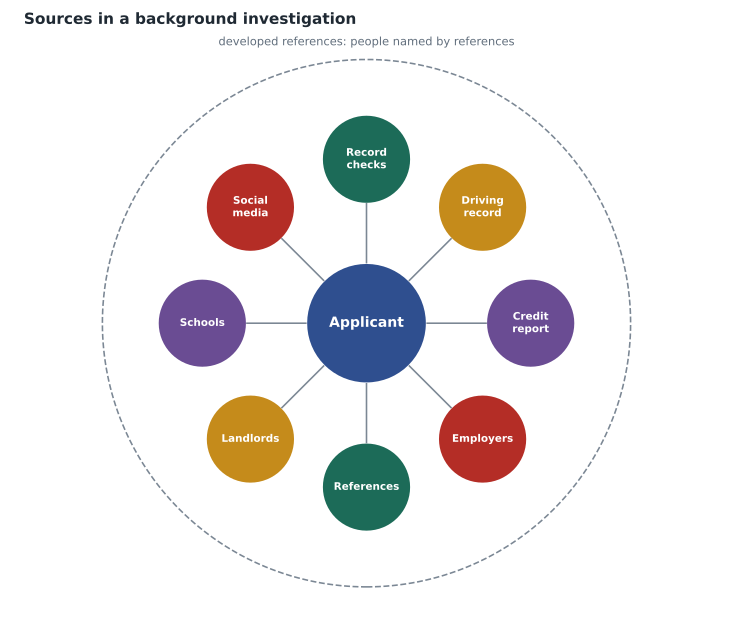
Boyce invites one of Port Ardent's background investigators to the class. Detective Constable Ana Ruiz, a former fraud investigator, has been doing background files for three years. She brings a redacted file, about a hundred and twenty pages long, for an applicant who was hired two years ago. It includes the applicant's personal history form, police record checks, a driving abstract, a credit report, notes of interviews with nine references, three former employers, two former landlords and two neighbours, a review of public social media, and a twelve-page summary report. Ruiz says the average file takes her about forty hours over six to eight weeks.
'People think a background check is a computer search,' she says. 'The computer part takes an hour. The rest is me talking to people who know you, and checking that what they say matches what you said.' This lesson follows an applicant's file through the last stages before an offer: the background investigation, the psychological assessment, the medical examination and, in some services, other checks such as a security clearance.
The background investigation
The background investigation has two purposes. The first is verification: confirming that what the applicant has said is true and complete. The second is prediction: looking for patterns of behaviour that suggest how the applicant is likely to behave as an officer. Investigators look especially at honesty, reliability, judgment, respect for others, temper and self-control, use of alcohol and drugs, financial responsibility, and any history of violence, harassment or discrimination.
The investigation usually begins with record checks, including the Canadian Police Information Centre, local police records in every place the applicant has lived, and court records. The investigator then works through the personal history form, contacting references, employers, schools, landlords and sometimes neighbours and former partners. For the RCMP, the field investigation is combined with a security clearance assessment, because members need clearance to handle protected information. Investigators often ask references for the names of others who know the applicant, so they hear from people the applicant did not choose.
Ruiz describes the most common problems she finds. The largest group is omissions: jobs left off the form because they ended badly, a prior application to another service, an old charge the applicant assumed did not count. The next is minimizing: describing a firing as a resignation, a fight as an argument, regular drug use as 'once or twice'. A smaller group involves patterns that cause concern even when disclosed: repeated conflicts with supervisors, a series of short relationships ending with police calls, debts ignored for years, or a social media history of demeaning comments about women or minority groups. 'One bad job is a bad job,' she says. 'Four bad jobs is information.'
She also explains what does not usually end an application. A single youthful mistake that was disclosed, a past debt that has been paid, a firing that the applicant explains honestly and that the employer confirms, and past counselling for a problem that has been dealt with are all things she sees regularly in files that end in a hire. What she looks for is honesty, insight and change.
| Finding | Usually a concern? | Why |
|---|---|---|
| Undisclosed job that ended in dismissal | Yes | Concealment is itself an integrity problem |
| Disclosed youth charge resolved years ago | Not usually | Disclosed, resolved, with no pattern |
| Several unpaid debts in collections | Often | Suggests unreliability and financial pressure |
| Paid-off student loan default | Not usually | Resolved and explained |
| Repeated police calls to a residence for disputes | Often | May indicate a pattern of conflict or violence |
| Public posts demeaning a group | Yes | Suggests bias and poor judgment that would affect public trust |
| Past counselling for grief, now well | Not usually | Seeking help is good judgment |
Other checks
Some Canadian services also use other tools. A few have used pre-employment polygraph examinations, though the practice is not universal and its value has been debated. Most require a drug screen at some point, and services publish their own rules about past drug use. For the RCMP and some other federal roles, applicants must also meet the requirements for a security clearance, which includes checks on finances, associations and loyalty. Ruiz's advice for every kind of check is the same: answer truthfully, and if you remember something you left out earlier, say so before the check rather than after.
The psychological assessment
Most police services require a psychological assessment before hiring. It usually has two parts. The first is a set of standardized written tests of personality and psychological functioning, sometimes including the personality assessment taken earlier in the process. The second is an interview with a psychologist, who reviews the test results, the personal history and sometimes parts of the background file, and asks about the applicant's life, relationships, stress, coping, and reasons for wanting the job.
The psychologist is not looking for perfect people. They are looking for conditions or traits that would make the job unsafe or unmanageable: serious untreated mental illness, poor impulse control, high hostility, rigid thinking, substance misuse, or a pattern of poor coping under stress. They are also looking for strengths that predict success, such as emotional stability, conscientiousness, empathy and the ability to recover from difficulty. The assessment must respect human rights law; a past or current mental health condition is not in itself disqualifying, and services must consider accommodation.
Applicants worry about this step more than any other. Boyce's advice: sleep properly the night before, answer the tests honestly and consistently, and in the interview, be open about difficulties you have had and what you did about them. 'The applicants the psychologists worry about,' she says, 'are the ones who say they have never felt stressed or sad. That is either not true or not healthy.'
The medical examination
The medical examination checks that the applicant meets the service's health standards and can safely do the job and its training. It usually includes a general physical examination, vision and hearing tests, and sometimes blood tests, a review of medications and a cardiac assessment. In Ontario, the OACP medical package with vision and hearing results is completed early, as part of the certificate, and services do a further medical examination before hiring. The RCMP's Health Services assesses applicants against its own health and psychological standards. As with every other stage, conditions that are disclosed and well managed are assessed on their merits.
What references are asked
Ruiz describes her reference interviews. She does them in person or by phone, usually for twenty to forty minutes. She asks how long the person has known the applicant and in what capacity, how the applicant handles stress, conflict and criticism, whether they have ever seen the applicant lose their temper, drink to excess or use drugs, how the applicant treats people they do not need to impress, whether the applicant is reliable with money and commitments, and whether the reference would trust the applicant with a gun and with their family's safety. She always ends by asking whether there is anything else she should know, and who else she should talk to.
She has learned to listen for hesitation. 'Most references are friends, and they want to help,' she says. 'But they are also being asked about someone carrying a gun in their community, and most people take that seriously. When someone pauses for a long time before answering a question about temper, I write down the pause.' She also notes that former partners, when contacted, can be the most informative sources about how an applicant behaves under stress at home, which is why domestic history is examined carefully.
The applicant's rights
Desjardins reminds the class that applicants have rights in this process too. They must consent to the checks, usually in writing, and the consent forms describe what will be collected and how it will be used. Privacy law, including Ontario's Freedom of Information and Protection of Privacy Act and the Municipal Freedom of Information and Protection of Privacy Act, governs how public bodies handle personal information, and applicants can usually request access to information held about them, subject to exemptions. Services must also follow human rights and disability law in how they use what they learn. Applicants who believe they have been treated unfairly can ask for reasons and, in some cases, complain to the relevant oversight or human rights body.
Boyce adds a practical point. If an applicant is unsuccessful at the background stage, the service may not give detailed reasons, especially if third parties provided information in confidence. Applicants can ask what areas to work on before reapplying. 'Sometimes the answer is time,' she says. 'Two more years of steady work and no problems changes a file a great deal.'
How long it takes, and why
Ruiz explains why background investigations take so long. References are slow to call back. Former employers may have closed or changed hands. Records from other provinces, states or countries may take weeks to arrive. Applicants who have lived or studied abroad may need additional checks. An applicant with a straightforward history and organized documents may be finished in a month; an applicant who has moved often, held many jobs or left gaps in the form may take three. She sees no reason for applicants to worry about a long silence, but she does ask them to keep her informed of changes, such as a new job, a new address or a new relationship, during the investigation.
She adds that investigators are not trying to find reasons to reject people. 'Most of my files end with a recommendation to hire,' she says. 'I am the person who gets to tell the panel that what you said was true. Help me do that.' Applicants can help by giving complete contact details for every reference and employer, warning references that she will call, explaining gaps in the form before she asks, and answering her questions directly. When she does find a problem, she usually gives the applicant a chance to explain it before her report is written.
Desjardins connects the background investigation to the investigation courses in the program. Ruiz's method is the same one the students learned for criminal investigations: gather information from several independent sources, compare it, look for inconsistencies, and give people a chance to explain before reaching a conclusion. 'You will be doing this to other people for the rest of your careers,' he says. 'It is fair that it is done to you first.'
Finally, Ruiz reminds the class that the background investigation does not end at hiring. Officers are subject to ongoing checks, including periodic security clearance renewals for some roles, and they must report changes such as arrests, charges, civil suits and some financial events to their service. 'The habits that get you through the background are the habits that keep you in the job,' she says. 'Tell the truth, and tell it first.'
Amara asks whether her parents and siblings will be contacted. Ruiz says that family members are sometimes interviewed, mainly to confirm addresses and background, and that investigators may ask about close associates if there is a reason to. Having a relative with a criminal record is not in itself a bar to hiring, but applicants should disclose it if asked, and should be aware that services have rules about associating with people involved in crime.
Worked problem
An honest correction
Three weeks after submitting his personal history, Marco remembers that he was questioned by military police, as a witness, about a fight in a bar near his base nine years ago. He was not charged. The form asked whether he had ever been questioned by any police or security agency. What should he do?
Show solution
- Recognize that the question covers being questioned as a witness, so the event should have been listed.
- Contact the background investigator promptly, before any interview or check, and explain the omission.
- Provide the details he remembers: date, place, what happened, his role, and that he was not charged.
- Offer the names of anyone who could confirm his account, such as his former section commander.
- Note the correction in his own file with the date he made it.
Answer: Ruiz notes the correction in her report as an example of candour. Had she found the military police record first, she would have had to ask why it was missing.
Common mistakes
MistakeA background check is a database search.
InsteadRecord checks are a small part; most of the work is interviews and verification.
MistakeSeeking counselling will disqualify me.
InsteadSeeking help is usually seen as good judgment; services assess current functioning.
MistakeIf I omit something, they will probably not find it.
InsteadInvestigators find most things, and concealment is treated as an integrity problem.
MistakeThe polygraph is a perfect lie detector.
InsteadResearch shows it performs better than chance but is far from perfect, especially for screening.
Summary and key terms
- The background investigation verifies the application and looks for patterns that predict behaviour.
- Omissions and minimizing are the most common problems; disclosed, resolved matters usually are not decisive.
- Some services add a security clearance, drug screening or other checks; polygraph use is not universal.
- The psychological assessment looks for risks and strengths, not perfection.
- Medical and psychological assessments must respect human rights and disability law.
- CPIC
- Canadian Police Information Centre, the national police database.
- Security clearance
- A government assessment of reliability and loyalty for access to protected information.
- Background investigation
- A detailed check of an applicant's history, honesty and conduct.
- Developed reference
- A person named by a reference rather than by the applicant.
- Minimizing
- Describing past conduct as less serious than it was.
Practice problems
Work each problem on paper first, then reveal the answer to check.
How long does Ruiz spend on an average background file?
Show answer
About forty hours over six to eight weeks.
What did Ruiz mean by 'four bad jobs is information'?
Show answer
A repeated pattern is more significant than a single event.
What two parts does a psychological assessment usually have?
Show answer
Standardized written tests and an interview with a psychologist.
What should an applicant do if they remember an omission?
Show answer
Tell the investigator promptly, before it is discovered.
Lesson quiz · 5 questions
Score 60% or more to complete this lesson.
Create a free account to save your progress, take quizzes and earn a certificate.