
LES-215 · Lesson 7 of 12 · 20 min
Preparing physically: progressive training, injury prevention, sleep and nutrition
▶ Video coming soon A video version of this lesson is on the way.
After Marco's first practice test, Boyce introduces the class to Constable Theo Grant, who runs Port Ardent's recruit fitness program and coaches applicants twice a month. Grant has a kinesiology degree, eleven years in patrol and a reputation for being very calm about other people's panic. He looks at Marco's results and says, 'Good. Now we know. You have time.' Then he asks each student when their physical test is, and writes the dates on the board with the number of weeks remaining. The shortest is Marco's retest, eleven weeks away. The longest is Jesse's, about seven months.
'Most applicants who get hurt or fail do one of two things,' Grant says. 'They start too late and try to cram, or they start on time and do too much too soon. Fitness is built the way pensions are: small, regular deposits, and you do not touch the principal.' This lesson covers the principles of safe preparation for a police physical test and for the career that follows. It is general guidance for healthy adults. Anyone with a medical condition, an injury or concerns about starting exercise should see a doctor or other qualified health professional first.
Start where you are
The first step is an honest baseline. Grant has each student do a version of their target test under supervision, or as close as they can manage, and record the results: shuttle run stage, circuit time and the time for each segment. They also record how they felt the next day. 'The baseline is not a judgment,' he says. 'It is a map. Without it you are guessing.' He adds two other measures: resting heart rate on waking, which tends to fall as aerobic fitness improves and rise when someone is overtired or getting sick, and a simple record of sleep.
For people who have not been active, the general public health guidelines are the place to start. Canada's 24-Hour Movement Guidelines for adults recommend at least 150 minutes a week of moderate to vigorous aerobic activity, muscle-strengthening activities at least twice a week, several hours of light activity, and seven to nine hours of good-quality sleep a night. An applicant who is not yet meeting these guidelines should build up to them before adding test-specific training.
The principles of training
Grant teaches four principles. The first is specificity: the body adapts to what it is asked to do. Running improves running; push-ups improve push-ups; dragging a sled improves dragging. General fitness helps, but the last weeks before a test should look a lot like the test. The second is progressive overload: to improve, the training load must increase gradually over time, by adding a little distance, a few repetitions, a little weight or a little speed. The third is recovery: the body adapts during rest, not during the workout. Rest days, easier weeks and sleep are part of the plan, not interruptions to it. The fourth is consistency: three moderate sessions every week for four months will do far more than six hard sessions one week and none the next.
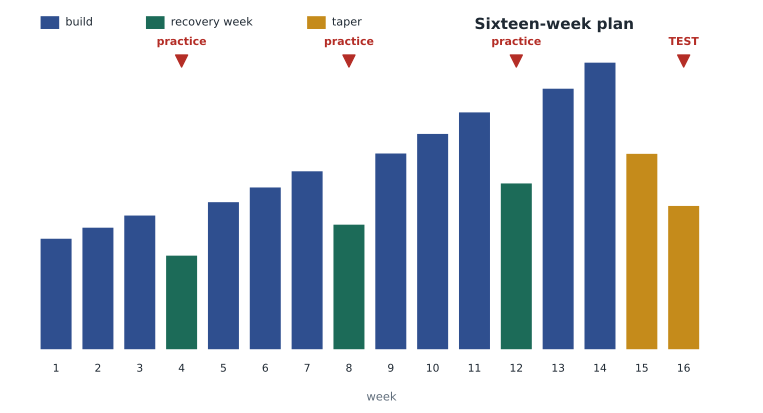
From these principles comes a simple rule for running, which causes more injuries than any other part of preparation. Increase weekly running time or distance by no more than about a tenth from one week to the next, and every third or fourth week, reduce it for a recovery week. Similar caution applies to strength work: add weight or repetitions in small steps, and stop a set when form breaks down.
| Week | Minutes | Week | Minutes | Week | Minutes |
|---|---|---|---|---|---|
| 1 | 60 | 5 | 80 | 9 | 106 |
| 2 | 66 | 6 | 88 | 10 | 117 |
| 3 | 73 | 7 | 97 | 11 | 129 |
| 4 | 51 (recovery) | 8 | 68 (recovery) | 12 | 90 (recovery) |
Each build week is the previous build week times 1.1, so the recovery weeks do not reset the progression: week 5 continues from week 3, at 72.6 × 1.1 ≈ 80 minutes. By week 11, the plan reaches 129 minutes, about 2.15 times the 60 minutes of week 1.
Marco's plan starts at sixty minutes of running a week, spread over three sessions, and builds to a little over twice that by week eleven, with recovery weeks in weeks four, eight and twelve. It looks slow to him. 'You lost a lot of running fitness when you switched to weights,' Grant says. 'You will get it back faster than you lost it, but not faster than your tendons can adapt. Muscles improve in weeks. Tendons and bones take months.'
Building a balanced program
A complete program for a police physical test includes aerobic training, interval or anaerobic training, strength and muscular endurance, mobility, and practice of the test itself. Grant shows the class a sample week for an applicant with about four months to go, for someone who is already moderately active. He stresses that it is an example, not a prescription, and that everyone's plan should start from their baseline.
| Day | Session | Purpose |
|---|---|---|
| Monday | Easy run, 25 to 40 minutes at a pace where you can talk | Aerobic base |
| Tuesday | Full-body strength: squats or lunges, pushing and pulling exercises, carries, core | Strength and muscular endurance |
| Wednesday | Rest or light activity such as walking or cycling; mobility work | Recovery |
| Thursday | Intervals: short hard efforts with full recovery, such as six to eight 30-second runs | Speed and anaerobic capacity |
| Friday | Strength with test-specific movements: pushing, pulling, dragging, push-ups or sit-ups as relevant | Specific strength |
| Saturday | Longer easy aerobic session, or a test simulation every third week | Aerobic base; test practice |
| Sunday | Rest | Recovery |
Intervals deserve care. They build the ability to work hard for short periods, which is what most police tests demand, but they are also where injuries happen. Grant recommends starting intervals only after several weeks of regular easy running, warming up for at least ten minutes before them, keeping the number of hard efforts small at first, and never doing hard sessions on consecutive days. Test simulations count as hard sessions.
Strength training should cover the main movement patterns: squatting, hinging at the hips, pushing, pulling, carrying and bracing the trunk. Correct technique matters more than load, especially at the start. Applicants without experience should get instruction from a qualified trainer, and many community centres and college gyms offer it. Push-ups and sit-ups improve quickly with regular practice, but technique must match the test's standard, since repetitions with poor form are not counted.
Preventing injury
Grant reminds the class that an injury in the weeks before a test is the most common reason applicants who were on track fail or postpone. Most training injuries are overuse injuries: shin pain, tendon pain at the knee, heel or Achilles, and stress reactions in bone. They are usually caused by doing too much too soon, too little recovery, sudden changes in surface or footwear, or ignoring early pain.
- Warm up before every session with five to ten minutes of easy movement, then a few gradually harder efforts.
- Increase load gradually, and change only one thing at a time: distance, speed, weight or frequency.
- Wear footwear suited to the activity and replace running shoes when they are worn.
- Treat pain that worsens during a session, persists the next day, or changes how you move as a reason to stop and rest.
- Get early advice from a physiotherapist or doctor for pain that does not settle within a few days, rather than training through it.
- Keep at least one full rest day each week, and sleep enough to recover.
'Some discomfort is normal when you are working hard,' Grant says. 'Sharp pain, pain that gets worse as you go, and pain that makes you limp are not. Stop, rest and get it looked at. I have seen more tests lost to stubbornness than to weakness.'
Sleep
Grant spends as long on sleep as on running. Sleep is when much of the body's repair happens, and too little of it slows recovery, raises injury risk, weakens immune function and harms concentration, mood and decision-making. Most adults need seven to nine hours. Students who work evenings, as Linh does, or who have young children, as Marco does, often get far less. Grant suggests practical steps: a regular sleep and wake time, a dark, cool, quiet room, no screens for the last half hour before bed, limiting caffeine after early afternoon, and avoiding alcohol close to bedtime, which disrupts sleep even when it seems to help. He also points out that a hard training session on four hours of sleep is more likely to injure than to help. 'If you have to choose between an early workout and an hour of sleep,' he says, 'most weeks, choose the sleep.'
Desjardins connects this to the officer wellness material from the safety course. Shift work makes sleep harder for most of a police career, and officers who build good sleep habits before they are hired cope better with nights. Fatigue impairs driving, judgment and memory, and it is a factor in collisions and errors on duty. The habits the students build now are habits for the job.
Nutrition basics
Nutrition is where applicants are most likely to be misled. Grant keeps his advice simple and general, and he is firm about what not to do. He uses Canada's Food Guide as a starting point: fill about half the plate with vegetables and fruit, a quarter with protein foods, and a quarter with whole-grain foods, and make water the drink of choice. People who train regularly need enough total energy to fuel and recover from their sessions, enough protein spread through the day, and enough fluids, especially in heat. Regular meals help energy and concentration on long days.
He is just as clear about what to avoid. Crash diets, very low calorie plans, skipping meals to make weight, and cutting out whole food groups without medical advice all harm training and health. Rapid weight loss usually means losing muscle and energy, not just fat, and it makes a physical test harder, not easier. Supplements marketed for performance or weight loss are not regulated like medicines, may contain undeclared or banned substances, and are unnecessary for passing a police test. Energy drinks and stimulants can cause heart rhythm problems and poor sleep. 'If something promises fast results, it is selling something,' he says. 'Eat real food, regularly, enough of it. If you have specific needs or questions, see a registered dietitian or your doctor.'
Grant also notes that some applicants become anxious about their bodies under the pressure of testing, and that this can tip into unhealthy eating or exercise patterns. He tells the class that anyone who finds themselves preoccupied with food, weight or exercise, or using them to cope with stress, should talk to a health professional. Preparation is meant to build health, not trade it for a test score.
Hydration and heat
Dehydration reduces performance and increases the risk of heat illness. Applicants should drink regularly through the day, more in hot weather and during long sessions, and arrive at the test well hydrated but not overloaded. Training in summer heat needs more care: shorter or earlier sessions, more breaks and attention to the warning signs of heat illness covered in the emergency management course.
Worked problem
Adjusting a plan after a setback
In week seven of her plan, Amara feels pain on the inside of her lower leg during an interval session. It eases after she stops, but it is there again on her easy run two days later and is tender to press. What should she do?
Show solution
- Stop running for now. Pain that returns on the next run and is tender to touch is a warning sign, not something to train through.
- Get it assessed by a physiotherapist or doctor, since shin pain can range from irritated tissue to a bone stress injury.
- Keep fitness with activities that do not hurt, such as cycling, swimming or the strength work that does not aggravate it, if the clinician agrees.
- When cleared, return to running at a lower level than before, and rebuild gradually.
- Look for the cause: in week six she had added a third interval session and switched to new shoes in the same week.
Answer: Amara loses two weeks of running but keeps her aerobic fitness on the bike, returns gradually, and still reaches her test date. Two changes in one week, more intervals and new shoes, were the likely cause.
Common mistakes
MistakeThe harder I train, the faster I improve.
InsteadImprovement comes from gradual overload plus recovery; too much too soon causes injury.
MistakeRest days are wasted days.
InsteadAdaptation happens during recovery; rest is part of the plan.
MistakeGeneral gym training is enough for any police test.
InsteadSpecific training for the test's tasks and format is needed, especially in the final weeks.
MistakePain is weakness leaving the body.
InsteadSharp or worsening pain is a reason to stop and get advice.
Summary and key terms
- Start from an honest baseline and build up to the public health activity guidelines before adding test-specific work.
- Apply specificity, progressive overload, recovery and consistency.
- Increase running by no more than about a tenth a week, with regular recovery weeks.
- A balanced program includes aerobic, interval, strength, mobility and test practice.
- Most training injuries are overuse injuries caused by doing too much too soon; stop for sharp, worsening or persistent pain.
- 24-Hour Movement Guidelines
- Canadian recommendations for activity, sedentary time and sleep.
- Specificity
- The principle that the body adapts to the particular demands placed on it.
- Progressive overload
- Gradually increasing training load so the body continues to adapt.
- Recovery week
- A planned week with reduced load to allow adaptation.
- Taper
- A short reduction in training before a test so the body is rested.
- Overuse injury
- An injury caused by repeated stress without enough recovery.
Practice problems
Work each problem on paper first, then reveal the answer to check.
How many weeks did Marco have until his retest?
Show answer
Eleven.
Why should hard sessions not be done on consecutive days?
Show answer
The body needs recovery between them, and back-to-back hard days raise injury risk.
What two changes did Amara make in week six?
Show answer
She added a third interval session and switched to new shoes.
What is resting heart rate useful for?
Show answer
Tracking aerobic fitness and spotting overtiredness or illness.
Lesson quiz · 5 questions
Score 60% or more to complete this lesson.
Create a free account to save your progress, take quizzes and earn a certificate.