
LES-215 · Lesson 1 of 12 · 19 min
Careers in law enforcement: who polices, and where
▶ Video coming soon A video version of this lesson is on the way.
On the first morning of the last course in the program, Professor Ray Desjardins does not start with a lecture. He hands each of the five students a sheet of paper with one question on it: 'Where do you want to be on your first day as a constable, and what will you have done to get there?' Amara Okafor writes 'Port Ardent patrol' without hesitating. Jesse Morningstar writes 'Nimkii Bay Anishinaabe Police Service'. Priya Sandhu writes 'RCMP, federal policing' and then crosses out the second half. Marco DiSanto writes 'patrol, maybe canine later' and adds, in smaller letters, 'with two kids.' Linh Tran leaves the sheet blank for a long time and finally writes 'not sure it is policing, but somewhere in public safety.'
Desjardins collects the sheets and puts them face down on the desk. 'We will look at these again in the last lesson,' he says. 'By then each of you will have a written career plan, a portfolio, and a realistic timeline. Some of you will have changed your answer. That is not failure. Choosing the right job is the first part of doing it well.'
This course is the program's capstone. The earlier courses covered the law, investigation, evidence, communities, mental health, youth, victims, emergencies and officer safety. This one asks a practical question: how does a graduate of the program actually get hired, trained and established in a career in policing or a related field? It follows the five students through the fall term of 2026 as they research the options, sit the first tests, train for the physical standards and build their applications. The course has a guest throughout: Sergeant Elaine Boyce, who has run Port Ardent's recruiting unit for four years after fifteen years in patrol, traffic and the sexual assault unit. 'I read about eleven hundred applications a year,' she tells the class. 'We hire about forty. I want every one of you to be in the forty, or to have chosen something else with your eyes open.'
The shape of policing
Policing in Canada is delivered at four levels. Municipal police services, such as Port Ardent's, serve a city or region under provincial law. Provincial services, the Ontario Provincial Police, the Sûreté du Québec and the Royal Newfoundland Constabulary, police areas without a municipal service and handle provincial responsibilities such as highway patrol. The Royal Canadian Mounted Police is the federal service, and under contract it also acts as the provincial and many municipal police in eight provinces and the three territories. First Nations police services, such as the Nimkii Bay Anishinaabe Police Service, police their communities under agreements with the federal and provincial governments. Each level has its own hiring process, its own training path and its own culture.
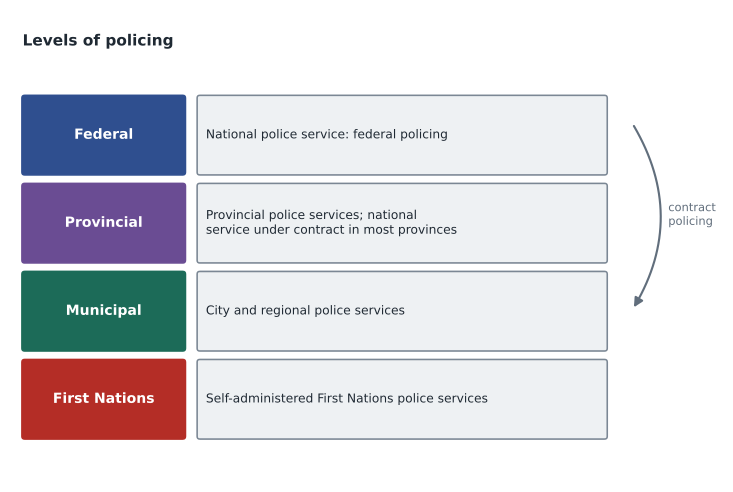
Size matters more than most applicants expect. Most Canadian police officers work for a small number of large services: the RCMP, the provincial services and the big-city municipal services. Many smaller services have fewer than a hundred officers. A large service offers more specialized units, more promotion opportunities and more structured training, but also more bureaucracy and less choice about where and when you work. A small service may offer more variety on each shift, closer ties with the community and faster responsibility, but fewer specialized positions and less backup.
Boyce asks each student to name one thing that would make them unhappy in a job. Marco says missing his children's events. Priya says a job with no investigative work. Jesse says being posted far from home. Amara says a slow shift. Linh says being the one who has to use force. 'Write those down,' Boyce says. 'They are as important as what you want. A service that posts new officers anywhere in the country, or a highway patrol that sends you to a post you did not choose, may be the wrong fit for someone who needs to be near family. The recruiters will not tell you what you will hate. You have to work it out.'
What the job actually is
Television suggests that police work is mostly chases, arrests and confrontations. The earlier courses in this program showed that most of the job is different. Patrol officers spend much of a shift responding to calls about disputes, disturbances, collisions, people in crisis, alarms and minor crimes, and a large part of each shift writing reports. Many calls end without any criminal charge. Desjardins puts up the Port Ardent figures the class used in an earlier course: of about 5,600 incidents a year that were not traffic matters, the largest groups were disturbances and disputes, property crimes, wellness checks and mental health calls. Violent crime was a small fraction. 'If what you want is excitement every shift, you will be disappointed,' he says. 'If what you want is to help people on the worst days of their lives, and to be trusted to do it well, you are in the right place.'
The job also has costs that applicants should weigh honestly. Shift work, including nights, weekends and holidays, is normal for the first years of most careers. Exposure to trauma is cumulative, as the officer wellness lessons in the safety course showed. Public scrutiny is constant, and every decision can be recorded and reviewed. Officers can be injured, and a small number are killed each year. The pay and benefits are generally good, and a full career usually ends with a pension, but they are earned under real pressure. Boyce's advice is blunt: 'Ride along. Talk to officers who are five, ten and twenty years in. Ask them what they would tell their own kid. Then decide.'
| Level | Examples near Port Ardent | Typical first posting | What it suits |
|---|---|---|---|
| Municipal | Port Ardent Police Service, Bay Township Police Service | Patrol in the city | People who want to stay in one community |
| Provincial | Ontario Provincial Police detachments | Detachment patrol, highways | People open to rural work and transfers |
| Federal | RCMP federal policing, contract policing in the west and north | General duty anywhere in Canada | People willing to relocate |
| First Nations | Nimkii Bay Anishinaabe Police Service | Community patrol | People with ties to the community |
Pay, benefits and the realities of the first years
Police salaries in Canada are set by collective agreements negotiated by police associations, and most services publish their pay grids. A new constable typically starts at a recruit or fourth-class rate and moves up through third, second and first class over about four years, as long as performance is satisfactory. Overtime, court time and shift premiums add to base pay, and most services offer health benefits and a defined-benefit pension. Desjardins warns the students not to choose a service for its starting salary alone. 'Look at the pay after five years, the pension, the shift schedule, the cost of living, and whether you will be able to transfer to the work you want.'
| Year | Service A | Service B |
|---|---|---|
| 1 | 74,000 | 79,000 |
| 2 | 82,000 | 84,000 |
| 3 | 90,000 | 89,000 |
| 4 | 99,000 | 94,000 |
| 5 | 108,000 | 99,000 |
| Five-year total | 453,000 | 445,000 |
Service B pays 5,000 dollars more in the first year and 2,000 more in the second, but service A pulls ahead in year three and is 9,000 dollars ahead by year five, because it moves officers to first class after four years. Over five years, service A pays 8,000 dollars more in total, and the gap keeps growing after that.
The example uses invented numbers, but the lesson is real: a higher starting salary can mean less money over the first five years if the progression is slower. Amara, who had been impressed by a service with a high starting rate, works out that the Port Ardent grid pays more by her fourth year.
Choosing where to apply
Most applicants apply to more than one service, and recruiters expect it. Boyce suggests a short list of two to four employers that genuinely fit, rather than applications everywhere. Each application takes time, and a half-hearted application to a service you do not want can be noticed if you later apply to one you do. She also points out that services talk to each other: if you withdraw from one process or fail a background check, another service may learn of it. Honesty and consistency across applications matter.
Research each service before applying. Read its annual report and strategic plan, look at the community it serves, attend an information session, and if possible ride along with an officer. Learn its structure, its priorities and its current challenges. In Ontario, most municipal services and the OPP use a common pre-screening certificate, which makes it easier to apply to several. The RCMP has its own process, and Quebec services recruit graduates of the École nationale de police du Québec.
- Fit: the community, the work and the schedule match what you want and can sustain.
- Requirements: you meet the minimum standards, or can meet them before you apply.
- Training: you understand where and how long the training is, and what it costs or pays.
- Future: the service offers the paths you might want later, such as investigations or specialized units.
- Family: the posting, relocation and schedule are realistic for the people who depend on you.
Why services are hiring now
Boyce tells the class that this is a good time to apply, and explains why. Many services are short of officers. A large group hired in the late 1990s and early 2000s is now reaching pension age, fewer people applied during the difficult years around 2020, and some officers left the job early. Communities have also grown, and new responsibilities, from cybercrime to mental health response, have added to the workload. The RCMP published a national recruitment strategy for 2026 to 2029, and Ontario increased the number of recruits trained at the Ontario Police College, adding a fourth intake each year and raising each intake to about 550 recruits. Ontario also eliminated tuition for the basic constable course.
A shortage does not mean standards have dropped. 'We are hiring more people,' Boyce says, 'but we are not hiring people we would not have hired ten years ago. The background check is the same. The integrity questions are the same. What has changed is that we work harder to find good applicants and help them through the process.' Services now run information sessions, mentoring programs for applicants, women-in-policing workshops, fitness practice sessions and outreach to communities that have been under-represented in policing, including Indigenous, Black, South Asian and newcomer communities.
Desjardins adds a caution. In a tight market, some applicants receive offers from more than one service and are tempted to accept the first. Others accept an offer and then withdraw when a better one arrives. 'You are allowed to choose,' he says, 'but do it honestly and early. Tell a service as soon as you know you will not accept. The people who handle your file will remember how you behaved, and policing is a smaller world than it looks.'
Worked problem
Building a short list
Marco is a veteran with two young children and a partner who works days at the hospital. He wants patrol now and possibly canine work later. He is considering Port Ardent, the Ontario Provincial Police, the RCMP and the Canada Border Services Agency. How should he narrow the list?
Show solution
- List what he must have: a posting within commuting distance of the hospital, predictable rotation, and a path to canine.
- Check each employer's first posting. The RCMP and the border agency can post new members anywhere in Canada, and the OPP assigns detachments across the province.
- Check which employers have a canine unit and how officers are selected for it.
- Remove the employers whose first posting conflicts with his family needs, at least for now.
- Apply to the remaining two, and note the others as possible later moves.
Answer: Port Ardent and the neighbouring Bay Township service stay on the list; the employers that relocate new officers are set aside for now, not forever.
Common mistakes
MistakeThe bigger the service, the better the career.
InsteadLarge services offer more specialized units, but smaller ones can give more variety and faster responsibility; fit matters most.
MistakeStarting salary is the best way to compare employers.
InsteadCompare pay over several years, the pension, schedule and future paths.
MistakeApplying everywhere improves your chances.
InsteadA short list of employers that fit, with strong applications, works better; services notice inconsistent or abandoned applications.
MistakePolice work is mostly arrests and pursuits.
InsteadMost of the work is calls for service, problem-solving and reports.
Summary and key terms
- Policing is delivered at several levels, each with its own hiring, training and culture.
- Most patrol work is calls for service, disputes, collisions and people in crisis, with a large share of report writing.
- Applicants should weigh the costs of the job, such as shift work, trauma exposure and scrutiny, as well as its rewards.
- Compare employers on fit, requirements, training, first posting, pay over several years and future paths.
- Research each service through its reports, information sessions and ride-alongs before applying.
- Contract policing
- RCMP policing of provinces and municipalities under agreements with their governments.
- Detachment
- A local RCMP or OPP office serving an area.
- Recruiter
- An officer or civilian who runs a service's hiring process and advises applicants.
- Ride-along
- An observation shift with a patrol officer, offered by many services to applicants and students.
- First posting
- The location and unit where a new officer is first assigned.
Practice problems
Work each problem on paper first, then reveal the answer to check.
What did Marco list as something that would make him unhappy in a job?
Show answer
Missing his children's events.
In the pay example, which service paid more over five years?
Show answer
Service A, with 453,000 against 445,000.
Why should applicants talk to officers at different stages of their careers?
Show answer
To understand the job's long-term realities, not just the start.
Name three things to research about a service before applying.
Show answer
Any three of: its annual report and plan, the community, its structure and priorities, information sessions, ride-alongs, first postings.
Lesson quiz · 5 questions
Score 60% or more to complete this lesson.
Create a free account to save your progress, take quizzes and earn a certificate.