
LES-215 · Lesson 11 of 12 · 20 min
Ethics, the oath and the first years of a career
▶ Video coming soon A video version of this lesson is on the way.
Near the end of the term, Desjardins brings a framed document to class and stands it on the desk. It is the oath he swore in 1994, signed and witnessed, with a faded crest at the top. 'I have read it maybe a hundred times since,' he says. 'Usually after a bad shift. Sometimes after a good one.' He tells the students the story some of them heard in the first year: as a rookie, he watched a senior officer slap a handcuffed man in the back of a cruiser and said nothing; fifteen years later, as a sergeant, he saw an officer start to do the same thing and stepped between them. 'The oath did not change between those two days,' he says. 'I did. This lesson is about what the oath means in practice, and about how to survive the first years with your values and your health intact.'
The oath and what it promises
In Ontario, every police officer must take an oath or affirmation before beginning duties, in the form set by a regulation on oaths and affirmations made under the Community Safety and Policing Act. Ontario's police oaths have long committed officers to uphold the Constitution of Canada, to preserve the peace and prevent offences, and to discharge their duties faithfully, impartially and according to law. Officers are also bound by a code of conduct set by regulation. RCMP members swear their own oath of office and allegiance. First Nations constables take the oath set for their service. Whatever the exact words, the oath makes three promises: to obey and uphold the law, including the law that limits police power; to treat people fairly and without favour; and to be honest.
Desjardins points out that the oath does not promise loyalty to colleagues. Loyalty matters in policing, he says, and officers rely on each other in danger. But when loyalty to a colleague conflicts with the law or with honesty, the oath settles which comes first. The earlier courses described the consequences when officers forget this: wrongful convictions built on dishonest testimony, public inquiries into cover-ups, and communities that stop calling the police.
Ethical pressure in the first years
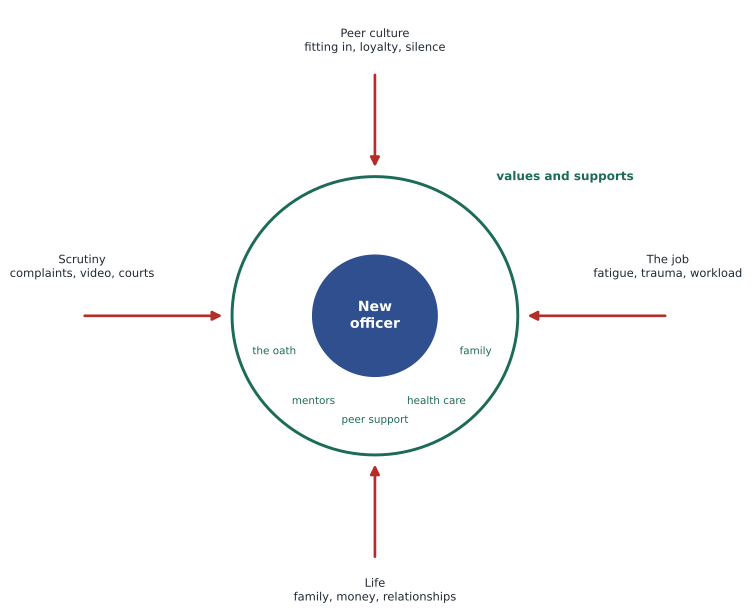
Most ethical failures in policing do not start with a dramatic decision. They start with small accommodations: rounding a time in the notes, letting a colleague's rude comment go, accepting a free coffee that turns into a free meal, writing that a person 'resisted' when they only pulled away. New officers are especially vulnerable because they want to fit in, they are being evaluated, and they do not yet trust their own judgment. Boyce, who sat on Port Ardent's professional standards panel for three years, says that almost every serious case she saw began with something small that someone saw and did not mention.
The students discuss scenarios. A coach officer tells a recruit to write in her notes that she saw a driver go through a red light, when she was looking the other way at the time. A senior officer at a party makes a joke about a racial group, and everyone laughs. A business owner offers free meals to officers on patrol in his area 'because he likes having them around.' A colleague who has been drinking insists on driving home. In each case, the class agrees on the right answer quickly. What takes longer is working out how to do it: what to say, to whom, and when.
Desjardins gives them a simple framework. First, recognize the issue: is this a matter of law, honesty, fairness or safety? Second, act within your role: you can refuse to write what you did not see, decline the meal, take the keys. Third, use the proper channel: speak to the person directly if that is safe and appropriate, and if not, or if it continues, report to a supervisor or professional standards. Fourth, document: write down what happened and what you did. 'You will not always get it right,' he says. 'But if you have thought about it before, you will get it right more often than people who meet it for the first time on the night.'
| Situation | The ethical issue | A sound response |
|---|---|---|
| Coach asks you to note what you did not see | Honesty in evidence | Refuse; write only what you observed; raise it with the coach, then a supervisor if needed |
| Offensive joke at a gathering | Respect and fairness | Do not join in; say something if you can; report if it continues or targets a colleague or the public |
| Free meals from a business on your beat | Impartiality and gifts | Decline politely; follow the service's gift policy |
| Impaired colleague wants to drive | Safety and law | Take the keys or arrange a ride; involve a supervisor if necessary |
| Colleague uses unnecessary force | Law and duty to intervene | Intervene if safe, report, document |
Several Canadian services and provinces have written a duty to intervene into policy or regulation, requiring officers to intervene when they see another officer using excessive force or committing misconduct, and to report it. Desjardins says these rules matter, but that the hard part is not knowing the rule; it is acting on it in front of people whose respect you want. 'The first time is the hardest,' he says. 'After that, people know who you are, and it gets easier, because the wrong things stop happening around you.'
Oversight and accountability
New officers sometimes feel that every decision is being watched, and they are right. Body-worn cameras, public video, complaint systems, internal audits and civilian oversight bodies such as Ontario's Special Investigations Unit and the Law Enforcement Complaints Agency all examine police conduct. Desjardins suggests seeing this as protection as much as threat. An officer who works lawfully, writes accurate notes and treats people with respect has very little to fear from scrutiny, and often benefits from it, because the video and the record show what really happened. The officers who suffer most from oversight are those who relied on nobody looking.
Surviving shift work
The second half of the lesson turns from ethics to the practical realities of the first years. Grant joins the class again to talk about shift work. Most new officers work rotating shifts, including nights, for years. Night work disrupts the body clock, and long-term shift workers face higher risks of sleep problems, digestive problems, weight gain and cardiovascular disease, as well as fatigue-related errors and collisions. The strategies that help are simple but take discipline: protecting sleep after night shifts with a dark, quiet room and a consistent routine; a short nap before a first night shift; eating regular, lighter meals at night; limiting caffeine in the last hours of a shift; getting daylight after waking; and keeping some regular exercise. Families need a plan too: a shared calendar, agreed quiet hours, and time together that is protected from overtime as far as possible.
Marco, whose partner works days at the hospital, asks how couples manage. Grant, whose own partner is a nurse, says that it is hard but common, and that the couples who manage best talk about it early and often. 'Plan the hard weeks in advance,' he says. 'Decide together which overtime you will take and which you will not. Your sergeant can plan around a known family commitment. They cannot plan around a surprise.'
Wellness, trauma and asking for help
Boyce returns to the theme of the officer wellness lessons. Over a career, officers are exposed to many traumatic events, and the effects build up. New officers should learn the services available to them, such as peer support teams, employee assistance programs and psychologists who work with police, and use them early rather than in crisis. They should watch for warning signs in themselves and colleagues: changes in sleep, irritability, withdrawal, increased drinking, cynicism and loss of interest in things they used to enjoy. Asking for help is a sign of professionalism, not weakness. Ontario law presumes that post-traumatic stress disorder in first responders, including police officers, is work-related for workers' compensation purposes. She tells the students that if they or anyone they know is in crisis, they can call or text 9-8-8.
Money, social media and off-duty life
New officers often earn more than they ever have, and Boyce sees some get into financial trouble quickly: expensive vehicles, large debts, and a reliance on overtime that cannot last. She suggests living on base pay and saving or investing overtime, building an emergency fund, and paying attention to the pension. She also reminds them that officers are bound by their service's policies on and off duty. Social media posts, conduct at parties and in bars, and private disputes can all lead to discipline if they reflect badly on the service or undermine trust. 'You are an officer when you are off duty,' she says. 'People will know who you are, and they will tell your chief.'
Desjardins finishes with a short exercise. He asks each student to write a letter to themselves to be opened after their first year of service, describing why they chose this work and the kind of officer, communicator or analyst they intend to be. He collects the letters in sealed envelopes and promises to mail them in a year. 'Some of you will read it and smile,' he says. 'Some of you will read it on a hard day and remember. Either way, you will know whether you kept your promise.' Marco writes his in ten minutes. Linh takes the whole period. Jesse writes his in Anishinaabemowin and English.
Building a career, not just a first job
Boyce ends with advice about the longer career. The first five years shape the rest. Officers who write excellent reports, testify well, treat people with respect and keep learning are the ones selected for specialized units and promotion. She suggests that new officers find a mentor who is a few years ahead of them, keep a record of good work and training, and take on small extra responsibilities, such as teaching a short session to colleagues or joining a community committee. She also warns against cynicism, which she sees as the most common occupational hazard. 'You will see people at their worst, and it will be tempting to decide that everyone is like that,' she says. 'They are not. Remember the people who thanked you, and the calls that ended well. There are more of them than you think.'
Priya asks about relationships with colleagues. Boyce says that the people on a platoon become close, which is one of the job's great strengths, but that new officers should keep their professional boundaries: avoid gossip, take complaints about colleagues to supervisors rather than social media, and be careful with relationships within the chain of command. Services have policies on workplace harassment and on reporting relationships, and those policies protect new officers as much as anyone. 'If something at work feels wrong,' she says, 'tell someone you trust, and if that does not work, tell someone with authority. You are not alone, even in your first month.'
Worked problem
Saying no to a coach
Three weeks into her coach officer period, a recruit is asked by her coach to write that she saw a driver go through a red light, so that the ticket will stand up in court. She was looking at a pedestrian at the time and did not see the light. What should she do, and how?
Show solution
- Recognize the issue: her notes are evidence, and writing what she did not see would be false.
- Act within her role: write only what she observed, including that she was looking at the pedestrian.
- Speak to the coach directly and respectfully: 'I didn't see the light, so I can't put it in my notes. You can put what you saw in yours.'
- If the coach insists or retaliates, raise it with the platoon sergeant, as the service's policies require.
- Record the conversation in her own notes, with the time.
Answer: The coach, who had been testing her, signs off her evaluation that night with a comment on her integrity. If he had not been testing her, the right answer would have been exactly the same.
Common mistakes
MistakeThe oath is a ceremony.
InsteadThe oath defines the officer's obligations to law, fairness and honesty and is the standard conduct is judged against.
MistakeLoyalty means protecting colleagues no matter what.
InsteadLoyalty cannot override the law or honesty; the duty to intervene and report applies.
MistakeEthics problems are rare dramatic decisions.
InsteadMost begin with small accommodations that go unmentioned.
MistakeOversight is mainly a threat to officers.
InsteadAccurate records and video often protect officers who act lawfully.
Summary and key terms
- The oath commits officers to the law, impartial service and honesty.
- Ethical failures usually start small, and new officers face strong pressure to fit in.
- A simple framework helps: recognize, act within your role, use the proper channel, document.
- Many services and jurisdictions impose a duty to intervene in and report misconduct.
- Oversight and recording protect officers who work lawfully and honestly.
- SIU
- Special Investigations Unit, Ontario's civilian agency that investigates serious incidents involving police.
- LECA
- Law Enforcement Complaints Agency, which handles public complaints about Ontario police.
- Oath of office
- The solemn promise an officer makes before beginning duties.
- Duty to intervene
- An obligation to stop and report misconduct, such as excessive force, by another officer.
- Professional standards
- The unit that investigates complaints and misconduct within a service.
Practice problems
Work each problem on paper first, then reveal the answer to check.
What changed between Desjardins's two experiences in the cruiser?
Show answer
Not the oath, but his willingness to act on it.
Name the four steps of the framework.
Show answer
Recognize the issue, act within your role, use the proper channel, document.
Why is it often easier to intervene after the first time?
Show answer
People know who you are, and wrong things stop happening around you.
How can video protect officers?
Show answer
It shows what really happened when an officer acted lawfully.
Lesson quiz · 5 questions
Score 60% or more to complete this lesson.
Create a free account to save your progress, take quizzes and earn a certificate.